
Though Puducherry is often viewed through the lens of its French colonial past, the region’s sacred history predates European arrival by many centuries. Located between Tondaimandalam and Cholamandalam, it became part of the Chola realm in the eleventh-century CE, inheriting a tradition of temple construction, artistic patronage, and inscriptional record-keeping that shaped much of medieval Tamil Nadu. Several koils or kovils (temples) in and around the town are referenced in early Saiva devotional hymns, linking the region to the itinerant pilgrimages of the Nayanmars, such as Thirujnanasambandhar, and to the wider sacred geography of Tamil country.
These temples functioned not only as ritual centres but also as repositories of social and political memory. Their walls bear inscriptions spanning centuries; their icons and mandapas reflect changing artistic idioms; and their histories register episodes of patronage, destruction, relocation, and rebuilding — particularly during the period of French colonial consolidation in the eighteenth-century.
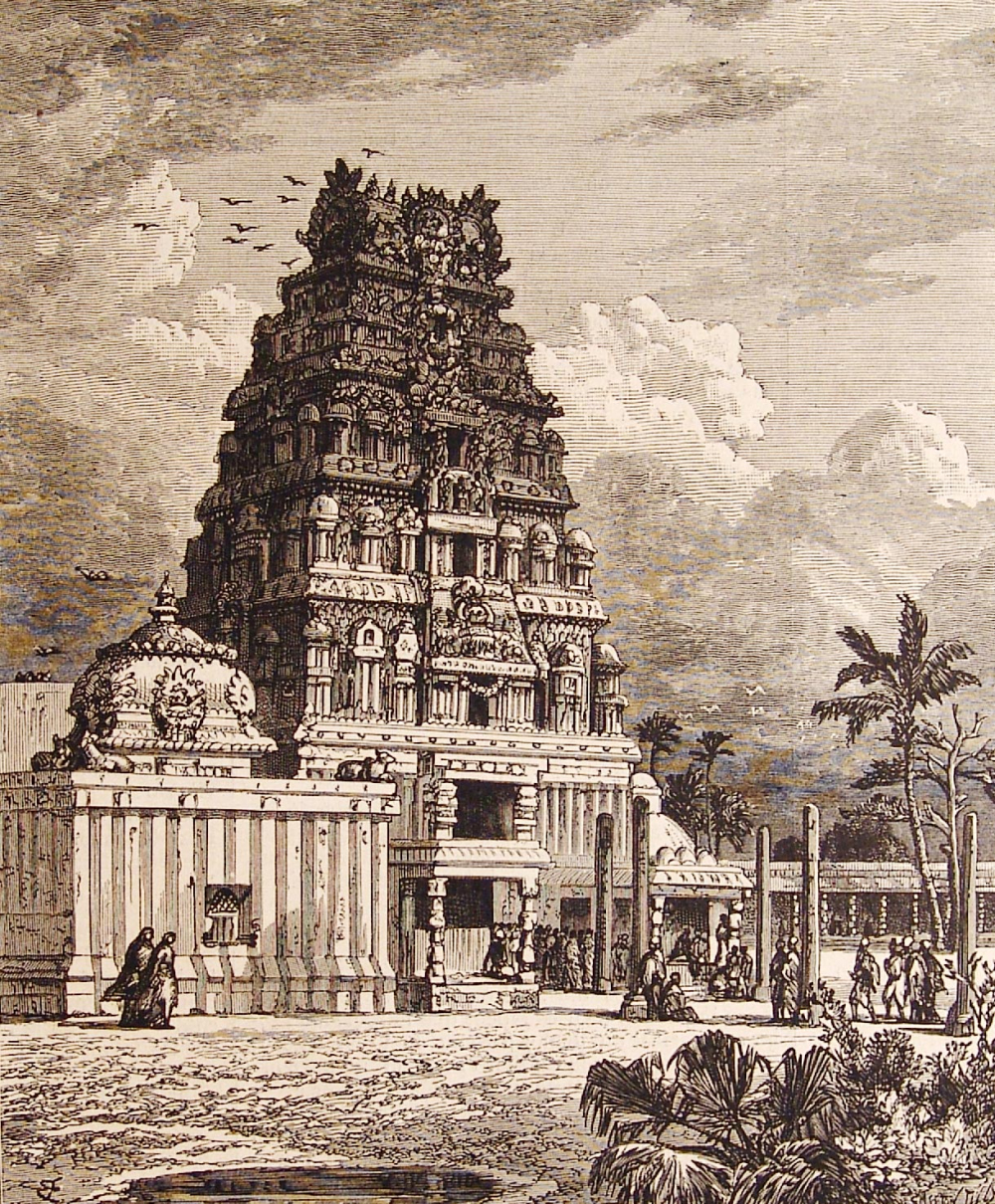
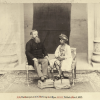
Illustration of a temple at Villianur in the El viajero ilustrado (1878). (Picture Courtesy: Fondo Antiguo de la Biblioteca de la Universidad de Sevilla/Wikimedia Commons)
Today, that sacred landscape of Puducherry survives in multiple forms: in large Siva and Vishnu temples, in neighbourhood Vinayaka shrines sustained by local communities, and even in sites shaped by interfaith patronage. Read together, they reveal a temple-town whose religious and cultural continuities persist alongside and beneath the better-known colonial urban fabric.
Manakkulavinayakar Temple
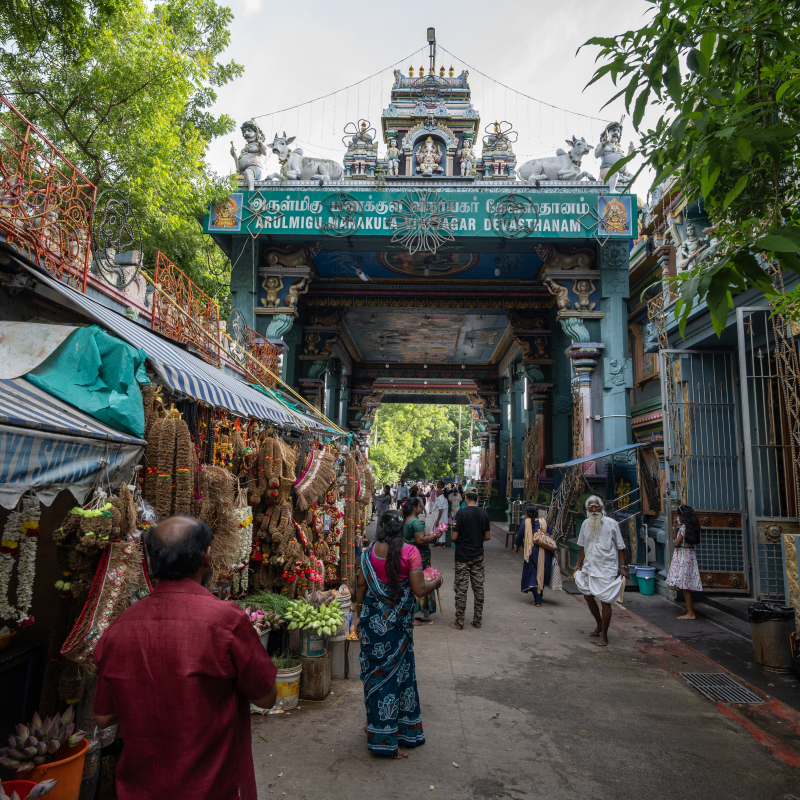
This is a very popular and widely known temple of god Vinayaka in the town, located near the sea shore and at the heart of French town. This temple is said to be part of the fort constructed by the French during the last part of the seventeenth-century.
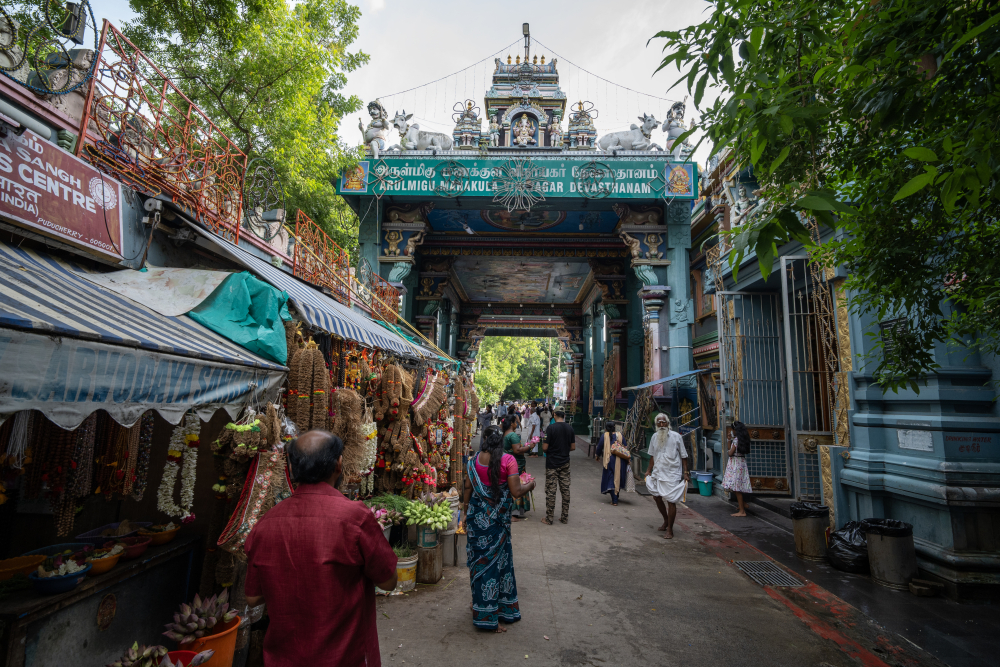
Manakula Vinayagar, the only temple in the French quarter in Puducherry. (Picture Credits: Joseph Rahul)
The main tower, made of brick and cement and measuring 24 feet, consists of 2 tiers. Statues of God Vinayaka with his mount, the musika (mouse) at his feet are installed. The legend portraying Vinayaka offering the cakrayudha (disc-weapon) to God Vishnu is depicted on the northern side. On the southern side is depicted another legend that portrays Vinayaka receiving the mango fruit after circumambulating Siva and Parvati, while Murugan is mounted on the peacock hovering in the sky.
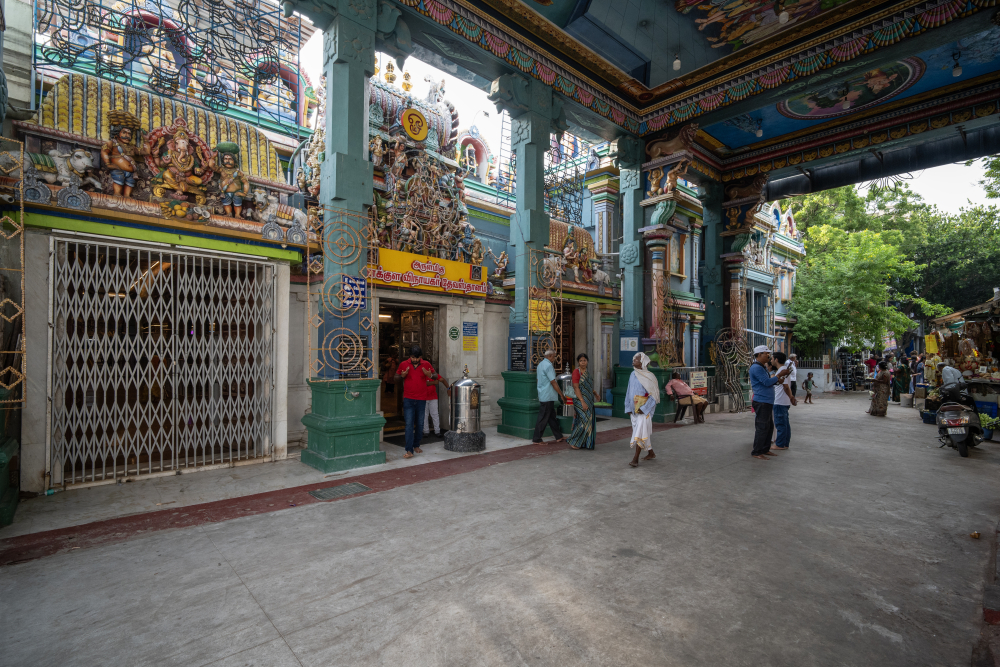
Ceiling mural depicting Lord Ganesha’s marriage with Riddhi and Siddhi, daughters of Lord Brahma, at the historic Manakula Vinayagar Temple, Puducherry. (Picture Credits: Joseph Rahul)
In the garbhagraha (sanctum sanctorum), an ancient idol of Vinayaka with four hands is installed. The shrine for Candeshvara is situated in the north-west. The temple ceilings are decorated with artistic paintings depicting Purana stories as well as floral designs. There is a small linga made of crystal installed inside the big chamber, where all the idols made of brass and copper are kept. This lingam is noteworthy in particular as it was unearthed from the cultivable land at a village near Senji some 60 years back.
Siddhivinayakar Temple
This temple, also known as Elai Pillayar Koil (the Vinayaka Temple for the poor), is situated on the southern part of the Gandhi Road. Though a modest structure without much pomp, hence known as the temple for the poor, this temple is nearly 300-years old, with the main tower constructed in 1876.
The image of Vinayaka installed inside the sanctum is small. Around the sanctum, there is the prakara for circumambulation, and at the left side (on the north of the sanctum), there is a special shrine for Siva, here named Vaidyanatha, and for Taiyalnayaki. The other deities that one finds in a normal Siva temple are also installed: Nataraja, Sivakamasundari, and bronze images of gods such as Siddhivinayaka and Murugan with his spouses Valli and Devasena.
Salai Man Pillaiyar Koil
This small shrine, situated on the junction between the busy Anna Salai and the Easvaran Koil Street, is popularly known as ‘Akhanda Paripurana Yazppana Akkasami Man Pillaiyar Koil.’ The huge image of Vinayaka here is said to be made of clay.
The story around it goes that it was worshipped regularly by one young saint who came from Jaffna (or Yazppanam, in Sri Lanka) and settled in Pondicherry many years ago. In his younger days, the saint used to utter the word ‘akka’ (sister) very often and thus he came to be known as Akkasami. Though a very small shrine, a large number of people regularly come there to pray and there is a considerable crowd of devotees during special days.
Muthaliyarpettai Murugan Temple
Muthaiya Muthaliyarpettai is the full name of the locality now commonly known as Muthiyalpettai, on the northern side of Pondicherry. There is a temple for Murugan situated on the street opposite to the clock tower. The idol of Murugan, accompanied by his consorts Valli and Devasena, is installed at the samadhi (shrine or tomb) of Muthaiya Siddhar. The samadhi here appears to be nearly 300 years old. Supposedly under divine command, an idol of Murugan along with his two consorts was installed at the beginning of the twentieth-century. This temple has been constructed by the Senkuntar community, whose main profession is weaving and who are traditionally staunch devotees of Murugan.
Kausika Balasubrahmanyar Temple
This temple for Murugan is opposite the railway station. It was constructed by a Muslim by the name Mohammad Ghouse, who was very devoted to Murugan since boyhood and used to worship an image of the god at his house. He also used to help the priests in the temples nearby, during the decoration of the idols of various gods for procession on festival days. It is said that Murugan appeared in Ghouse’s dream and directed him to construct a temple. Inspired by the divine command, Mohammad Ghouse purchased a piece of land at the present location and arranged to construct the temple. After the death of Mohammad Ghouse, the temple has been managed by his brother and his sons. On festival days, many local people throng the temple to worship. This temple now occupies a very important place among the Murugan temples in Pondicherry.
Vedapurisvarar Temple
The ancient name of Puduchery is Vedapuri and the deity in this Siva temple is very well-known as Vedapurisvara—the Lord of Vedapuri. This temple of Siva is now situated on Gandhi Road. The original temple was on the very same site, where the Janmaraggini Matha Cathedral now stands. The original temple had a lingam that had emerged by itself (svayambhu) but the entire temple was demolished against public opinion on 8th September 1748 under the orders of Dupleix, the then French Governor. The details of this event are recorded in Anandarangam Pillai’s diary. Only in 1777, after many protracted meetings with the government, land was allotted at the present site to construct the new Vedapurisvara Temple.
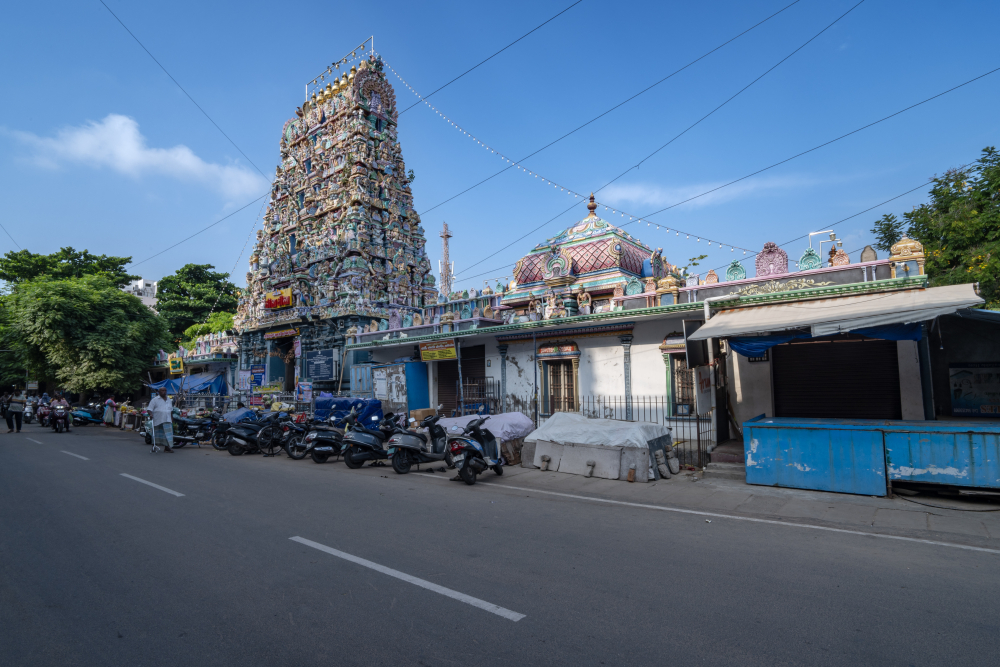
Vedapurisvarar Temple in Puducherry. (Picture Credits: Joseph Rahul)
The rajagopuram (main tower) measuring 75 feet faces east. In the space between the main tower and the inner prakara, on the north is a library. Inside we see Vrishabha (the bull), which is considerably big, facing the lingam at the sanctum. Beyond the Vrishabha, we have the mahamandapa (pillared pavilion) with 20 huge granite columns, the ardhamandapa (semi-open hall), the antarala (vestibule), and lastly, the sanctum where the large linga of Vedapurisvara is installed and worshipped. On the northern side of the mahamandapa, is the ardhamandapa. Facing the south is a sanctum for Tripurasundari, whose granite statue is nearly 5 feet tall with four hands.
This temple was built in parts and continued to grow over time. For instance, the construction work for the Tripurasundari sanctum was started in 1901, but the ardhamandapa before the sanctums of Vedapurisvara and Tripurasundari, as well as the mahamandapa that connects both, were constructed in 1890. There are also a series of shrines for gods and goddesses in the enclosure, among them a long and separate shrine for the 63 Nayanmars (saiva saints of Tamilnadu). Each of these shrines were constructed by different people at different periods.
Kalahastisvarar Temple
This Siva temple was constructed to the north of the old Vedapurisvara temple on Mission Street in 1715. It is surrounded on all side by a thick three-feet wide wall 16 feet in height. The temple occupies a large area of 12,000 square feet, and has three entrances - on the east, south, and the north - of which the eastern tower is five-tiered. The shrine of Kalahastisvarar consists of the sanctum, the ardhamandapa, and the front mandapa (pavilion). On the left of the sanctum, we have the shrine of Jnanambika. This temple, being so large, also contains shrines to several other gods and goddesses. On the northern side there is a separate shrine for Vishnu under the name of Varadaraja Perumal. Many festivals spread throughout the year are celebrated in the temple. The temple is managed by the Ayira Vaisya community.
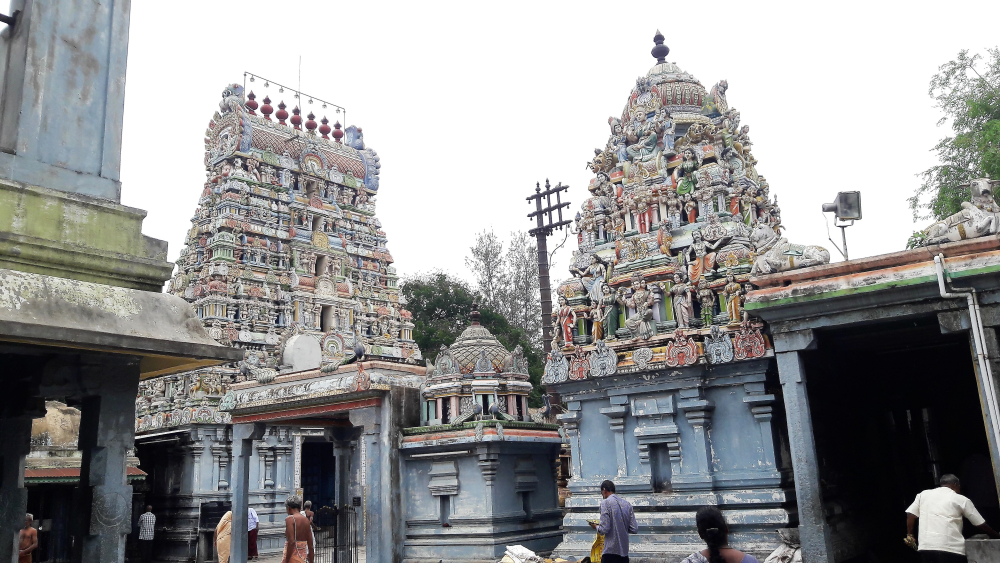
Kalahastisvara Temple. (Picture Courtesy: Ssriram mt/Wikimedia Commons)
Varadarajap Perumal Temple
This Vishnu temple which was already in existence, right at its present place in Gandhi Road, when the old Vedapurisvara temple was demolished in 1748. Some of the images from the demolished temple were safely stored here.
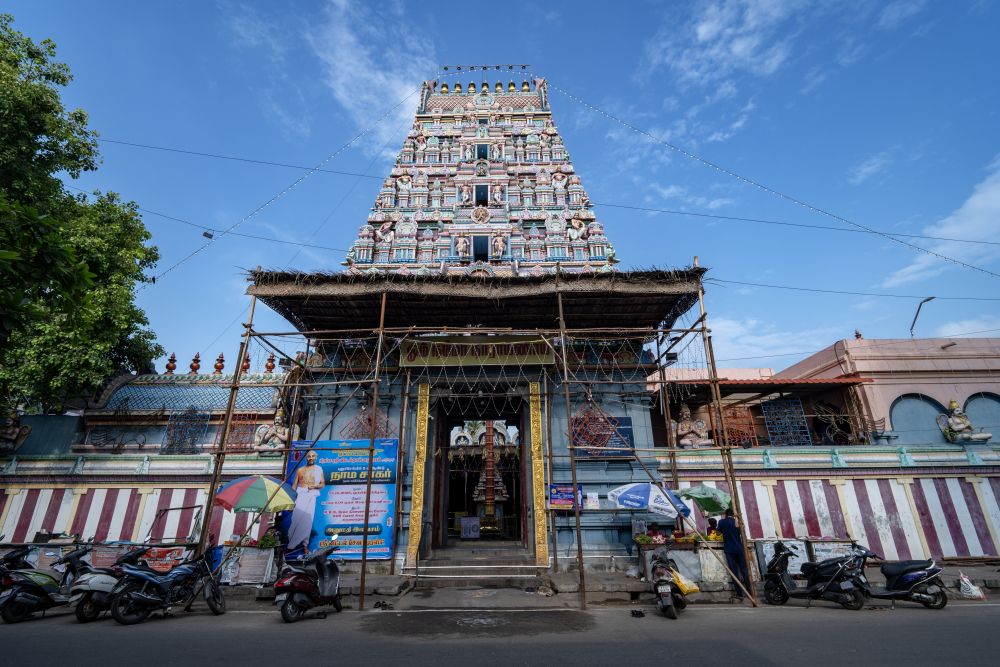
Sri Varadaraja Perumal Temple in Puducherry. (Picture Credits: Joseph Rahul)
The main temple consists of the sanctum, the ardhamandapa, and the mahamandapa. On the wall around the sanctum, different forms of Vishnu in many other holy places are sculpted. The deity in the sanctum measures 7 feet in height, sculpted in a standing pose accompanied by Sridevi and Bhudevi on either side. It is said that these images, along with some others were found in the sea some 200 years ago. This temple also contains the images of Alvars, devotees of Vishnu, and of various Vaishnava acharyas. Next to the shrine of Andal we have a small shrine for Kodandarama; adjacent to this, there is a small room where the four walls are paved with mirrors and at the centre the idol of the god taken on procession is placed. This too is a popular temple and many festivals are celebrated in it throughout the year.
Conservation and Heritage
Though some of these temples were destroyed (as in the case of the ancient Vedapurisvarar Temple) by the French colonial authorities, most have been restored by the work of local communities. Nearly all of these temples continue to be daily sites of use and engagement for devotees, which has contributed to their maintenance.
Simultaneously, the Indian National Trust for Art and Cultural Heritage (INTACH) and the Puducherry Government are jointly working towards ensuring the preservation of these historic sites. On the recommendations of the State-Level Heritage Conservation and Advisory Committee (SLHCAC), the Puducherry Government has declared several temples ‘protected buildings’ and granted them heritage tags, including the Vedapurisvarar Temple. The Archaeological Survey of India (ASI) has also recognized several historical temples as Monuments of National Importance, including the Varadaraja Perumal Temple, and authorized their protection.
These legislative efforts, in concert with the local communities, have ensured the relative maintenance and upkeep of these ancient temples in Puducherry.
Bibliography
Balasubramanyam, S. R. Early Chola Temples. Madras: Bureau of Tamil Publications, Tamilnadu Government, 1974.
———. Middle Chola Temples. Faridabad: Thomson Press (India) Limited, Publication Division, 1975.
Cāminātaiyar, U. Ve. Tiruvāvaṭutuṟai Yātīṉattu Makāvittuvāṉ Tiricirapuram Śrī Mīṉāṭcicuntaram Piḷḷaiyavarkaḷ Carittiram. 2 vols. Ceṉṉappaṭṭaṇam: Kēsari Accukkūṭam, 1933–1934.
Ganesan, T. Two Śaiva Teachers of the Sixteenth Century: Nigamajñāna I and His Disciple Nigamajñāna II. Pondichéry: Institut Français de Pondichéry, 2009.
L’Hernault, Françoise, and Marie-Louise Reiniche. Tiruvannamalai: Un lieu saint sivaïte du sud de l’Inde. Vol. 3, Rites et fêtes. Paris: École Française d’Extrême-Orient, 1999.
Murugesan, C. S. Puducherik Koyilkal. 2 parts. Chennai: Sankar Patippakam, 2014.
Shulman, David. Tamil Temple Myths: Sacrifice and Divine Marriage in the South Indian Śaiva Tradition. Princeton: Princeton University Press, 1980.
Younger, Paul. The Home of Dancing Śivaṉ: The Traditions of the Hindu Temple in Citamparam. New York: Oxford University Press, 1995.
This essay has been created as part of Sahapedia's My City My Heritage project, supported by the InterGlobe Foundation (IGF).