
Gwalior, with its massive fort, emerged as a prominent city in modern times at the beginning of the nineteenth-century, when it became the capital of a state ruled by the Scindia (Shinde) dynasty. Located at a strategic point, between northern India and the Deccan, the city has long been shaped by its position within wider networks of movement, exchange, and power.
Ancient Foundations
The genesis of the state dates to the first half of the eighteenth-century, when the Marathas established control over the Malwa region of central India. Malwa had been the suba (province) of the Mughal empire. The Scindias were important Maratha military chiefs, who played a crucial role (along with other sardars, military chiefs, primarily the Holkars and the Puars) in Maratha expansion into central India.
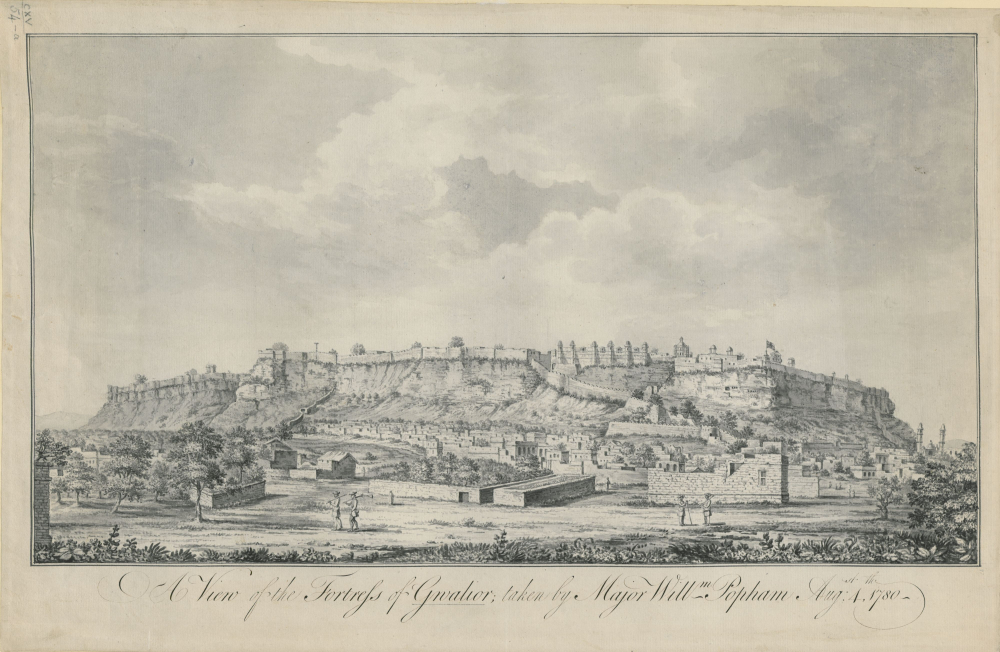
A view of the Fortress of Gwalior, 1780. (Picture Courtesy: British Library/Wikimedia Commons)
Gwalior itself lies at the northern edge of central India and is not located in Malwa proper, i.e, the Malwa plateau. The fort, and the settlements at the foot of the hill on which it is built, historically constituted the nucleus of Gwalior city. The importance of the site and its strategic location on one of the principal routes from northern India to the Deccan was recognised quite early. In fact, an early sixth-century CE inscription from the reign of the Huna ruler Mihirkula has been found at Gwalior. One of the oldest extant structures on the hill itself is a temple carved into the rock face, dating back to the late ninth-century. An inscription in the temple has one of the earliest representations of the number zero, the symbol ‘0’. Other inscriptions in the temple indicate that in the late ninth-century, Gwalior (referred to as Gopadri, in some of them) was part of the territories of the Pratihara (Gurjara-Pratihara) ruler Bhoja and that the fort was already in existence. Kanauj was the capital of the Pratiharas at that time and Gwalior a frontier outpost.
Although Pratihara rule had more or less come to an end by the beginning of the eleventh-century, a line of Pratiharas exercised control over the Gwalior region intermittently. The political history of the two centuries following the end of Pratihara power is somewhat obscure. Apart from the Gwalior Pratiharas, chiefs belonging to regional lineages successively held Gwalior for short durations. At least one of them, the Kachchhapaghatas, has left their imprint on the city’s landscape in the form of spectacular temples, particularly the ‘Sas-Bahu’ Temple and the lesser ‘Sas-Bahu’ Temple located within the fort, which were built in the late eleventh-century. Gwalior was briefly occupied by the Ghaurids who had become the dominant power in north India by the late twelfth-century, and subsequently became part of the Delhi Sultanate till the end of the fourteenth-century. It acquired greater significance with the southward expansion of the Sultanate under the Khaljis and the Tughlaqs. Ibn Battuta, who spent several years in India during the reign of Muhammad bin Tughlaq, refers to his halt in the city when he was travelling from Delhi to south India and notes that Gwalior is “a big city with an impregnable fortress isolated on the summit of a mountain.”
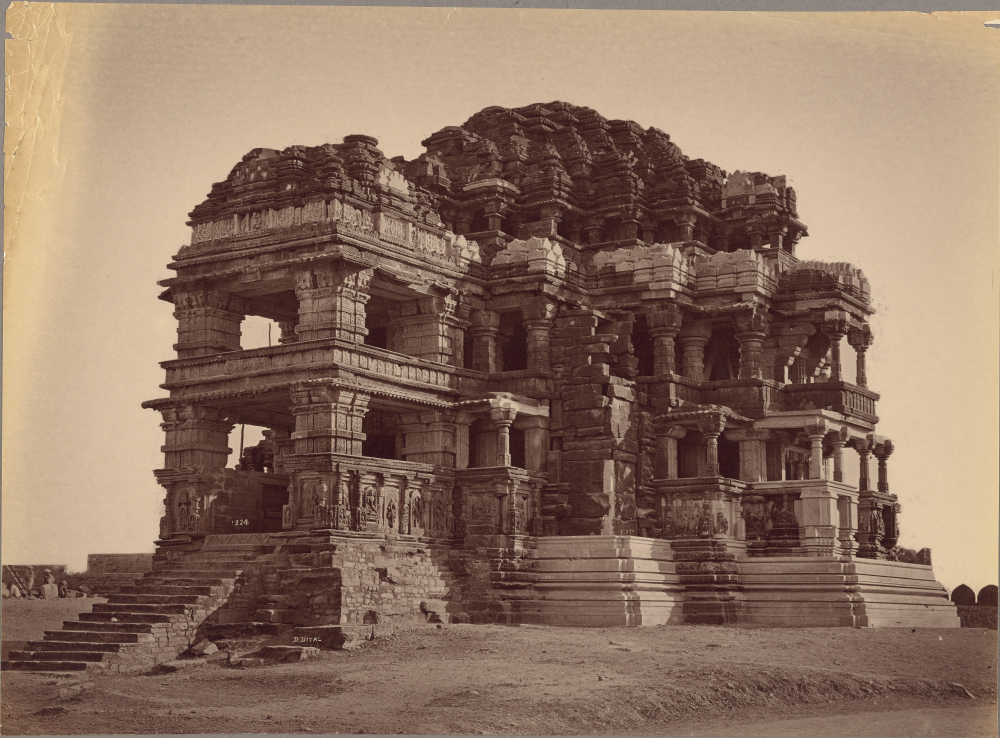
The popular Sas-Bahu Temple. (Picture Courtesy: Lala Deen Dayal/Wikimedia Commons)
The decline of the Delhi Sultanate towards the end of the fourteenth-century, hastened by the foray of Timur into north India (1398-99), led to the emergence of several regional polities. These included a kingdom centred on Gwalior, ruled by the Tomar dynasty.
Regional Rises and Falls
The Tomar chiefs of Gwalior were initially feudatories of the Tughlaqs. The Tomars had gradually become independent and eventually created their own state, even though rulers of the dynasty occasionally paid tribute to the Delhi sultans, especially to the Lodis in the early sixteenth-century.
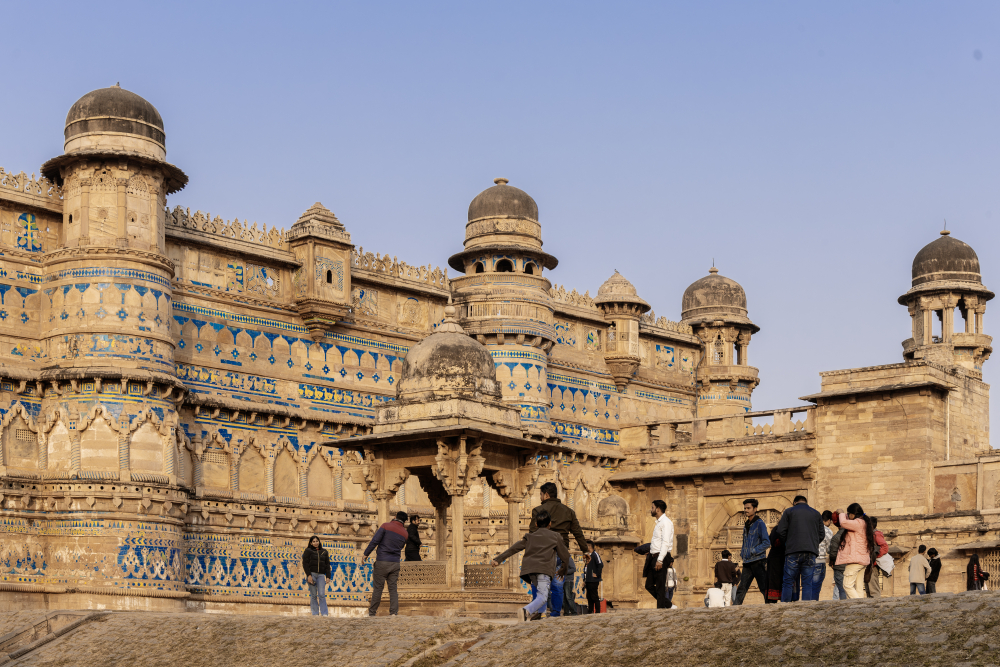
Mansingh Palace, Gwalior Fort. (Picture Credits: Pranjal Jain)
Man Singh (1488-1518), the most illustrious of the Tomar rulers, added many structures to the Gwalior Fort, giving to it its present appearance, and built an imposing and elegant palace, the façade of which is adorned with beautiful tiles. The palace was much admired by Mughal emperors and was one of the sources of inspiration for architectural styles that evolved under Akbar and his successors. Through his patronage, Man Singh also made Gwalior a flourishing centre of art and culture. The Tomar court was one of the most vibrant regional courts that emerged during the long fifteenth-century between Timur’s military expedition and the founding of the Mughal empire. Man Singh’s ancestor Dungar Singh contributed to the evolution of the north Indian vernacular by commissioning Hindavi versions of the Mahabharata and the Ramayana, the earliest known versions of the great epics in the language. It was during Dungar Singh’s reign that the fabrication of a large number of Jain icons, many of them colossal in size, was initiated in Gwalior (c. 1440 onwards). The carving of these images of Tirthanakaras, which are a conspicuous feature of the hill on which the fort stands, “resulted from complex patronage networks that included Jain scholars, monks, and merchant sponsors.”
Gwalior also became a centre of Sufi worship under the Tomars. It was the spiritual centre of Muhammad Ghawth (Ghaus, Ghawth or Ghouse) of the Shattari order of Sufism. His tomb, built during Akbar’s reign, is located in the old town, i.e., the Mughal-era settlement. Man Singh was also renowned as a patron of classical music, and was himself an accomplished musician. Gwalior, like some of the other regional courts of the post-Sultanate period, provided sustenance to musicians, artists and litterateurs who migrated from Delhi due to the upheavals caused by Timur’s invasion. The great Tansen was a product of the rich tradition of music which evolved under the Tomars. He is buried within the complex containing the tomb of Muhammad Ghawth.
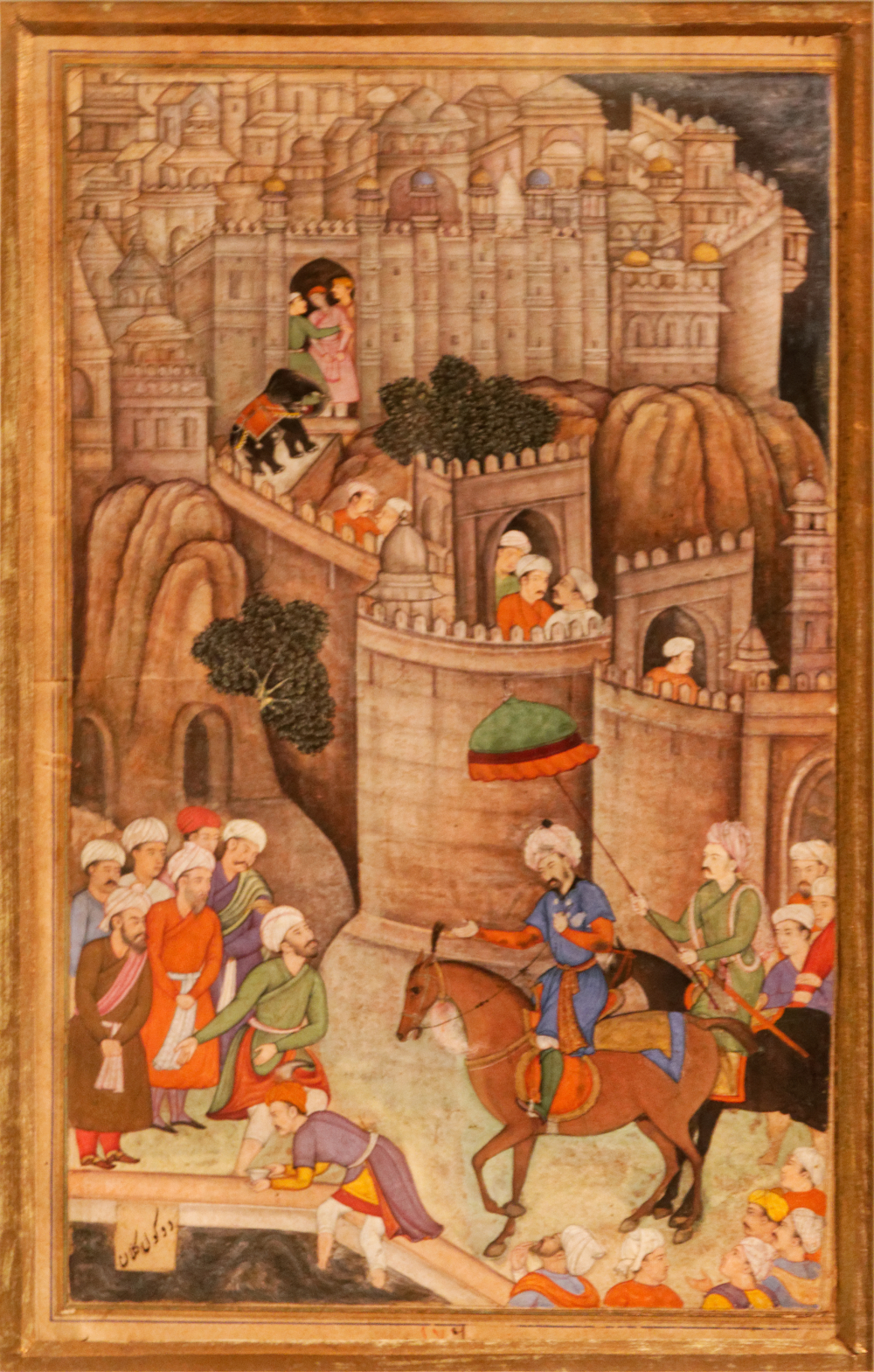
Babur inspecting Gwalior Fort. (Picture Courtesy: National Museum/Wikimedia Commons)
For about a decade after Man Singh’s death, Gwalior was a part of Lodi territories. It then passed into the hands of the Mughals. Babur left an account of his visit to Gwalior (“which is called Galior in books”) soon after it came into the possession of the Mughals. Most of this account is devoted to a description of the fort. In the course of his tour of the fort, he saw the Jain icons, which he seems to have found offensive. Some of the images were defaced on his orders (most have subsequently been restored). This action has been attributed to Babur’s iconoclasm, though recent scholarly writings have suggested that motives for the order were complex, ranging from aesthetic reasons to momentary irritability. It has been pointed out that the temples within the fort, which too were viewed by Babur, remained untouched. The visit to Gwalior is depicted in at least three separate illustrations of Baburnama editions prepared under Akbar, indicating its historical significance for Babur’s successors.
Gwalior retained its strategic importance under the Mughals. The town, which had grown up close to the northern end of Gwalior hill, expanded further in this period. Jahangir, Shahjahan and Aurangzeb added new buildings. Some of the buildings within the fort were occasionally used for incarcerating prominent state prisoners, especially recalcitrant members of the royal family.
The Anglo-Scindia Tussle
At the beginning of the eighteenth-century, the Mughals lost their monopoly of power in the suba of Malwa. An intense struggle for control over the region occurred in the roughly seven decades between Mughal decline and colonial ascendancy.
The Marathas were the main beneficiaries in this struggle. Maratha history in the first half of the eighteenth-century is dominated by three peshwas (prime ministers; de facto rulers), Balaji Vishwanath, Baji Rao I and Balaji Baji Rao. Under Baji Rao (1720-40), the Marathas embarked on a major expansionist venture. Within the space of less than a quarter century, the Marathas were ruling over most of western India, parts of the Deccan, Malwa, and central India. Maratha conquests, coordinated from Pune (the seat of the peshwas) were executed by various Maratha sardars. The project of Maratha expansion was intertwined with a system of assigning shares of revenue to warrior-chiefs by the peshwa. These assignments provided the Bhonsles, the Holkars, the Scindias, the Gaikwads, and other Maratha sardars the territorial and resource base for extending the boundaries of the Maratha state. By building upon these, the great Maratha sardars managed to establish autonomous control over parts of the Deccan, and western and central India. This was followed by heritable chiefship within the families of some of the sardars, namely, the Bhonsles, the Holkars and Scindias in central India, and the Gaikwads in Gujarat — to name the most powerful Maratha dynasties.
Malwa first became a target of the Marathas in the 1720s. The Maratha conquest of the plateau was complete by 1738, when the Mughals formally ceded the province to the peshwa. Malhar Rao Holkar and Mahadji Scindia were the two most outstanding Maratha sardars in eighteenth-century Malwa politics. Malhar Rao (d. 1766) dominates the first half of the century, Mahadji Scindia (d. 1794) the latter half. Between them they laid the foundations of Maratha hegemony in the region. Scindia consolidation was halted by the Third Anglo-Maratha war (1817-18) and the ascendancy of the East India Company in central India following it. The Scindiastate was incorporated into the empire as a ‘native’ (or princely) state. It became one of the five princely states in the British Indian empire entitled to a 21-gun salute.
The ancient city of Ujjain was chosen by the Scindias as their capital when they established their authority over parts of Malwa. It remained the capital till c. 1810, when the durbar (court) shifted to Gwalior. After Gwalior became the seat of government, Ujjain continued to be the headquarters of Scindia administration in Malwa prant (province), the administrative unit comprising Scindia territories in Malwa. Gwalior, the Scindia capital, became the headquarters of the northern division or Gwalior prant.
Whereas the original urban settlement of Gwalior in the pre-Scindia era was located in the area north of Gwalior hill, a new township came up in the early nineteenth-century in a zone adjacent to the southern base of the hill. The initial temporary nature of this new settlement as a military camp is evident from the name for this part of the modern city: Lashkar or cantonment. Some of the localities in Lashkar such as Sikandar Kampoo (Alexander’s Brigade) and Shinde ki Chhawni (Scindia's Cantonment) too reflect its military origins. A new cantonment situated at Morar, lying east of the fort, was developed in 1844 for stationing contingents of Scindia troops commanded by British officers. Thus, modern Gwalior comprises the old city, Lashkar, and Morar.
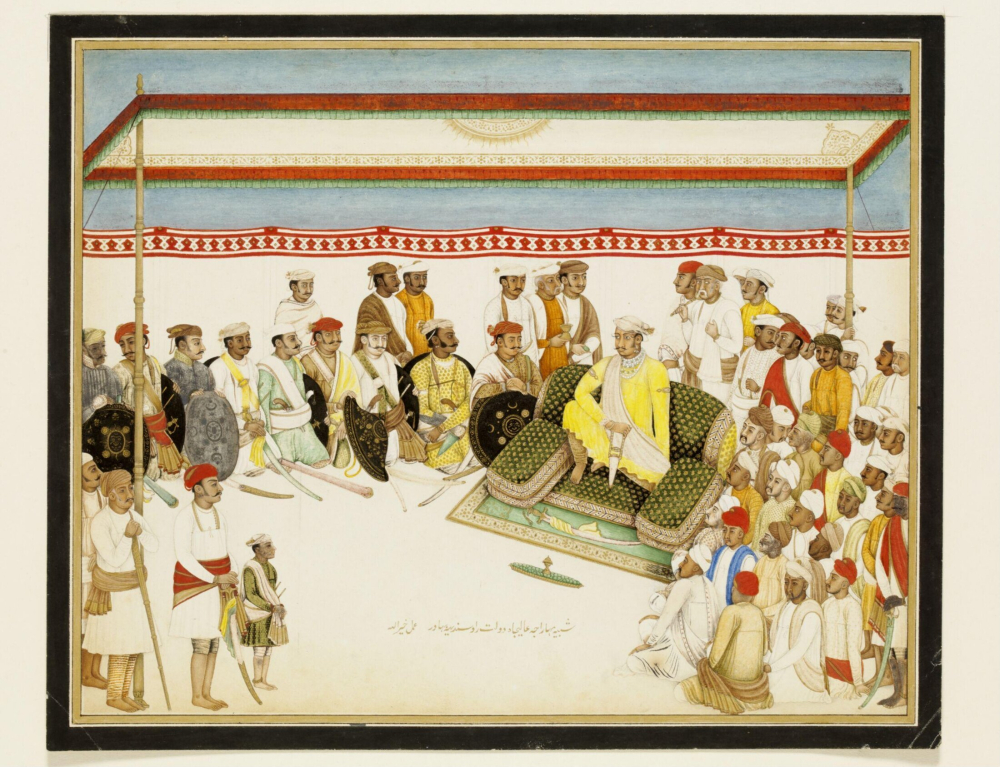
Portrait of Maharaja Ali Jah Daulatrao Scindia of Gwalior. (Picture Courtesy: Victoria & Albert Museum)
The military potential of the Scindia state was not immediately exhausted in 1818. The state remained a force to be reckoned with down to the middle of the century. Viewed from an all-India perspective, this was among the handful of states which had the potential to resist for long, but not prevent, colonial penetration. Even after the Third Anglo-Maratha war, when the authority of the reigning Scindia ruler Daulatrao was severely curtailed, the state retained a great measure of real power for several decades. A major military campaign had to be launched against it as late as 1843 to ensure its complete subordination. A large military force led by the Governor-General marched into Gwalior, where it was stationed for several weeks and departed after enforcing British authority.
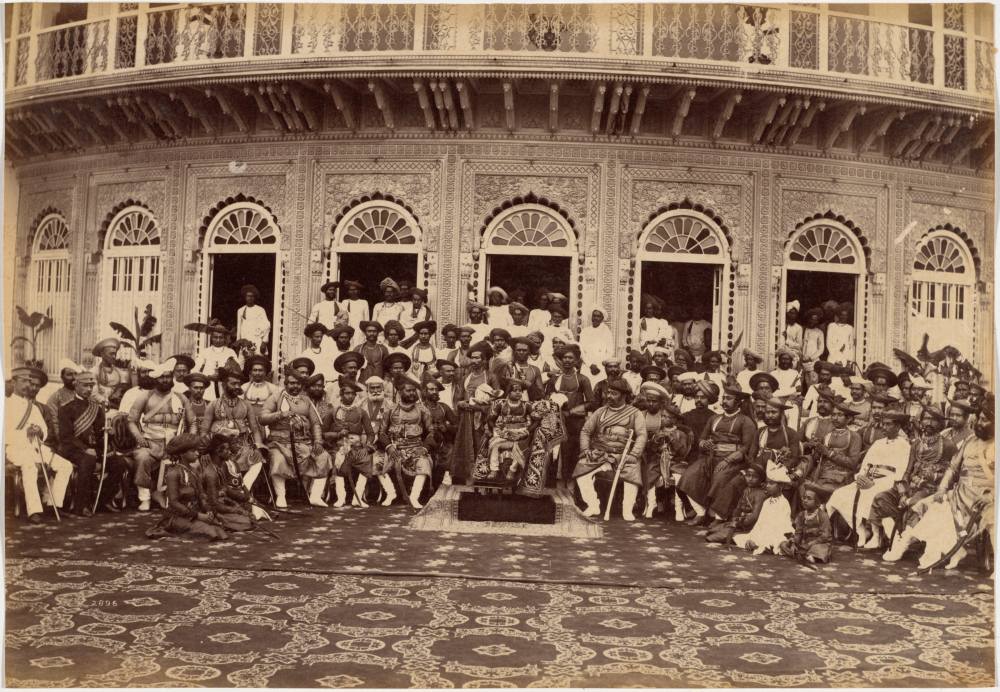
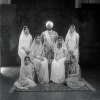
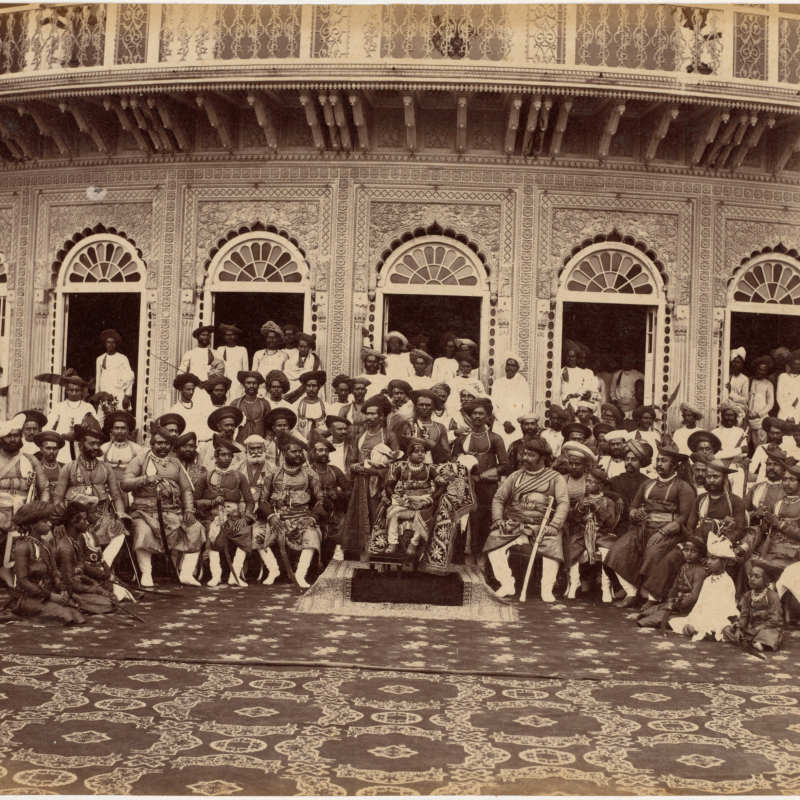
Maharaja Scindia, nobles, and high officials, Gwalior. (Picture Courtesy: Cleveland Museum of Art)
Gwalior was a major centre of the revolt of 1857, and witnessed a fierce contest between the rebels and a large British armed force led by Hugh Rose. The rebels under the leadership of Rani Lakshmi Bai and Tatya Tope moved to Gwalior in early 1858 after the fall of Jhansi and Kalpi. The British army launched a major operation in June to capture Gwalior. In the intense fighting that ensued, Rani Lakshmi Bai died in the thick of battle. By the end of the month, the British were in control of Gwalior, and the ruler, who had left the capital when the rebels took over, was escorted back. The British continued to occupy the fort even after the revolt had ended and handed it back to the ruler only in 1886.
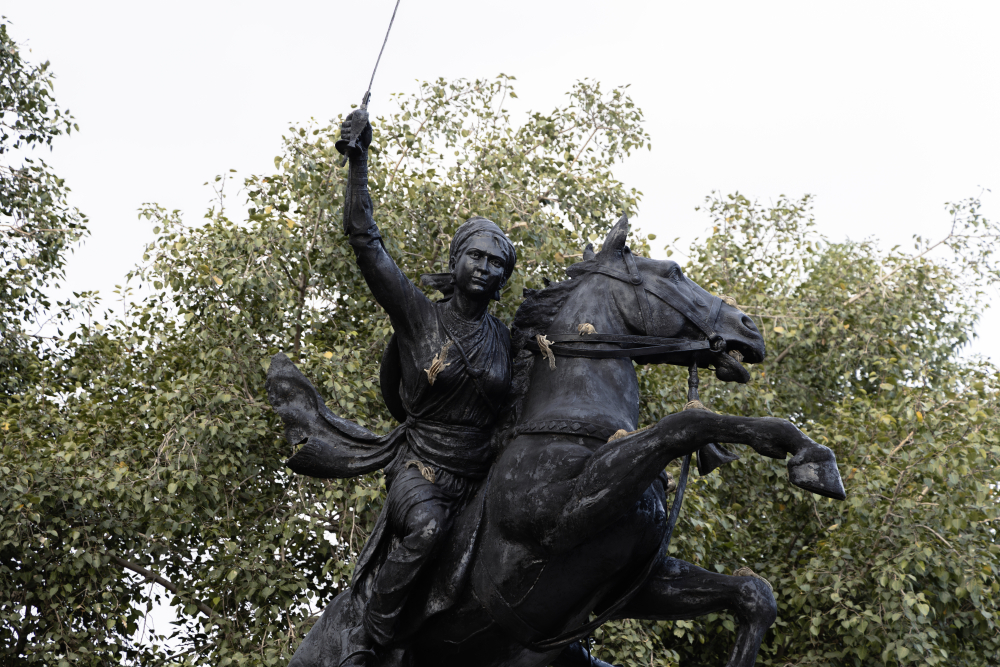
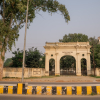
Rani Lakshmibai Memorial. (Picture Credits: Pranjal Jain)
In the latter half of the nineteenth-century and the early twentieth-century, Gwalior became an industrial centre with a textile mill, a leather factory, a cement factory, engineering works, and a state-owned pottery-making enterprise. Gwalior Potteries was a reputed brand name in the previous century. The city also had a manufacturing concern for making nibs for fountain-pens, which required considerable technical expertise in those days. Gwalior was on the main route of the Great Indian Peninsula Railway which connected Delhi and Punjab with Bombay (now Mumbai). It was also the main terminus for a narrow-gauge railway network, a project of the state, the Gwalior Light Railway.
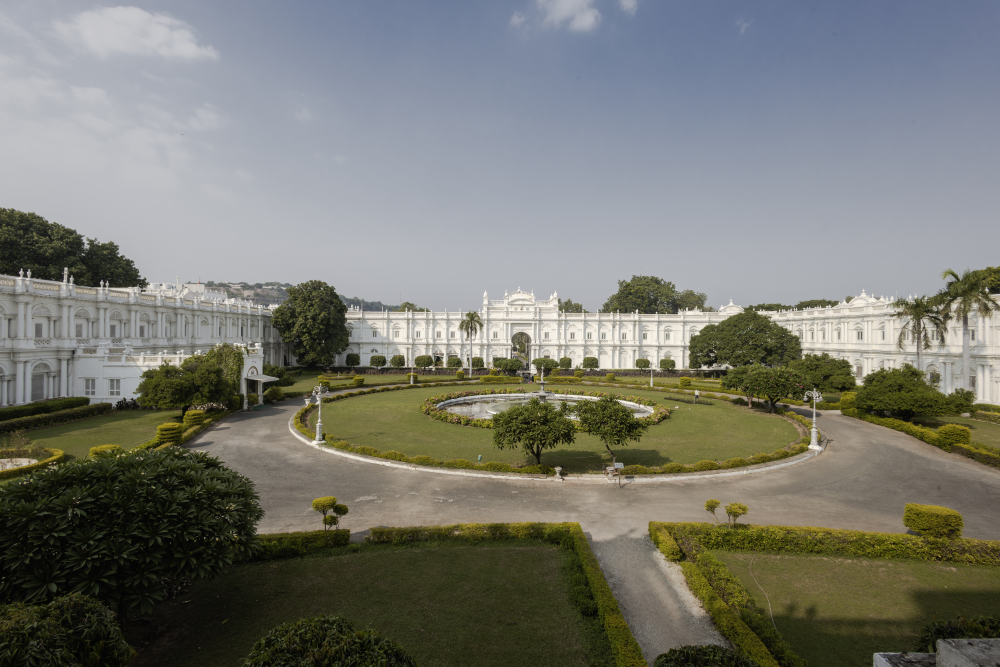
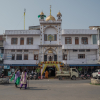
Jai Vilas Palace. (Picture Credits: Pranjal Jain)
Surprisingly, there are no grand public buildings in modern Gwalior other than the impressive Jai Vilas Palace built in the last quarter of the nineteenth-century. Lashkar had a relatively modest city centre, the Jayaji Chowk, with a Town Hall, the state-owned Alijah Durbar Press, and Victoria Market. The fort completely dominates the skyline with no other structure interfering with the view.
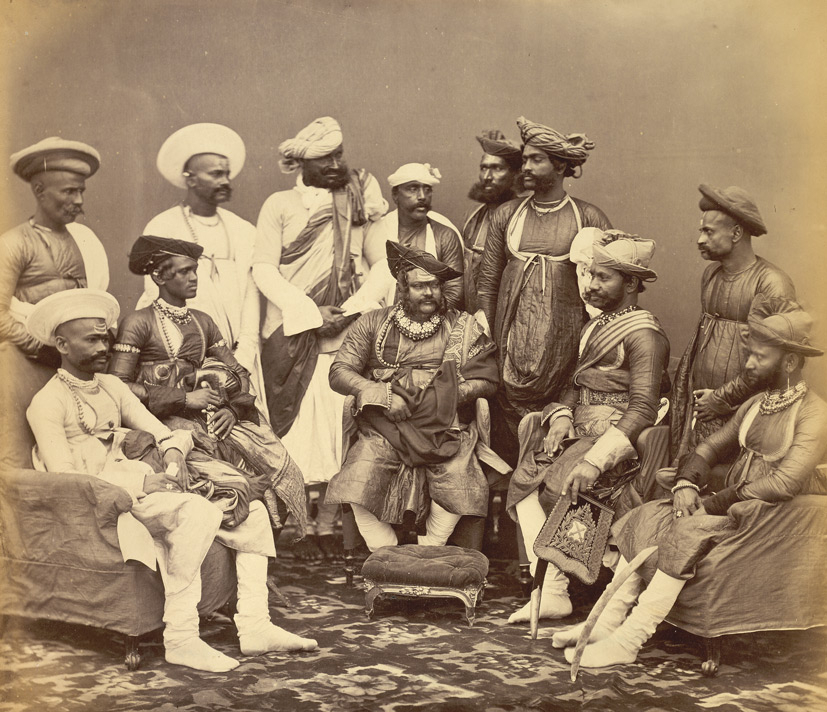
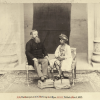
Photograph of the Maharaja of Gwalior (Jayajirao Scindia) with state officials, 1870. From Lee-Warner Collection: 'Bombay Presidency. William Lee Warner C.S. (Picture Courtesy: Wikimedia Commons)
Gwalior under the Scindias emerged as one of the leading centres of Hindustani music. Its tradition of classical music, with roots in the era of the Tomars, found expression in the Gwalior gharana or ‘school of music’. Daulatrao himself was a disciple of Naththan Khan who has been regarded as the progenitor of the gharana. The origins of the ‘school’ go back to an earlier generation. The tradition was enriched further by three grandsons of Naththan Khan. Jayaji Rao (d.1886) became a disciple of the youngest of these grandsons, Natthu Khan. Natthu Khan’s principal disciple, and (adopted) son, Bade Nissar Hussain was given the position of court musician after his guru’s death in the 1880s. Disciples of Bade Nissar Hussain were among the foremost exponents of the Gwalior gharana in the early twentieth-century. Several Maharashtrian vocalists of the gharana received their training from masters in Gwalior. Some of the other eminent gharanas, particularly Patiala and Jaipur, have evolved from the Gwalior gharana.
Post-Independence
The Scindia state ceased to exist as a princely state following its accession to and merger with the Indian Union in 1948. After independence, when the princely states of Malwa were integrated to constitute Madhya Bharat (which in turn was included in Madhya Pradesh when the latter was formed in 1956), the Scindia and Holkar territories together accounted for three-fourths of the area of Madhya Bharat. The size of the Scindia state then was about twice that of Indore (Holkar).
The independent Indian state had to accommodate the interests of both Gwalior and Indore when they acceded to the Union. This was reflected in the compromise over the choice of capital for Madhya Bharat — rotating between Gwalior and Indore. Subsequently, Bhopal was made the capital of Madhya Pradesh when the state came into existence with the merger of the Bhopal state with Madhya Bharat and Vindhya Pradesh. Gwalior has since declined in political importance. Nevertheless, it is one of the major urban centres of Madhya Pradesh, and is today a major tourist destination. The main tourist attraction is of course the fort with its numerous buildings, many of them of great antiquity. The inhabitants of Gwalior go about their everyday lives under the shadow of the fort and its rich history.
Bibliography
Bernhaut, Ross. ‘Babur, Akbar, and the Transformation of Gwalior’s Rock-Hewn Tirthankaras.’ Archives of Asian Art, 73 no. 2 (2023): 107-143.
Eaton, Richard. India in the Persianate Age, 1000-1765. United Kingdom: Allen Lane, 2019.
The Baburnama: Memoirs of Babur, Prince and Emperor, translated by Wheeler Mcintosh Thackston. New York: Oxford University Press, 1996.