
The hill fortress of Gwalior in northern Madhya Pradesh has an illustrious history spanning one and a half millennia. Monumental construction on the hilltop is first attested in the sixth-century CE and proliferated from the eighth-century onwards. Since this initial phase of the city’s development, Jains have established numerous temples around the hill and carved countless images into its cliffsides, some of which continue to be worshipped today.
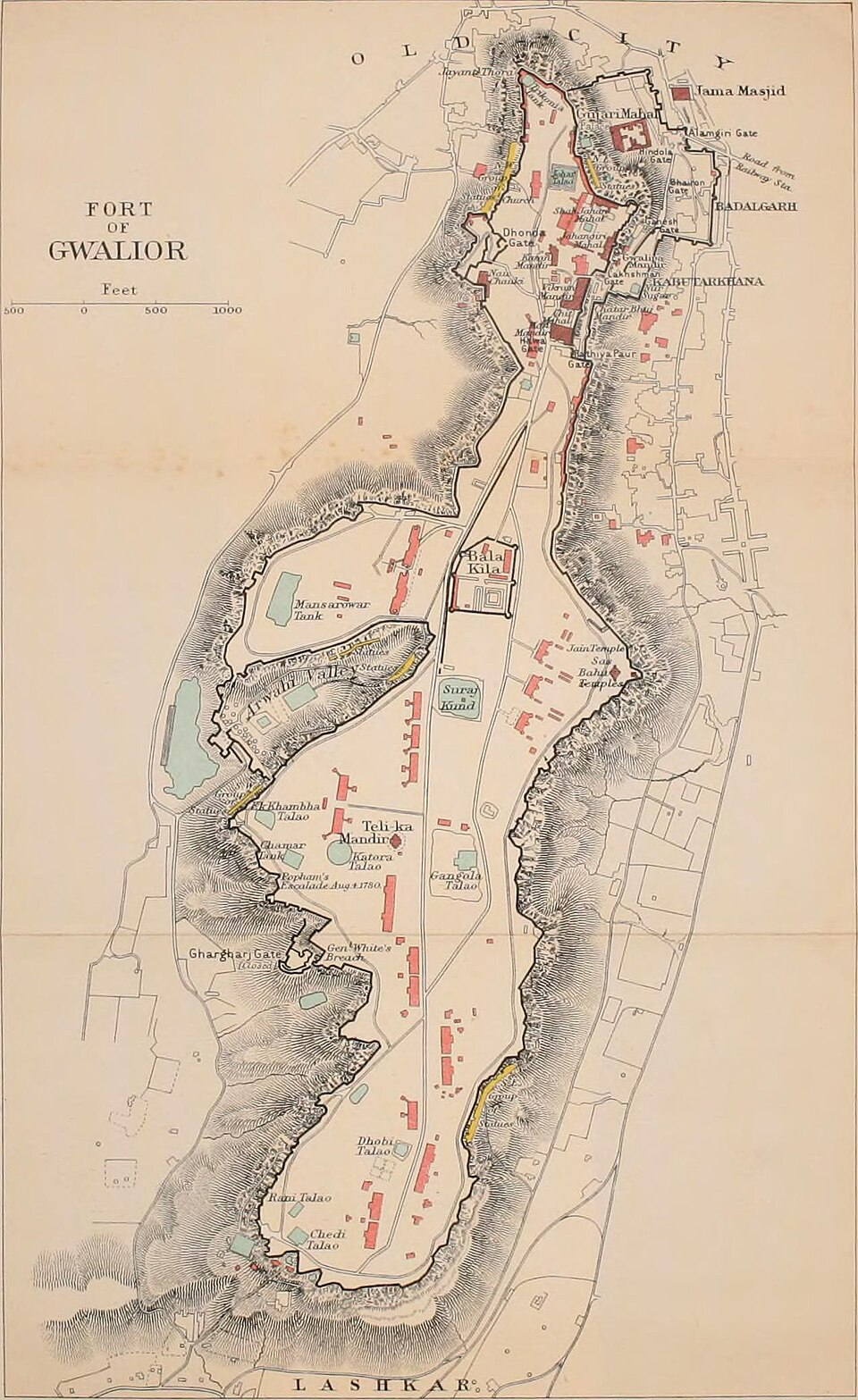
Gwalior Fort map from 'A handbook for travellers in India, Burma, and Ceylon' by John Murray, 1911. (Picture Courtesy: Wikimedia Commons)
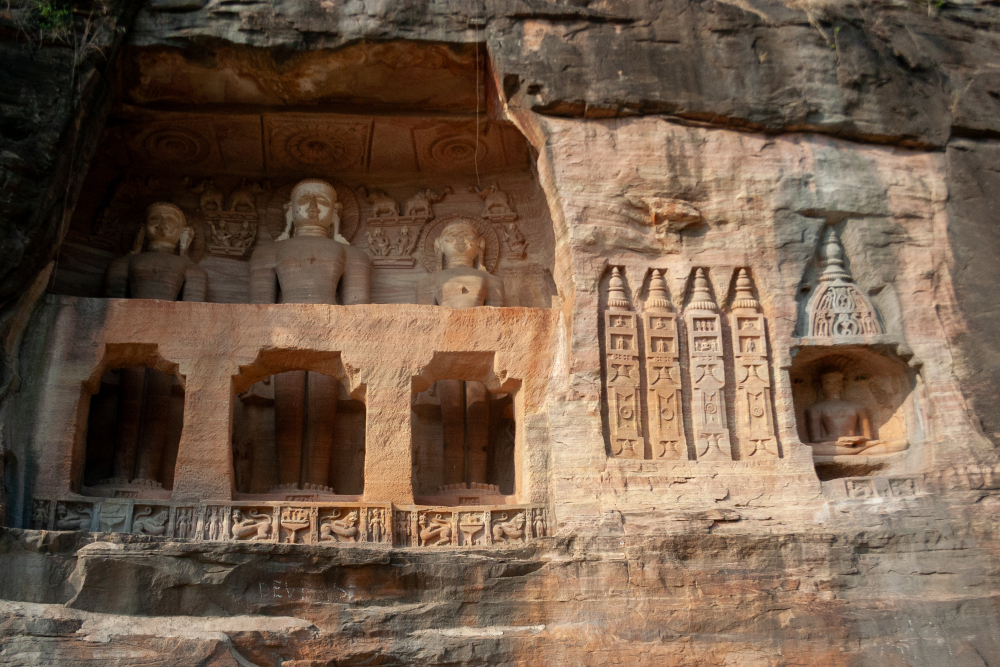
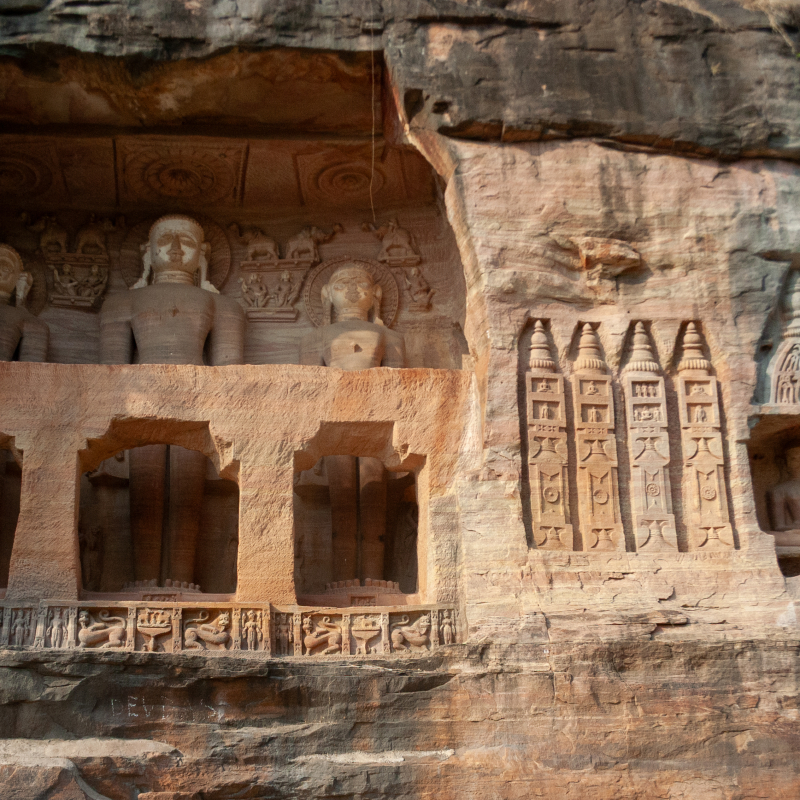
Rock-cut Jain Tirthankara sculptures carved into sandstone cliffs at Gwalior Fort, overlooking the fort plateau on the western escarpment. (Picture Credits: Ayan Ghosh)
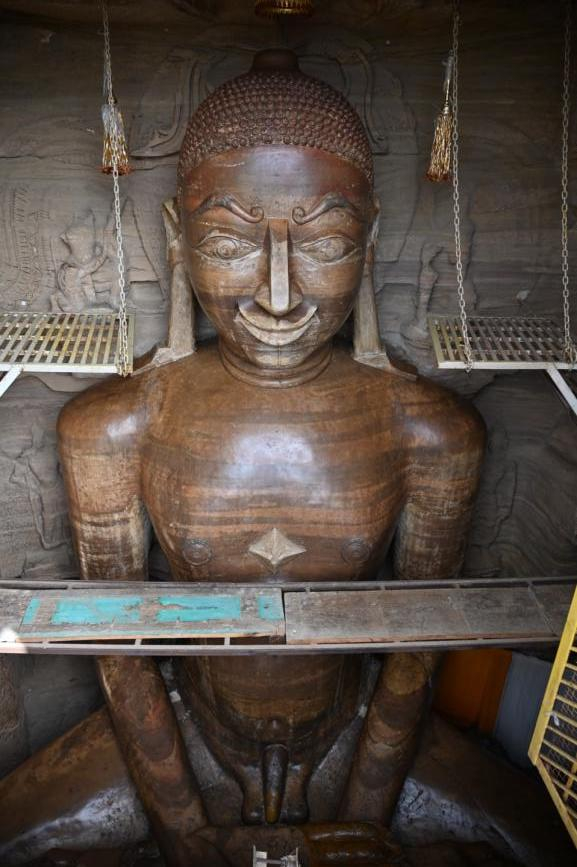
The central focus of Jain sculpture is the Jina (Victor) or Tirthankara (Ford-maker) — an enlightened, liberated being who once taught and fundamentally embodies the principles of Jainism. They are thus saviours not in the redemptive sense, but by virtue of revealing the path of emancipation from the cycle of samsara (transmigration). Icons of these quintessential renunciants are portrayed in postures of seated or standing meditation. Since the Jain statues on Gwalior hill were overwhelmingly sponsored by members of the Digambara (Sky-clad) community, they are depicted without clothing, reflecting the sect’s rigorous commitment to the ideal of relinquishing all material possessions.
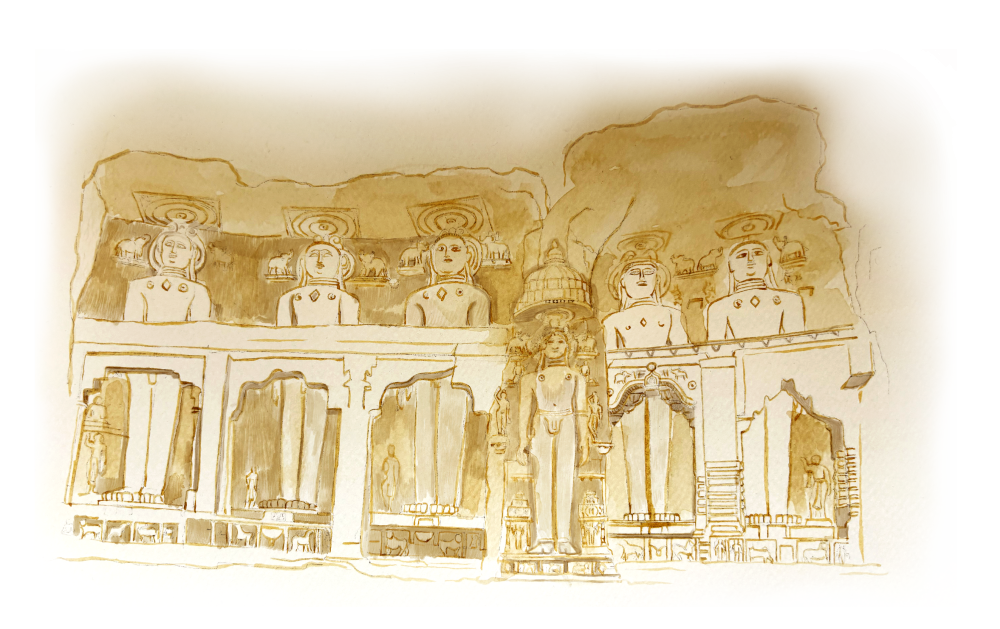
Jain Tirthankara sculptures carved into sandstone cliffs, arranged in tiered niches with standing figures and shrines. (Illustration Credits: Jisha Unnikrishnan)
Early Temple Sculpture
Jain statuary of the earliest period in Gwalior (approximately the eighth-century) falls into two broad categories based on the mode of production: sculptures originally fabricated for freestanding masonry temples, and images hewn directly into the living rock face of the hill. Though all structural Jain temples in Gwalior from the eighth-century have since vanished, sculptures attesting to their existence are preserved in archaeological museums and open-air displays around the fort. One image portrays the Jina Rishabhanatha (also known as Adinatha) flanked by an engaged square column, giving some sense of its original architectural context on a temple wall . Recognizable by his cascading locks of hair, Rishabhanatha is regarded as the first of twenty-four Tirthankaras that have appeared in our present avasarpini, a descending half-cycle of time in Jain cosmology. Before each of the twenty-four Tirthankaras was represented in sculpture with an identifying emblem, images of the different Jinas were essentially indistinguishable. Rishabhanatha was an exception due to his characteristic tresses, as was the twenty-third Jina Parshvanatha, who is shown sheltered by a canopy of serpent heads.
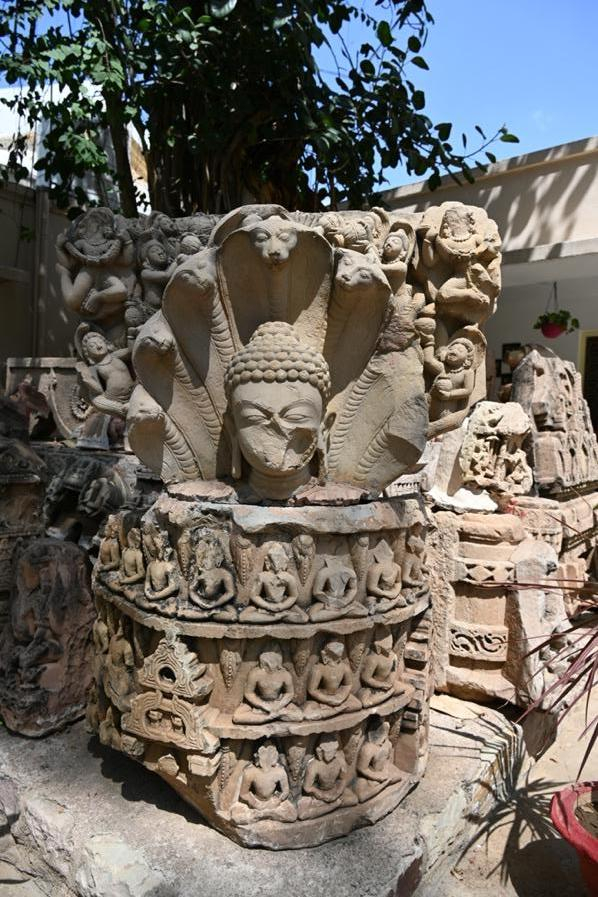
Head of Parshvanatha (above); Nandishvara Dvipa drum fragment (below), The Scindia School. (Picture Credits: Ross Lee Bernhaut)
One popular image type was the caturvimshati-patta, a stele representing the twenty-four Tirthankaras. A standard format for these panels presents a haloed Jina — often Rishabhanatha since he is first in the sequence — surrounded by twenty-three smaller-scale Jinas on the sculpture’s frame. Another image type portrayed Nandishvara Dvipa, the eighth and outermost island-continent of the middle world (madhyaloka) in Jain cosmography, where deities venerate eternal Jina icons. The fifty-two eternal temples situated on Nandishvara Dvipa are signified by drums that house forty-eight enshrined seated Jinas, which would have supported a caturmukha (four-faced) image with four addorsed Tirthankaras.
Early Rock-Hewn Imagery
The earliest rock-hewn Jain images in Gwalior were chiseled into the westernmost bluff of the hill, just outside of the Urvai gate. This active temple site is known today as the Shree Mata Trishala Atishay Kshetra, after a monumental image of Trishala, mother of Mahavira — the twenty-fourth and final Tirthankara of the current epoch. Adjacent to this sculpture is a relief depicting the yaksha (male divine attendant of a Jina) Sarvanabhuti (or Sarvanha), the yakshi (female divine attendant of a Jina) Ambika (or Kushmandini) and her two children, and their attendants. Ambika sits with her children upon her lion mount beneath a fruit-laden mango tree. This imagery reflects her mythological association with motherhood and fertility. Goddesses such as Ambika played a critical role in Jain devotion as intercessors in worldly affairs. By contrast, liberated Jinas have irrevocably transcended material existence. They reside for eternity in siddhashila, the crescent-shaped realm of perfected, disembodied souls (siddhas) at the vertex of the universe. Various seated and standing Jinas occupy additional niches in these excavations, including an exquisite colossal image of Rishabhanatha.
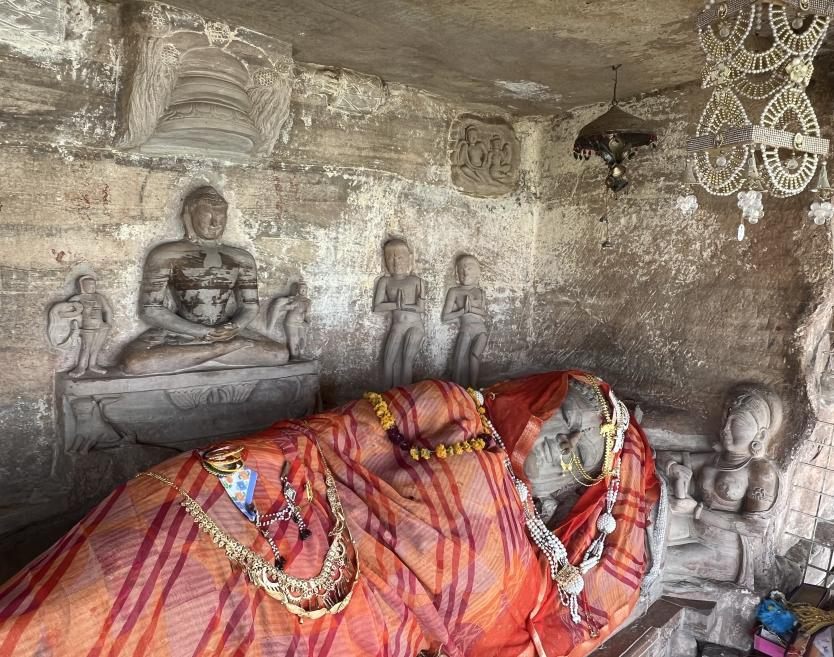
Trishala, Sri Mata Trishala Atishay Kshetra. (Picture Credits: Ross Lee Bernhaut)
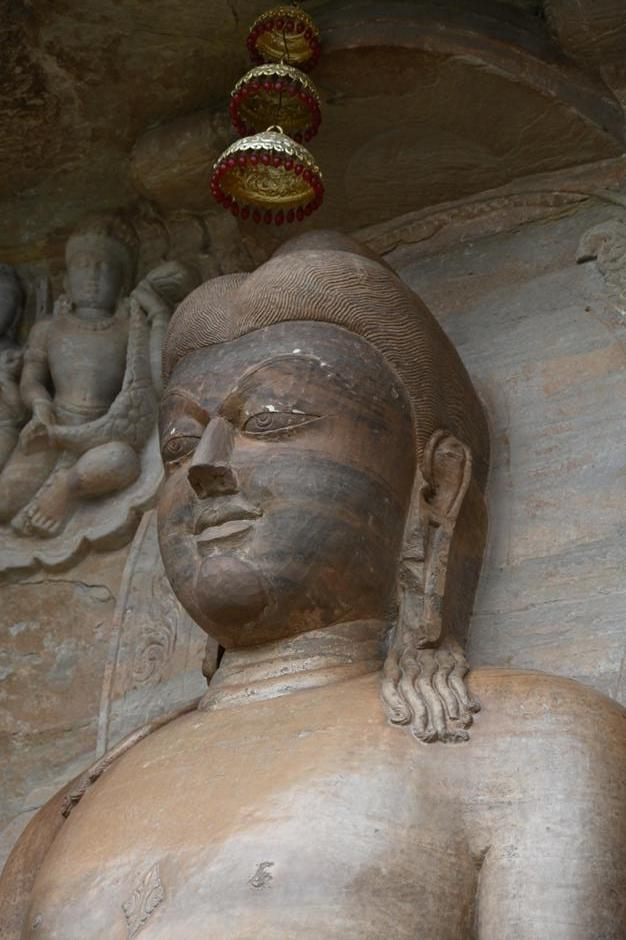
Rishabhanatha, Sri Mata Trishala Atishay Kshetra. (Picture Credits: Ross Lee Bernhaut)
Roadside Images and Hilltop Temples
While the Shree Mata Trishala Atishay Kshetra is situated on a secluded part of the hill removed from the path of pedestrian traffic, other images are carved along the road snaking up to the fort from the northeast. Epigraphic evidence suggests that this thoroughfare was considerably developed in the ninth century by Mihira Bhoja, a sovereign of the Gurjara-Pratihara dynasty that ruled the fort between the late eighth- and mid-tenth centuries. Most sculptures lining the path represent Hindu deities, but there are three Jinas carved between Shiva lingas. These include a life-sized standing Tirthankara in a two-tiered shrine, a small standing Jina in an aedicule crowning a pillar, and a tiny seated one to the south. Their style and the paleography of records attending the latter two images suggest they were fabricated around the tenth-century.
After the Gurjara-Pratiharas, the Kacchapaghata dynasty reigned from Gwalior Fort between the mid-tenth and late twelfth-centuries. Archaeological evidence attests that several structural Jain temples were built during the period of their ascendancy. One was discovered by the British archaeologist Alexander Cunningham in 1844, though it no longer survives. His excavation yielded “several naked Jain figures” and an inscription from 1108.
Another Jain temple occupies the grounds of the Scindia School on the southern part of the fort. It has three superimposed stories and bears moldings dateable to the twelfth-century, although it was restored in the fifteenth century. British officer and surveyor James Blaikie Keith dug up “a number of large statues representing various Jaina Thirthankars” and a pair of pedestals from beneath this temple’s bottom story. Additional dislocated early medieval Jain sculptures, currently housed in the Gujari Mahal Archeological Museum and throughout the fort, confirm that multiple Jain temples were constructed on the hill during this period.
Tirthankaras of the Tomara Era
Gwalior’s most famous Jain statues are undoubtedly the dozens of colossal Tirthankaras that were carved at various locations around the hill in the fifteenth-century. Patronage of these colossi resulted from the confluence of several factors. In the wake of Timur’s invasion of Delhi in 1398, numerous Digambara merchant families migrated to Gwalior. The influx enlarged the considerable Jain community already residing there and brought new wealth to the city. Another contingent within the patronage network were the bhattarakas, or lineages of Digambara monastic preceptors. Unlike the itinerant and naked mendicants (munis) of the sect, bhattarakas were sedentary, clothed, and involved in worldly affairs. The eminent lay poet and scholar Raidhu served in the critical role of pratishthacharya, presiding over the consecration of many of the images. Of course, a project of such magnitude could not have been executed without the endorsement of the kings of the Tomara Rajput dynasty, which ruled Gwalior Fort from the end of the fourteenth-century until its capture by Delhi sultan Ibrahim Lodi in 1518.
These Jain excavations are concentrated in four locations around Gwalior hill. The northeastern cluster is colloquially known as the Girnar or Neminatha group due to the enshrined image of the twenty-second Tirthankara in one of the caves. It is reached via a steep footpath that peels uphill off the principal northeastern ascent to the fort. The southwestern group lines the escarpments on either side of the Urvai valley, a deep ravine wedged into the western part of the hill. Entry to the valley housing these colossal Jinas, as well as the main road up to the fort from the west, is guarded by the Urvai gate. Building activity commenced on the southern side of the gorge in 1440. Included in this set of images is the largest in all of Gwalior, a fifty-seven-foot-tall standing Adinatha. Over the next two decades, work on both sides of the valley would continue in spurts.
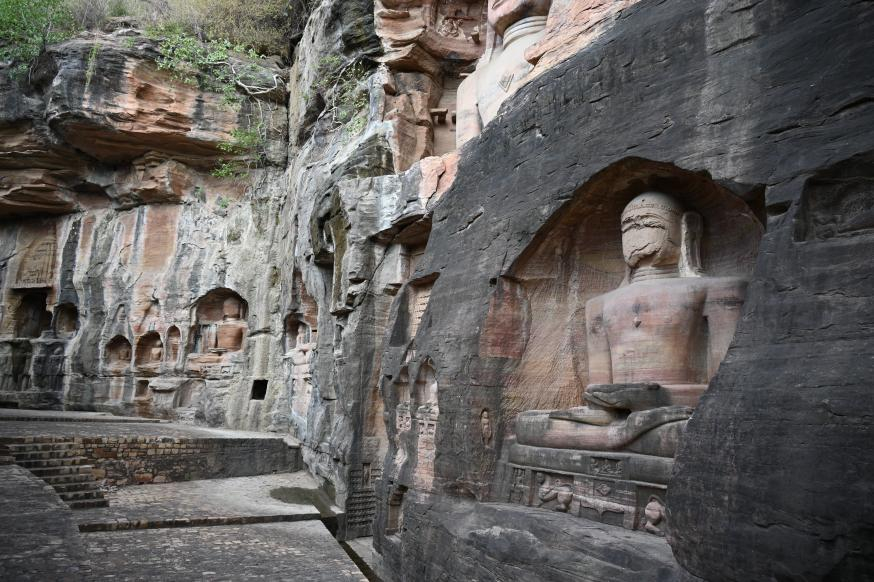
Southwestern group of Jain rock-cut sculptures. (Picture Credits: Ross Lee Bernhaut)
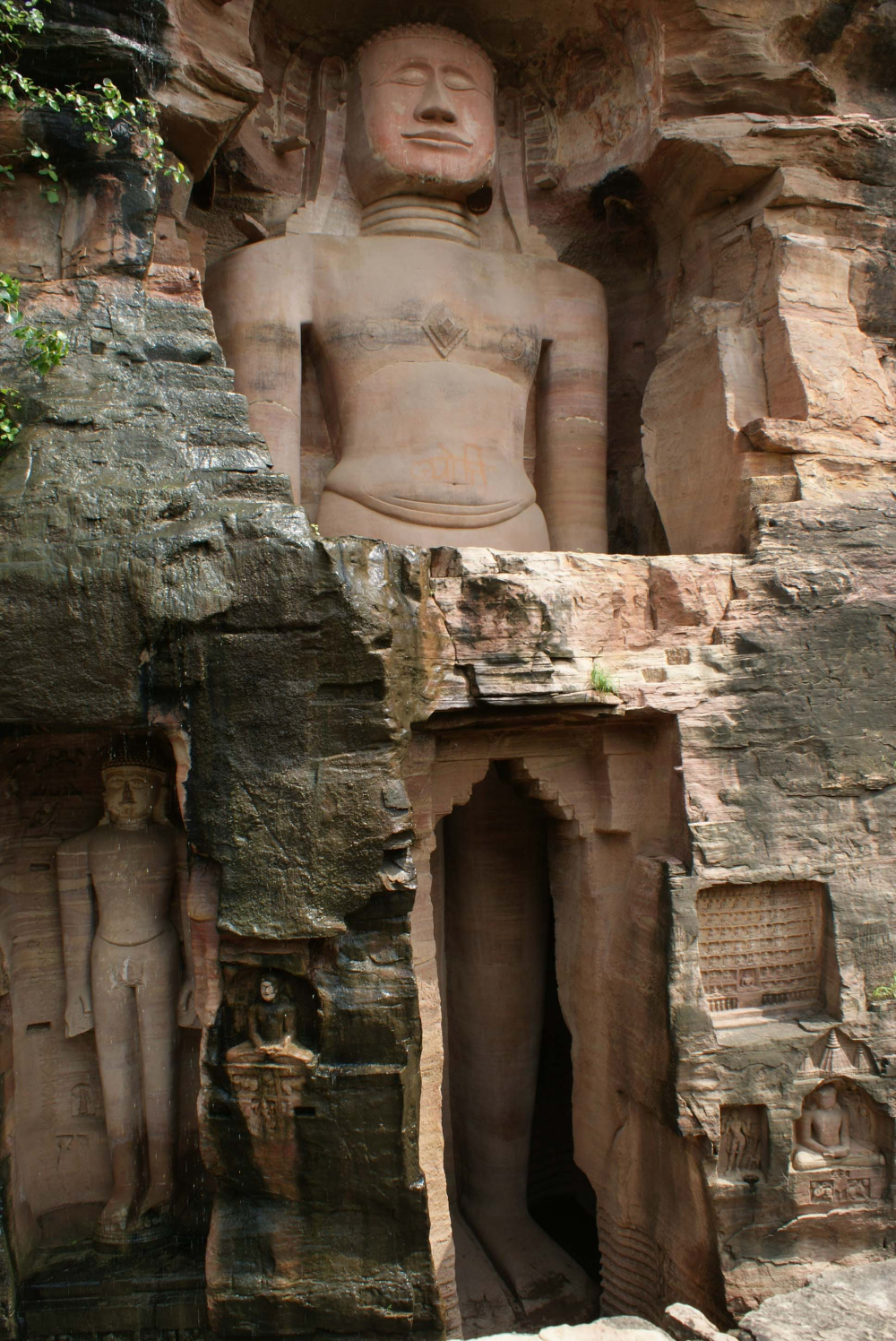
Adinatha Sculpture. (Picture Courtesy: Jolle/Wikimedia Commons)
The southeastern group, also known as Ek Patthar ki Bavri, is carved into the sheer scarps along the southeastern face of the hill. Inscriptional evidence suggests that construction on this site was undertaken in earnest from 1468 onwards. Image dedications here largely subsided by the 1480s, but continued sporadically into the sixteenth-century. The final group of Tomara-period Tirthankaras was established on the northwestern spur of Gwalior hill, just north of the Dhodha Paur gate to the fort. This cluster is popularly called the Naminatha group due to the colossal image of the twenty-first Tirthankara enshrined there. The first recorded consecrations among this set of images took place in 1470, with another spate occurring in 1474. Gwalior’s giant Jinas appear in a staggering array of sizes and configurations, and are housed in sanctuaries displaying diverse framing features culled from the repertory of temple, palace, and military architecture. Their sophistication and heterogeneity, which reflect Gwalior’s fortified urban environment, are unparalleled among the Jain caves of the region.
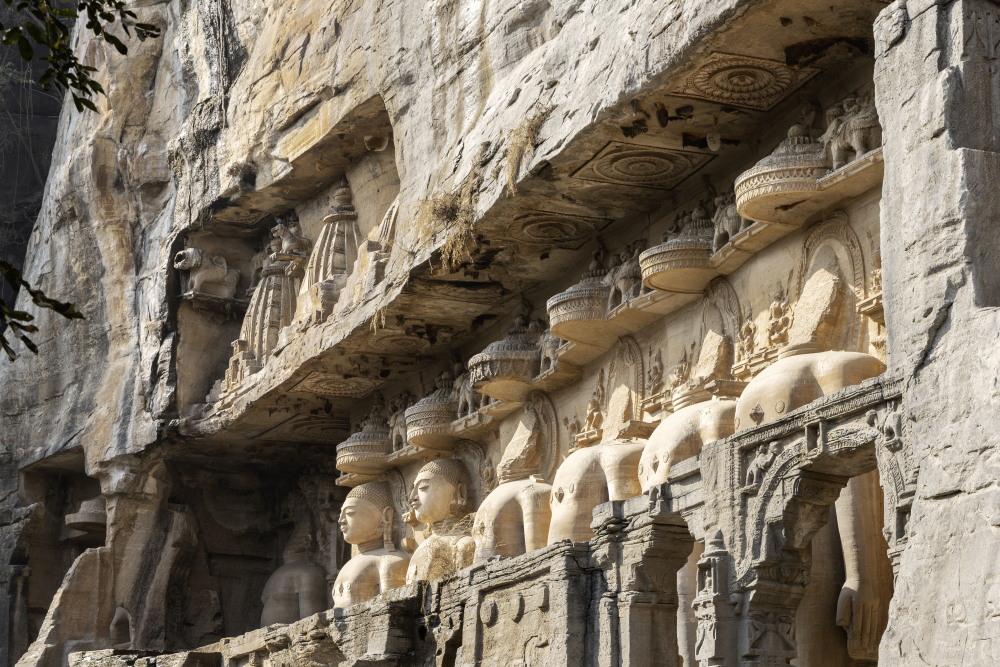
Ek Patthar ki Bavri or the Southeastern group of Jain rock-cut sculptures. (Picture Credits: Pranjal Jain)
Naminatha, the northwestern group of Jain rock-cut sculptures. (Picture Credits: Ross Lee Bernhaut)
Desecration and Reclamation
Observing Gwalior’s rock-hewn Tirthankaras today, viewers will notice that the heads and exposed genitals of most images have been disfigured. These acts of marring are generally attributed to the first Mughal emperor Babur based on his memoirs, the Baburnama. Babur relates his encounter with the statues in the Urvai valley during a tour of Gwalior in 1528. After commenting on their naked state, he identifies these “idols” as the sole defect of the valley and thus enjoins their destruction. As the material record makes clear, these images were neither obliterated nor subjected to indiscriminate mutilation. On the contrary, the heads, reproductive organs, and bodily extremities of the statues were targeted. This programmatic defacement seems to reflect prevalent ideas about the neutralization of idols articulated in Islamic theology and law. Although each of the four major fifteenth-century groupings of Jain colossi sustains iconoclastic damage, the earlier rock-cut images at Shree Mata Trishala Atishay Kshetra survive with their faces and genitals intact.
In the time since the colossal Tirthankaras were desecrated, the Jain community of Gwalior has pursued strategies for reclaiming and repairing these images. Indeed, most sculptures with heads today have been restored with stucco. Cunningham already noted the replastered heads of Jinas in the 1860s. Evidence from archival photographs suggests that reconstitution initiatives continued until recent times. Today, the rock-cut Jain statues of Gwalior exist both as objects of art historical interest and as actively venerated images which have engendered the construction of adjoining temples. This illustrates how Gwalior’s Jain past continues to shape the city’s cultural and religious landscape in the present.
Bibliography
Bernhaut, Ross Lee. ‘Babur, Akbar, and the Transformation of Gwalior’s Rock-Hewn Tirthankaras.’ Archives of Asian Art 73, no. 2 (2023): 107–43.
Costello, Corbett. ‘Inscribing the Social and Sacred Landscape: Jain Monuments and Their Memorial Traces in Medieval Gwalior.’ South Asian History and Culture 11, no. 1 (2020): 60–77.
Cunningham, Alexander. Archaeological Survey of India. Four Reports Made During the Years of 1862–63–64–65, Vol. II. New Delhi: Indological Book House, 1972.
De Clerq, Eva. ‘Memories of Yoginīpura: Delhi’s Digambara Merchant Community after Timur.’ South Asia: Journal of South Asian Studies 40, no. 3 (2017): 531–43.
De Clercq, Eva. ‘Bhaṭṭārakas and Digambara Monastic Lineages of Fifteenth Century Gwalior: Glimpses from Raïdhū’s Writings.’ Journal of Asian History 45, no. 1/2 (2011): 63–83.
De Clercq, Eva, and Tillo Detige. ‘Colossi and Lotus Feet: Paṇḍitas and Bhaṭṭārakas in the North Indian Digambara Legacy.’ In Jaina Painting and Manuscript Culture: In Memory of Paolo Pianarosa, edited by Julia A. B. Hegewald, 303–35. Bonn: EB-Verlag, 2015.
Cort, John E.. Framing the Jina: Narratives of Icons and Idols in Jain History. New York: Oxford University Press, 2010.
Granoff, Phyllis. ‘Mountains of Eternity: Raidhū and the Colossal Jinas of Gwalior.’ Rivista di Studi Sudasiatici 1 (2006): 31–50.
Hultzsch, E. ‘XX.—The Two Inscriptions of the Vāillabhaṭṭasvāmin Temple at Gwalior.’ Epigraphia Indica 1 (1892): 154–62.
Keith, J. B. Preservation of National Monuments: Fortress Gwalior. Calcutta: Superintendent of Government Printing, 1883.
Meister, Michael W. ‘Āma, Amrol, and Jainism in Gwalior Fort.’ Journal of the Oriental Institute 22 (1973): 357.
Singh, A. K. and Navneet Kumar Jain. Inscriptions of Gwalior: Material for the History of the Gopādri Region. New Delhi: B.R. Publishing Corporation, 2016.
The Baburnama: Memoirs of Babur, Prince and Emperor, translated by Wheeler Mcintosh Thackston. New York: Oxford University Press, 1996.
Willis, Michael D. Inscriptions of Gopakṣetra: Materials for the History of Central India. London: British Museum Press, 1996.
This essay has been created as part of Sahapedia's My City My Heritage project, supported by the InterGlobe Foundation (IGF).