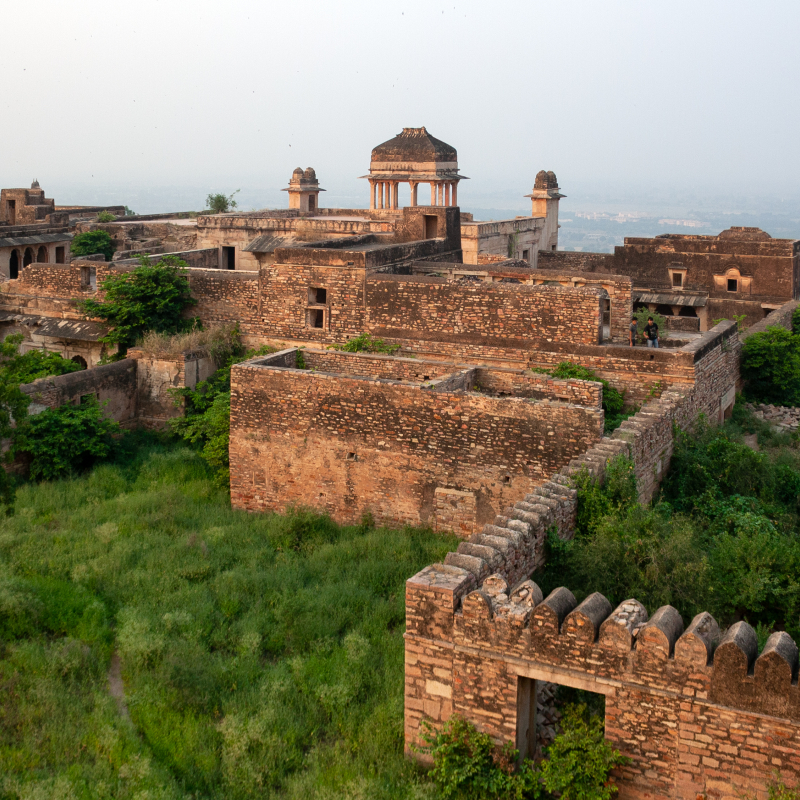

The fort in Gwalior, built atop a plateau, dominates the skyline, no matter where one stands in the city. The urban landscape seems to have grown outwards from it, making it the centre of Gwalior. The image of the Man Mandir — a fifteenth-century palace built by Man Singh Tomar — is arguably the most well-known visual of the city. Structures dating from as early as the eighth–ninth-centuries CE, such as the Teli ka Mandir, stand alongside later additions like the Scindia School and other palaces preserved within the three square kilometres enclosed by the fort walls.
This commanding presence is closely tied to the fort’s geography and architectural evolution. Gwalior Fort rises from a long sandstone plateau, extending for nearly two kilometres and rising over 100 metres above the surrounding plains. Its steep, near-vertical escarpments form a natural defensive barrier, while access to the summit is controlled through winding approaches and fortified gateways such as the Urvai and Gwalior gates. Over time, successive rulers adapted the site — developing palaces, temples, and water systems that allowed the fort to function as a largely self-sufficient settlement during periods of siege. These features made it not only secure, but enclosed and difficult to access.
It was these very features, of elevation, enclosure, and controlled access, that shaped the fort’s later histories. At the onset of winter, Gwalior decks up for Diwali — and alongside, the Sikhs in town also prepare for celebration. Four hundred years ago, it was on Diwali that Gwalior Fort was the site of an event which changed the meaning of the day for Sikh community forever. Yet this is not the only history the fort holds. Over time, it came to be used as a prison for political rivals, religious figures, and members of ruling elites, giving it a distinct place within the histories of power and confinement in the region.
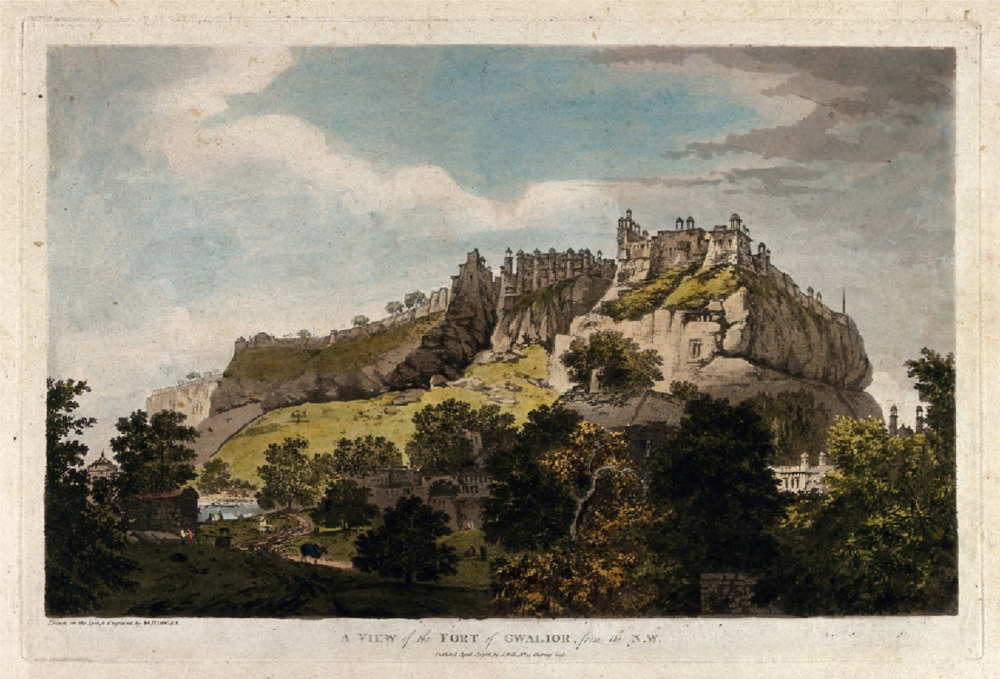
Fort of Gwalior. Coloured etching by William Hodges, 1786. (Picture Courtesy: Wellcome Collection/Wikimedia Commons)
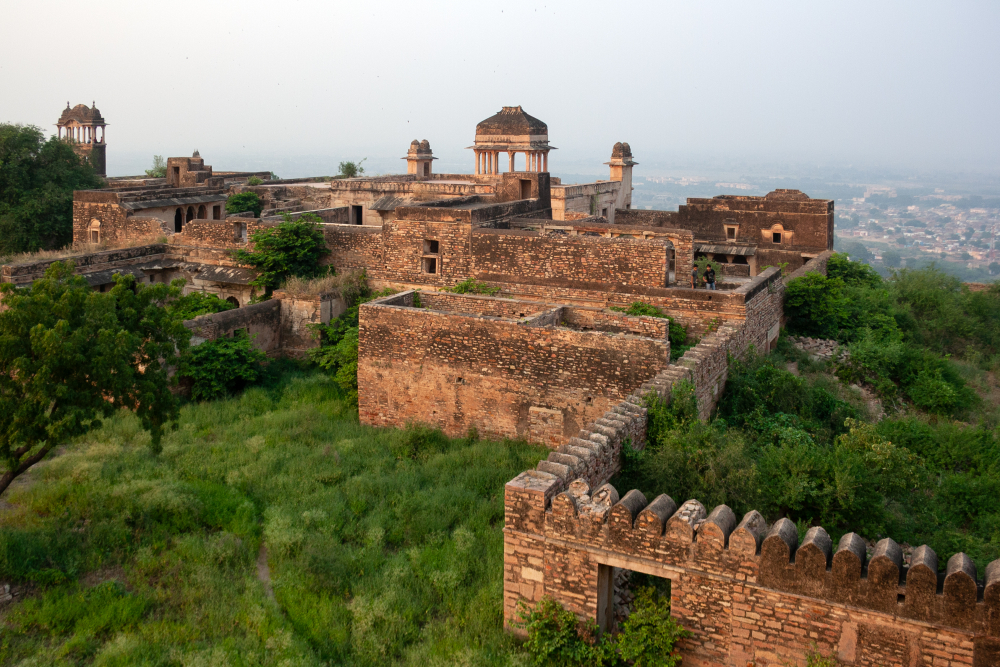
Palace ruins at Gwalior Fort, including residential courtyards, pavilions, defensive walls, and bastions, built of sandstone and masonry, overlooking the surrounding cityscape from above. (Picture Credits: Ayan Ghosh)
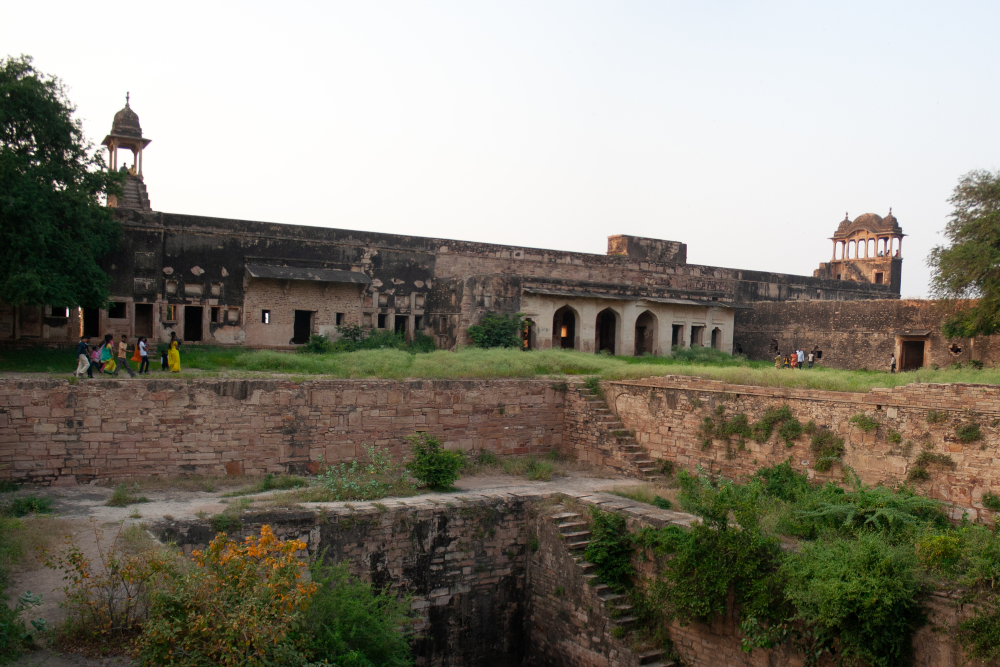
Stone-built stepwell within Gwalior Fort, part of an integrated rainwater-harvesting system, collecting monsoon runoff and storing water for daily use and siege-time resilience. (Picture Credits: Ayan Ghosh)
The Sikh History of Gwalior Fort
The most famous story of Gwalior Fort is associated with the Sikh celebration of Diwali as Bandi Chhor Divas (Day of Releasing Prisoners), commemorating the end of the internment of Guru Hargobind Singh, the sixth guru of the Sikh faith. The circumstances leading to his incarceration remain a matter of historical debate. What is evident, however, is that Guru Hargobind had, by this time, begun to articulate a more assertive conception of Sikh authority — combining spiritual leadership with temporal power such as holding his own court, bearing arms, and potentially unpaid fines. He was consolidating military power before imprisonment, organising the armed forces of the Akal Sena. The Akal Takht, a fortress outside Harminder Sahib in Amritsar, was constructed on his orders too. These actions were received poorly by the Mughals, who likely saw this as a threat to their own powers. Historically, the execution of Guru Arjan Dev — a consequence of his support for a rebellion against Jahangir (r. 1605-1627) — had already poisoned relations between the Sikhs and the Mughal Empire. Within this context, Guru Hargobind Singh’s activities may have caused anxiety for the court. What we know for certain is that the guru was summoned to the court to converse with the emperor: Jahagir’s memoirs tell us that he found the guru to be arrogant and had him imprisoned to teach him a lesson in humility, with no further light shed on the charges against him.
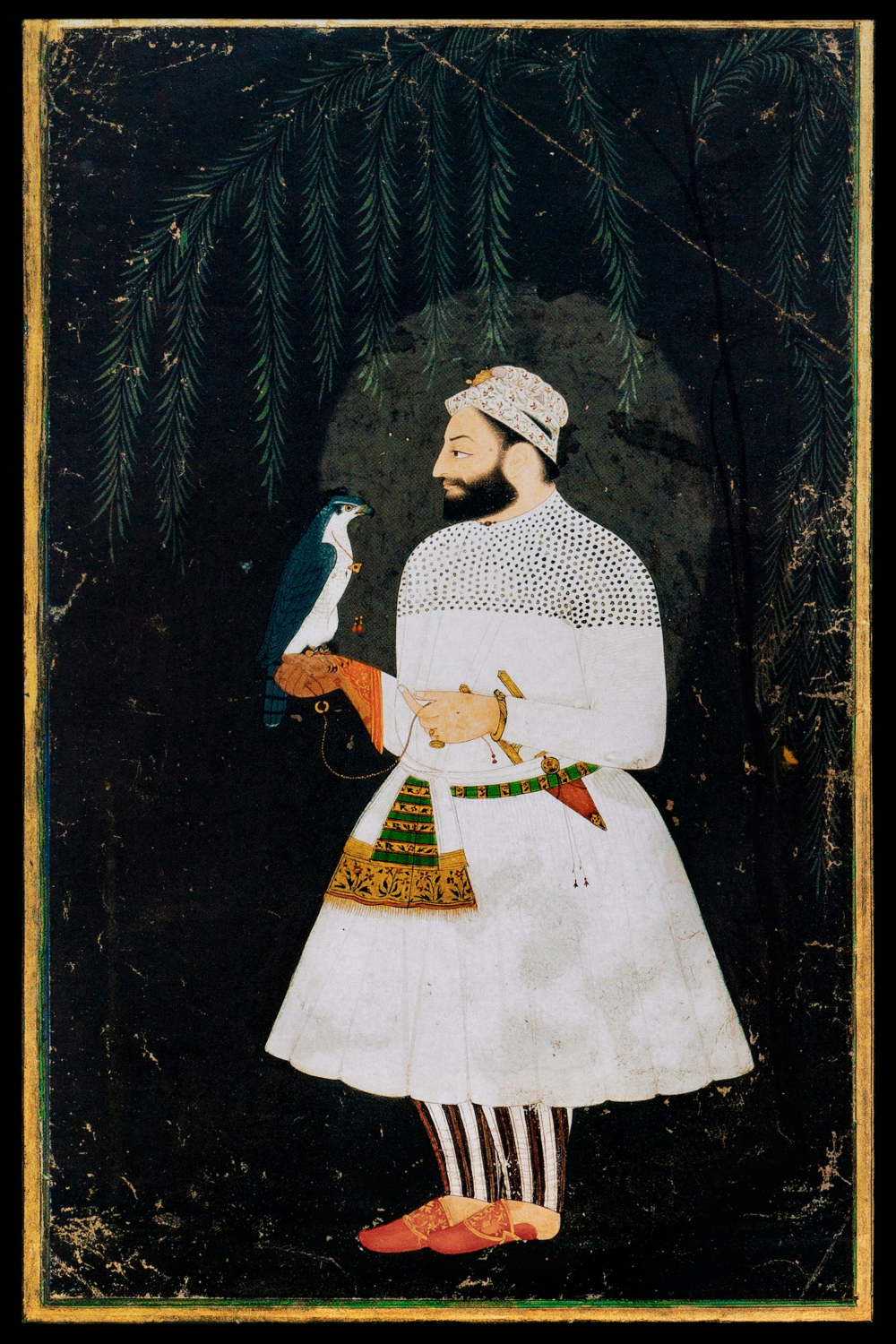
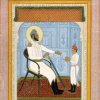
Contemporary painting of the sixth Sikh guru, Guru Hargobind Singh. (Picture Courtesy: Wikimedia Commons)
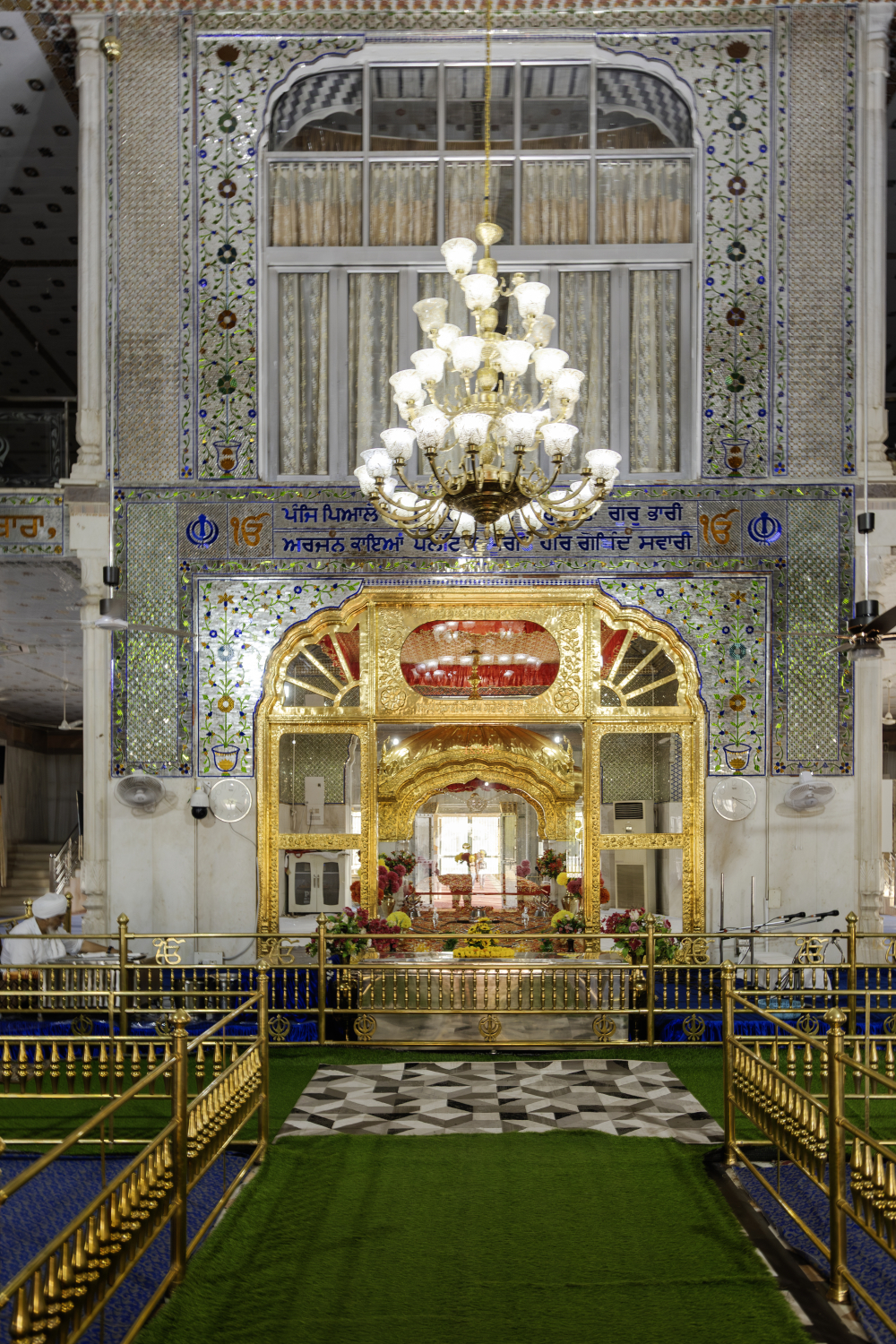
Inside of the Gurudwara Data Bandi Chhor Sahib. (Picture Credits: Pranjal Jain)
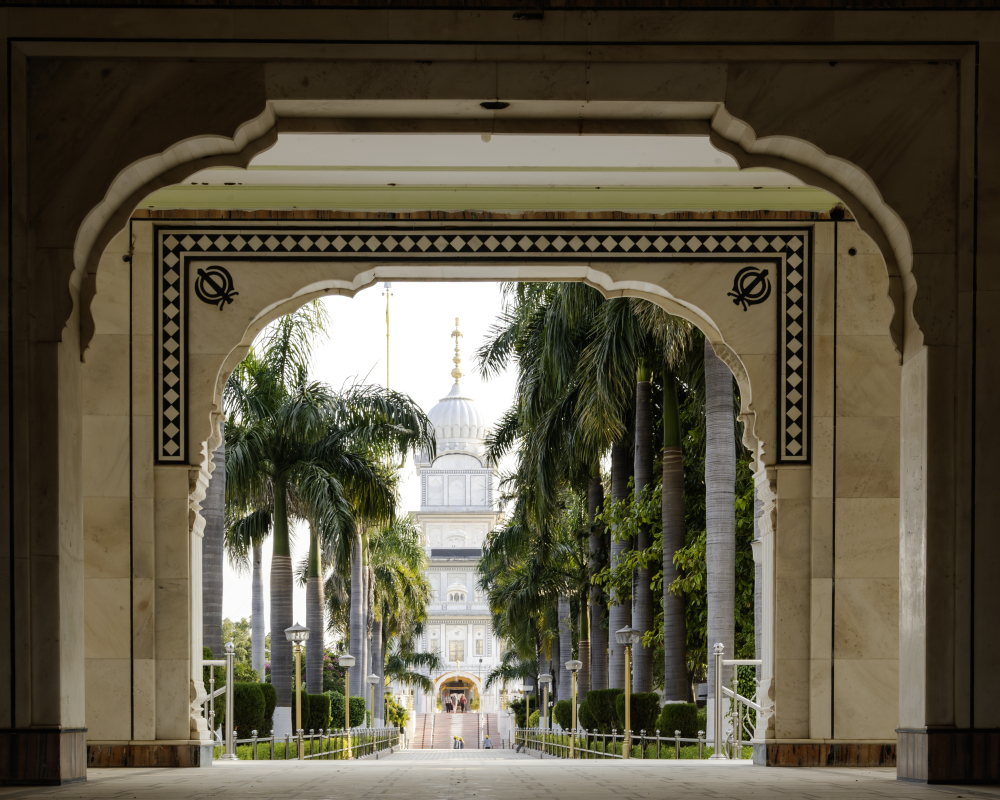
Gurudwara Data Bandi Chhor Sahib. (Picture Credits: Pranjal Jain)
Just as the reasons for Guru Hargobind Singh’s imprisonment are conjectural, so too is the duration of his incarceration. Conflicting accounts suggest a time period that could be as short as two months or as long as 12 years, although fact does declare he was released in 1620. His release was probably secured by the Sufi saint Hazrat Mian Mir, who directly intervened with the emperor. Over the years of his imprisonment, the guru’s followers paid homage to him below the fort’s walls, as we know from the Dabistan-e-Mazahib, a fascinating account of South Asia’s religions in the seventeenth-century.
The strangest part of the guru’s release, however, recounts how he also assured the release of 52 princes, who were also held in Gwalior. One particularly lively version of this arc, the favourite of guides in the fort today, goes that the guru refused to walk away unless the other prisoners were also freed. In turn, Jahangir ordered that whomsoever could touch the ends of the guru’s robes while he walked out would be released. Miraculously, the robe was long enough that all 52 imprisoned princes could hold it and gain their liberation. The guru was henceforth known as the Data Bandi Chhor (The Munificent Liberator). Today, a gurudwara built in the twentieth-century stands within the fort complex, commemorating the story of incarceration and eventual release.
Royal Prison of the Past
Gwalior Fort was the prison of choice for a number of high-status individuals during the Mughal era. This started with the imprisonment (and execution) of Akbar’s cousin Abul Qasim and continued long into Aurangzeb’s reign.
It is a little difficult to say why Gwalior Fort was chosen as a site for a high-security prison. In part, it might be the geography of the area: the fort sits on a plateau, making it next-to-impossible to escape; simultaneously, it was not too far from Agra. After the last Tomar ruler died, nobody could claim it as their ancestral home, making specific attacks on the fort unlikely. At the same time, it would have been unwise to leave the place ungarrisoned and open to unorganized use, thus meaning that turning it into a prison might have been the most practical idea.
The prisoners of Gwalior Fort were usually of some significance, ranging from rival sultans to princes of the royal family, or even religious preceptors. This was a prison for the elite and aristocrats. Of the many personalities who dared to resist the Mughal empire and wound up imprisoned in Gwalior Fort, there are records remaining only of certain religious and political figures.
Religious Leaders
Other than Guru Hargobind, another religious leader, Shaikh Ahmed Sirhindi, also found himself jailed in Gwalior. If Guru Hargobind and the empire had disapproving views of each other, Sirhindi was an outright opponent of Akbar’s policies, even calling him the “enemy of Islam.” Sirhindi denounced Shi’ism, Hinduism, and any other faith that did not subscribe to his version of Sunni Islam in a series of letters made public in 1617 and 1619. When Jahangir ordered his arrest in 1619, the charge brought against him was, ironically, of infidelity and hearsay. A legend around this scene recounts Sirhindi’s refusal to perform the sijda, a court prostration, and thereby defying Jahangir. This story, however, is likely the material of fantasy, created to portray Sirhindi as a devout Sunni. Yet Jahangir’s punishment did add insult to injury, Sirhindi was believed to be handed over to a Hindu Rajput custodian, Ani Rai Singh, when he was kept in Gwalior for around a year. After his release, Sirhindi had tempered down a bit: his letters were no longer as virulent as before. The story of Sirhindi’s incarceration has generally been forgotten, hardly recounted even by the tour guides of Gwalior Fort.
The Prisoners from the Deccan
If the political motivations behind imprisoning religious leaders were murky, the reasons behind jailing rival sultans were obvious. Three distinct sultans of the Ahmednagar Sultanate, based in the Deccan, were kept in Gwalior Fort.
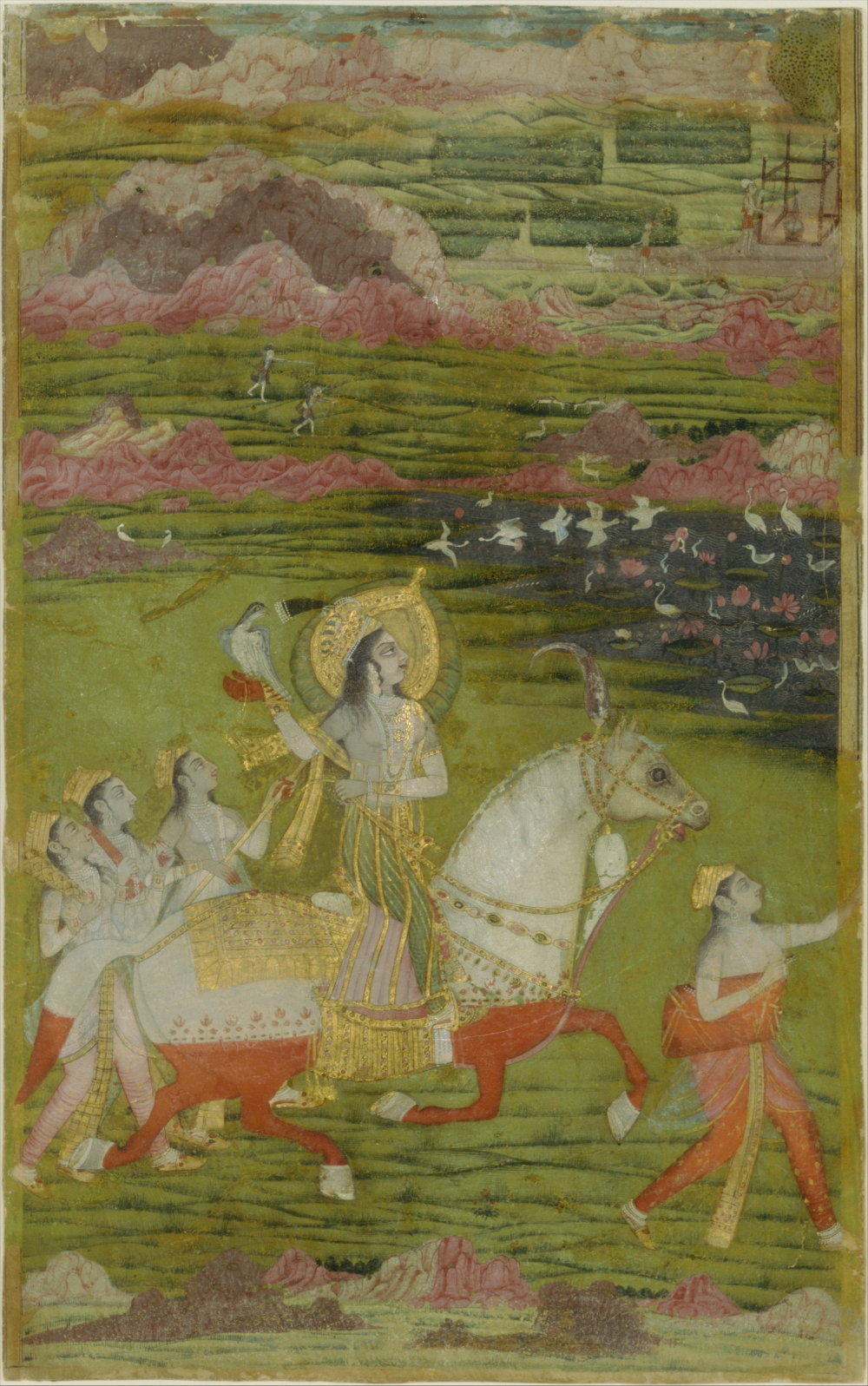
Chand Bibi hawking with attendants in a landscape. (Picture Courtesy: The Metropolitan Museum of Art)
First among them was Bahadur Nizam Shah, the infant ruler. His great-aunt Chand Bibi was the informal leader of the sultanate, frustrating Akbar’s attempts to conquer the Deccan. By the late 1590s, she had allied with other local sultanates to thwart the Mughals. However, by the very end of the sixteenth-century, Mughal forces had attacked Ahmednagar, with one of Akbar’s sons leading the charge. Although Chand Bibi appears to have been inclined towards negotiating a settlement, she was assassinated by factions within her own nobility. In the aftermath, the Mughals ransacked the fort and took the young sultan away, promptly holding him in the fort of Gwalior. What happened to Bahadur Nizam Shah then is unknown, but the absence of any voice or trace points towards his eventual death in Gwalior.
The Nizam Shahs managed to persist even after the fall of their capital and the ruler. Malik Amber, the Ethiopian Prime Minister and de-facto ruler of the Nizam Shahi sultanate, proved a challenge for Akbar’s successor, Jahangir. Amber’s son, Fath Khan eventually placed Hussain Nizam Shah on the throne who was a distant relative of Bahadur. But a fresh wave of attacks under Shah Jahan undid decades of stiff resistance by Ahmednagar, and in 1633, this new Sultan was also sent away to Gwalior as another Nizam Shahi prisoner.
The last Nizam Shah, Murtaza, was backed by a powerful landed elite called Shahaji Bhonsle (the father of Shivaji). After Amber’s death, the empire chipped away all that remained of the Ahmednagar Sultanate. Shahaji folded under pressure from the invading armies and gave up Murtaza Nizam Shah in the end. This marked the end of Ahmednagar Sultanate, with the imprisonment of its last sultan in Gwalior Fort.
The Princes of the Empire
A number of Mughal princes were among the prisoners in Gwalior Fort. In fact, one of the first high-status prisoners in the fort was Akbar’s cousin, Abul Qasim, who was confined during early struggles for succession within their family. During Aurangzeb’s reign, several princes began to be incarcerated in Gwalior. As Shah Jahan fell ill, and a brutal war of succession began between his four sons, Aurangzeb found himself allied with his younger brother Murad Baksh, the then-governor of Gujarat. This alliance was pivotal in jointly defeating their main foe and elder brother, Dara Shukoh. But brothers could not remain allies for long in a war of succession: soon after, Murad was drugged and imprisoned in Gwalior, where he was also executed. Interestingly, he is buried in the ‘Traitor’s Cemetery’ inside the fort’s complex, though the exact location inside the fort is unclear.
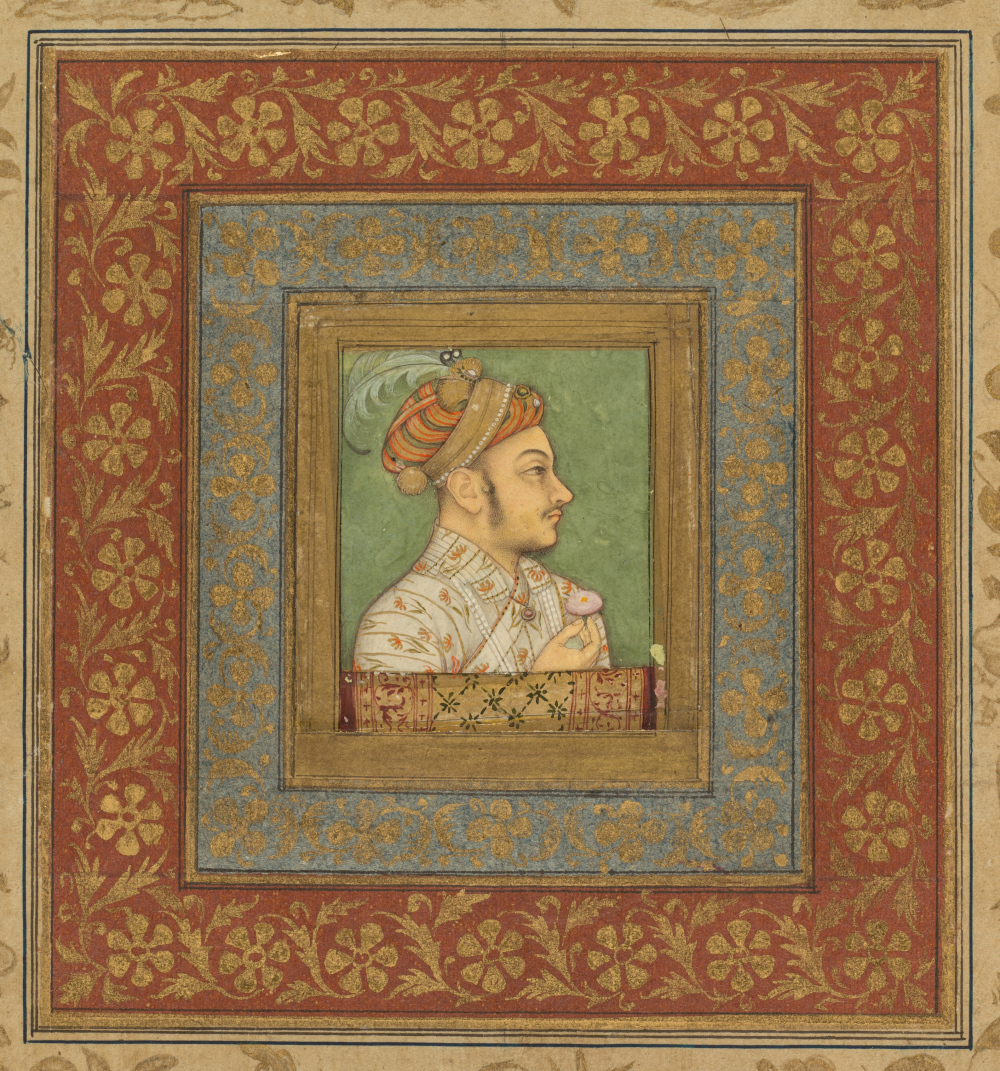
Portrait of Murad Bakhsh. (Picture Courtesy: The Cleveland Museum of Art)
Another Mughal prince buried in that very cemetery was Aurangzeb’s nephew and Dara’s elder son, Sulaiman Shukoh. After his father’s losses on the battlefield, Sulaiman fled and found refuge in the kingdom of Garhwal, which refused to hand him back. Rajput ruler Jai Singh was entrusted with the task of bringing Sulaiman back and successfully achieved the task by working covertly with rebels in Garhwal. Eventually, Sulaiman was brought to Gwalior and executed in the fort. His younger brother, Siphir Shukoh, was also incarcerated in Gwalior, but managed to survive. Even Aurangzeb’s son, Muhammad Sultan, did not escape imprisonment, although he too is rumoured to have survived. A portrait of Muhammad Sultan in an unadorned robe still survives: probably painted in the fort itself, it shows us a rare glimpse of how prison life must have fared for the royal princes.
Besides such fleeting details, there is little to no information remaining of the stories from inside the fort.
Ghosts of the Fort
Given its long history as a prison, and one around which several legends accumulate, Gwalior Fort continues to generate stories and myths today. Like many forts in the country, it is often spoken of as haunted. Executions did take place in Gwalior Fort and several prisoners are rumoured to have died there. Today, the residents of the city believe that certain chambers of the place were once the execution chambers for its prisoners — and around these rise small legends of ghosts, of the executed who are said to still reside in the fort. Murad Baksh, for one, was spoken about as though he still roams the ramparts.
These stories point towards a common cultural memory that retains an impression of how the fort was used by the Mughal Empire. Equally, they also show how the politics of high-brow individuals, and the violence that comes with it, continue to touch and inflect the lives of the masses that witnessed it.
Bibliography
Chanda, Avik. Dara Shukoh: the man who would be king. HarperCollins, 2019.
Eaton, Richard. India in the Persianate Age, 1000-1765. Penguin, 2019.
Francesca Galloway, "Bust portrait of a prince, probably Muhammad Sultan, the son of Aurangzeb," YouTube video, 1:33, February 24, 2022.
https://www.youtube.com/watch?v=dzW-IpBLd-o
Gandhi, Supriya. The emperor who never was: Dara Shukoh in Mughal India. Harvard University Press, 2020.
Gupta, Hari Ram. History of the Sikhs. Munshiram Manoharlal Publishers Pvt Ltd, 1939.
Gurdwara data bandi chor sahib. (n.d.). SikhiWiki, Free Sikh Encyclopedia. https://www.sikhiwiki.org/index.php/Gurdwara_Data_Bandi_Chor_Sahib
Habib, Irfan M. “The Political Role of Shaikh Ahmad Sirhindi and Shah Waliullah.” Proceedings of the Indian History Congress 23 (1960): 209–23. http://www.jstor.org/stable/44304065.
Joshi, Neelima. “Beyond a Penal Practice: Incarceration Under the Mughal State (1556-1707).” Proceedings of the Indian History Congress 80 (2019): 388–95. https://www.jstor.org/stable/27192892.
Pillai, Manu S. Rebel sultans: The Deccan from Khilji to Shivaji. Juggernaut Books, 2018.
Sarkar, Jadunath. A short history of Aurangzib, 1618-1707. MC Sarkar and Sons, 1930.
Annemarie, Schimmel. The empire of the Great Mughals: History, art and culture. Reaktion Book, 2006.
Sharma, Parvati. Jahangir: An intimate portrait of a great Mughal. Juggernaut Publication, 2018.
Syan, Hardip Singh. Sikh militancy in the seventeenth century: Religious violence in Mughal and early modern India. Bloomsbury, 2013.
Thornton, E. (1862). A Gazetteer of the territories under the government of the East-India Company, and of the native states on the continent of India.
Truschke, A. Aurangzeb: The man and the myth. Penguin Viking, 2018.
This essay has been created as part of Sahapedia's My City My Heritage project, supported by the InterGlobe Foundation (IGF).