
When we turn to the history of a city such as Gwalior, narratives tend to coalesce around its monumental architecture — its fort, palaces, and temples — structures that articulate the authority and aspirations of ruling elites. This emphasis produces what may be described as a vertical historiography, one that privileges elevation, visibility, and power. Far less visible, and consequently less documented, are the built environments of its citizens. Yet beneath this monumental skyline lies a more expansive, horizontal history: a vernacular architecture that shaped the lived experience of the city.
These domestic and commercial structures were not incidental. They were consciously designed, responding to climate, economy, and social life. In older commercial neighbourhoods such as Lashkar, the built fabric still reveals a careful negotiation between private and public space — one that continues to structure everyday urban life.
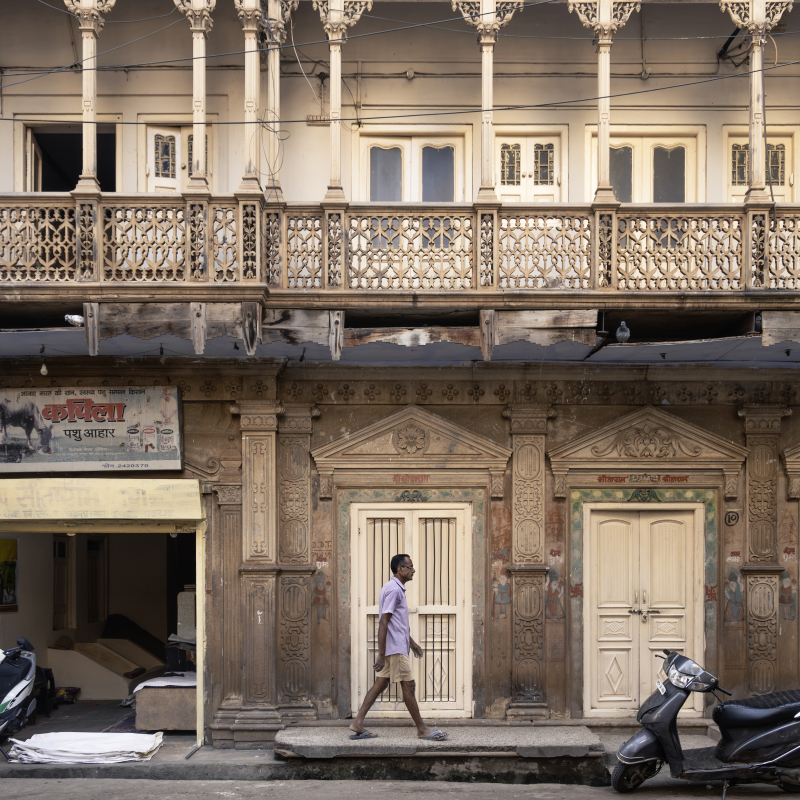
Archival photographs from 1913 offer an important point of reference. They show upper storeys projecting into the street through stone railings and shaded by chiks (bamboo blinds), while the ground level accommodates temporary or semi-permanent shopfronts. These features were not merely aesthetic; they mediated heat, visibility, and commerce. While the materials and surfaces have evolved — fabric awnings replaced by synthetic printed signage, façades layered with electrical wiring — the underlying spatial logic remains remarkably consistent. The contemporary street, in this sense, retains the imprint of early twentieth-century urbanism.
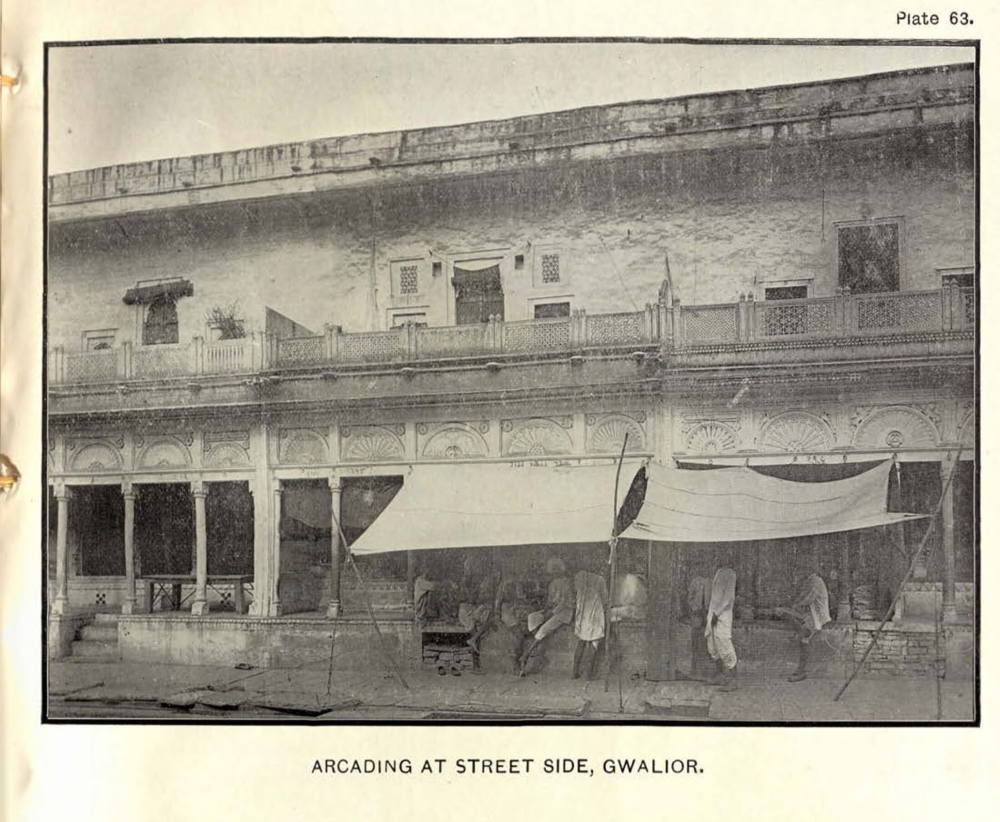
Arcading at the street side, Gwalior. (Picture Courtesy: Wikimedia Commons)
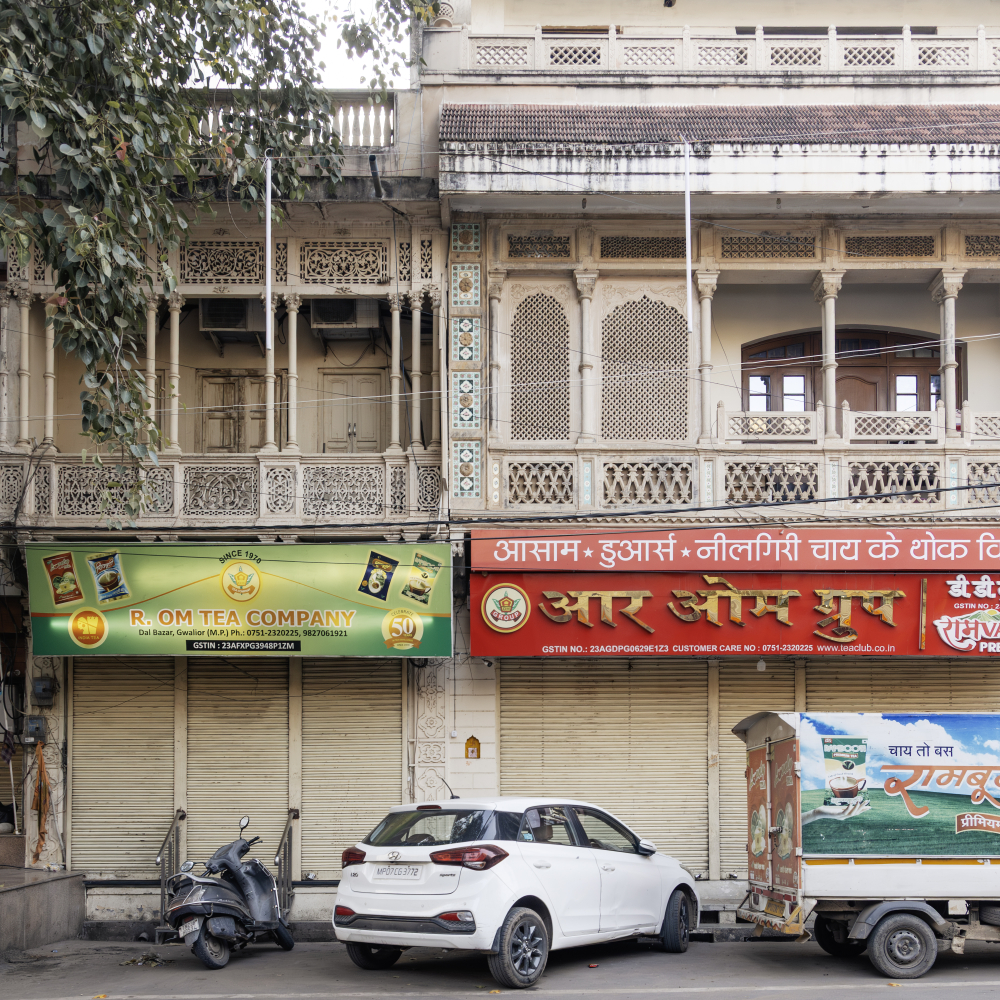
Old houses in Dal Bazar, Gwalior. (Picture Credits: Pranjal Jain)
Colour emerges as another important register of this architectural culture. The richly painted interiors of Jain temples in Lashkar and Dal Bazar, supported by mercantile patronage, suggest a broader aesthetic sensibility that extended into domestic space. Painted wooden balconies, glazed tiles, and coloured window frames introduced vibrancy into the otherwise muted palette of sandstone. Such chromatic choices may also be read as expressions of a mercantile identity, asserting presence and prosperity within the dense commercial fabric of the city.
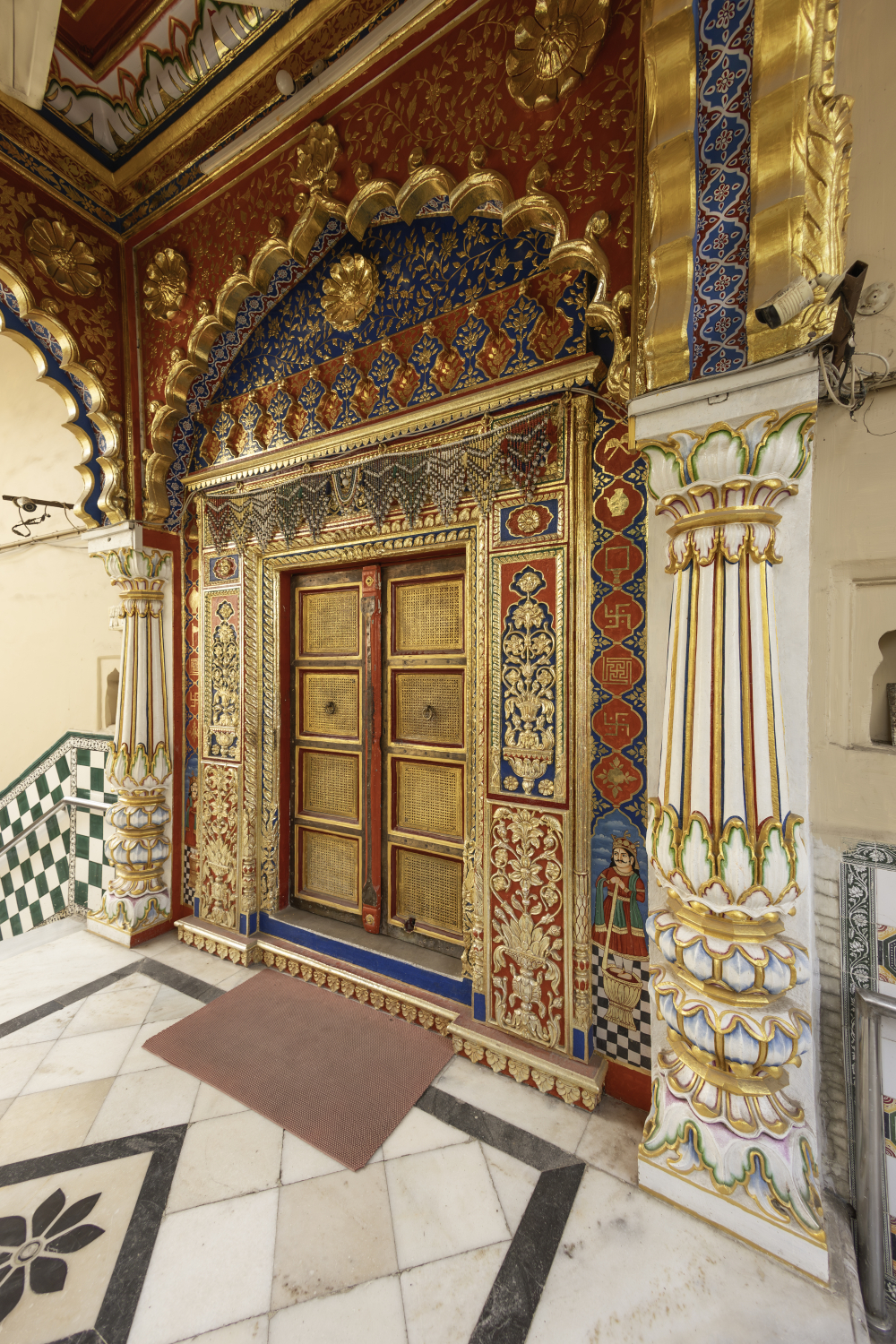
Interiors of a Jain Temple. (Picture Credits: Pranjal Jain)
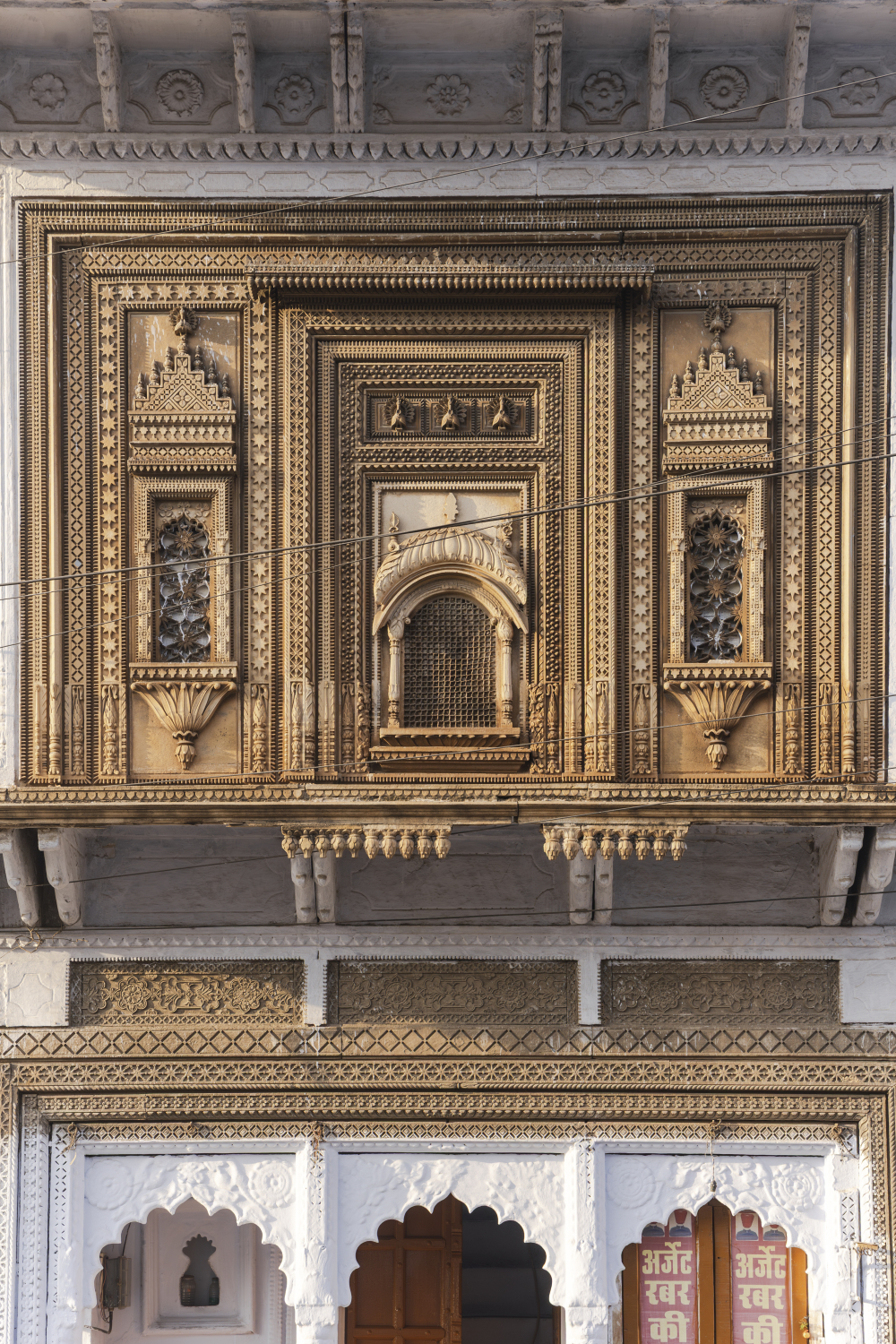
Details of a Maratha-like facade near Oont Pul. (Picture Credits: Pranjal Jain)
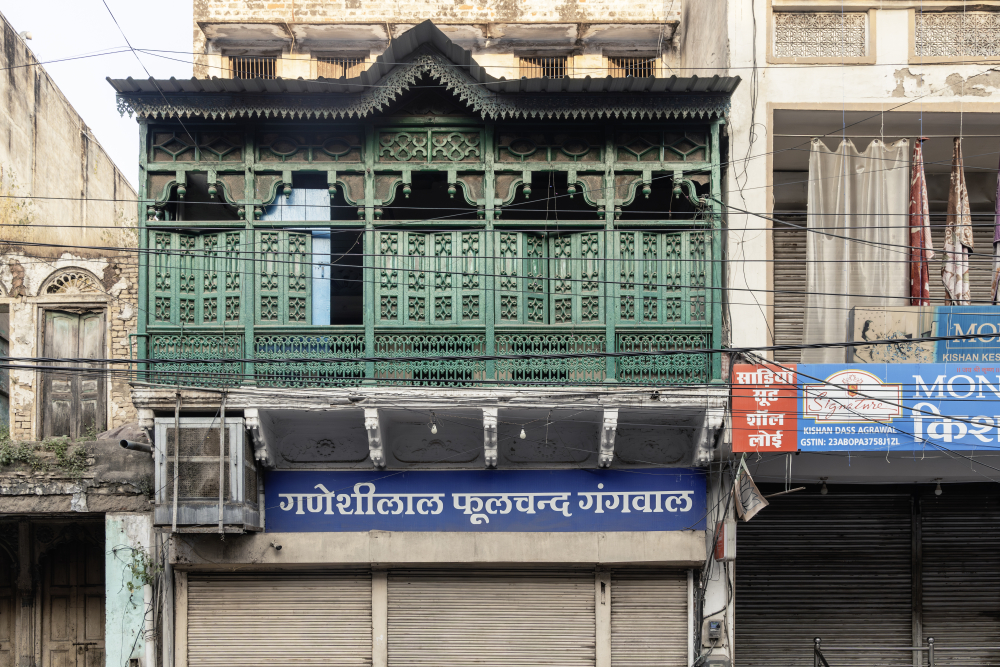
Green exterior of a house. (Picture Credits: Pranjal Jain)
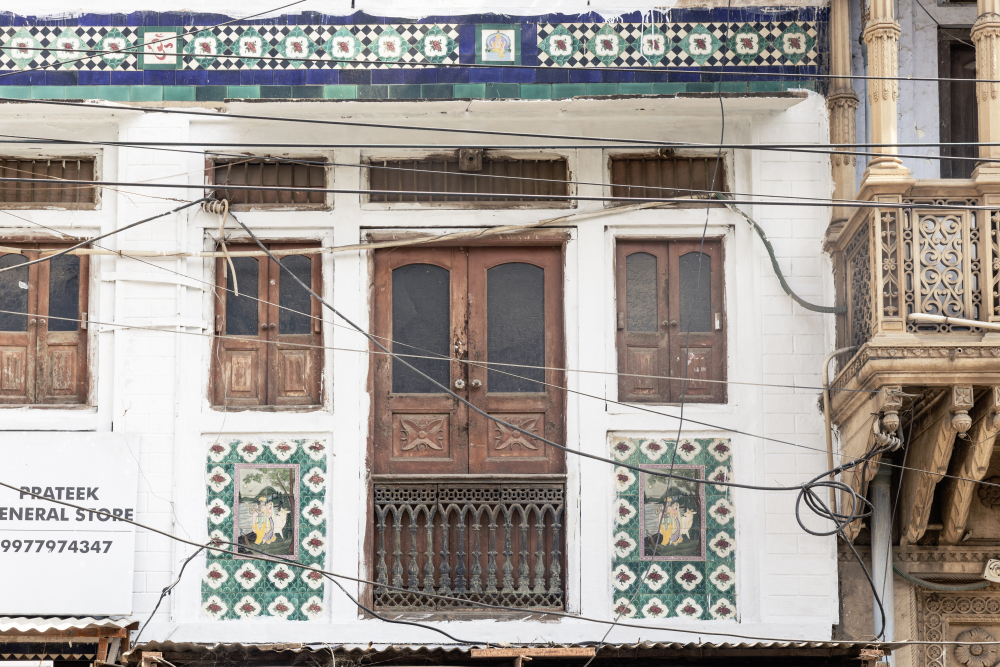
Floral tilework on a wall. (Picture Credits: Pranjal Jain)
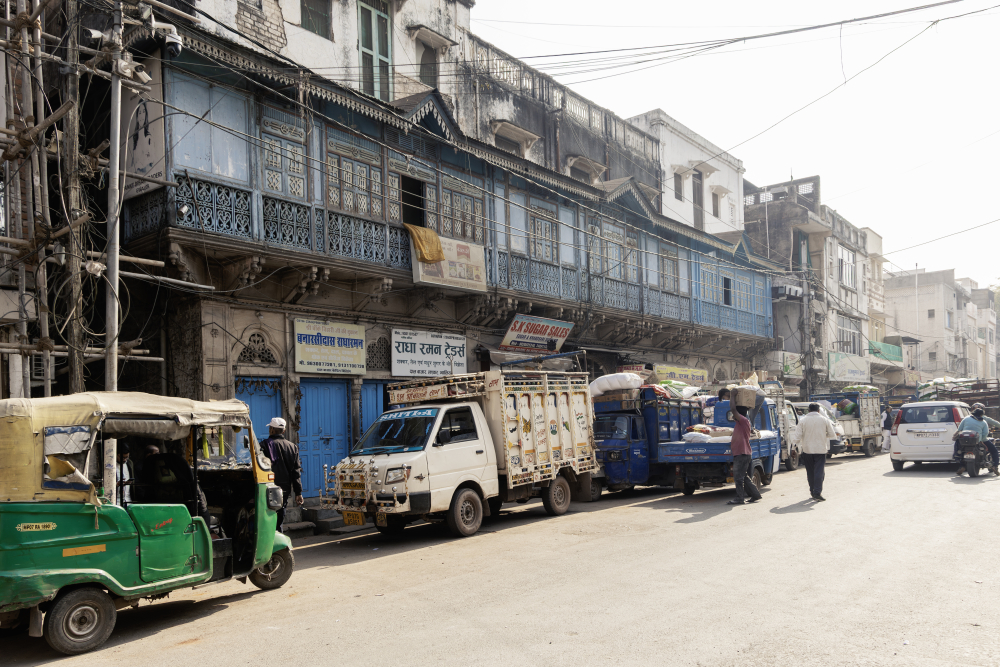
Blue coloured first floor of a house in Dal Bazar. (Picture Credits: Pranjal Jain)
Gwalior’s domestic architecture also reflects its position as a site of cultural and economic exchange. Under the Scindias, and through sustained mercantile activity, the city absorbed multiple stylistic influences. Elements associated with emerging Art Deco vocabularies: geometric railings, stylised floral motifs, and sunburst patterns, appear alongside older features such as jharokhas (projecting enclosed balcony or window) and jalis (latticed screen), which regulated light, air, and privacy. Similarly, Neo-Classical motifs such as columns, pediments, and symmetrical compositions were selectively incorporated, often translated into local materials such as sandstone rather than executed in their original forms.
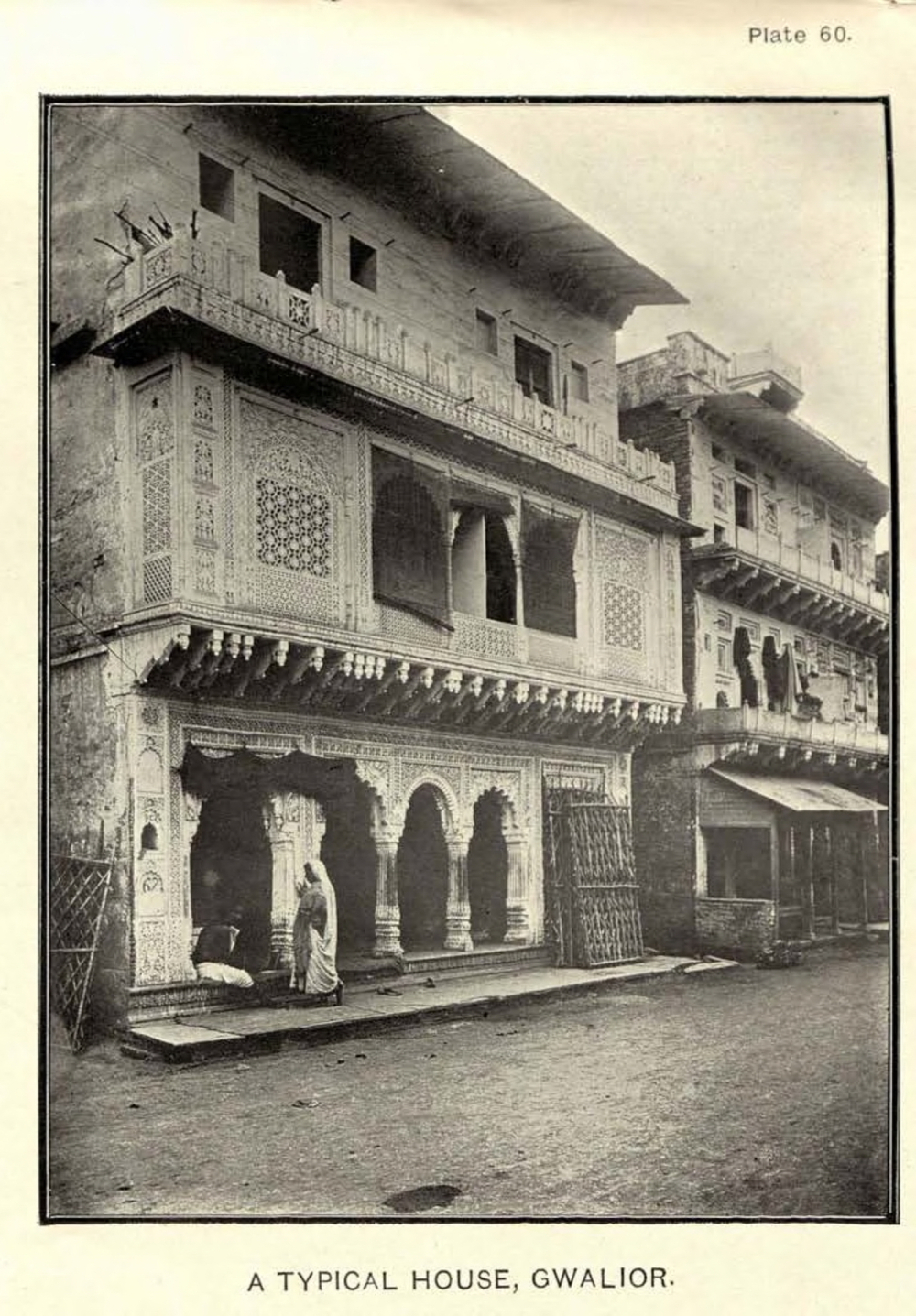
A typical house, Gwalior. (Picture Courtesy: Wikimedia Commons)
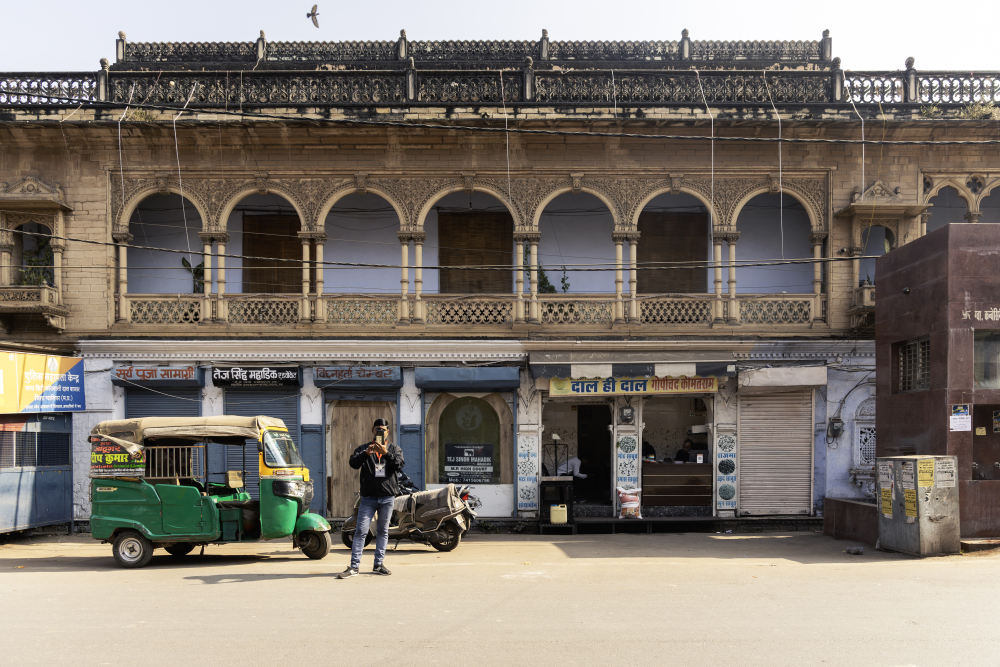
A house in Dal Bazar with Greek elements. (Picture Credits: Pranjal Jain)
In areas such as Morar, this process of adaptation is further complicated by the presence of colonial institutions. The proximity of structures such as Christ Church, MGM School and neighbouring structures form a layered architectural landscape, where European forms intersect with regional building practices. Smaller structures, such as local banks or commercial buildings, often reinterpret these influences at a more modest scale, resulting in hybrid forms that are neither purely colonial nor entirely vernacular. The same vicinity has the District Bank building which flaunts a motley of colours and railings. The street features recessed balconies and floral motifs rendered not in the reinforced concrete of Mumbai, but in regional sandstone. This stands in stark ideological contrast to the State Bank of India (SBI) building at Maharaj Bada. The latter, a monolithic modernist structure, utilises architecture as an instrument of state authority, whereas the District Bank’s motley colours and idiosyncratic railings represent a more personal, democratic interpretation of modernity.
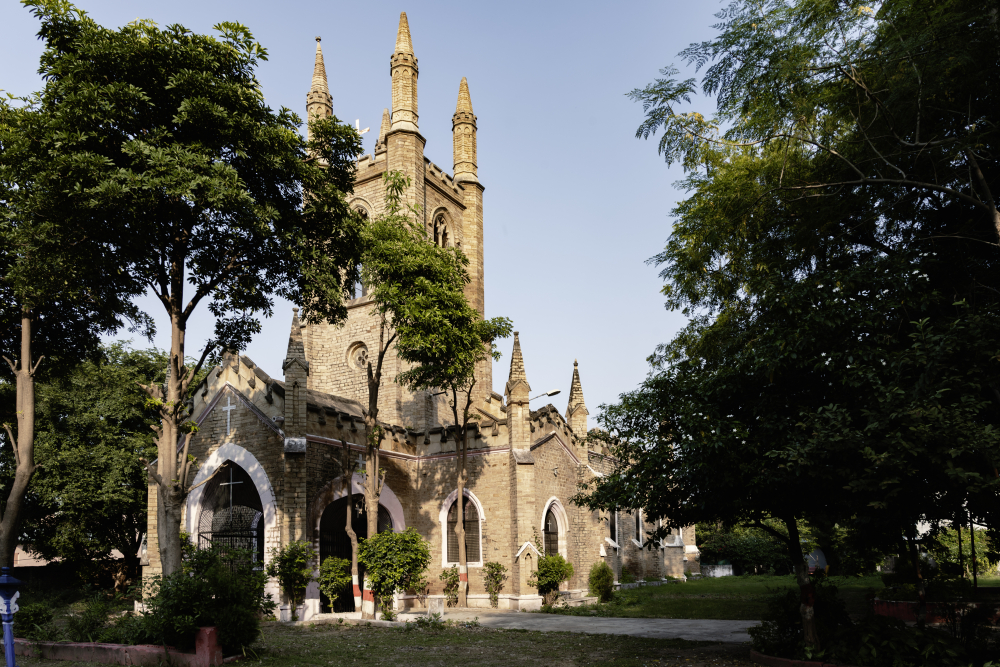
Christ Church, Morar. (Picture Credits: Pranjal Jain)
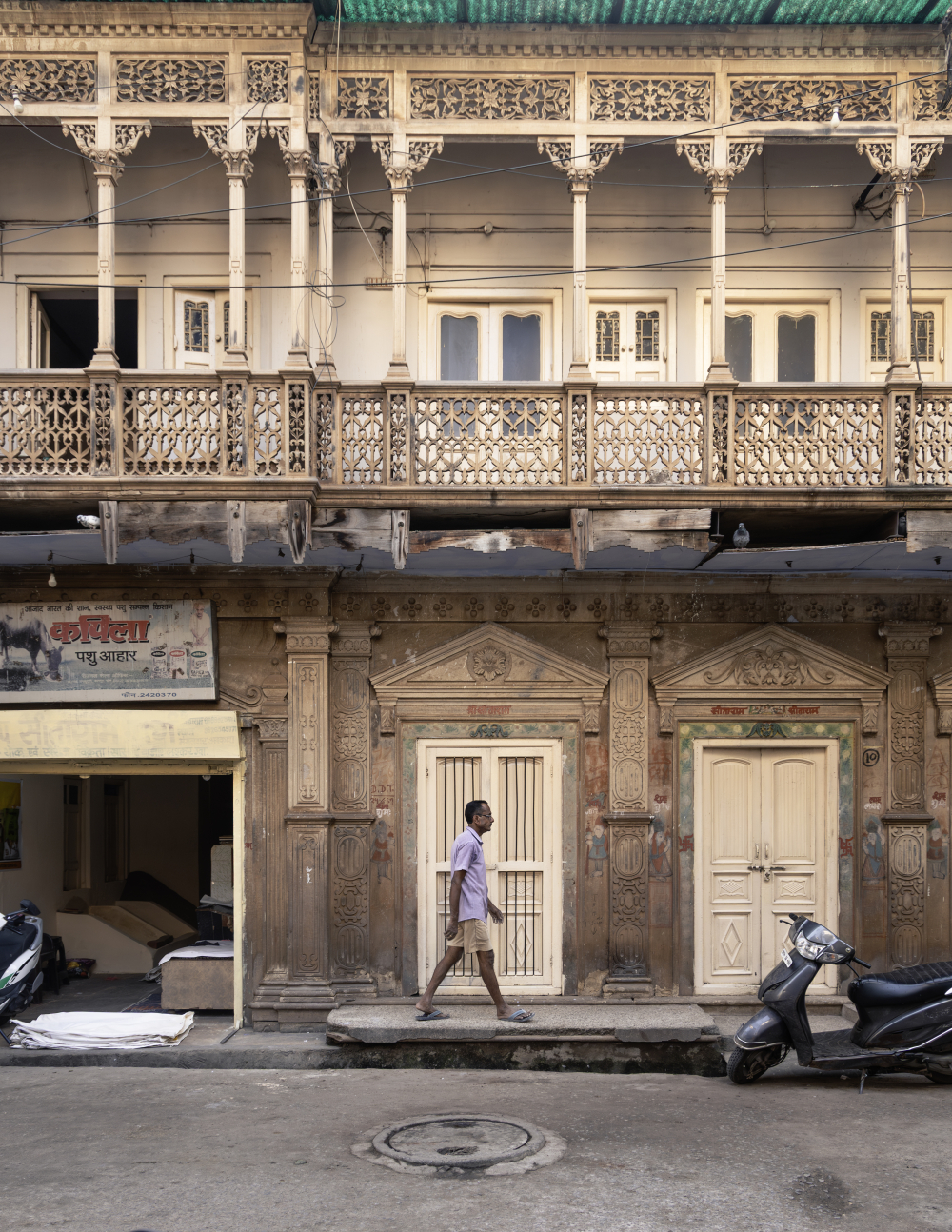
An old house with triangle-pediments, colonnades and a shop. (Picture Credits: Pranjal Jain)
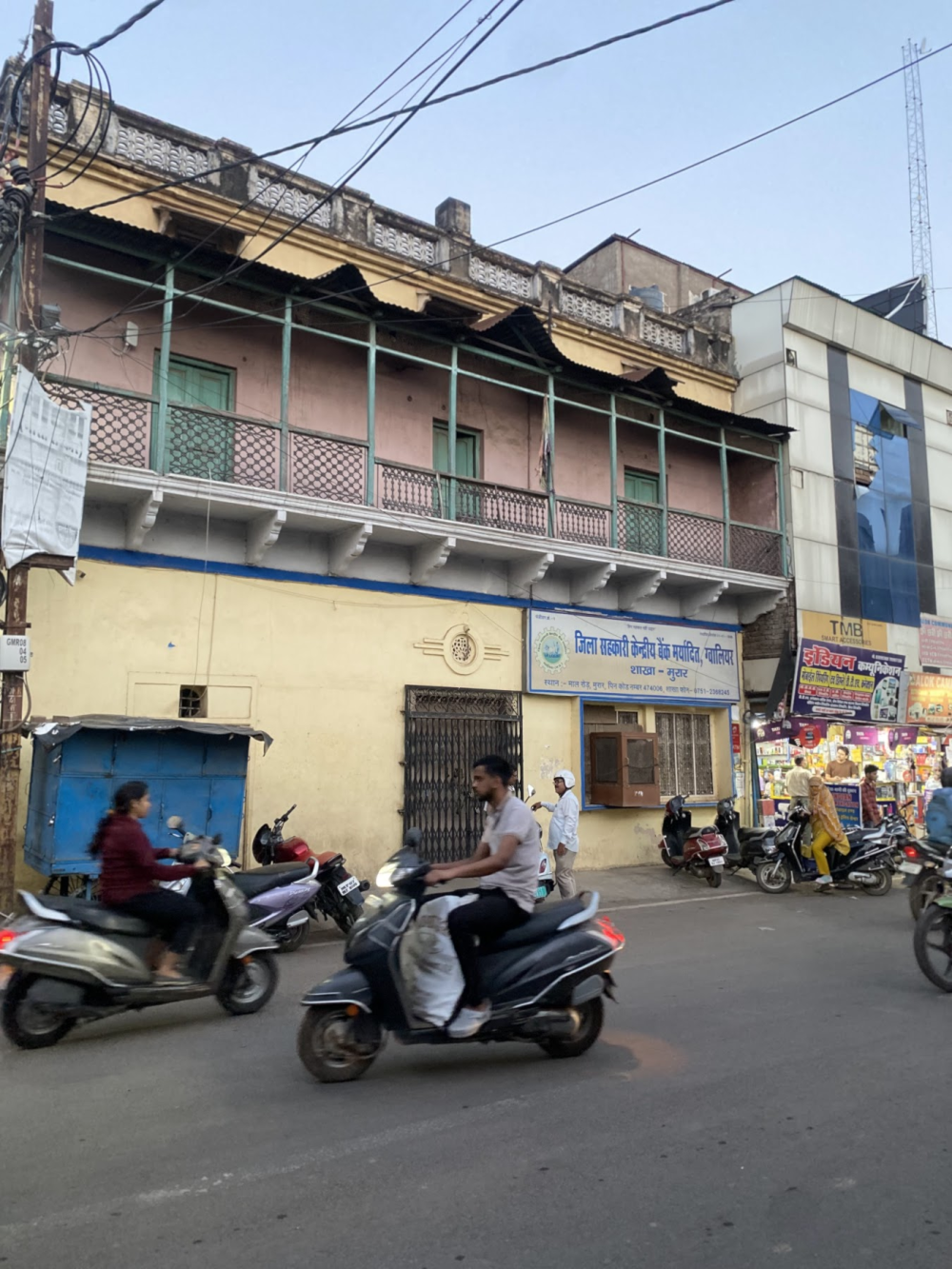
District Bank building. (Picture Credits: Sarthak Sharma)
Beyond broader stylistic tendencies, domestic architecture in Gwalior also functioned as a medium of personal and social expression. House façades frequently incorporated names, symbols, and imagery, effectively transforming architecture into a form of inscription. Residences such as Shiv Bhawan, where the name is integrated into the railing design, or houses that embed the owner’s identity within decorative programmes, suggest that the built form was also a site of self-representation. The waves on the top, and the vertical lines surrounding it are art-deco influences to a very Indianised design. Ramswarup from Mathura, made sure that his house carries his name forever: it is tucked within the railings, in between a couple of lions, flanked by grape vines. Other home-owners were more eclectic in their style, using tiles to create arabesque patterns. These tastes are European and Indian, even if the owner moved only from Mathura to Gwalior. This home from 1965 does exactly that and also carries a sculpture of Krishna in the centre of the pediment. Other homes might make a political statement: Gandhi and the British Queen both feature in the railings of different buildings. The presence of figures points to a society negotiating overlapping identities in a period of transition. Architecture, in this sense, becomes a record not only of aesthetic preference but also of ideological positioning.
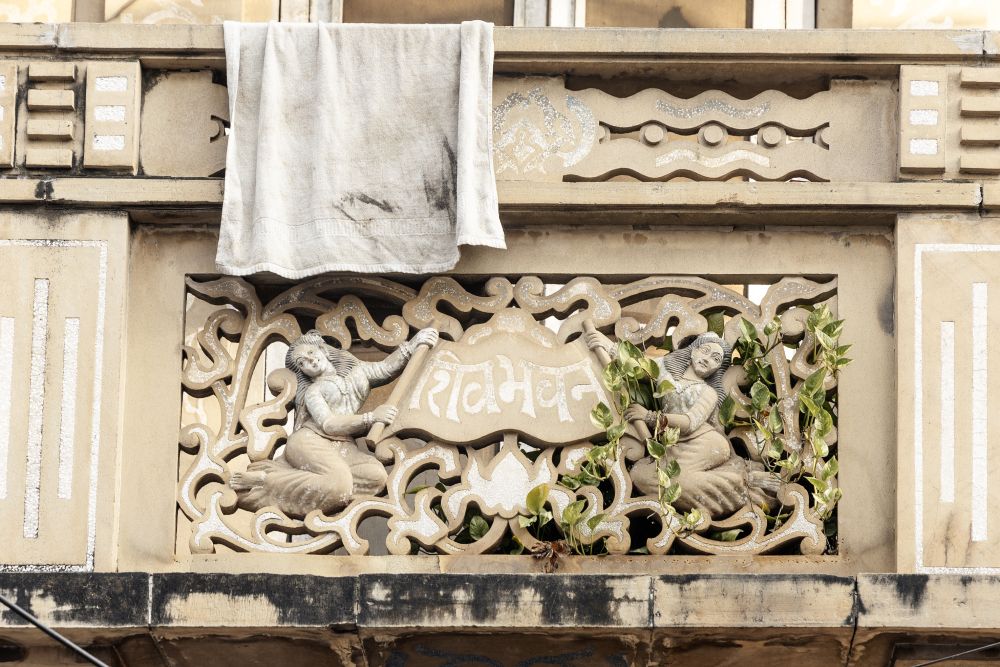
Jali reading Shiv Bhawan. (Picture Credits: Pranjal Jain)
It is important, however, to situate these structures within their social context. The houses described here largely belong to merchant and trading communities concentrated in commercial areas. They do not represent the entirety of Gwalior’s urban population, but they do offer insight into how wealth, mobility, and patronage shaped the city’s visible fabric.
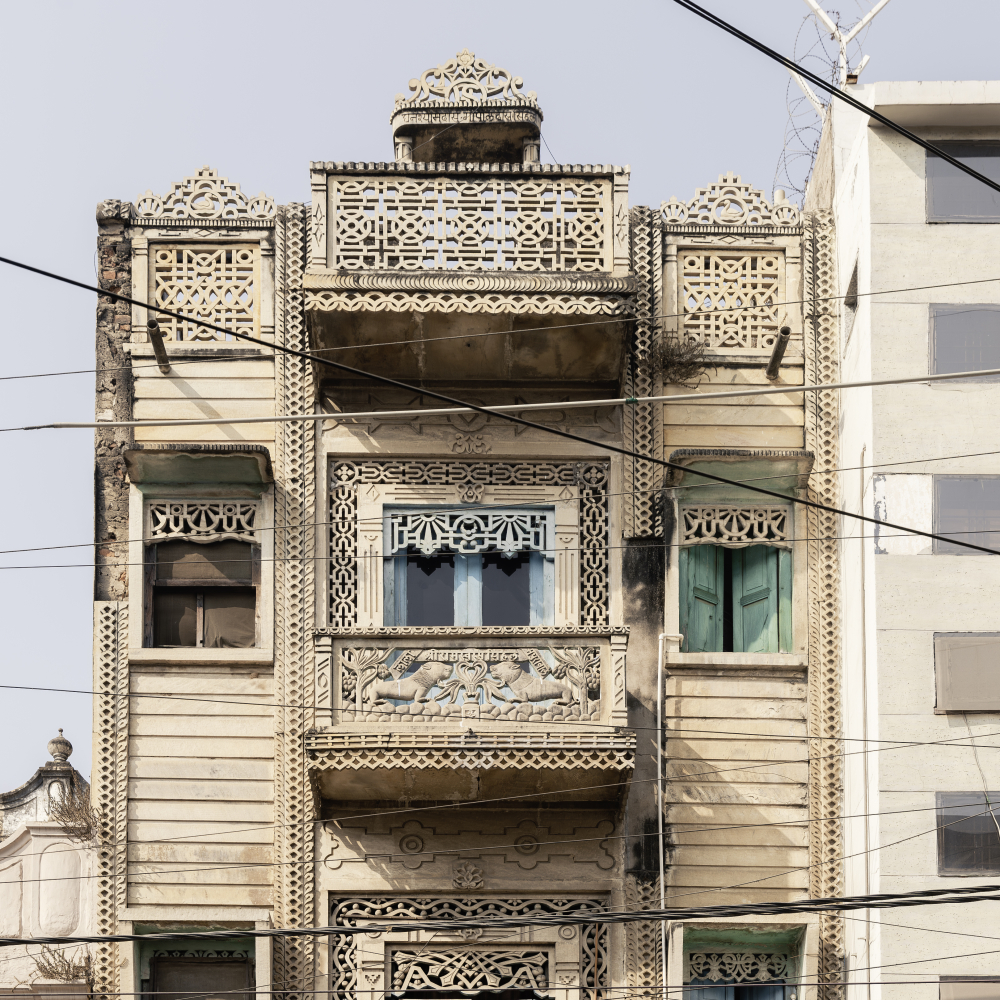
An old home with the owner’s name in balcony railing. (Picture Credits: Pranjal Jain)
In the present, these structures face increasing pressure. The demands of contemporary urban life — commercial expansion, vehicular movement, and modern infrastructure — have altered their original form and function. Ground floors have been adapted for retail, often at the cost of architectural integrity, while upper storeys, difficult to retrofit for modern use, are frequently abandoned. Features once integral to their design such as narrow balconies, wooden windows, and dense street engagement, now sit uneasily alongside air-conditioning units, electrical networks, and the spatial demands of a contemporary city.
Yet these buildings continue to define the character of Gwalior’s historic markets. Even in altered states, they retain traces of earlier ways of inhabiting the city. To read them closely is to recognise that Gwalior’s architectural history is not confined to its monuments. It resides equally in these quieter, everyday structures — forms that, though often overlooked, offer a more intimate understanding of how the city was lived, adapted, and imagined over time.
This essay has been created as part of Sahapedia's My City My Heritage project, supported by the InterGlobe Foundation (IGF).