
In most books on the history of Hindi Sahitya (literature), Vishnudas and his compositions are given negligible space. Similarly, underdiscussed is the language he employed for writing his epic stories: the word ‘Gvaliyari’ appears infrequently. George Abraham Grierson, in many volumes of Linguistic Surveys, does not reference it once. In recent research, Vishnudas has been termed the first Hindi poet of the fifteenth-century, suggesting that ‘Hindi’ has now replaced Gvaliyari. However, some scholars have attempted to recover Gvaliyari as the language of Vishnudas and his texts — and to understand how Gvaliyari became identical with Hindi and Brajbhasha by the eighteenth-century.
The Growth and Disappearance of Gvaliyari
Literary languages are the recorded languages, even as several others were spoken and used. During the ninth and thirteenth-century, Sanskrit theorists like Bhamah recognised only Sanskrit, Prakrit, and Apabransha as the literary languages. The local languages slowly crept into literary texts and influenced the formation of a language. Sheldon Pollock (2006) discusses how a dialect became a textual and literary language through various processes: religious, political, social and cultural.
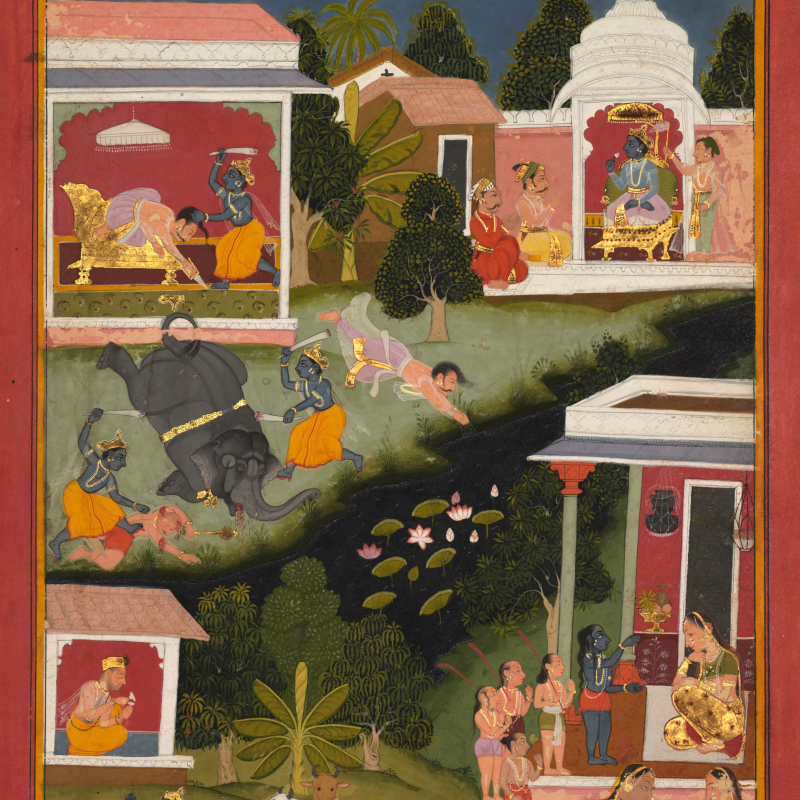
Religion played a primary role in the transformation of a vernacular language into a literary one. Brajbhasha, for instance, evolved due to its rhythmic suitability for Krishna bhakti (devotion): Surdas composed emotional-devotional poetry in it. Braj as a language of poetry was thus recognised in the sixteenth-century, though it became associated with Vaishnavism during 1486-1534 CE.
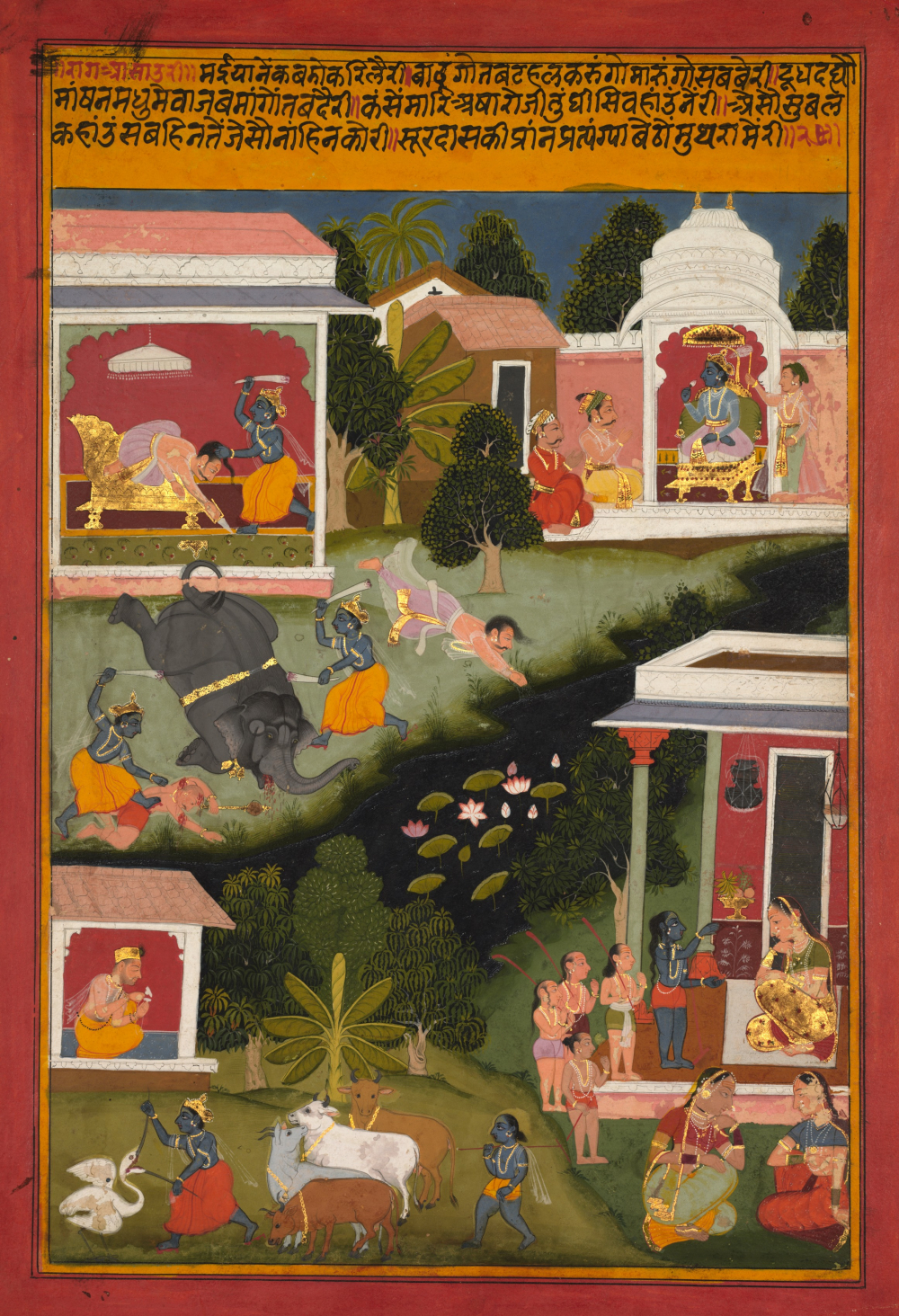
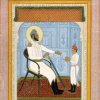
Krishna asks for sweets, an episode from 'Sursagar'' of Surdas. (Picture Courtesy: The Cleveland Museum of Art)
Another primary force for the transformation of a local language were the rulers. Kings, in order to legitimise their newly acquired kingships, desired to demonstrate their knowledge of Indian culture through transmuting and disseminating Sanskrit epics in a language understood by the masses. Kings would patronise poets, who implicitly or explicitly projected their patrons as embodiments of the attributes that the ideal kinds in epics possessed. In this fashion, the subject population would grow to regard the king as a legitimate ruler. Simultaneously, a vernacular or local dialect used to spread these adapted epics would become a literary language. Among the regional powers, the Tomars of Gwalior promoted the local language in Gwalior and it came to be known as Gvaliyari. Vishnudas would contribute to this project through his rewriting of the epics Mahabharata and Ramayana in Gvaliyari. The credit of being the first to promote Gvaliyari might thus be given to the Tomars and then Vishnudas, part of a pan-Indic phenomenon via which several local dialects were being transformed into literary languages.
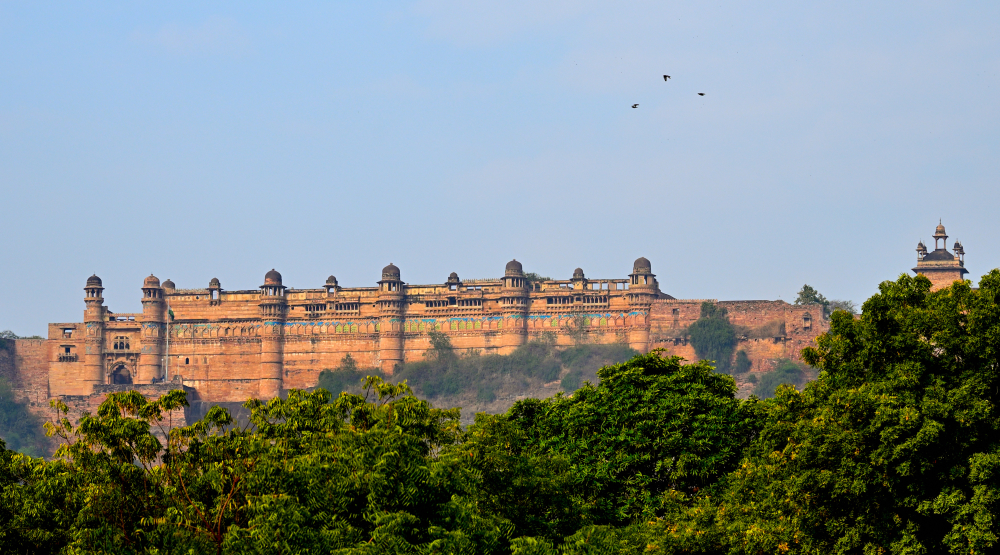
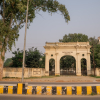
Mansingh Tomar’s palace walls. (Picture Courtesy: Sharvarism/Wikimedia Commons)
How then did the emerging language of Gvaliyari vanish into Brajbhasha or Hindi? Shiv Prasad Singh’s (1958) extensive research on the history of Brajbhasha before Surdas, based on a critical analysis of many scholars both Indian and European, finds that the language spoken in Braj Mandal, which included Gwalior, Bharatpur (Rajasthan), and Bundelkhand (Uttar and Madhya Pradesh) during the tenth to fourteenth-centuries, was called Brajbhasha. In the Linguistic Survey of India, Volume IX, George Grierson concluded that Brajbhasha assumed many forms in different regions, though he does not refer once to Gvaliyari while enumerating around 390 dialects. So, it is that the language spoken in Gwalior – Gvaliyari – came to be subsumed within Brajbhasha.
Some scholars speculate that Gvaliyari may have been a precursor to Brajbhasha. Famous Brajbhasha poet, Keshavdas, is often figured as distantly related to Vishnudas. As Vishnudas wrote during the fifteenth-century and Keshavdas in the sixteenth, it has been suggested that Gvaliyari may have traveled and transformed into Braj over that time. While other scholars dispute the connection between the two poets, they concur that Keshavdas’ ancestors may have migrated from Gwalior to his town of Orccha, carrying along Gvaliyari. Lallu Ji Lal, the Bhasha-Munshi, a scholar and teacher of Brajbhasha at Fort William College in Calcutta in 1800, refers to Brajbhasha as the spoken language of the Hindus in the Braj region — where Gvaliyari is also known to have been spoken. One theory, thus, is that Gvaliyari became obscure in name when Brajbhasha was embraced. Though both languages share similarities, their relationship continues to remain unclear even today.
What can be taken with some certainty, however, is that the fall of the Tomars in Gwalior led to the fall of the cultural traditions they supported. Vishnudas was forgotten. Like the dhrupad raga originated in Gwalior but later came to be associated with Akbar, the linguistic traditions too underwent a shift under the Mughals — who sought to give recognition to Braj for political gains in the region. This becomes another way that Gvaliyari was then buried and Brajbhasha gained currency.
Eventually, all these different languages and dialects came to be grouped under Hindustani or Hindi by the colonial linguists. From this direction, we see that Gvaliyari might have become Hindi over a period of time — and so Vishnudas became the first poet who composed epics in Hindi. In his essay “Early Hindi Epic Poetry in Gwalior: Beginning and Continuities in the Ramayana of Vishnudas,” Imre Bangha argues that Vishnudas was the first to adapt the epics Mahabharata and Ramayana in Gvaliyari as early as 1442 CE (2014).
Vishnudas Composes
The history of Vishnudas is obscure, as he himself wrote nothing of it. He was born to a Brahmin family in Gopachal, now called Gwalior. His father, Karna Vyas, was known to be a great poet and Nathpanthi Sundardas was his preceptor.
A culture of literature prevailed in the local tongue at that time. Ramdas, the successor of Sundardas, had composed a prosaic text in Brajbhasha. Jains and Sufis had settled in Gwalior during the Tomar rule, with the Sufis and Nathyogis producing poetic verses in order to communicate with the public. Though Brajbhasha was thus a literary language even before Vishnudas existed, there is no evidence to suggest that any poet had composed any narrative poem equivalent to Vishnudas’ mahakavya (great poem) Mahabharata till the end of the thirteenth-century.
Apabhransh poets, like Raidu and Yashkirti, were patronised by the Jain merchants at the same time that Vishnudas became the court poet. In spite of the prevalence of Nath-yogis and Jains in the region, Vishnudas was inclined towards the Vaishnava bhakti tradition due to the rise of Bhakti in the north. He would produce famous bhakti-lore.
At the time, Ramayana and Mahabharata were orally performed in all religious communities in Gwalior, with the stories being told in the local language for discrete audiences, the ruling elites, and the masses. Vishnudas attests to this as follows: Chaudah sai ru banvai aana./Pandu-charit mai sunyo purana (Aadi Parv, verse 34) (It was when year 1492 came, I listened to Pandu Charit, the Purana).
In the age of state-formation, the period was marked by the conquests and defeats of the rulers. As Gwalior was surrounded by Malwa, Delhi, Datiya and Orchha, Panna, it was frequently attacked by its neighbours. The environment was therefore conducive for compositions like Mahabharata and Ramayana to glorify the rulers. When Dungarendra Singh (r. 1427- 59) succeeded in obtaining the throne of Gwalior, having averted many attacks from Malwa and Delhi, he patronised art and culture for the remaining years of his rule. During this phase, he asked Vishnudas to narrate the Mahabharata for him. It was in this context that Vishnudas composed his first katha-kavya (story-poem), the Pandav-Charit — which would go on to be called Mahabharata by its copywriters and editors during the seventeenth-century. In Vishnudas’ words: Barnau pandav-charit abheu, jo parsad karai guru deu (I narrate Pandav-Charit now and dedicate it to my Guru).
In the story-poem, Vishnudas praised the king for his skills of averting threats from Malwa and Delhi tactfully, implicitly showcasing the qualities of a good king. It is interesting to note that Dungarendra Singh did not ask the poet simply to compose and recite Mahabharata, but to explore how a hundred Kauravas could not kill five Pandavas, suggesting that the king wanted an emphasis on the nobility of the Pandavas (and likely himself, as an extension of their figures). Vishnudas writes:
Tihi Tamoru diyo kai haatha. Puni poochhai Dongaru Nar Natha.
Kahi kavidas hiye dhari bhau Kauro- Pandav ki sati bhau.
Panch Pandu sau Kauron bhaye. Kahi kyun Jurjodhan kai laye. (Aadi Parv, verse 38 – 39).
(Having given the text to me, Dongaru, the lord of the people, then raised a query.
Keeping your hand on your heart you tell me honestly brother Kavidas, the truth of Kaurav- Pandava’s story.
Five Pandavas and hundred Kauravas, still they brought a huge army of great warriors).
In addition, Vishnudas in his various other works — Ramayana, Svargarohan, Rukmini-Mangal and Sneh-lila — was eulogising Dungrendra Singh and other rulers of this dynasty. These epic stories were recited orally in public and the poet delineated these performances in Gvaliyari.
Concluding Verses
Having discussed different perspectives on Vishnudas’s language and the ways in which the languages of the midlands (Madhya Desh) were clubbed together as Hindi in the colonial period, we should conclude in the words of Krishna Kavi, a poet of the early eighteenth-century:
Pratham Dev vani bahuri Prakrit Bhasha Jaani.
Des bhed tin hoi hain Bhasha vividh prakar.
Barnat hai tin saban me Gvariyari ras saar.
Braj Bhasha Bhakhat sakal surbani samtul.(First Dev Vani/ Sanskrit and Prakrit-bhasha thereafter.
Regional variations create languages of many sorts.
Among all these, Gvaliyari narrates the essence of Rasa.
Most people speak Brajbhasha which is at par with Sanskrit.)
It is evident from this that Gvaliyari and Brajbhasha were considered two languages even during the eighteenth-century. Chandrabali Pandey, the author of Keshavdas, wrote that Gvaliyari became Brajbhasha through the flute of Lord Krishna, again indicating a distinction between the two. It is therefore reasonable to consider Gvaliyari, the language of Vishnudas, different from Brajbhasha. These references also make it reasonable to consider Gvaliyari, the language of Vishnudas, different from Brajbhasha. Today, this question of Vishnudas and his texts — once likely markers of regional identity — have been subsumed under the wave of broader linguistic histories of the time and nineteenth-century nationalism.
Bibliography
Bush, Allison. The Poetry of Kings: the Classical Hindi Literature of Mughal India. New Delhi: Oxford University Press, 2012.
Bangha, Imre. ‘Early Hindi Epic Poetry in Gwalior: Beginnings and Continuities in the Rāmāyan of Vishnudas.’ In After Timur Left: Culture and Circulation in Fifteenth Century North India, edited by Francesca Orsini & S. Samira, 365-402. New Delhi: Oxford University Press, 2014.
Dvivedi, Shri Hariharnivas. Mahakavi Vishnudas Krit Mahabharata (Pandav-Charit). Gwalior: Vidya Mandir Prakashan, 1973.
Nagendra & Har Dayal. Hindi Sahitya Ka Itihas 44th edition. New Delhi: National Publishing House, 2015.
Pollock, Sheldon. The Language of Gods in the World of Men: Sanskrit, Culture and Power in Premodern India. New Delhi: Permanent Black, 2006.
Singh, Shiv Prasad. Sur Purv Braj Bhasha Aur Uska Sahitya. Varanasi: Hindi Pracharak Pustakalaya, 1958.
Tomar, Mohan Singh. Hindī Rāmkāvya aur Viṣṇudās kī Rāmāyan-kathā. New Delhi: Takshashila Prakashan, 1979.
This essay has been created as part of Sahapedia's My City My Heritage project, supported by the InterGlobe Foundation (IGF).