
The colonial town of Puducherry has been home to some of India's greatest poets, spiritual seekers, and visionaries, especially during British rule. It possesses the rare virtue of being both a political refuge and a spiritual haven for several luminaries who, on their part, were both freedom fighters and spiritual seekers. While the silence of the little French colony helped them hide from the raging British persecution and fuel the national movement from underground, it also nourished them with the spirituality that the town had seen for over centuries, with the presence of many siddhas (realized souls) and their samadhis (final resting places).
One such figure is the great freedom fighter, poet, philosopher, and spiritual guru, Sri Aurobindo, who came incognito from Bengal to Puducherry on 4th April, 1910. He not only escaped the British by smuggling himself into French territory, but rather followed a divine adesha (spiritual instruction) that ordered him to sail to Puducherry. Ever since, the town became his “cave of tapasya” (a space of sustained spiritual practice and meditation), which he never left. It was there that he produced most of his writings and steeped himself in deep spiritual practice until the very end of his life, attracting disciples and devotees from across the world. The Sri Aurobindo Ashram, one of the major highlights of Puducherry today, stands as a prominent testimony to the greatness of his philosophy and spiritual vision. It houses the sacred samadhi of Sri Aurobindo and his spiritual collaborator Mirra Alfassa, commonly known as The Mother.
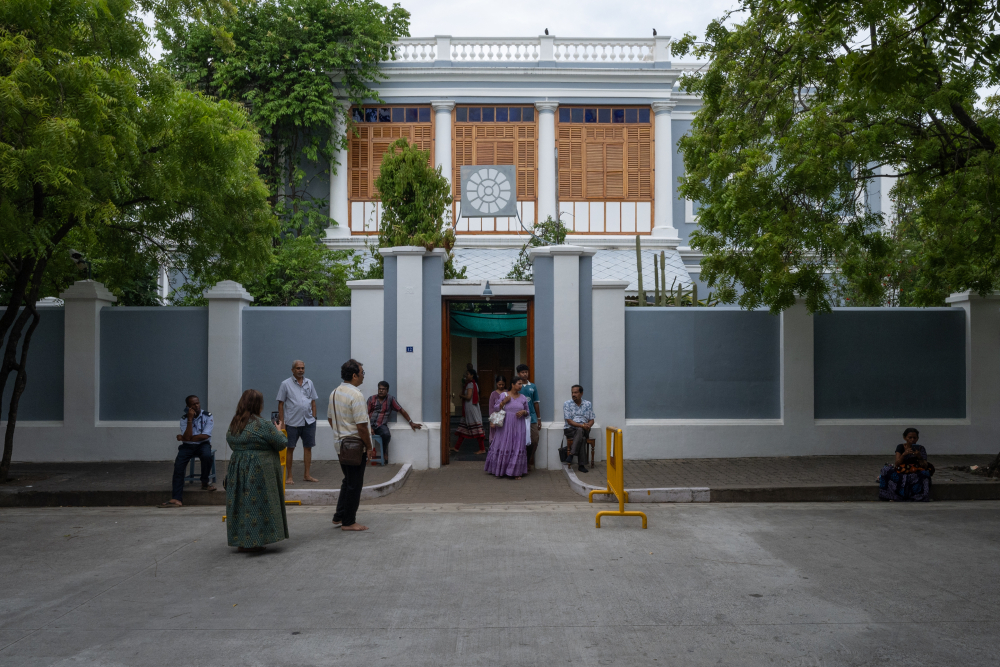
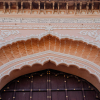
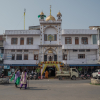
Sri Aurobindo Ashram, Puducherry. (Picture Credits: Joseph Rahul)
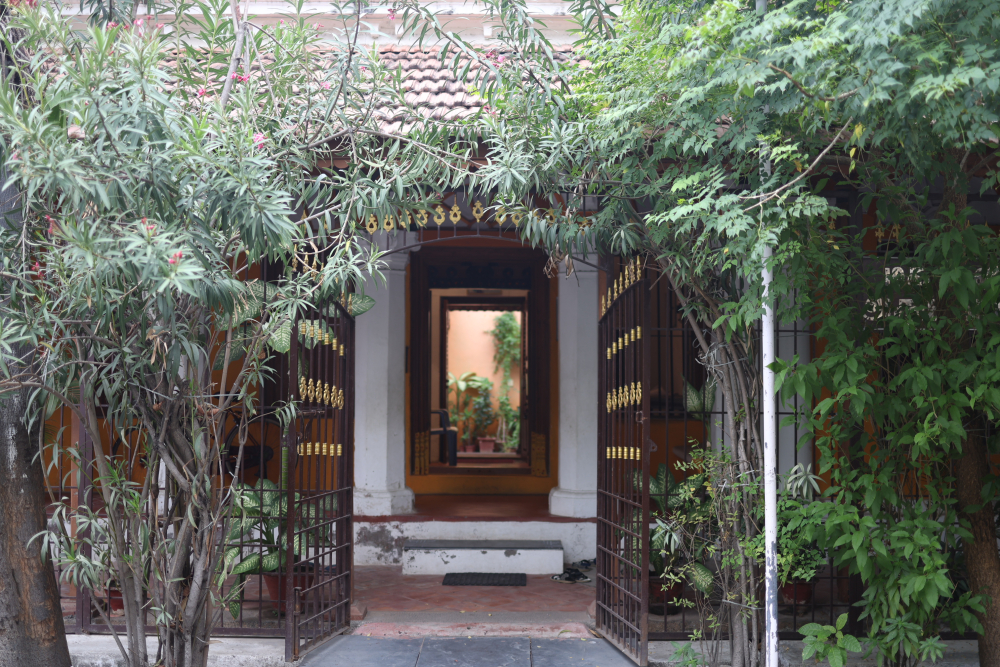
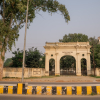
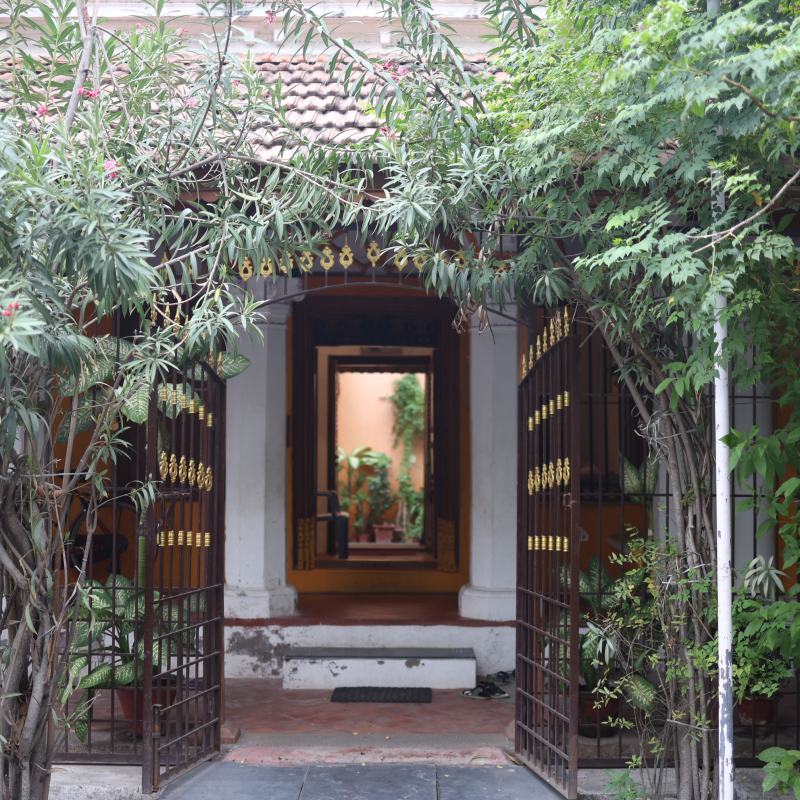
The former residence of Subramania Bharathi, now converted into a memorial museum. (Picture Credits: Sayali Athale)
While the presence of Sri Aurobindo and his Ashram plays a prominent role in the historical and spiritual significance of Puducherry, not too far from there is situated a monument, less frequented, but equally important to both national and Tamil cultural heritage. No. 20, Eeswaran Dharmaraja Koil Street, is where Mahakavi (great poet) Subramania Bharati took shelter during his stay in Puducherry from 1908 to 1918.
Bharati is arguably the greatest forerunner of modern Tamil literature and a Tamil nationalist poet, whose fiery poems sparked a revolutionary zeal in several freedom fighters. His vast body of poetry explored and opened new perspectives and styles of expression in Tamil. Moreover, he was a visionary in his own right with a deep spiritual quest. A great deal of his writings, including his major poems and unique poetic prose (vacankavitaikal), which paved a new path in Tamil literature, were composed during his stay in Puducherry.
Hailing from Ettayapuram, situated far south in the Tirunelveli district in Tamil Nadu, and later involved fervently in the freedom movement as a journalist and editor in Chennai, Bharati too found refuge in Puducherry in the face of an imminent arrest by the British. Ten years in the French town not only protected him from the British government, but also introduced him to new worlds of poetry, philosophy, and spirituality — including a cherished and enriching acquaintance with Sri Aurobindo.
Puducherry still holds silent witnesses to the presence and coming together of these two literary giants more than a hundred years ago. Among them is the famous promenade by the sea, popularly known today as the ‘rock beach’, a majorly frequented tourist landmark. This crowded and beachless seafront might have changed immensely from the quiet and expansive shoreline of early twentieth-century Puducherry, yet a row of iron poles still stands far out at sea, amidst the waves, silently recalling a bygone era.
These iron poles are the remnants of a pier that served as a pathway to those who came to Puducherry by sea. Inaugurated in 1865, this pier stretched straight into the sea for over 100 metres from the Place de la Republique, known today as Gandhi Square, with its famous statue of Mahatma Gandhi. Severely damaged during a cyclone in 1952, these iron poles are all that remind us today of a special moment in the town’s history. This was the very pier on which Sri Aurobindo disembarked from the S. S. Dupleix on 4th April 1910, to meet Bharati and other revolutionaries who were there to receive him. This moment marked the beginning of a special phase in both Sri Aurobindo’s and Bharati’s lives.
For Bharati, Sri Aurobindo was already “the proudest gem of our nation...the rising sun — the worthiest and the noblest son of Sri Bharata Mata”, as he had expressed in his heartfelt appreciation of the Karmayogin journal edited by Sri Aurobindo in Kolkata. So inspired was Bharati that he began a Tamil Karmayogi in Puducherry. Simultaneously, in his India magazine, he had been closely reporting in detail on Sri Aurobindo’s revolutionary activities. He had translated some of his speeches and writings for a Tamil audience in Puducherry, even before Sri Aurobindo set foot in the South. Rejoicing in Sri Aurobindo’s release from the Alipore jail, Bharati had portrayed him, in his weekly cartoon, as tarmasuriyan (the sun of Dharma) released from the rahu (malicious eclipse) of the British acquisition.
Bharati also published a significant conversation between his press representative in Kolkata and Sri Aurobindo, where he stated that his man was convinced that Sri Aurobindo was a “maha-siddha” who truly had a direct vision of god. Such was the luminary in the eyes of the Mahakavi, when he received him on this pier whose iron poles still stand as an earliest witness of this momentous event.
The next ten years of Bharati’s life blossomed in the companionship and teachings of Sri Aurobindo. Both were deeply committed to India’s freedom. Bharati met Sri Aurobindo almost daily and spent hours learning, sharing knowledge, and discussing various topics. All of this happened not in the comforts of a mansion, but within little hideaways cramped with young revolutionaries who accompanied and served Sri Aurobindo. As Sri Aurobindo’s presence was a secret, given the constant danger of British spies, he was sheltered for the first six months in the house of Shankara Chetty, a wealthy and respected citizen of Puducherry. In a well-hidden room on the top floor of the Shankara Chetty house Sri Aurobindo resided, along with the other revolutionary disciples, in absolute secrecy and with little resources.
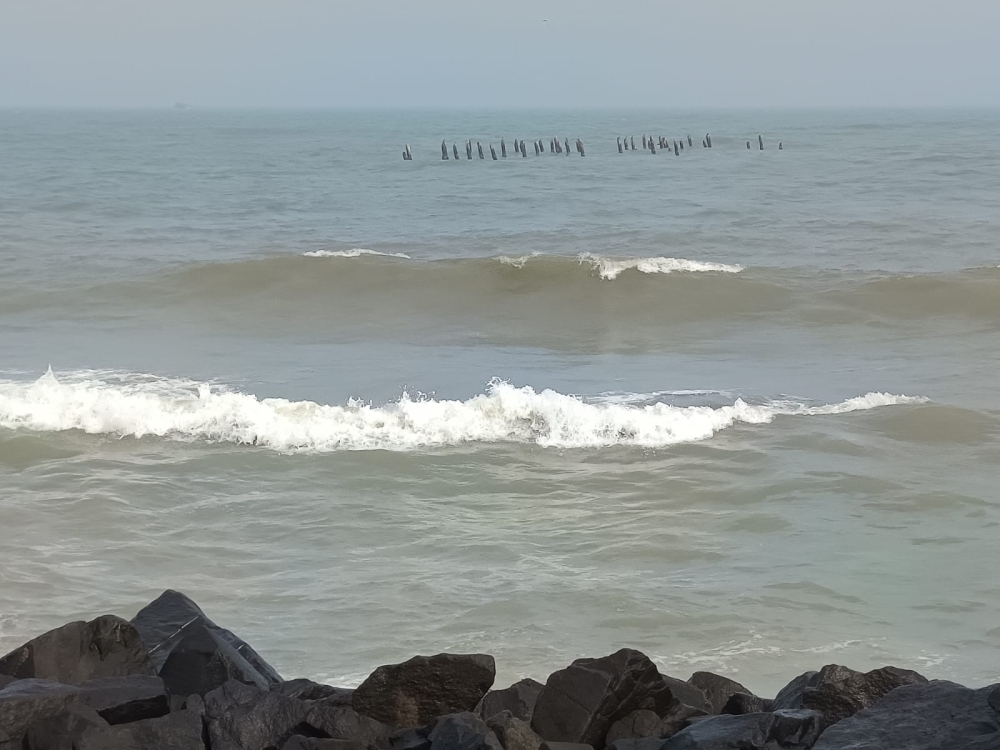
The piers still visible in the sea off the Puducherry Promenade where the old pier once stood. (Picture Credits: Aneesh Raghavan)
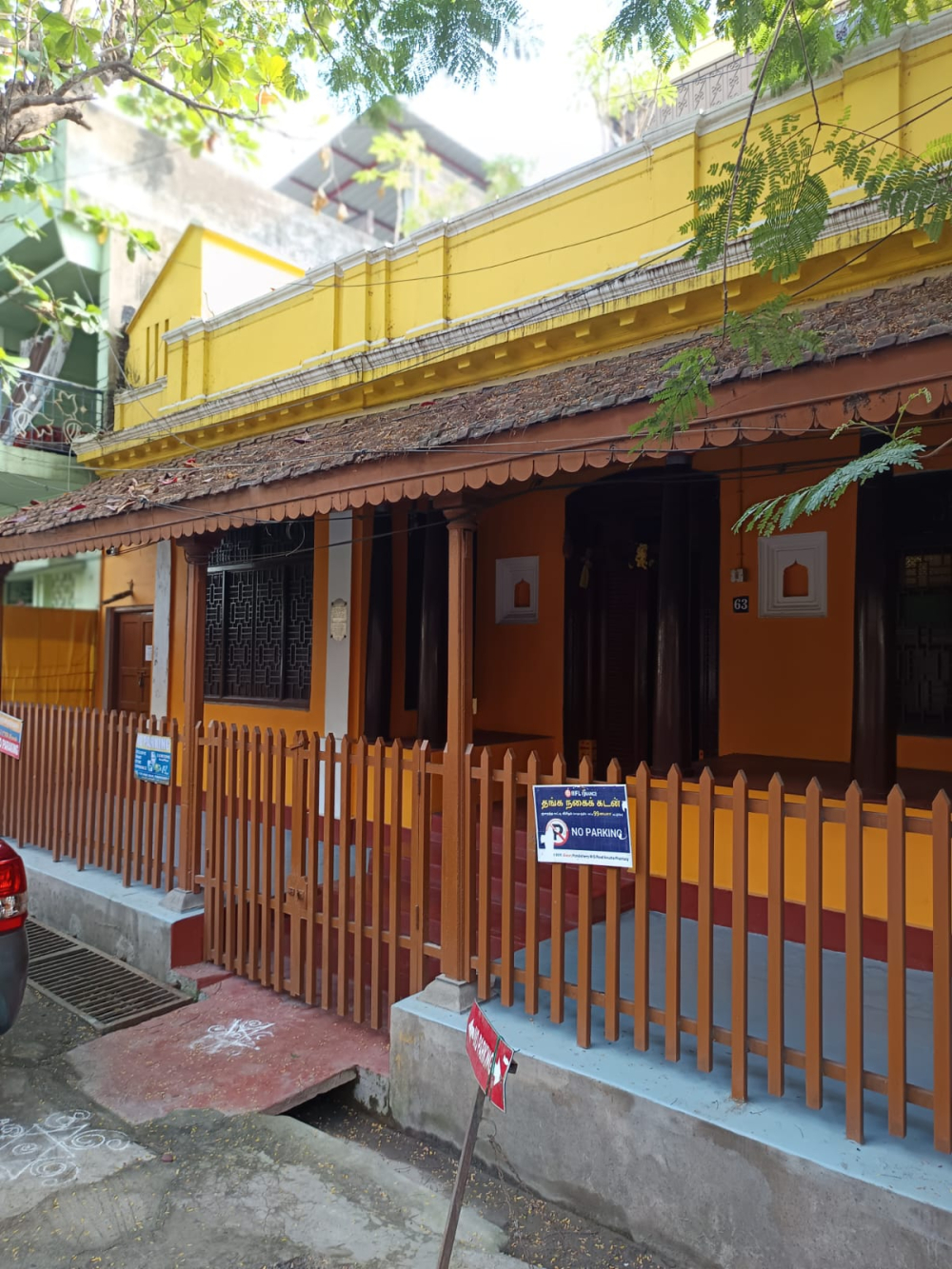
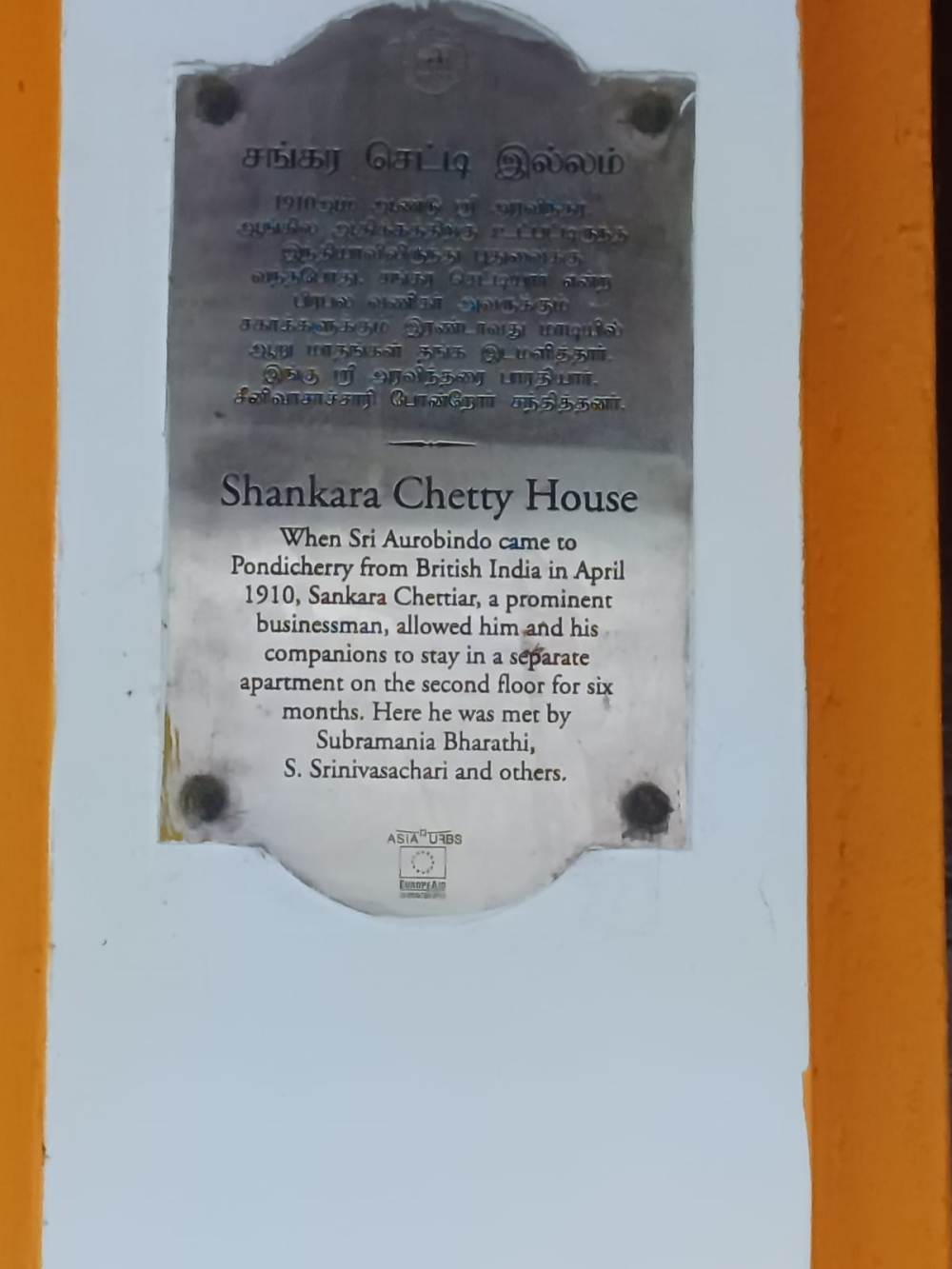
House of Shankara Chetty. (Picture Credits: Aneesh Raghavan)
Bharati was one of the few permitted to meet Sri Aurobindo without restrictions. He was central in bringing several ardent Tamil revolutionaries and admirers into the presence of Sri Aurobindo. One such Tamil revolutionary and writer, V. Ramaswamy Iyengar, fondly recalls days in the presence of Sri Aurobindo and Bharati at the Shankara Chetty house, in his Tamil biography on Bharati:
…Bharati would pour his poetic thought as though he had just caught them in their ethereal flow. Aravindar’s (Sri Aurobindo’s) poetry was as if he dug the very earth and revealed the treasure within. Poetic flavor brimmed in their words. \
All the nava-rasas danced in the conversations between Bharati and Aravindar. Poetry, history, philosophy, experience, creativity, humour, wit, deliberations, the eagerness to discover the truth, an abundance of literary delight, boundless thrill; all of these danced in and out during their conversations.
Sri Aurobindo was something of a phenomenon, more remarkable than remarkable men. The way in which he (Aurobindo) moved with us young men was something which I cannot easily describe. Affection is a poor word. Camaraderie is a dull word. Motherliness is good, but is only one aspect of his conduct towards us…
Where can I meet Bharathi again? Where can I meet Sri Aurobindo? These are the two Masters that moulded my life.
Such were the moments that the Bengali and Tamil patriots experienced and shared in the presence of Sri Aurobindo, even in the face of constant political dangers and the severe want of resources. Once, Sri Aurobindo was pushed to write to Motilal Roy, a wealthy patriot in Chandannagore, for financial assistance. In his letter, he said: “No doubt, God will provide, but He has contracted a bad habit of waiting till the last moment. I only hope He does not wish us to learn how to live on a minus quantity, like Bharati.”
Despite these grave difficulties, both Sri Aurobindo and Bharati produced volumes of writing during these years. Sri Aurobindo practiced his yogic sadhana and even instructed on it to the revolutionaries. In 1914, he began his famed monthly journal Arya, which contained most of his major works and some contributions from Bharati. By then, Sri Aurobindo had moved to a residence in Francois Martin Street, later known as the ‘Guest House.’ Bharati visited Sri Aurobindo and his companions every evening, without fail. Long hours into the night were spent in the study of the Vedas, Upanishads, and the Shrimad Bhagwad Gita under the guidance of Sri Aurobindo.
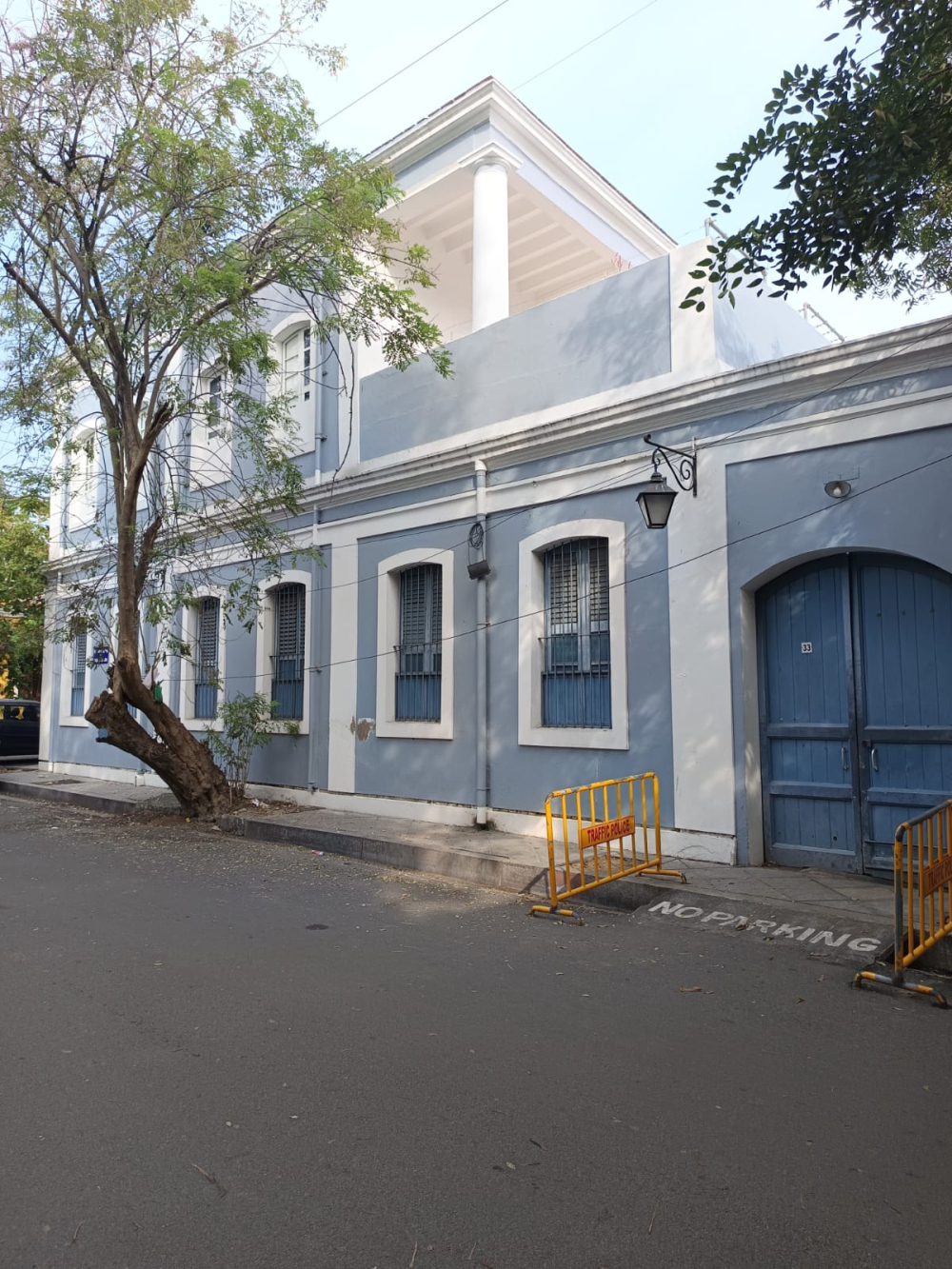
The 'Guest house' on Francois Martin Street. (Picture Credits: Aneesh Raghavan)
In one of his English essays, Bharati speaks of his surprise and curiosity regarding Sri Aurobindo’s “marvelous new theory of Vedic interpretations” and affirms it to be revealed knowledge by citing Sri Aurobindo’s statement, “it was shown to me.” Consequently, Bharati’s poetry and his unique poetic prose reflected Vedic ideas that were undoubtedly influenced by the teachings of Sri Aurobindo. In return, Bharati introduced Sri Aurobindo to the world of the Tamil Alvar saints. They worked together on translating some of the rich poetry from the storehouse of Tamil literature. Inspired by the Alvars, between 1908-1918, Bharati composed one of his three major works, titled Kannan Pattu (Song of Krishna), which was a modern reimagining of engaging with Krishna through many human relationships.
Sri Aurobindo worked in his residence and avoided coming outside, while Bharati roamed the town and found poetic inspiration in different parts of Puducherry. His retreats to the far-off groves in Karuvadikuppam, which housed the temple and the jeevasamadhi of the great siddha Siddhananda, resulted in his surreal Kuyil Pattu (Song of the Koel) in 1912, another of his major works. The small but famous Manakula Vinayagar of Puducherry inspired him to compose the forty-versed Vinayakananmanimalai (1919), praising the deity from a universal and esoteric perspective.
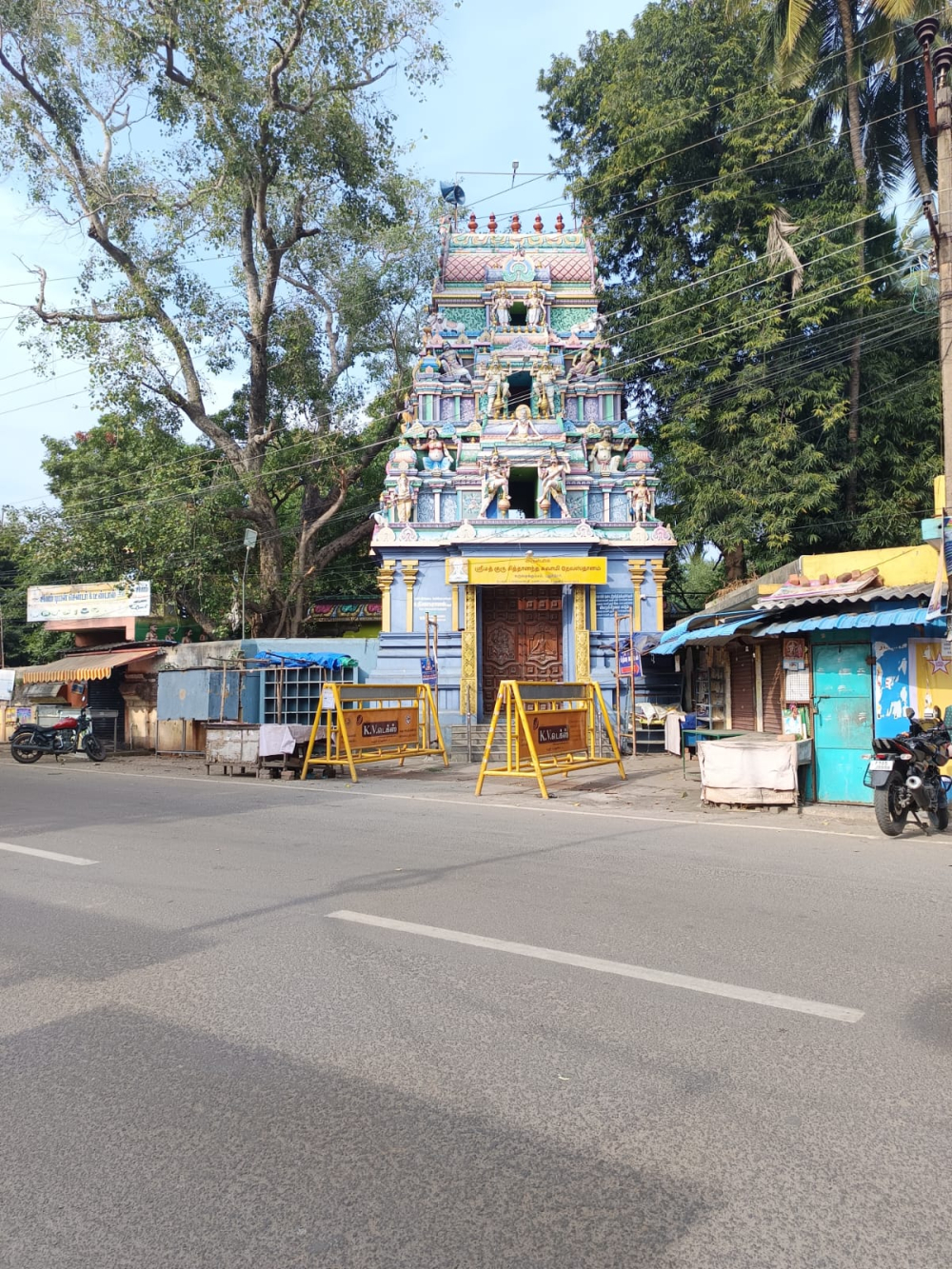
The Siddhananda Temple frequented by Bharathi. (Picture Credits: Aneesh Raghavan)
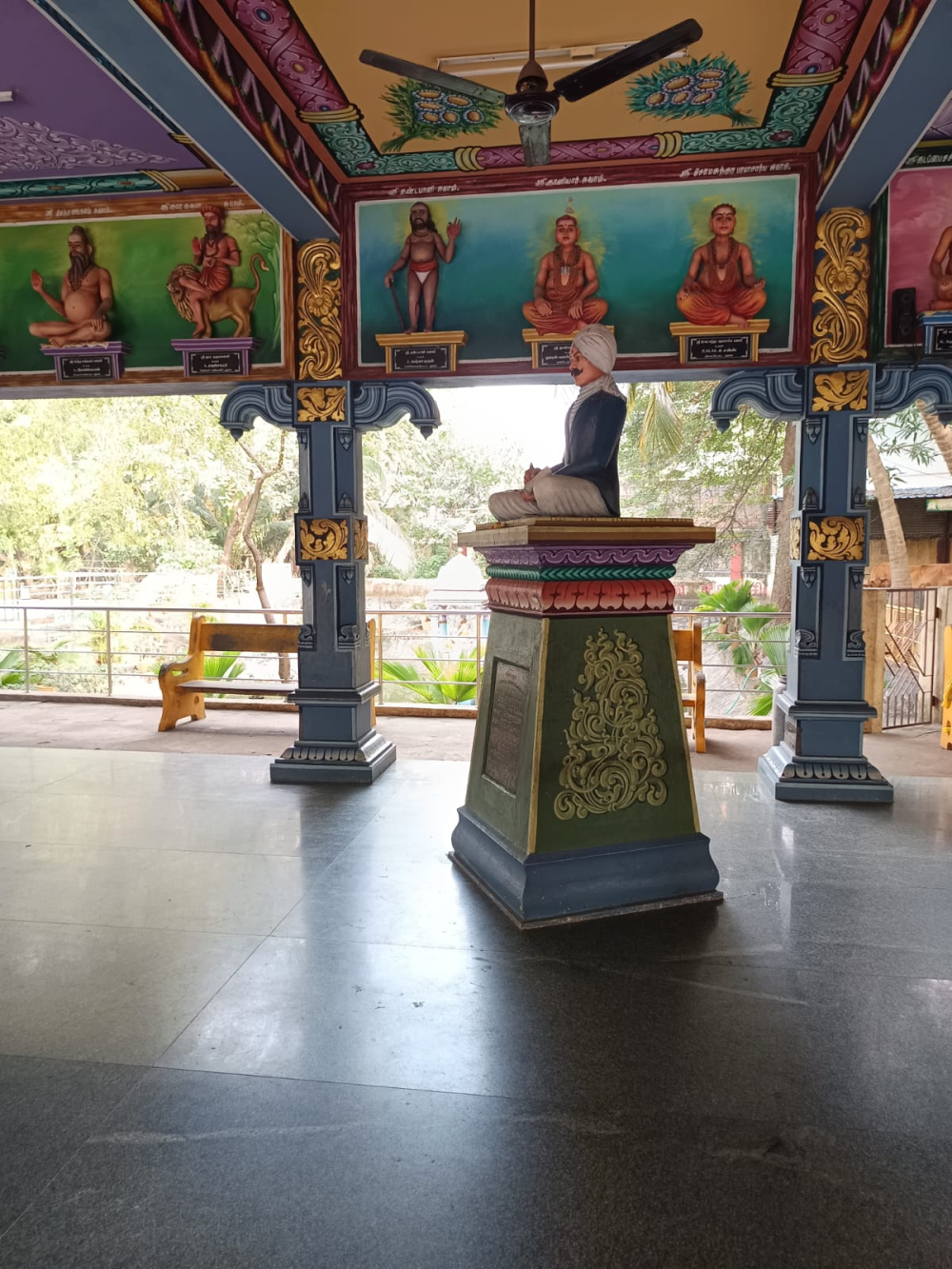
Subramania Bharathi's statue inside the temple. (Picture Credits: Aneesh Raghavan)
Apart from poetry, Bharati also found new meaning in his spiritual quest by coming into contact with siddhas he met in Puducherry, which he mentioned in his famous Parati Arupattaru (Bharati Sixty-Six) in 1923. In short, Bharati explored the world of poetry and spirituality that Puducherry offered, and his contact with Sri Aurobindo played a central role in these discoveries. Aravamudan, another young disciple of Sri Aurobindo and a devotee of Bharati, was present in their company from 1913 August. He recollects:
Bharati’s source of inspiration was from this afflatus of Knowledge and Power that ushered in a fresh Age. He recited and sang all his songs and poems-almost all of them- each as it rose from his soul, to Sri Aurobindo, before releasing them to the public. Times without number Bharati could be seen coming out of Sri Aurobindo’s room, his face beaming with a heavenly glow.
Thus, one might say that a turning point in Tamil literature was being shaped in Puducherry, right in the verandah of the ‘guest house’, under the influence of Sri Aurobindo.
In 1918, Bharati’s financial conditions and political tensions forced him to leave Puducherry, bringing an end to this long companionship with Sri Aurobindo. Bharati’s daughter Shakuntala, who accompanied her father for a last darshan of Sri Aurobindo at the guest house, recalls the final moments of their parting when “Sri Aurobindo’s peaceful and radiant eyes had moistened, and Bharati’s fiery eyes overflowed with tears.”
This marked the culmination of a rare confluence of two great minds, each of whom shaped history in their own spheres. Puducherry stands, even today, as an enduring witness to their coming together — its streets and spaces echoing the shared legacy of both Sri Aurobindo and Bharati.
Bibliography
Bharati, Shakuntala. “Sri Aravindaridam Vidaiperuthal.” Collected Essays on Subramania Bharati. n.d.
Bharati, Subramania. “Chitiravilakkam,” 15 May 1909. Mahakavi Bharathiyar.
http://www.bharathiyar.info/b_katturaigal/chithira150509.html. Accessed 13 January 2026.
_______________ “The Dawn.” Mahakavi Bharathiyar.
http://www.bharathiyar.info/b_katturaigal/the_dawn.html. Accessed 13 January 2026.
________________ “The Karmayogin.” Mahakavi Bharathiyar.
http://www.bharathiyar.info/english/karmayogin.htm. Accessed 13 January 2026.
________________ “Sriman Aravinda Goshudan Sambashanai.” Mahakavi Bharathiyar.
http://www.bharathiyar.info/b_katturaigal/sriman_aravind180909.html. Accessed 13 January 2026.
________________ “Varalaru.” Mahakavi Bharathiyar.
http://www.bharathiyar.info/varalaru_vara02.htm. Accessed 13 January 2026.
Iyengar, V. Ramaswamy. “Documents in the Life of Sri Aurobindo.” The Incarnate Word.
https://incarnateword.in/journals-and-magazines/archives-research-1977-94/1988/documents-in-the-life-of-sri-aurobindo. Accessed 13 January 2026.
Nandakumar, Prema. Subramania Bharati. Mysore: Rao and Raghavan, 1964.
Sri Aurobindo. “Letters to M (Motilal Roy).” The Incarnate Word.
https://incarnateword.in/sabcl/27/letters-to-m-motilal-roy. Accessed 13 January 2026.
This essay has been created as part of Sahapedia's My City My Heritage project, supported by the InterGlobe Foundation (IGF).