
Finding locally crafted products should not have been too difficult in Puducherry, or so I believed, and began my search at the Sunday market on Nehru Street, expecting it to be lined with artisans selling handmade wares. Instead, the stalls were heaped with synthetic garments and plastic toys. Eventually, towards one end of the market sprawl, between a man selling old electronics and an intriguing pushcart of ‘coconut flowers’ (in reality, sprouted coconuts), I spied two men standing next to squat columns of rolled kora mats. Kora, or sedgegrass mats are typical in Tamil country, where the wetlands and riverbanks abound in kora grass or Cypernus malaccensis, which is harvested to produce intricately woven, durable floor coverings.
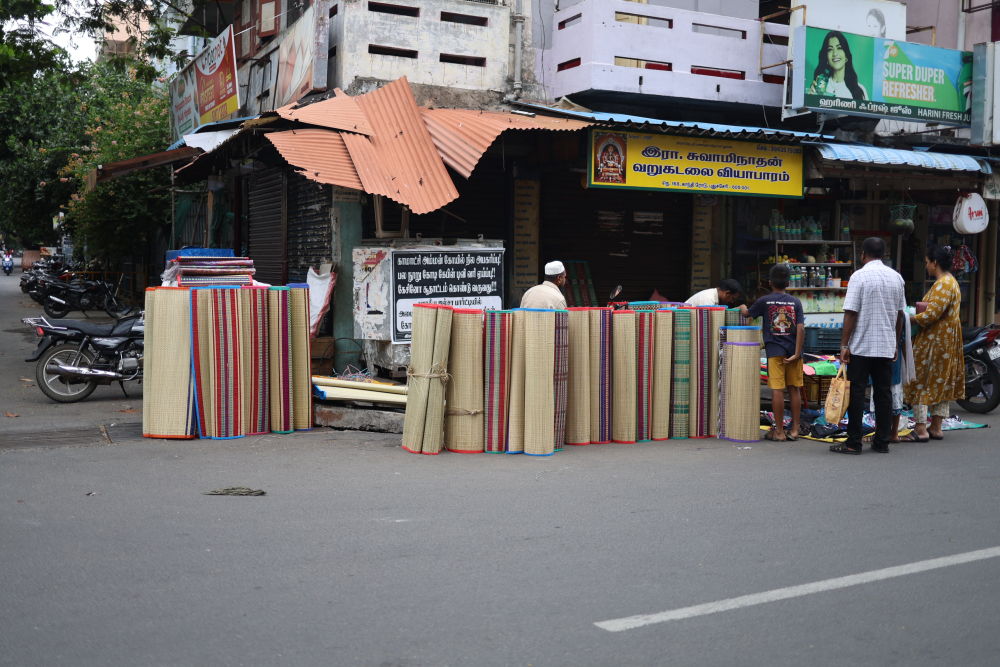
Kora mats sold in Pondicherry's Sunday market. (Picture Credits: Sayali Athale)
Kora mat-making is said to have been introduced to Pondicherry in the 1840s by Muslim mat weavers from the North Arcot region of Tamil Nadu, who would come to Pondicherry to harvest this abundant grass on the Sankaraparani (or the Gingee) riverbed. Eventually people like the Kuvandurs, Vanniyars, and Udayars, assisting the weavers in harvesting grass, learnt the trade and began practicing it as agriculture was not always economically sustainable. In 1943, when a flood uprooted the growth of kora grass, the craftsmen had to resort to purchasing it from the surrounding villages of Mannadipet, Villianur, and Nainarmandapam in Pondicherry, as well as from Chinnababusamudram and Vandavasi in the then Madras State. Till the 1960s, kora mat-making was practiced in Kaiklapet in the Mannadipet commune and in Odiampattu village in the Villianur commune of Pondicherry, where mat-weavers had formed co-operative societies. Over time, however, the practice faded away in these villages; and the kora mats currently sold in Puducherry are sourced from mat weavers in Vandavasi, Kollidam by the Kollidam river or weavers in Karur on the Kaveri riverbank.
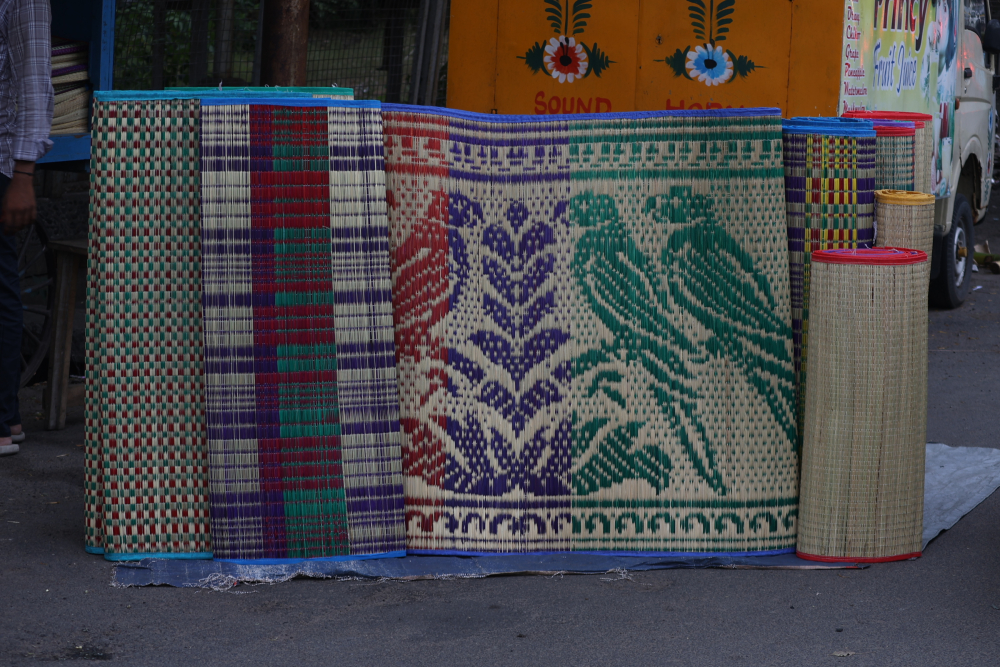
Kora mats feature a variety of intricate designs. (Picture Credits: Sayali Athale)
I continued along the market and two streets down, flanking the road leading to the cathedral of Our Lady of Immaculate Conception, found a smattering of shops selling handmade leather footwear in vivid unusual hues of pinks, blues, and yellows. While leatherwork has been a historical profession in the region, the establishment of the Hidesign enterprise in Pondicherry in the late 1970s gave a strong impetus to leather craft in the city, over time making it one of Pondicherry’s most prolific handicraft industries. Dilip Kapur, an Aurovillian, established Hidesign, now an internationally acclaimed brand, with the intention of creating contemporary products using traditional, environmentally responsible techniques of processing leather. With the increasing popularity of leather work in Pondicherry today, there are a large number of craftspeople in areas like Shanmukhapuram, Muthialpet, Villianur, and even in nearby Auroville, who tailor bags, purses, and shoes of impeccable quality. In the heritage town precinct itself are several shoemakers who make leather sandals in a spectacular range of colours and finishes and even cater to demands for customised designs. Belonging to the caste-based communities called Chikkiliyar and the Arunthathiyar, the leather-workers primarily use cow and goat leather, the tougher cow-hide used for footwear and the softer goat-hide for bags and purses. Their material is sourced from varied places like Ambur, Perimed, Ranipet, and Metpalayam in Chennai. While the craftsmen attest to most fellow leather-workers being local Tamilians, they are aware of a growing trend of craftsmen migrating to Pondicherry from northern India.
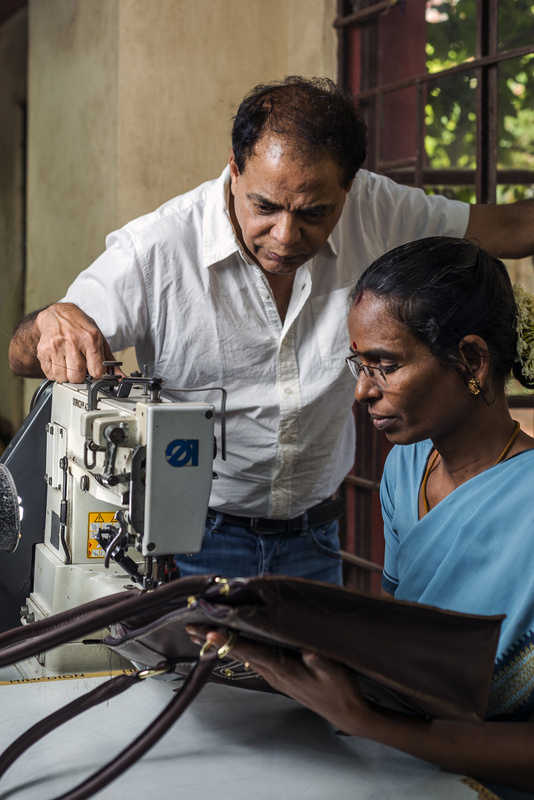
Dilip Kapur at the sample section Hidesign Atelier. (Picture Courtesy: Mypeepul/Wikimedia Commons)
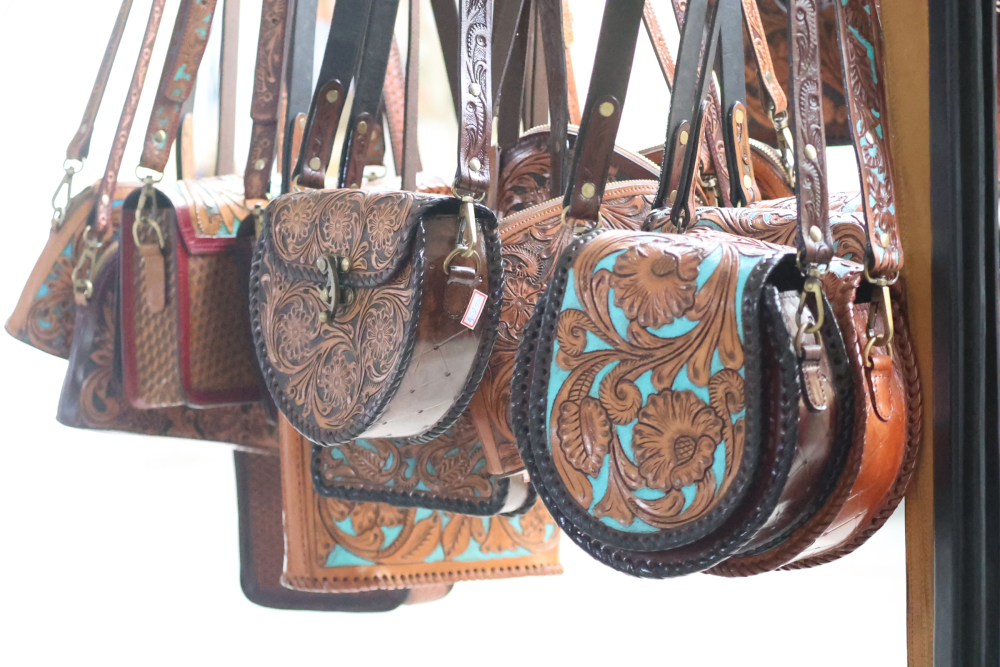
Leatherware made in the city. (Picture Credits: Sayali Athale)
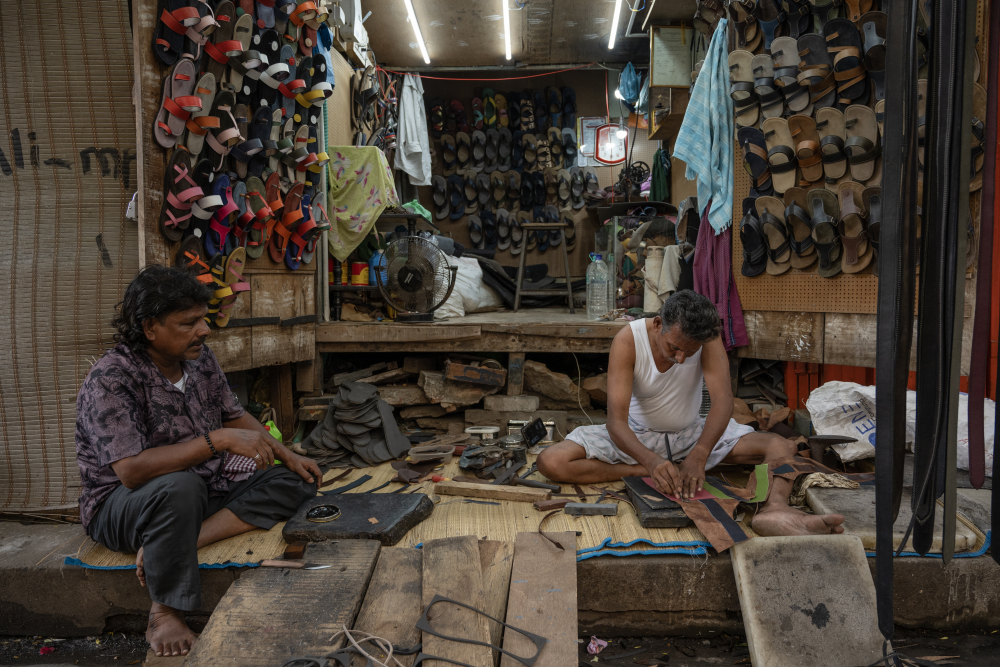
Shoemaker near the Immaculate Conception Cathedral. (Picture Credits: Joseph Rahul)
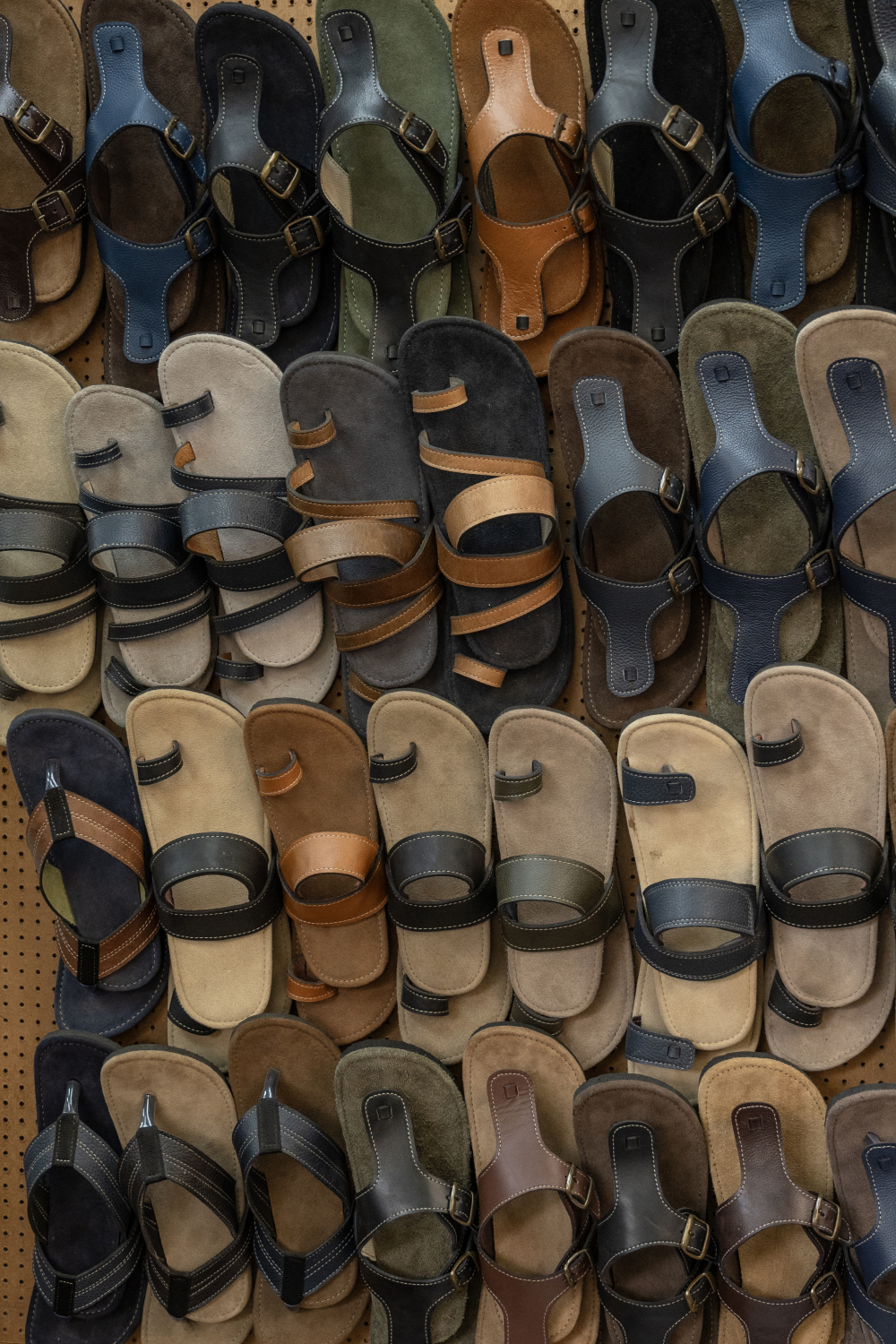
Leather sandals in a variety of colours and finishes made in the French town. (Picture Credits: Joseph Rahul)
In the same decade that Hidesign was set up, so was another workshop that would enrich the craft culture of the city. Under the auspices of the Sri Aurobindo Ashram, in 1971, Deborah Smith and Ray Meeker started the Golden Bridge Pottery (GBP) studio. Inspired by Japanese pottery and American stoneware, GBP developed a style of glazed stoneware that has come to be popularly recognised as Pondicherry pottery. Committed to an open practice in which they would share their knowledge and employ local youth, GBP has trained a considerable number of potters and studio ceramicists over the last fifty years.
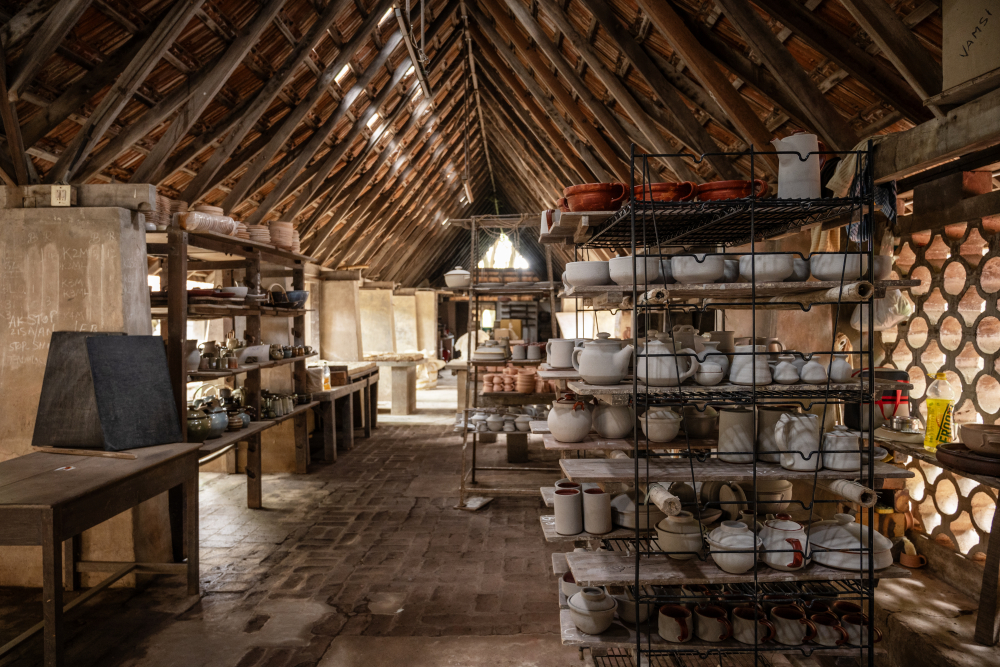
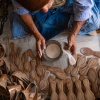
At the Golden Bridge Pottery. (Picture Credits: Joseph Rahul)
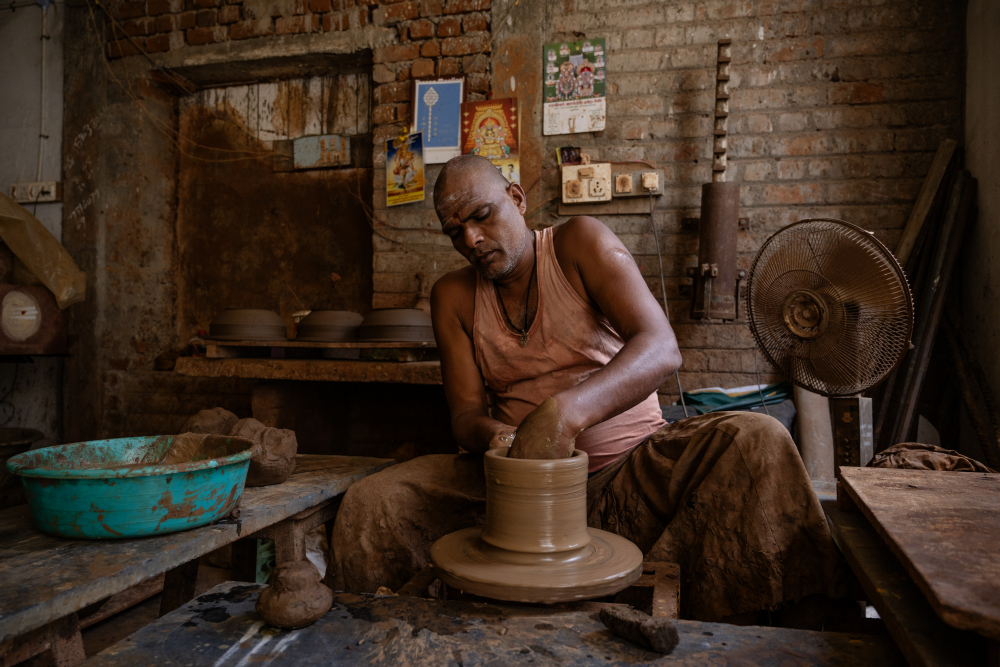
Potter Sadasivam at this workshop near Villianur. (Picture Credits: Joseph Rahul)
While stoneware was a new introduction in Pondicherry, terracotta existed in the region as a traditional industry, with village potters using local clay to make pots and utensils. Such earthenware is still sold in the potter’s street, or Kosakadai street, in the Tamil town. A little beyond the Tamil town, in Villianur, I met Sadasivam, a potter by family profession, but one who learnt the ropes at GBP, where he worked for over a decade. Sadasivam now runs an independent workshop with his wife, and the earthenware created by him shows GBP’s influence in its contemporary design language. He still prefers traditional terracotta over glazed pottery as material though, and showed me a large batch of fired clay casseroles ready to be shipped to Kerala.
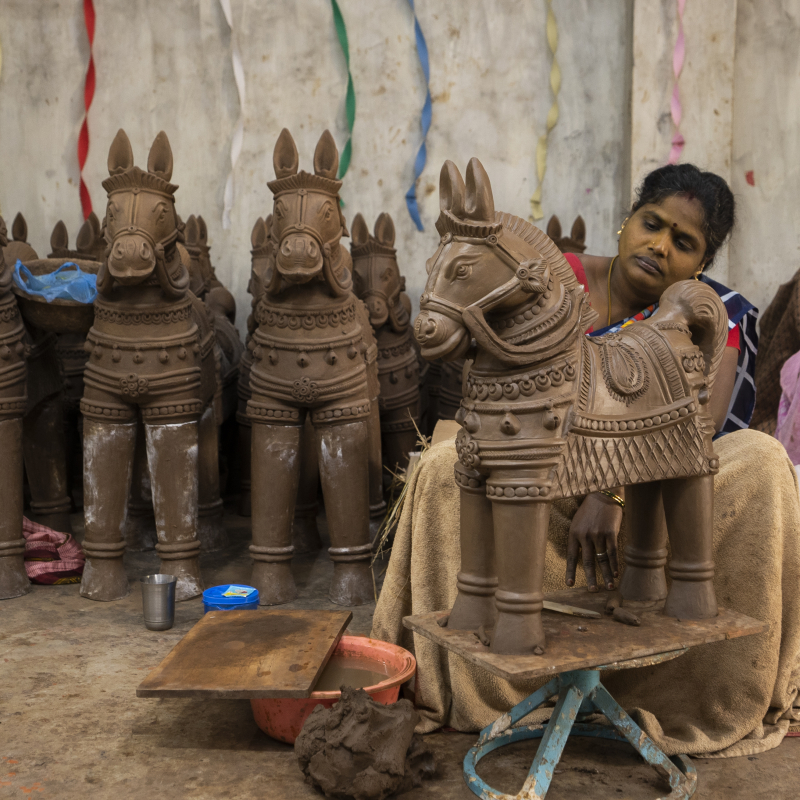
Also at Villianur is the practice of the national award and Padma Shri winner V. K. Munusamy, whose workshop near the historical Sri Kasi Vishvanathar temple is filled with terracotta figures of the Ayyanar horse, a signature of Villianur pottery. Villianur pottery has been conferred the official Geographical Indication (GI) tag by the government since 2011. In India, a GI-tag signifies a product's unique, region-specific quality, and provides its producers legal protection against unauthorized imitation.
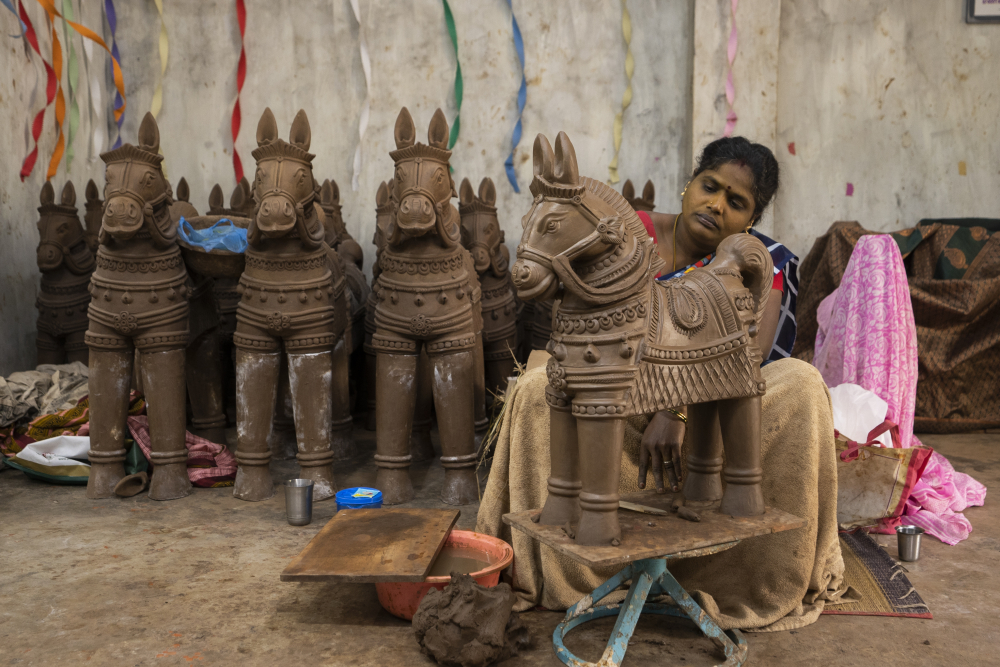
Making of Ayyanar horses. (Picture Credits: Jubin Bennet)
Terracotta production in Villianur traces back to artisans from the Kulalar community, who have traditionally worked with clay to create a range of objects. The clay mix used for Villianur pottery is composed of three types of soils, called kalippu (soft clay), thennal (river clay), and saavudu (fine sand), some of which were traditionally excavated from the bed of the Shankaraparani river. The wet mix is prepared by sieving the raw material to remove stones and then kneaded with water until it reaches a workable consistency. After drying it briefly, portions of the prepared clay are taken up for modeling. For large idols, the limbs are shaped separately and later assembled. The tools used to shape the clay are simple and made from local bamboo. Once the items are sculpted, they are decorated using patterns and stamps. The sculptures are then sun-dried to draw out residual moisture and minimise cracking during firing. In Villianur, firing does not take place in permanent kilns like those at GBP, but in temporary ovens assembled on open ground outside the workshop using paddy husk, wooden shavings, and cow-dung, each oven large enough to fire roughly forty to sixty pieces at a time. Sculpting is usually the men’s job, but women are involved in tasks such as kneading the clay, decorative stamping, preparing the kiln, and loading and unloading the objects. Ayyanar horses, elephants, Ganesh figures, Kamadhenu (wish-granting cow), drishti-bommai (masks placed on houses to ward off evil spirits), and Buddha statues are popularly made GI-tagged Villaniur pottery products.
Puducherry is also associated with a second GI-tagged craft: Thirukannur papier-mâché, named after the village of Thirukannur in the Mannadipet commune. Masks and dolls made in this technique are ubiquitous in craft stores and the craft market behind the Promenade, where I arrived on a Monday morning, looking forward to meeting some local craftspeople. A woman-seller informed me when I was looking at such dolls that there are only a few makers left today in Thirukannur. Many of these dolls are now made around Bengaluru and brought into Puducherry for sale. This raises questions about what the craft’s GI-tag signifies, when production is barely carried out in the place it is meant to represent.
In the last century, similar toys were produced in an area close to the heritage town known as Kosapalayam or Kuyavarpalayam. Traditionally, dolls there were made using terracotta, but under the influence of newer materials and colonial preferences, the artisans adopted papier-mâché made of a combination of paper, limestone, and gypsum. Ancillary materials like chalk powders, cement, adhesives, maize and rice flour, metal wire, zinc powder, white lead, copper sulphate as a preservative, natural gums, oils, and varnishes were also used in the process.
Papier-mâché dolls made using this technique range in size from three inches to a foot and half. They are based on a wide spectrum of religious and cultural sources, from Hindu mythology to scenes from the Bible, and also local characters and occupations. The dancing girl and the Gundu Chettiar — a funny man with a paunch — are particularly popular figures. Some of these dolls are also used as kolu or golu dolls — figurines arranged in tiers to narrate stories — during the Navaratri season in the Tamil month of Purattasi (September–October).
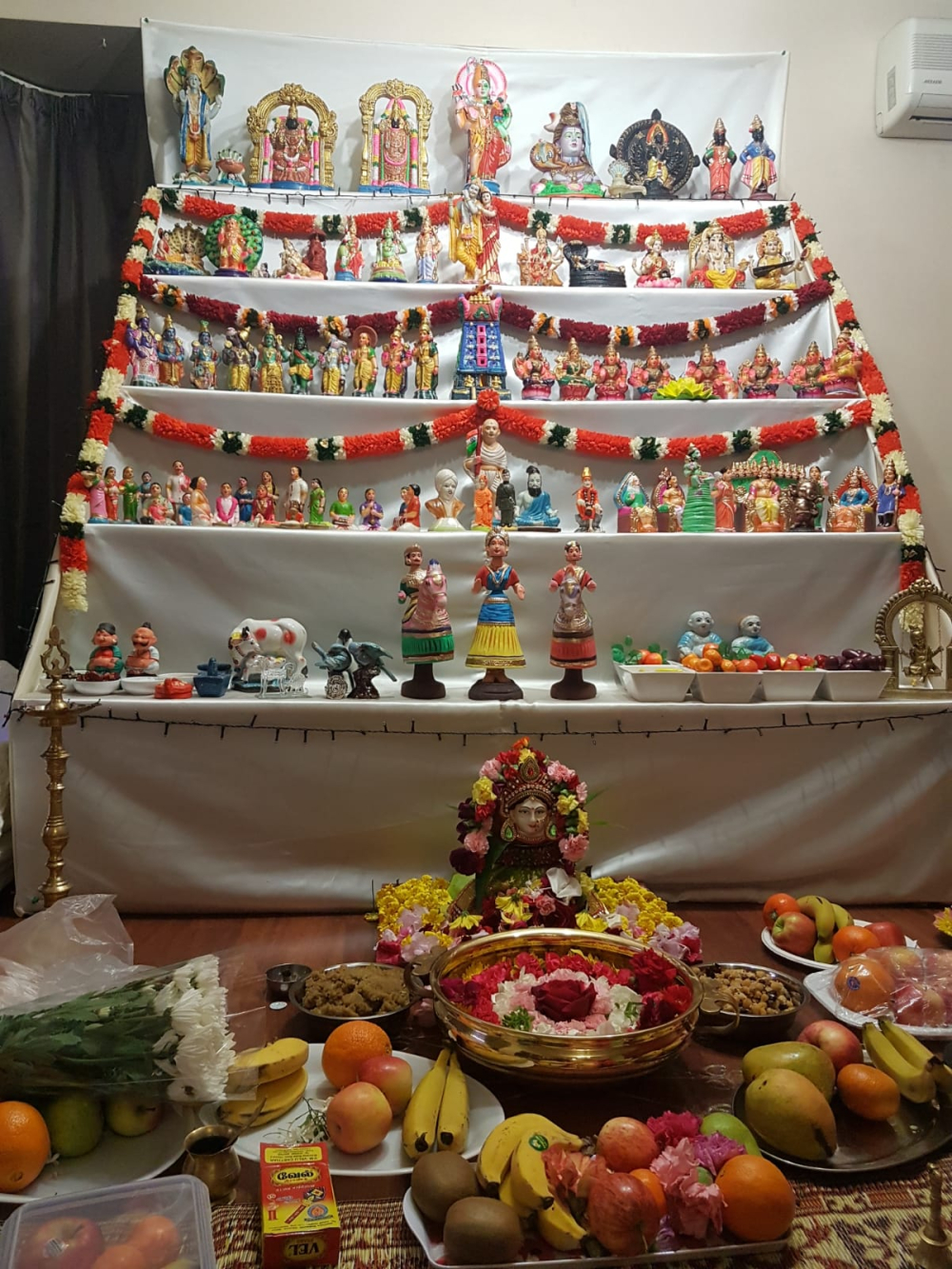
Display of Kolu dolls. (Picture Credits: Ksiva21/Wikimedia Commons)
Having examined the length of the Sunday market on Nehru Street and the state-run craft market behind the Promenade, I headed towards one of the Ashram stores along the beachfront—one of several outlets that sell handmade objects produced in the various departments of Sri Aurobindo Ashram. In the Ashram, work has always been considered as a part of Integral Yoga, and various kinds of craftwork were encouraged by the Mother (Mirra Alfassa). Department workshops are scattered across the heritage town within buildings painted white and grey, most of them established in the two decades between 1940-60. Some were established to fulfil everyday needs within the Ashram, while others, such as Golden Bridge Pottery, were established to encourage Ashram disciples’ skills in making. In their early years, these departments were intended to make the Ashram self-sufficient. Over time, several evolved into income-generating units. Amongst these departments is the hand-weaving section, set-up to produce textiles, and a batik department. A cottage industries section was established a few years later, which now has an outlet on Gingee Salai selling fragrant handmade incense sticks and soaps.
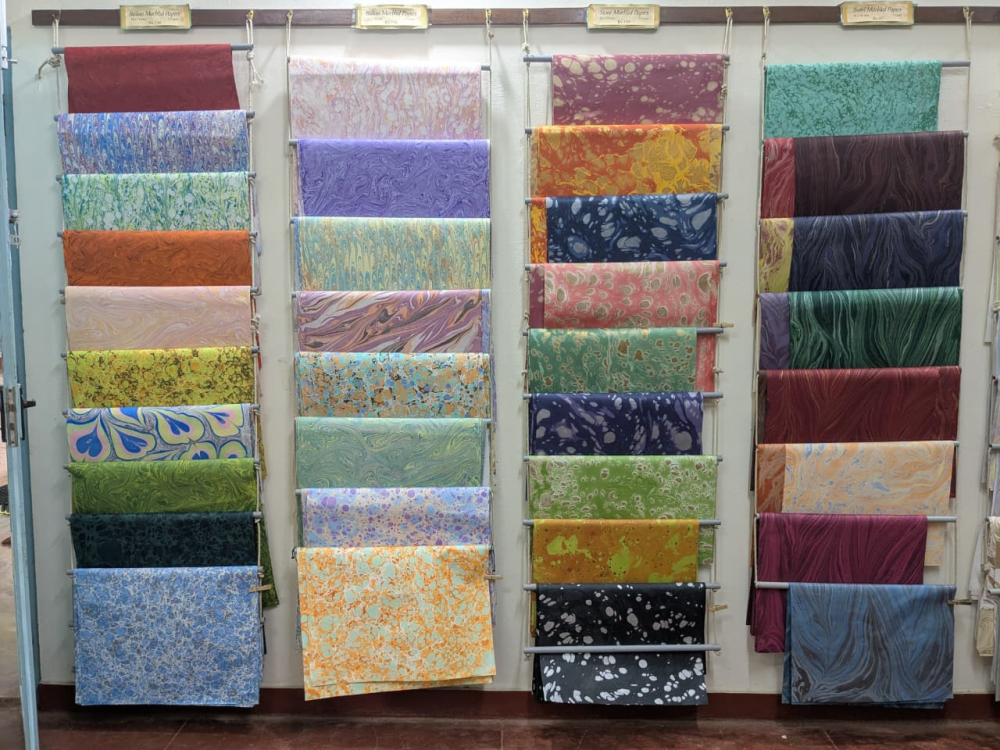
Marbled paper at the Ashram Handmade paper factory. (Picture Credits: Sayali Athale)
One of the Ashram’s best-known departments, the hand-made paper factory, was established in 1959 in a coconut plantation to the north of the Boulevard. They use a variety of bio-based materials, such as the leaves of bamboo, pineapple and eucalyptus, banana and sugarcane fibres, straw, and husk. But as its primary material, the factory uses waste generated in textile factories in Tirupur, Tamil Nadu in the form of white cotton rags. These rags are hand-sorted, cut to smaller sizes, and beaten with water in Hollander beaters to release long, strong cotton fibres and form a chutney-like pulp. Specific amounts of pulp are poured into traditional molds and pressed to form sheets. These sheets are peeled off the mould and drained further by being placed on felt surfaces. They are then dried in open air or in drying rooms on the floor above the factory. The next step is calendaring to smooth their surface to prepare them for further decoration such as marbling. Marbling, inspired by the Japanese technique of suminagashi (floating ink), was attempted by members of the ashram in 1942. The process begins with sprinkling droplets of oil paint on a surface of water. Immiscible, they float on the surface, where they are spread into different patterns with the help of a stick. A handmade paper sheet is then laid over the water surface, where it draws the paint onto it. Lifted and dried for a day, each sheet produced this way is completely unique. Marbling was later even taken up on silk and chiffon in the Ashram. Today, the handmade paper factory has an extensive collection of marbled paper, and an independent unit housed in a building named ‘Harmonie’ produces sarees and other apparel in marbled fabric.
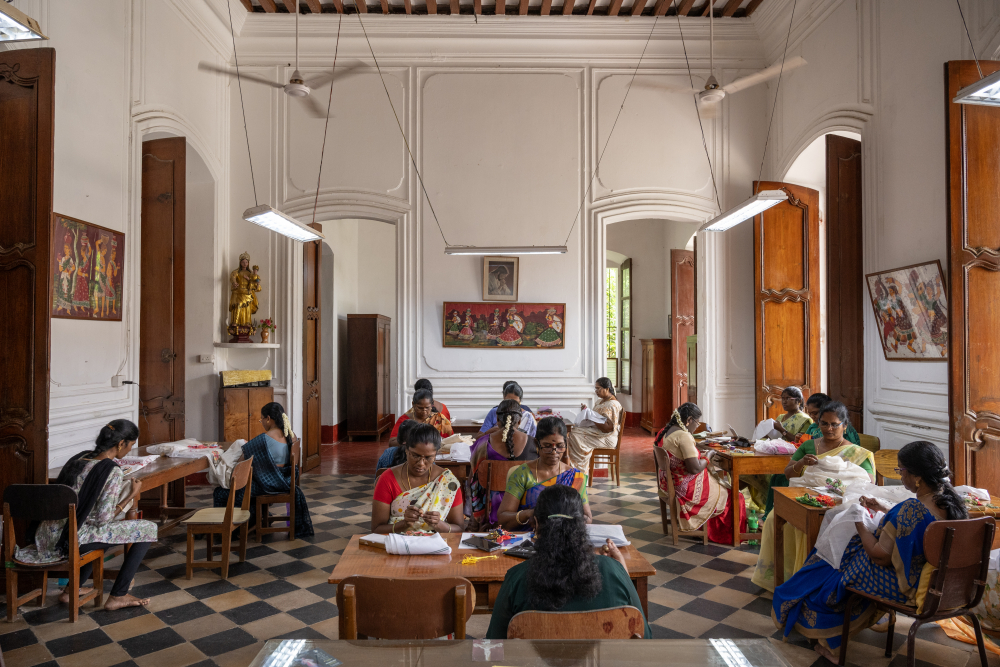
Inside the Cluny Embroidery centre. (Picture Credits: Joseph Rahul)
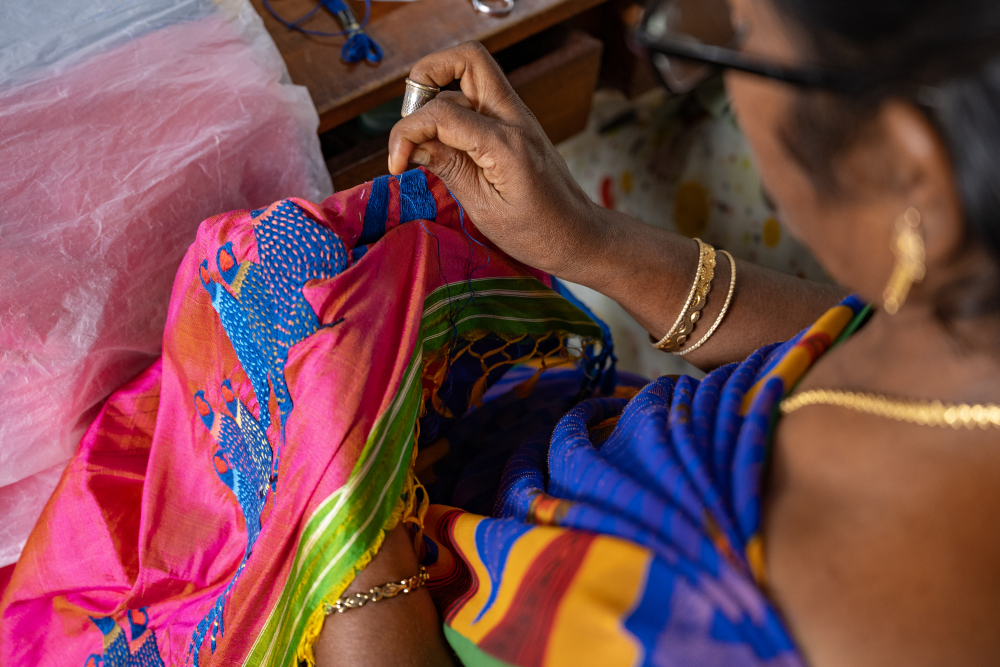
Women doing impeccable needlework at the Cluny Embroidery Centre. (Picture Credits: Joseph Rahul)
My self-guided craft tour ended at the stately colonial mansion that houses the Cluny Embroidery Centre. Run by the sisters of St Joseph of Cluny, the centre employs underprivileged local women and trains them in needlework. Their work is exemplary, the backs of the pieces embroidered with birds and flowers as clean as the fronts, with no visible knots.
For a town of its size, Pondicherry holds an unusually dense concentration of craft practices, both community and studio-based. Influenced by French rule and the presence of the Ashram, they lend the city a distinctive material character.
Bibliography
Census of India: Pondicherry state. Office of the Registrar General, Government of India, 1961.
This essay has been created as part of Sahapedia's My City My Heritage project, supported by the InterGlobe Foundation (IGF).