
Along the leafy Rue du Bazaar Saint Laurent in the French Quarter of Pondicherry, a modest showroom named ‘The Metal Crafts’ displays bronze images of a plethora of Hindu deities. Idols of Ganesha, Vishnu, Shiva, Parvati, Hanuman, Garuda, Narasimha stand along the white walls, varying in their scales and postures. Vasanth, the artisan who crafts these divine representations, explains that each image is created using a true-to-process lost-wax bronze casting method that originated centuries ago in the Chola period. Called madhuchhhisthavidhana, it is described in detail in the Manasollasa, a twelfth-century CE treatise by King Someshvara of Kalyana. While Swamimalai in the Thanjavur district of Tamil Nadu is the best-known centre for this craft today, the technology has roots across the Tamil region, including areas that now fall within Pondicherry. Despite the historicity of this profession, the difficulty of the craft has meant that fewer people are interested in continuing with the occupation. Vasanth and his uncle Bhaskar are the only artisans practicing lost-wax bronze casting in Pondicherry today.
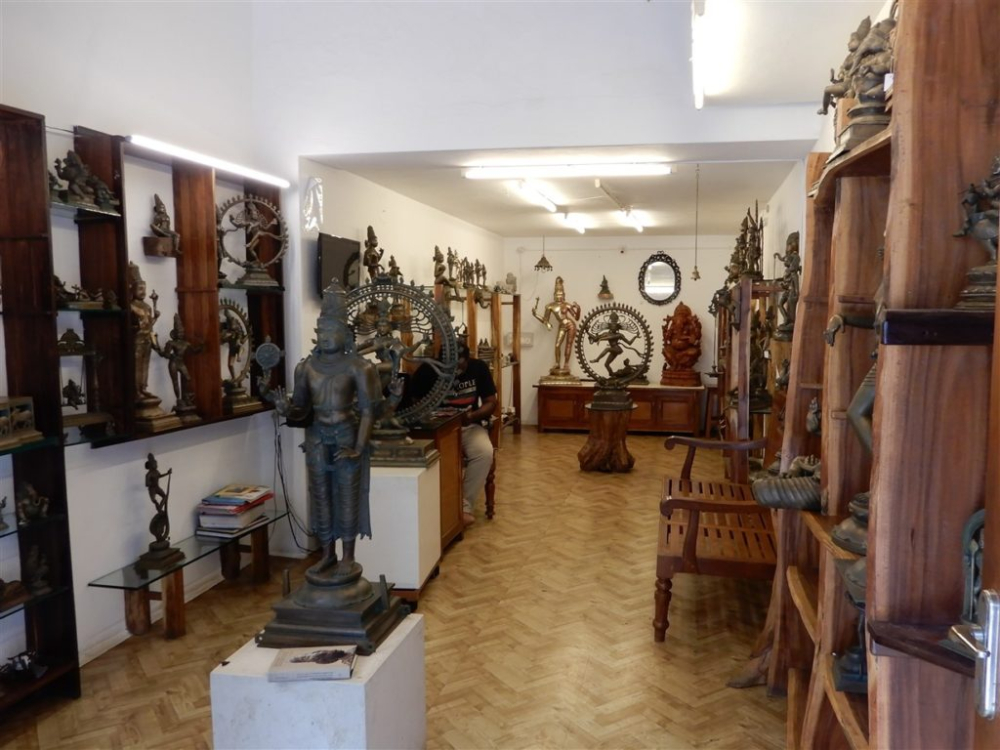
The Metal Craft showroom with a variety of bronze sculptures. (Picture Credits: Vasanth K)
The Chola sculptural tradition originated from the earlier experimentation in stone and bronze under the Pallava kings; with their defeat by Aditya Chola in 875 CE, the style of sculpting changed but many conceptual and technical foundations remained. From the ninth-century onward, lost-wax bronze casting became the signature of Chola image-making, and dynamic, sensuous utsavmurthis (movable idols of Hindu deities used for processions and festivals) were created for ceremonial purposes in the empire.
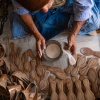
Lost-wax bronze casting is a long and laborious process. Crafting a three feet tall statue may take as long as four months. The sculptor first shapes the figure in beeswax mixed with a local tree resin and coconut oil, and models every detail including the jewellery, facial features, and hasta (hand formations) by hand. The proportions of the three materials dictate the pliability of the mix: a harder mixture with lesser oil is used for the main body, while a more malleable mix with a higher ratio of oil is used for finer details such as the face and adornments. The wax model is usually based on photographs of older idols in museums or temples, with the main body and the pedestal of the sculptures created separately. Vasanth uses a tala (coconut frond) to measure and mark the proportions of the statue; it is only through years of practice that he can recreate the grace of the classical sculptures.
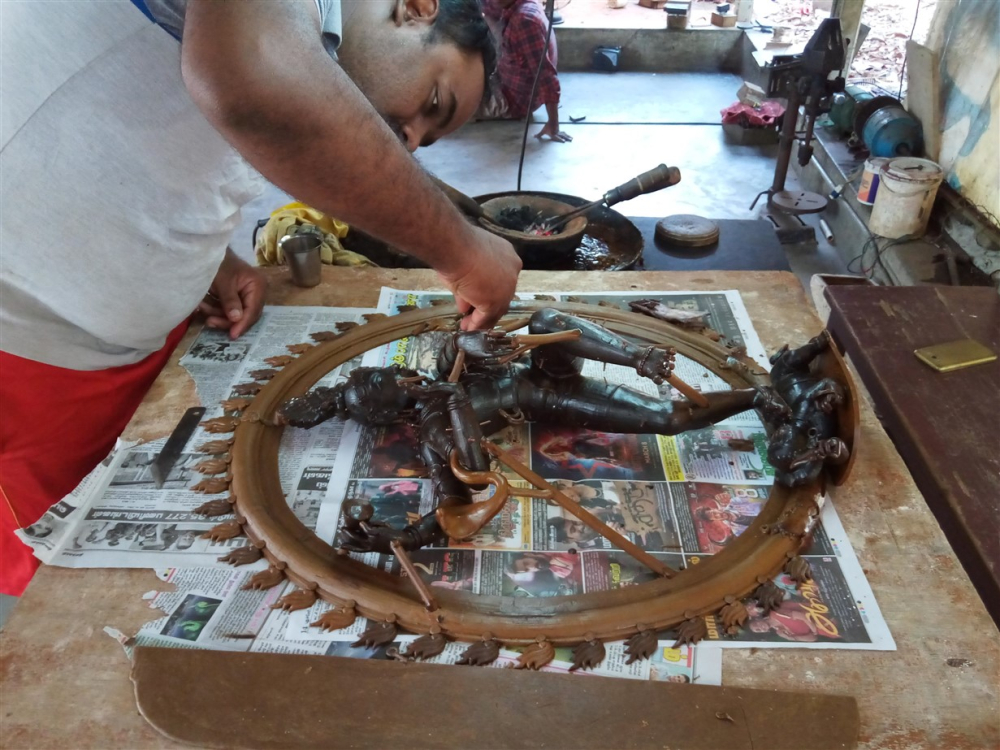
Creating a wax model. (Picture Credits: Vasanth K)
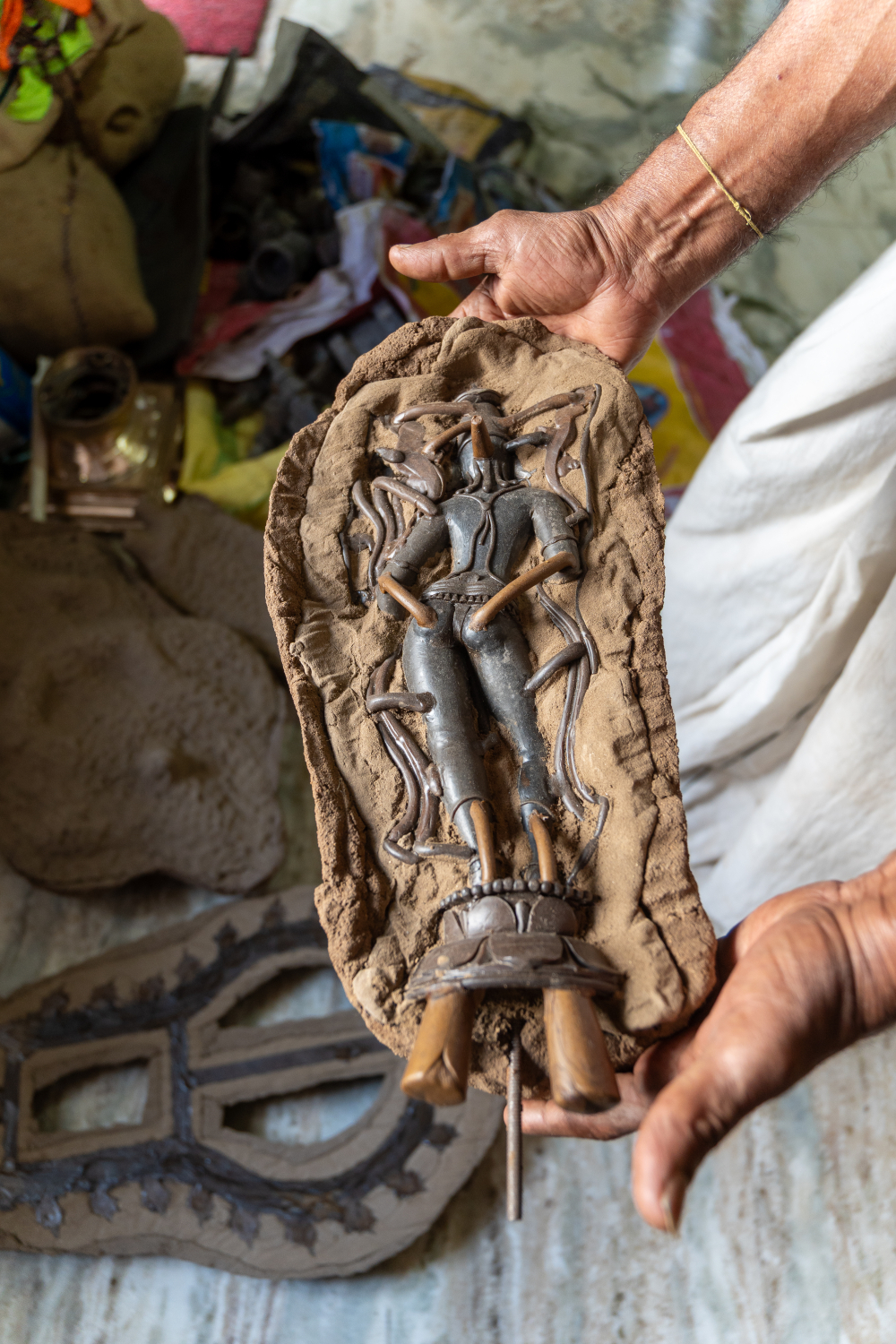
Lost wax bronze casting at Swamimalai. (Picture Courtesy: Rainer Halama/Wikimedia Commons)
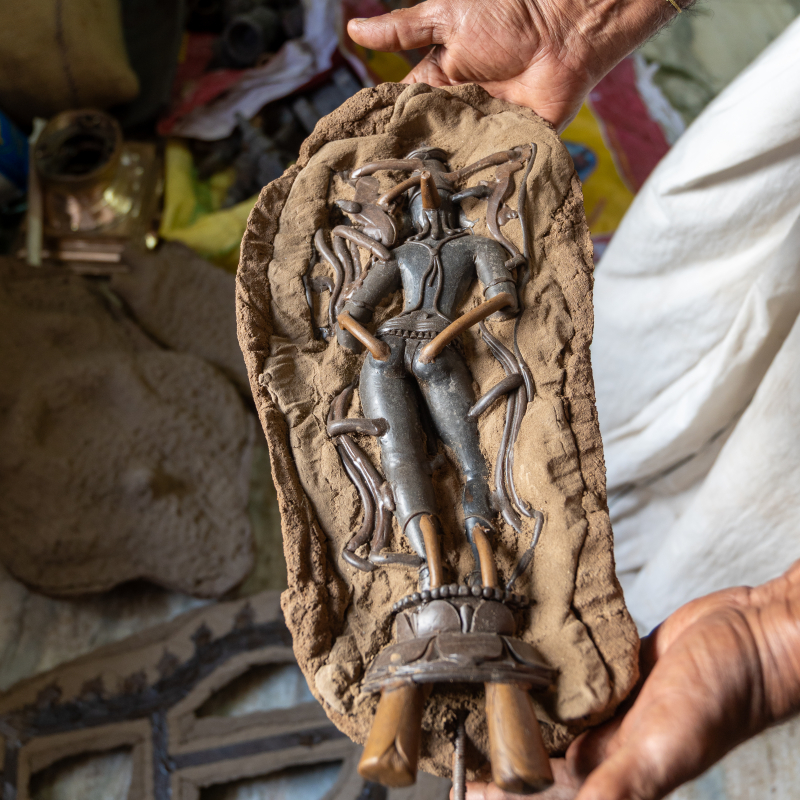
Once the wax model is ready, it is coated in successive layers of fine clay to form a mould. Bronze-casting flourished at Swamimalai as the Kaveri riverbed was said to have the right quality of clay required for this work. Earlier, Vasanth imported clay from Swamimalai by the truckload, but given the expense and inconvenience of it, he has since shifted to using a mixture of Plaster of Paris (PoP) and sand. In his workshop, he makes the mould by coating the wax model in successive layers of PoP interspersed with steel wire reinforcement. Using PoP also speeds up the process significantly: a mould using PoP can be made in a day given its quicker drying time, while the same mould using clay could take up to two weeks. However, PoP can only be used for statues weighing up to 20 kg. For heavier works, Vasanth still resorts to traditional clay. The completed mould, once dried, is heated so that the wax melts out from a port in the top, leaving a cavity in the clay or PoP body. The mould is then baked further to bring its temperature closer to that of the molten alloy that will be poured into the cavity next.
Although called bronze-casting, the alloy used by Vasanth to make these icons is in fact gun-metal. While bronze is an alloy of copper and tin, and brass of copper and zinc, the alloy used by Vasanth has an approximate ratio of 84 per cent copper, 14 per cent zinc and 2 per cent tin, giving it both malleability and hardness. The molten alloy is sometimes sprinkled with gold and silver for shastra (auspiciousness), with this five-metal mixture hence being called panchaloha (meaning "five metals" in Sanskrit, referring to a sacred alloy traditionally used for making temple idols). High quality metal scraps are melted in the furnace to create the alloy; simultaneously, the searing hot mould is buried in the ground next to it to keep it stable while the molten metal is poured inside. Statues for temples are usually solid cast and heavier, while private clients or non-religious institutions prefer lighter statues that are hollow. Typically, the arms and torsos of such statues have cavities. Although traditional methods use clay spacers to create the cavities while casting, Vasanth has adapted to using newer materials such as silicon rubber.
Casting the statues in the moulds is usually done in the evenings. The metal cools over-night, and the next morning, the outer mould is broken to reveal the metal image within. This image is then filed and polished to articulate details of the face, jewellery, clothing, and weapons. Since every mould can be used only once, each image created by this process in Vasantha’s workshop is unique.
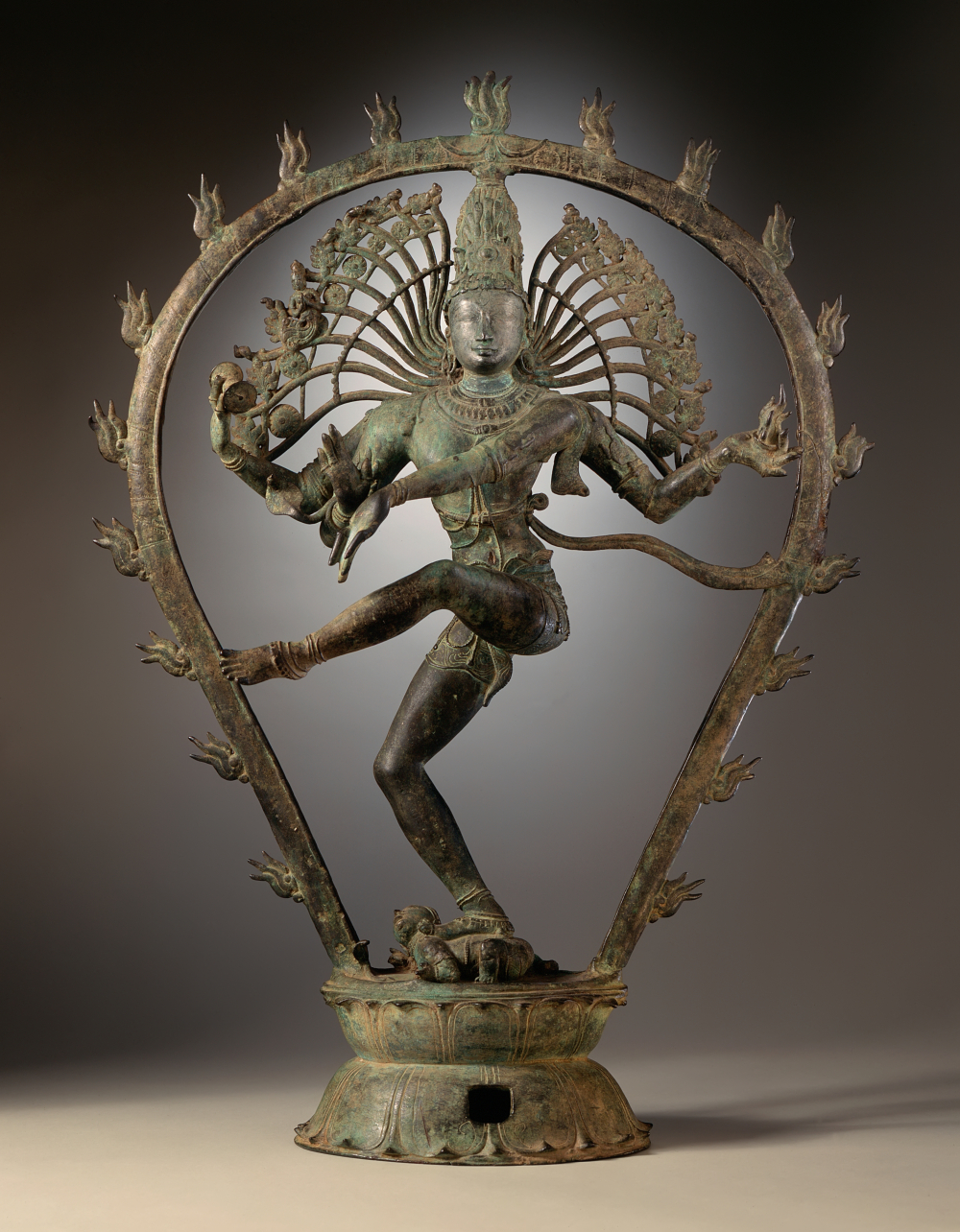
Nataraja, the most famous motif of Chola bronze statues. (Picture Courtesy: LACMA/Wikimedia Commons)
Historical references indicate that regions once governed by the Cholas, including present-day Pondicherry and its surrounding communes, supported clusters of hereditary bronze craftsmen. Among them were families of Asaris, locally called Thachar, who worked as carpenters but were also skilled in bronze casting. Villages such as Uruvaiyar, located along the Sankaraparani River, housed communities engaged in producing bronze icons for temples across the region up until the end of the twentieth-century. These artisans created images on commission that often adhered to strict canonical measurements prescribed in the Shilpashastra (ancient Hindu technical treatises and manuals defining the principles for arts, crafts, and iconography). Several historical statues of this kind have been unearthed, both in Pondicherry and its allied territory of Karaikal, and are now housed in the Pondicherry Museum, which has an impressive 81 bronze figurines from the Chola, Vijayanagara, and Nayaka period. Ranging from a golden-red of weathered bronze to a rich green patina, these statues include amongst others Ganesha in various poses, elegant representations of Shiva and Parvati as Thiripurandhaka and Thiripurasundari, the Pradoshamurthi, a dancing Thirugnanasambandar — the prominent Tamil Shaiva bhakti saint who lived during the Chola empire — and Vishnu as Laxminarayana, Gopalakrishna, and Rama. The age and storage conditions of these figurines have not much dented their aquiline features, the finesse of their jewellery, or the serenity in their expressions.
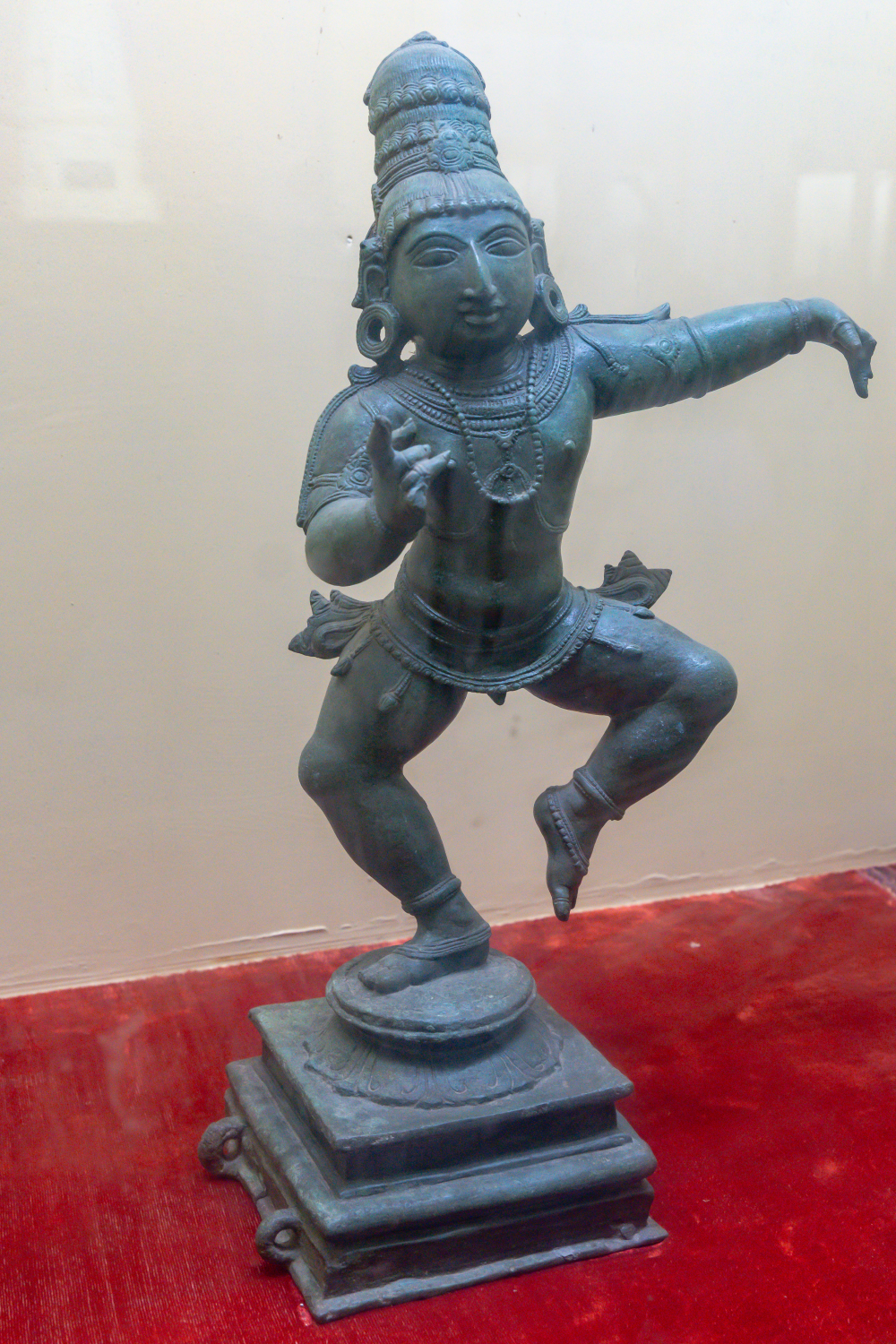
A dancing Thirugnanasambandar. (Picture Courtesy: Wuselig/Wikimedia Commons)
Vasanth’s work follows in this heritage. Although not a hereditary sthapati (bronze caster), his lack of interest in academics led him to begin training in this profession at the age of 16, under the tutelage of an icon maker named Ragan from Swamimalai. Working together with his uncle Bhaskar, who does most of the filing and detailing work on the bronze statues, Vasanth is in charge of making the wax models alongside handling the business operations. Of the modelling work, he says, “It is important to keep in mind the varying characteristics of all the figures. For example, Shiva is lean and powerful while Vishnu has a more rounded body. Ornaments and clothes are often specific to the different characters, and expressions also vary according to their avatars.”
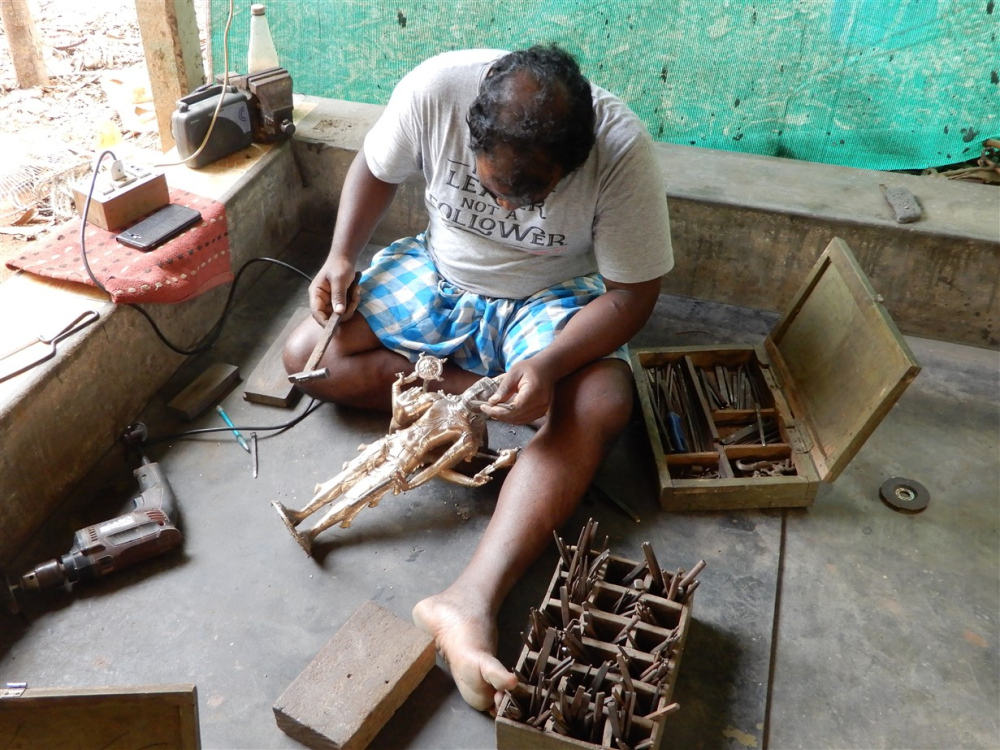
Bhaskar filing a statue to bring out the details. (Picture Credits: Vasanth K)
Among his notable creations is Gajasurasamhara, a powerful iconographic form where Shiva is shown dancing energetically within the flayed hide of the elephant demon Gajasura. This form was popular in both Pallava and Chola art for its dramatic energy and composition. Another significant image that Vasanth creates is Somaskanda, depicting Shiva with Parvati and the infant Skanda or Kartikeya. This representation emerged during the Pallava period (sixth–eighth-centuries) and became a major motif in South Indian temple art. The composition shows Shiva with four arms, Parvati seated beside him, and Skanda positioned between them in a dancing posture. One image that Vasanth makes particularly stands out: Nataraja standing on his hands in a very unusual posture that is a replica of the seventeenth-century statue currently housed in the Aurobindo Ashram library in Pondicherry. Speaking of his most memorable works, Vasanth describes the replica he created of a statue of Narsimha, which is currently in the Metropolitan Museum of Art. It took him four months to create it, with the final product weighing 20 kgs and sold for approximately 2.5 lakh rupees.
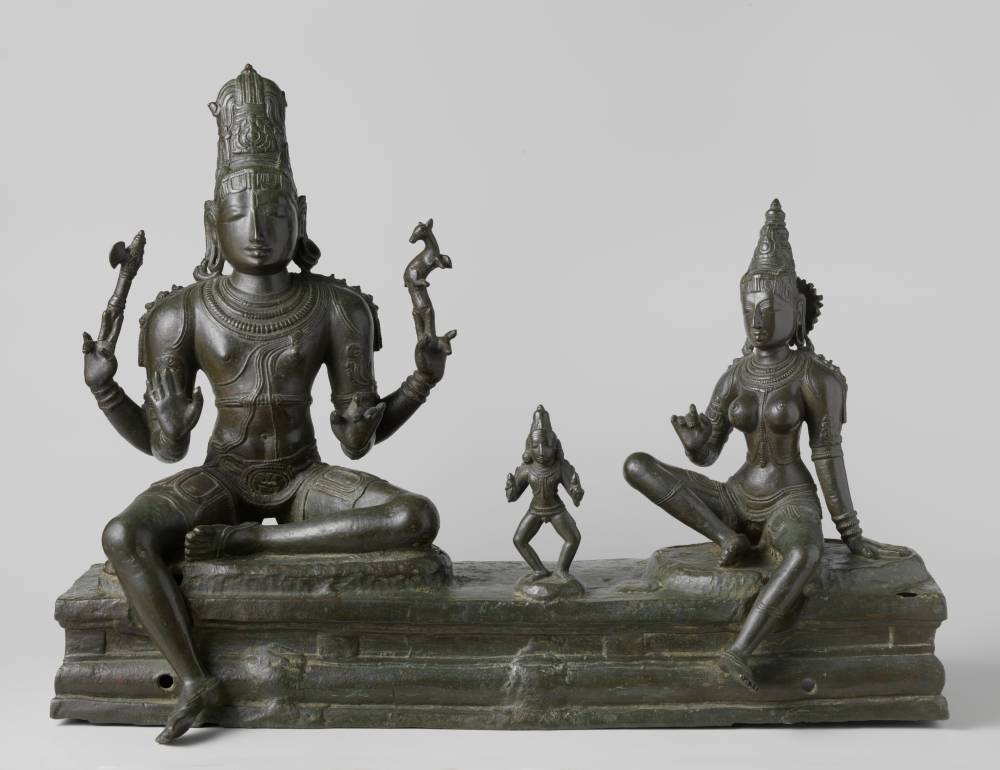
The Somaskanda sculpture at the Rijksmuseum. (Picture Courtesy: Rijksmuseum/Wikimedia Commons)
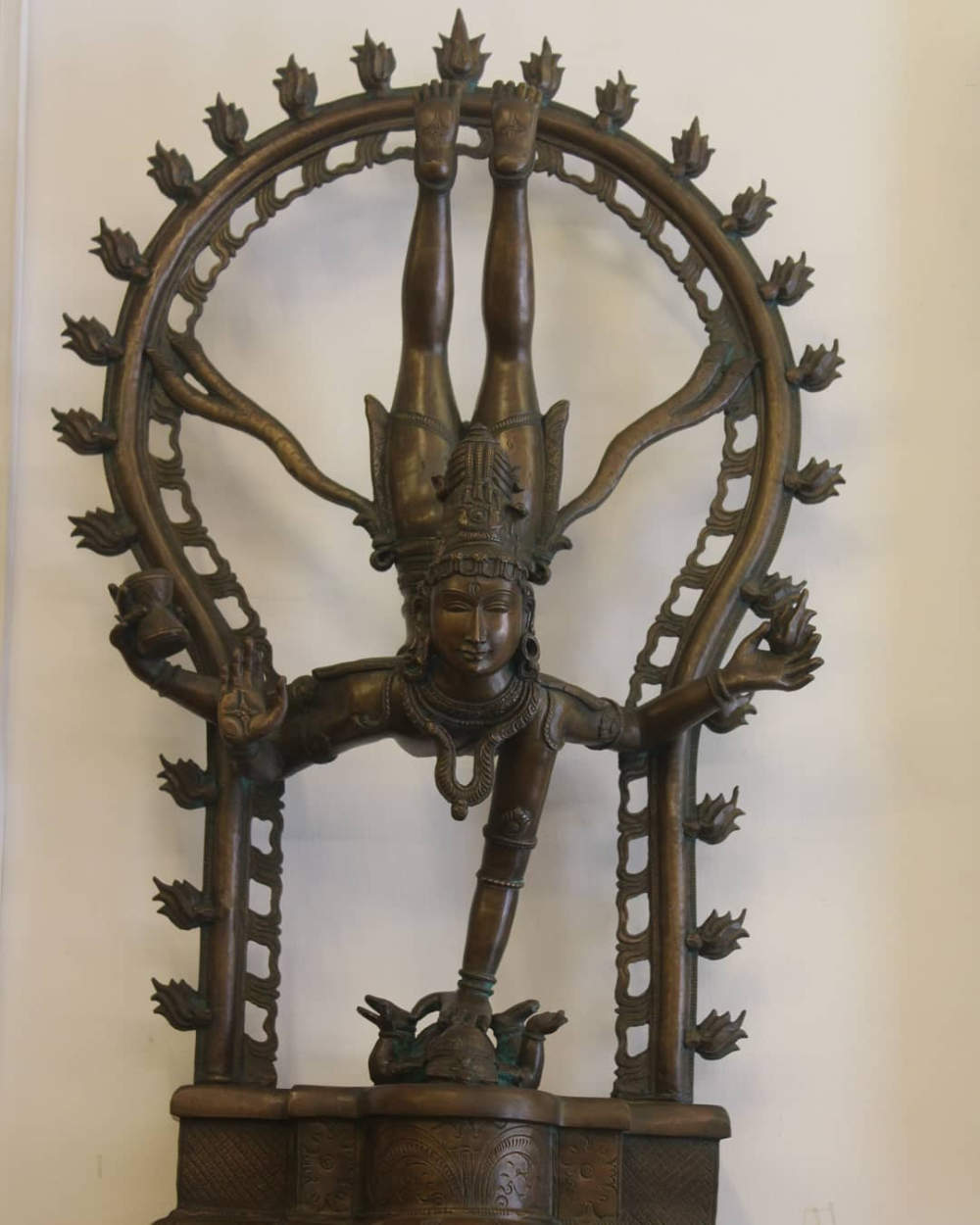
An unusual sculpture of Nataraja created by Vasanth based on the statue in the Ashram Library. (Picture Credits: Vasanth K)
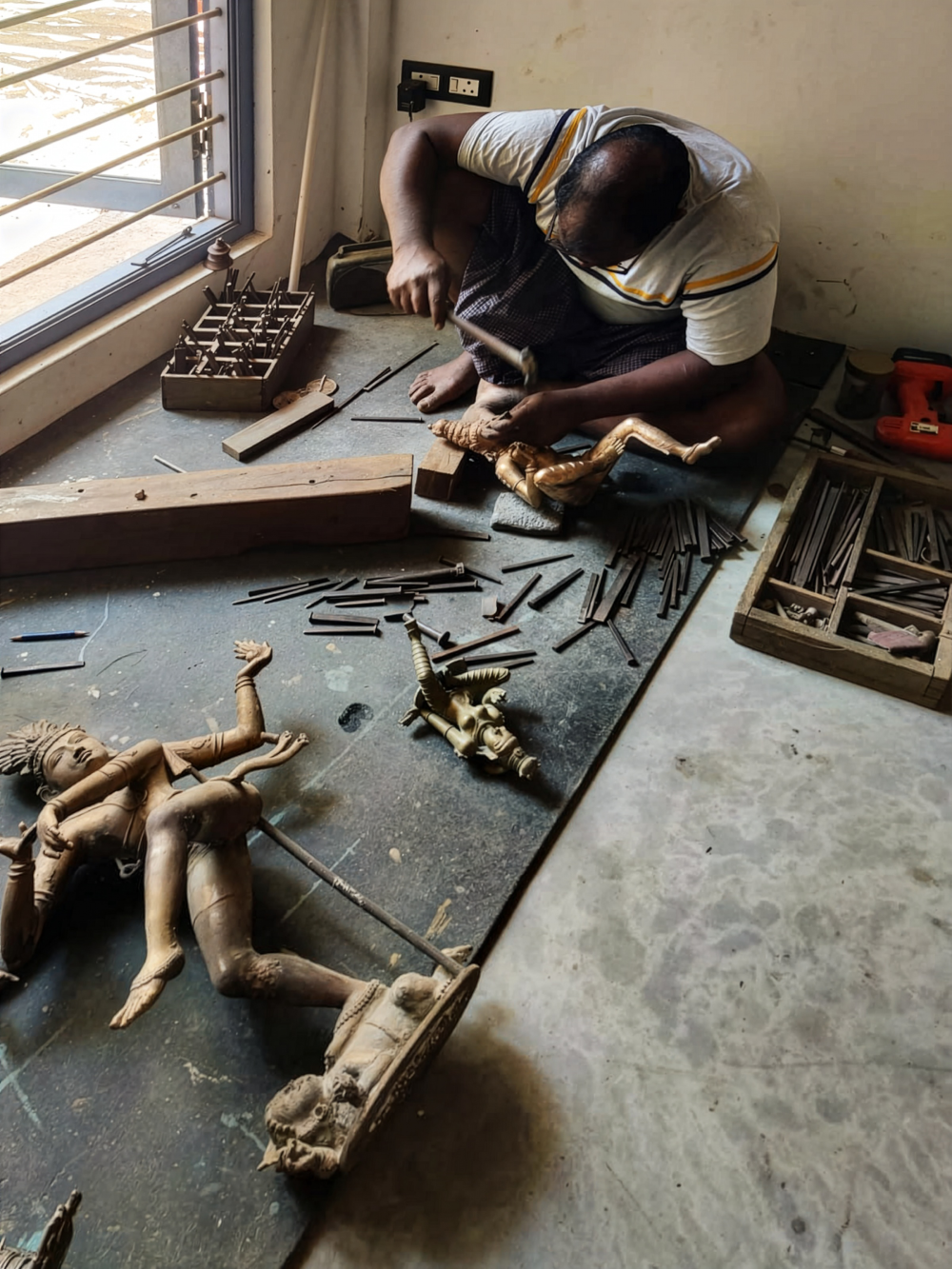
Working on the floor for several hours often leads to chronic back pain. (Picture Credits: Vasanth K)
Currently, Vasanth and Bhaskar are training two apprentices. At one time, they had a team of ten, but finding local youth interested in this craft has been difficult and most of their trainees come from Thanjavur. Inflated tourism in Pondicherry means that young men from the city are keener to join the tourism industry, where earnings are faster. In contrast, becoming a bronze artisan is a slow, demanding process. Says Vasanth, “Learning this craft requires a lot of patience and hard work. It takes more than six months to just learn to create wax models. When the master works, one must watch carefully; and when his work is done, one has to practice by imitating what he has made. One must be prepared to work on the floor for several hours.” The craft’s demands on the body have health implications as well. Despite donning protective gloves and masks, constant exposure to high temperatures — for the metal is heated up to 1000 degrees Celsius — eventually leads to eye problems and constant hair fall. Working on the floor for long periods stresses the spine and leads to chronic back-pain. Vasanth recollects how his master was weak and looked much older than he was at just 55 years, a peril of the job. These health risks are hardly a deterrent for him though. “If it was an easy task, everyone would be making sculptures,” he states.
Through artisans like Vasanth and Bhaskar, Pondicherry maintains but a fragile tether to a once-flourishing bronze-casting tradition. Through their practice, they keep an oft-forgotten aspect of the city’s intangible cultural tradition alive.
Bibliography
Census of India: Series 32, Pondicherry, Part XII. Census Atlas, Government of India, 1981.
Department of Art and Culture, Government of Puducherry. Puducherry Museum, 2025. https://art.py.gov.in/puducherry-museum. Accessed March 10, 2026.
Srinivasan, Sharada. ‘The Art and Science of Chola Bronzes.’ Orientations, 37 (8), (2006): 46-54.
Ślączka, A. Anna. ‘How to Make a ‘Cōḻa Bronze’? Theory and Practice of Bronze Casting in South India.’ European Association for South Asian Archaeology and Art (2023), 201- 210.
This essay has been created as part of Sahapedia's My City My Heritage project, supported by the InterGlobe Foundation (IGF).