
It was on a sweltering, humid June afternoon in 2023 that we disembarked from our bus outside the Seaside Guest House in Pondicherry. Our journey from the Chennai airport to the majestic, sand-scrubbed forms of the Shore Temple at Mahabalipuram felt akin to time travel. Driving along the East Coast road, the pale gray and white waters of a placid sea emerged as a landscape of relief, especially after the cacophony of Chennai. After four weeks of journeying across the sun-baked plains of India, the cadence of the surf and the electric green of the coconut palms soothed our frayed senses. Situated scenically on the coast of the Bay of Bengal, Pondicherry – a languid, formerly French colonial enclave – was intended to be a respite for us, a place where we could finally compile our notes, edit photographs and drawings, assimilate our impressions of the built legacy of the subcontinent, and savor the offerings of this curious Indo-French outpost.
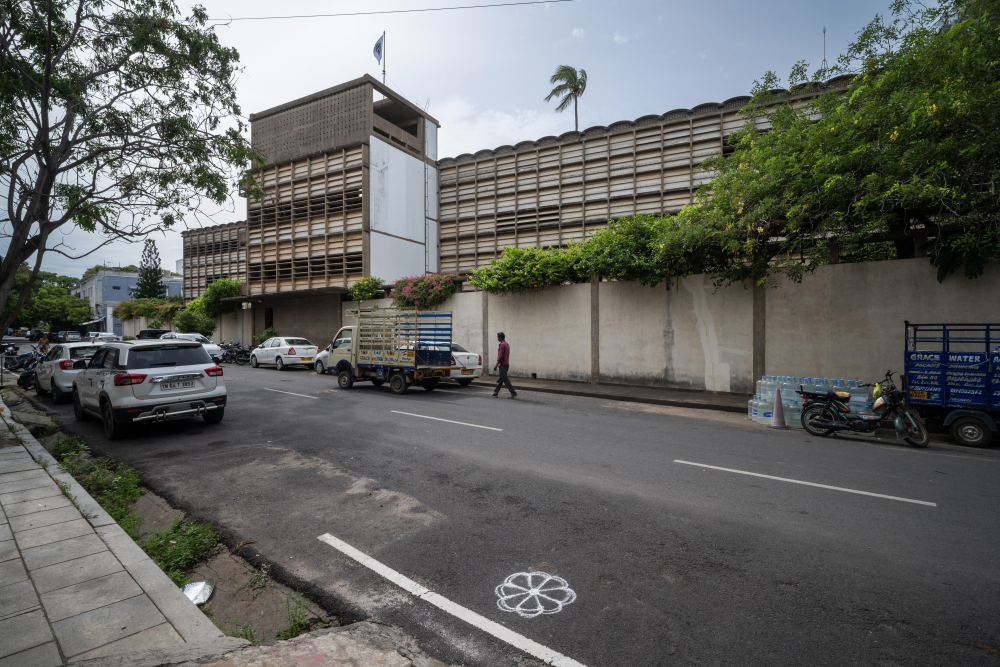
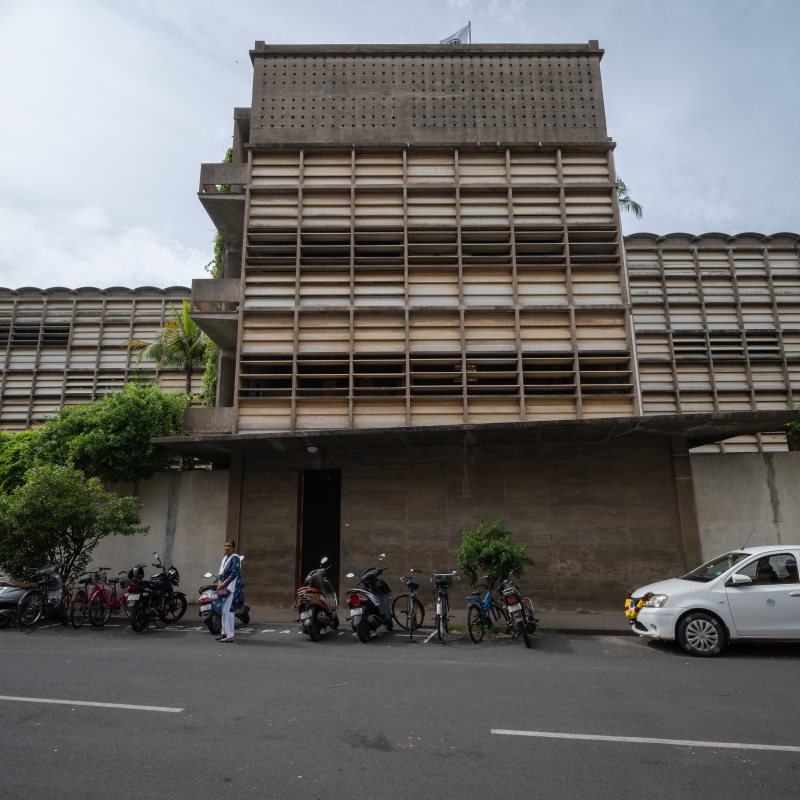
The front elevation of Golconde. (Picture Credits: Joseph Rahul)
Within the austere walls of the Sri Aurobindo Ashram – painted gray and white to match the sea — meandering through carefully swept corridors, we felt enveloped by a sense of order and serenity. Our olfactory radar led us to the Ashram perfumery, a high-ceilinged and cool room, where a selection of Ashram distillations – frangipani, sea salt and lime, hibiscus and khus – refreshed our spirits. Our senses enhanced by this restorative interlude, we walked towards the local bazaar across the large drain. This drain had historically been the border between the French colonial enclave and the “Tamil town.” As we approached the intersection of the streets Rue Dupuy and Rue D’Orleans, the lights and din of the evening bazaar were palpable even from a distance. In the fading light, we found ourselves walking alongside a high boundary wall, its exposed concrete surface draped with foliage – carefully trimmed arcs of bougainvillea and heady blossoms of jasmine. A polished teak door, crafted with some care, and adorned simply with a diminutive brass ornament – a lotus flower – beckoned beguilingly. Our gaze wandered skyward, toward the swaying coconut palms visible beyond the wall, and it was then that we caught our first glimpse of an extraordinary façade: hundreds of concrete louvers, arrayed in a grid, their tips catching the fading pink light of the setting sun. This was Golconde!
Over the next few years, our obsession with the building deepened, and we returned again and again, spending months documenting and recording the story of this remarkable cloister – a dormitory building for the devotees of the Aurobindo Ashram, commissioned by Sri Aurobindo and his spiritual companion known simply as The Mother (Mirra Alfassa). We were fortunate to spend hours with Mona Pinto, the long serving custodian and guardian of Golconde. As the wife of Udar Pinto, one of the Mother’s confidants who played a vital role in the construction and completion of this building, Mona introduced us to the ’spirit’ that pervaded the initial years of design and construction.
Sited on the threshold of the former French enclave and Tamil town, this dormitory for the Sri Aurobindo Ashram in Pondicherry, India, was designed by architects George Nakashima and Antonin Raymond.
The Makers of Golconde
Established in the early 1920s by Sri Aurobindo, a prominent Indian activist and spiritual leader, the Ashram focused on a spare, meditative existence. Sri Aurobindo and the Mother sought an architectural style that was similarly devoid of excess and ornament for the devotees’ dormitory. Golconde, designed by architects George Nakashima and Antonin Raymond, was to fulfil this requirement.
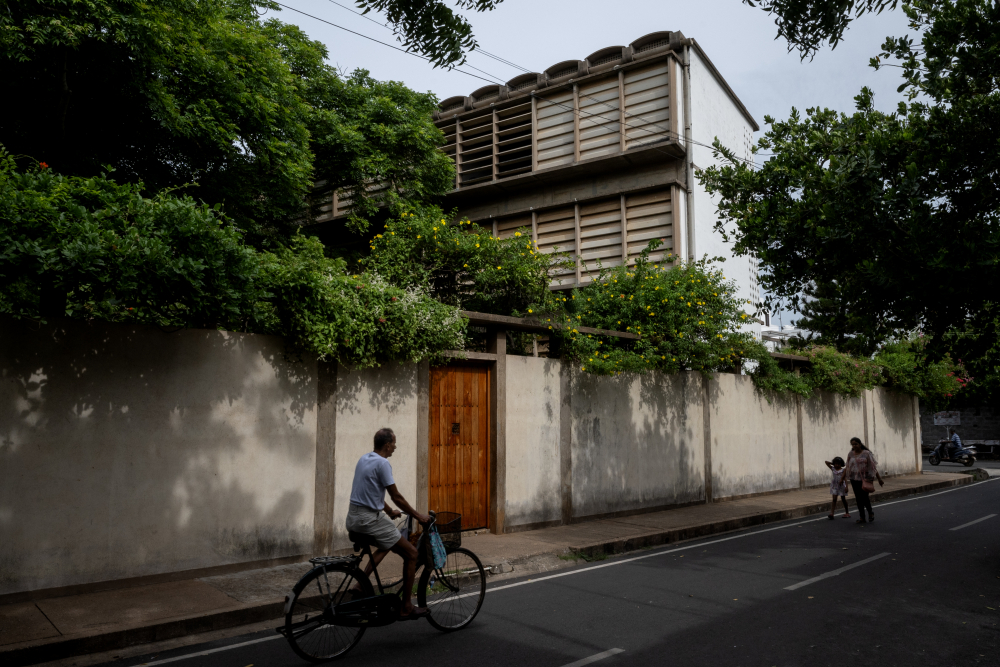
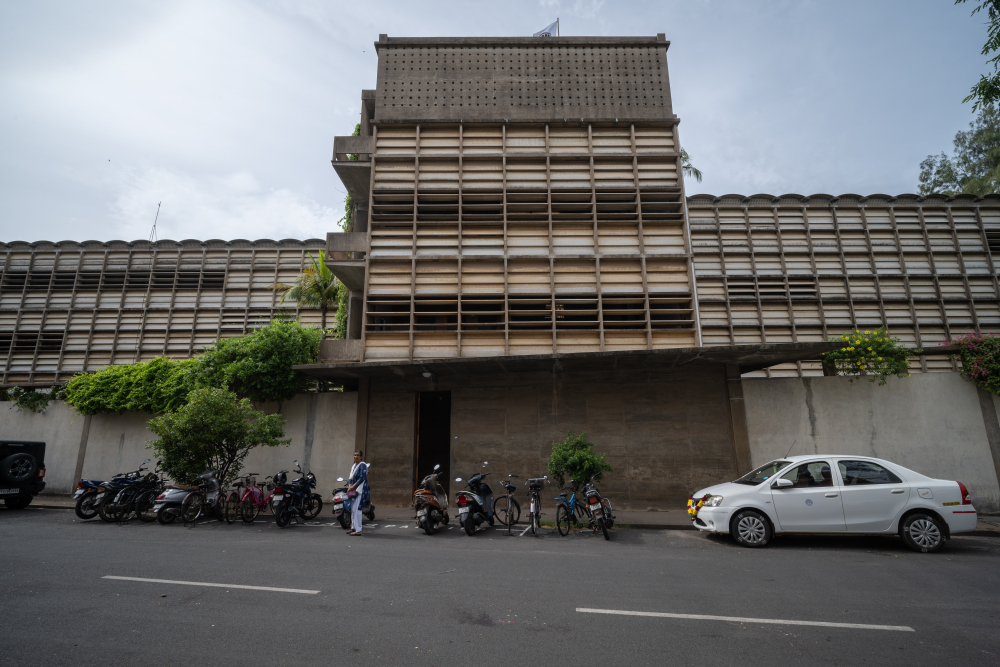
Views of the elevation of Golconde from different angles. (Picture Credits: Joseph Rahul)
In 1935, Antonin Raymond's architectural office in Tokyo received a commission for the design of a new residential dormitory for the ashram. Raymond had been recommended by Philippe В. St. Hilaire (also known as Pavitra), a French engineer and ashram devotee. The French government had expressed concern at the growing influence of the Ashram and proposed that the ashramites refrain from any further purchases of property in the French section. A property adjacent to the local Tamil neighborhood was selected as the proposed site for the new building. Funds for construction were donated by Sir Akbar Hydari, Prime Minister of the prosperous state of Hyderabad, whose son, Ali Hydari, had received solace in the ashram community. The dormitory was eventually named Golconde, after the famous Golconda diamond mines in Hyderabad.
The schematic design for the dormitory project was completed in early 1936. The construction supervision was entrusted to Nakashima and Francois Sammer — a Czech architect who had worked for Le Corbusier in Russia before joining Raymond's staff. The ingenuity of Raymond's design and the absence of skilled contractors in Pondicherry posed a particular dilemma for the construction of the building.
Nakashima spent the next two years as both an ashram devotee (he adopted the Indian name Sunderananda: one who delights in beauty) and a project architect. Slowly, he developed many of the building's careful construction methods and details on site. During his stay, he maintained a meticulous diary of the construction progress and dutifully submitted it to the Mother for her commentary. Although Raymond originally envisioned a six-month time frame for construction, this schedule did not account for Sri Aurobindo's desire to protect the tranquil ashram environment from the din associated with a commercial construction company. Thus a workforce composed solely of members of the ashram began construction. Due to the absence of an experienced construction crew, Nakashima's duties included the preparation of detailed drawings for the construction of the concrete form work.
By 1937, due to the imminent threat of war and political unrest in Asia and Europe, many of the materials and hardware originally stipulated in the building specifications could no longer be imported. The development of alternative solutions on-site became necessary. In order to cast all metal hardware components stipulated in the design drawings, the architects constructed a foundry on the building site. The devotees of the Sri Aurobindo Ashram donated brass utensils, including cups, bowls, and plates. These were melted and recast as bolts, hinges, and door handles.
Finally, George Nakashima left India in October 1939, having completed most of the concrete work for the structure. After Nakashima's departure, Udar Pinto, an Indian aeronautical engineer assumed the task of supervising the construction. He continued to work on the completion of the drawings and the design of the furniture. Like Nakashima, Udar consulted with the Mother on all decisions pertaining to the design. Under his supervision, the building was finally completed in 1942 — and had the distinction of being the first reinforced, cast-in-place concrete building in India.
The Design of the Dorm
Golconde is a remarkable architectural edifice, seamlessly negotiating between the tenets of early modernist architecture while addressing the pragmatic impositions of a tropical context. It predates the more renowned, Indian modernist essays by Le Corbusier in Chandigarh (1951–64) and Ahmedabad (1952–56). The immaculately maintained building uses a spare material palette: reinforced concrete primary structure, bowed concrete shell roof, and polished Cuddapah (a local slate) stone floors. From the exterior, the building has a surreal, abstract quality. The facades are modulated with operable asbestos-cement louvers set in custom-made brass hardware. Sliding teak wood lattice screens separate the interior rooms from the main, single-loaded corridors. Crushed seashell plaster walls and black stone floors in every room provide a luminous canvas for the mélange of breeze and light entering through the louvers and sliders. A central core, containing the main stair as well as the bathroom units, services the building. The rooms — all designed with a view of the South garden—are accessed via a gallery overlooking the North garden. The building interior thus functions as a threshold, always within proximity of the exterior. The most striking feature of Golconde is the skillful integration of the building with its landscape; shifts in scale from structure to detail, and transitions between exterior and interior, occur with grace and precision. The structure is one of the clearest examples of the modernist credo: architecture as the manifest union of aesthetics, technology, and social reform.
In the years since our book on Golconde was first published, the reasons to revisit the story of its creation have intensified. The acceleration of urbanization in India has seen an explosion of unplanned growth in slum settlements. The problems of social inequity have been exacerbated by the advance of climate change. A disregard for ecological safeguards has seen the proliferation of buildings with little sensitivity to site-appropriate building materials and scant knowledge of local construction technology. Eight decades after its completion, Golconde thrives as an archetype of visionary modern architecture, albeit one that by virtue of its design ethic, and the craft and care of its construction, remains vital to – and firmly rooted in – its cultural context.
Seeking spatial solace has been a human preoccupation for much of human existence. If ever the notion of sanctuary — of a place in the world at a safe remove from its tribulations — needed to be manifest, then this certainly is that time. Enforced isolations, mediated encounters, and filtered interfaces have become the norm. During the pandemic, as an unseen viral adversary unmasked our frailty, it reinforced the need for that essential human construct – shared, safe space. Created during another tumultuous time of human suffering — at the onset of the second World War — Golconde prevails as an exemplar of calm succor for its inhabitants.
Note: Parts of this article were originally published in the book ‘Golconde: The Introduction of Modernism in India’ by Pankaj Vir Gupta, Christine Mueller, and Cyrus Samii (New Delhi: Urban Crayon Press, 2010; New York: Actar Publishers, 2021).
This essay has been created as part of Sahapedia's My City My Heritage project, supported by the InterGlobe Foundation (IGF).