
Pondicherry was under French rule from 1674 and subsequently developed into a trading hub for the French East India Company. They dealt with textiles–and in particular, guinée cloth. Also known as blue cloth (indigo-dyed), this textile was renowned for its colour and quality — attributed to the alumina content in the river water and exported to numerous locations. In fact, in Senegal in West Africa, it even served as a medium of currency in the gum trade. This made Pondicherry well-known for its dyeing quality, with clothes manufactured across different parts of India sent there for dyeing.
In 1885, this inspired Jamshedji Tata to send his son, Dorabjee Tata to Pondicherry to establish a textile mill. This, however, did not materialize. According to R. M. Lala, two factors account for this failure. One was the financial unviability of the project; the other, likely the ill health of Jamshedji, who may have wished Dorabjee Tata nearer.
![An image from a collection of lithographs depicting life in French India in the 19th century. The image shows a weaver preparing the warp, his wife spinning, and in the background the warp mounted and the loom suspended from a tree branch. Source: French India, or collection of lithographed drawings representing divinities, temples, costumes [...]. Volume one, 1827. (Picture Courtesy: Caryatid, INHA digital library, NUM FOL EE 9 (1))](http://www.sahapedia.org/sites/default/files/styles/sp_inline_images/public/inline-images/82.43824189926212%2C634.7670250896058%2C3083.190247032403%2C3445.878136200717-0618_doucet_FEE9_01_000271.jpg?itok=8pn2SGHB)
An image from a collection of lithographs depicting life in French India in the 19th century. The image shows a weaver preparing the warp, his wife spinning, and in the background the warp mounted and the loom suspended from a tree branch. Source: French India, or collection of lithographed drawings representing divinities, temples, costumes [...]. Volume one, 1827. (Picture Courtesy: Caryatid, INHA digital library, NUM FOL EE 9 (1))
Meanwhile, once Pondicherry was recovered from British control (1793 and 1816) by the French, efforts were made to restore its trade prosperity and to develop the economy. Governor Richemont Desbassayns advocated for the establishment of a spinning and weaving cotton industry in Pondicherry. He cited in support the availability of 60 leagues of cotton from Tirunelveli, the safety of the harbour, cheap labour, and the large number of weavers, the quality of the water for dyeing, and the long-standing reputation of its linens. Finally, in 1827, a local ordinance was enacted to invite private entrepreneurs to establish industries, transforming Pondicherry from a trade post into an industrial hub.
The Emergence of the Textile Industry
In 1828, Blin, a businessman from Pondicherry, and Delbruck, based in Bordeaux, aimed to set up a textile mill. This was driven in the context of various government concessions, which included a 20 per cent discount on the machine, free shipping for equipment and workers, free land for the factory, and a loan of 30,000 francs at 4 per cent interest, repayable over six years.
Tempted by the concessions, the Le Prince et Poulain company, the machine builders of the Blin and Delbruck company, sought similar government support to set up their own, larger spinning mill in Pondicherry. In fact, Poulain sold his venture in France and oriented his future plans towards Pondicherry. However, this initial optimism only lasted until his arrival. The free transport clause could not be implemented, as no state-owned vessel was fitted out to carry the machinery, and to avoid delaying shipments, merchant ships were chartered. Despite this, the ship was delayed by the bad weather conditions and a sailors’ strike. Moreover, since the Suez Canal had not yet been opened, the machines were shipped from indirect routes. The freight for machines absorbed the bonus they were counting on to get them going. Each obstacle crossed, Poulain found himself at a loss before he even began his mill. Nevertheless, he succeeded in securing the concession from the government and an extension of the bonus for a further six years. Eventually, Charlemagne Poulain would go on to be considered a pioneer in sustaining the mill's operation.
By 1832, even the Blin and Delbruck businesses operated under the name Poulain & Co. Yet despite their investment in this new endeavour, Poulain and Duboy continued to face challenges in Pondicherry: the harsh climate, the negligence of the local workers, their softness, religious biases, and lack of knowledge in the mechanical industries. Even so, the two businessmen were convinced that even if the venture did not yield any expected benefits, it would serve as evidence that the French were the pioneers of incorporating European industry in India.
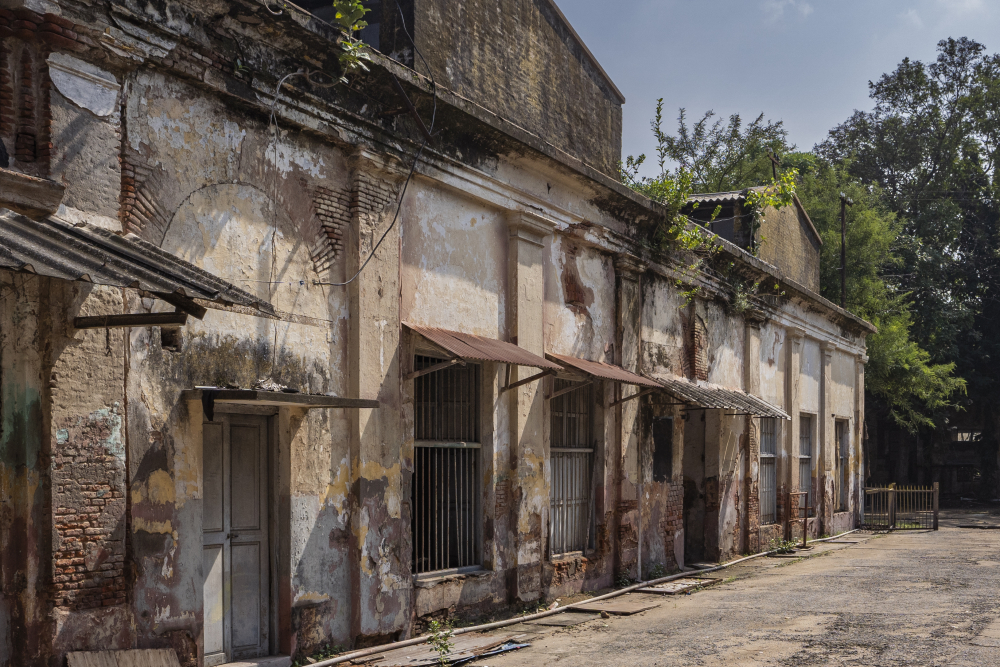
The run down building of the abandoned Savana mill, later renamed Swadeshi Cotton Mills. (Picture Credits: Jubin Bennet)
In 1835, the new factory's workforce consisted of 86 men, nearly all young, alongside 35 women and 97 children, indicating a diversification of Indian workers. The employment of women suggests that prejudices were also diminishing. In 1886, ownership was transferred and the factory was renamed ‘Savana’ with its central office located in Bordeaux, France.
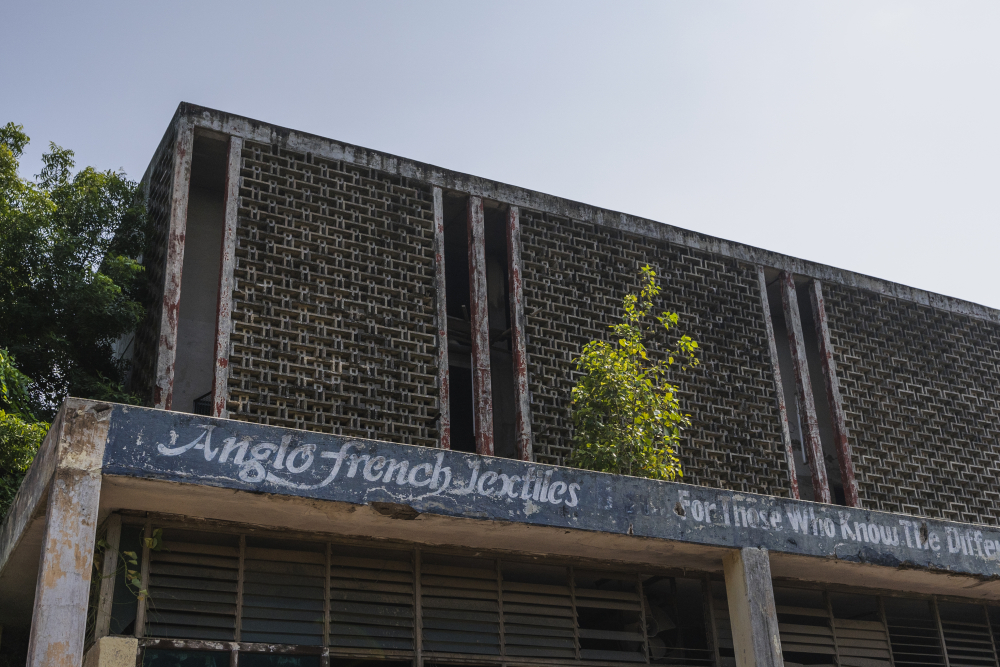
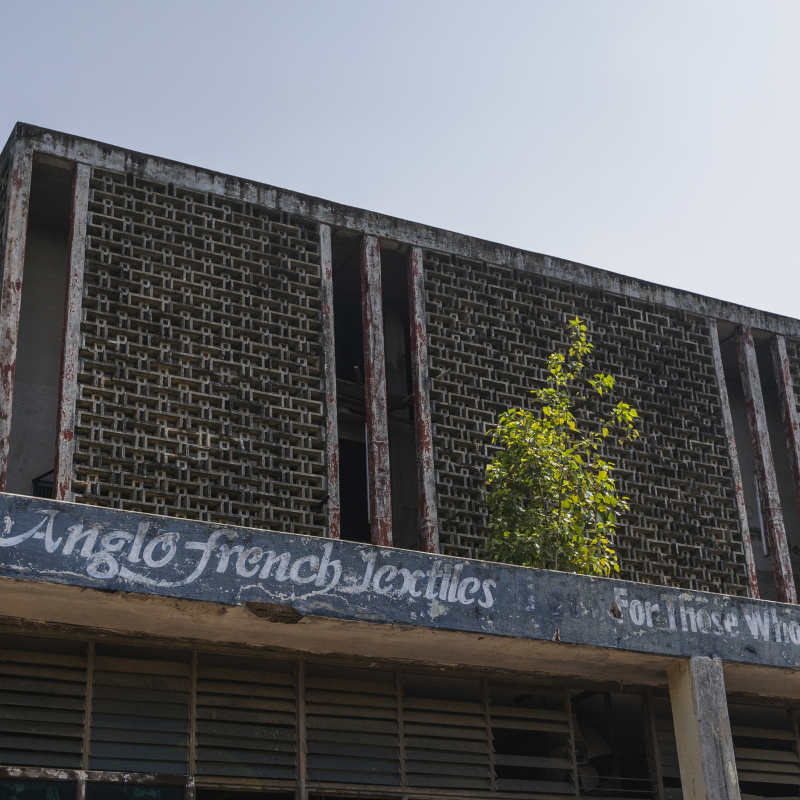
Rodier Mill, later renamed Anglo-French Textiles in 1955. (Picture Credits: Jubin Bennet)
Poulain and Duboy, however, inspired a series of similar endeavours. The second textile mill of Pondicherry was founded in 1892 under Henri Gaebele and called ‘Filature et tissage Gaebele.’ It was commonly called the Pondicherry Cotton Mills, and also referred to as the Mudaliarpet mill due to its location. The third mill, known as the Rodier mill, was an Anglo-French textile factory that opened in 1898 under the British firm's headquarters in London—it became the largest mill in Pondicherry. All these textile mill establishments contributed to the development of a new working-class community in Pondicherry.
The Strike of the Working Class
By 1936, approximately a total of 8000 Indian workers were employed across all three mills in Pondicherry. Like workers worldwide, they encountered extended working hours, low wages, and unfavourable conditions. In Bombay and Madras, workers used to work for 10 hours per day, while in Pondicherry, it extended to 11-12 hours—earning only between 12 and 14 annas. They lived under constant fear of dismissal if they displeased the management. Given these impossible conditions, the workers eventually organised a strike and demanded an 8-hour workday.
Due to a lack of legal recognition of trade unions in colonial India, workers lacked any proper means to advocate for the means to redress their grievances. Members of the Harijana Seva Sangham, established in 1933, worked among the mill workers and raised awareness of the dire conditions faced by the working class. This inspired the strikes in the Savana mills in 1935, where many hundreds were victimised. The workers thereupon began to consult the labour leaders V. Subbiah, Editor of the journal Swadhanthiram, and L. J. X. Doraiswami, Secretary of the French India Labour Conference Committee. Together, they conceived the idea of organising a workers’ conference on 10th May 1936, to urge the government to legislate necessary labour measures. Messrs. V. V. Giri and S. Guruswami, General Secretary and Assistant Secretary of the All India Railwaymen’s Federation, representing nearly one thousand transport workers in British India, were also invited to participate in the conference.
Unfortunately, the conference was banned. Disappointed, the workers returned to their headquarters, approximately 160 km from Pondicherry. The workers were so agitated that they then entered British territory (in Madras) and convened a meeting to protest against the actions of the local authorities in Pondicherry. On 23rd May 1936, the French government enacted local labour legislation for the first time, albeit exclusively affecting women and young workers, to offer them workers’ rights. The local workers of Pondicherry rose to conduct a meeting on 21st June, in part to commend the French government for this measure and in part to advocate for labour legislation that included male adult workers. Even though the meeting was banned within French territory, it was held in neighbouring British territory. This action was seen as an act of provocation, leading the French to deny workers the right to hold public meetings to voice grievances.
As the grievances remained unresolved and workers' rights to assemble or form associations were denied, the locals decided to organize a strike. The strike was led by local agitators, headed by Subbiah, who coordinated with labour activists in British India and France. The victories of workers in France and Italy encouraged Pondicherry workers to demand similar rights. Eventually, on 29th June 1936, workers in all three mills organised a “stay in” strike, demanding eight-hour workdays, collective bargaining rights, wage increases, holidays, and the right to form labour unions.
Finally, the government consented to enact legislation concerning working hours, wage increases, and holiday provisions. However, it declined to support the formation of trade unions. Once again, during the final week of July, employees initiated another strike. Consequently, the atmosphere was tense. Monsieur Solomiac, the governor of French-India, ordered an assault on the workers, leading to a confrontation between the armed police, aided by the military, and the unarmed workers. Shooting took place at the Rodier Mills and the Savana Mills. While none were injured by the strikers, hundreds of workers were injured and several killed by the police. The 1936 strike and the subsequent violence against the workers took the lives of 12 mill-workers. There was a reign of terror in the city. The shooting led to such a great panic that many thousands of workers left French territory as refugees for British territory in Tamil Nadu.
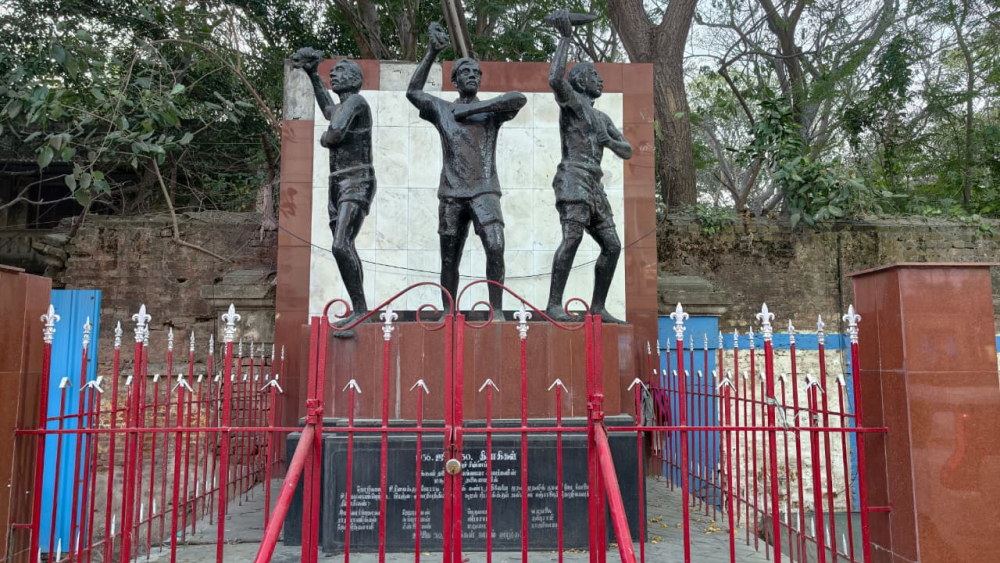
Statue commemorating the textile workers who fought for labour rights and were killed in police firing. (Picture Credits: Bharathapriya R)
Following the strike, the coalition government in France initiated an enquiry and appointed Senator Justin Godart to examine workers’ issues in French India. He recognised that the working conditions were unsatisfactory, pledged to deliver justice, and met all worker demands. As a result, Pondicherry's workers became pioneers in Asia by securing an 8-hour workday. To commemorate this event, a statue was erected in front of the Swadeshi Mill.
The Closure of the Mills
After Pondicherry merged with India, until the Annual Survey of Industries (1972-74), the cotton textile industry ranked first from the point of view of volume of employment. It accounted for 72 per cent of the total employment of all industries. Bharathi Mill and Swadeshi Mill were taken over by the National Textile Corporation until the Puducherry government assumed control of them in 2005. The third firm, Rodier Mill, operated until 1983, when its owner decided to shut it down. The Puducherry government took over that mill in 1986 and managed it until Cyclone Thane hit the territory in December 2011. Nonetheless, all three mills closed permanently in 2020 following an extended court proceeding, due to the economic crisis, the decline of the overseas market, and the diminished demand for cotton.
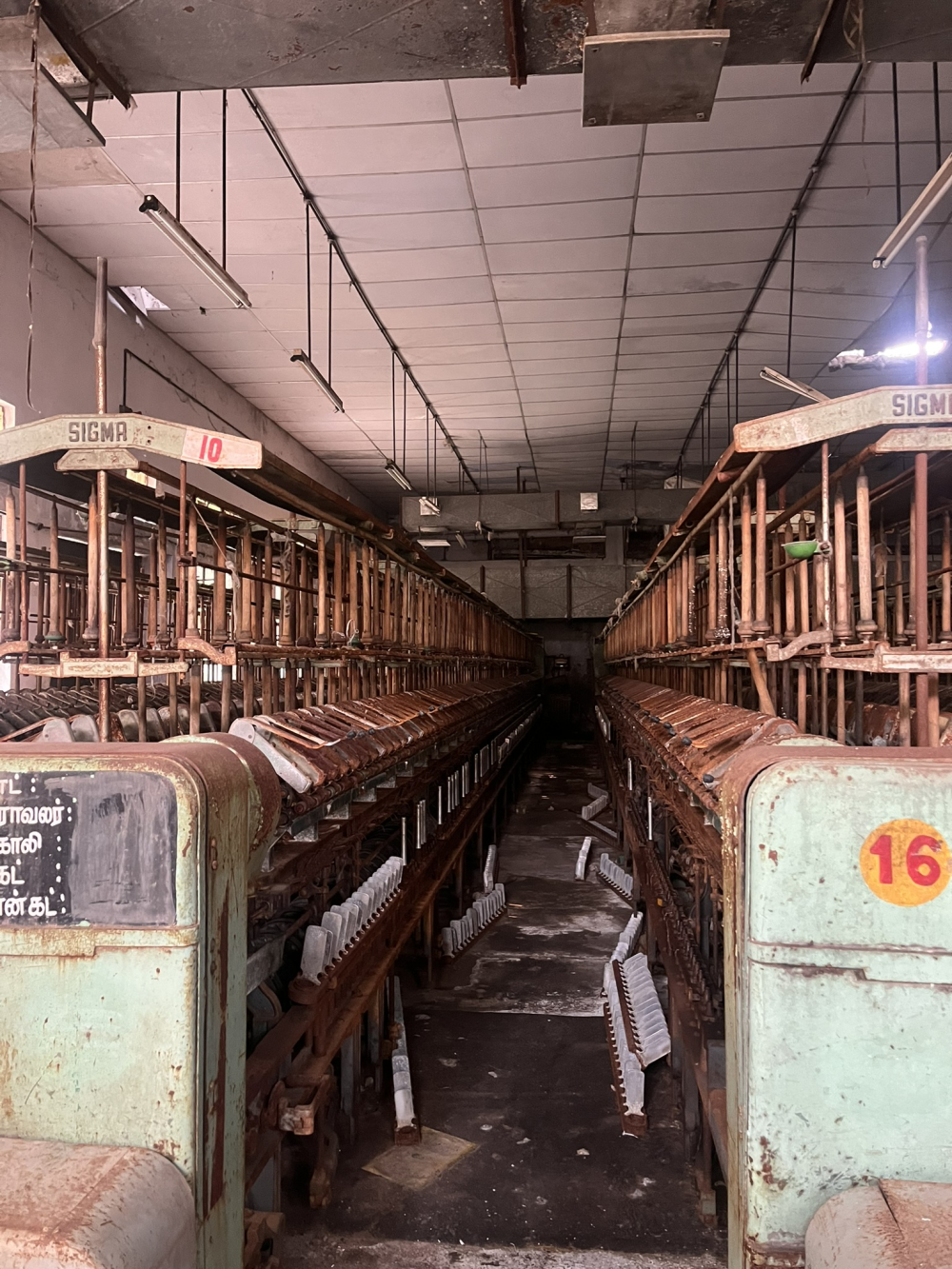
Defunct weaving machines inside Swadeshi Mills. (Picture Credits: Bharathapriya R)
As reported, the Workers’ Union stated that the mills were, in fact, reaping profits, but mismanagement and corruption led to losses. All the mill workers lost their jobs and consequently fell into financial crises. The areas surrounding the mills, once densely populated by mill workers, are now sparsely inhabited, with not even a few hundred populace remaining. Many workers migrated elsewhere; no surveys or official reports exist to document what happened to them after the closure of the mills.
Many prospects for the mills' reopening have emerged since late 2018. The chief executive officer of Anglo-French Textiles Ltd., P. Somasundaram, wrote a letter to the Prime Minister of India stating that, “at a rough reckoning, the total turnover after the reconstruction of Anglo-French Textiles, both home sales and export sales put together, may go up to Rs. 2,300 Crores. Besides, it provides direct employment for more than 22,000 people, including the people engaged by the clusters in the private sector, while indirect employment in other related areas may be to the tune of another 14,000 people. While looking at the high rate of unemployment of 45 per cent in Puducherry, which is the highest in India, the present scheme of reconstruction of Anglo-French Textiles Ltd. will constitute a boon to the people of Puducherry.” The potential benefits of reopening the mills is significant, particularly to the people of the area, and thus a prospect that continues to retain interest.
Conclusion
The Government of Puducherry is currently examining possibilities for the establishment of an information technology park and a textile industry at the site of the erstwhile Anglo-French Textiles Ltd. in the town, according to Home Minister A. Namassivayam's statement in the Assembly on Thursday, 20th March 2025.
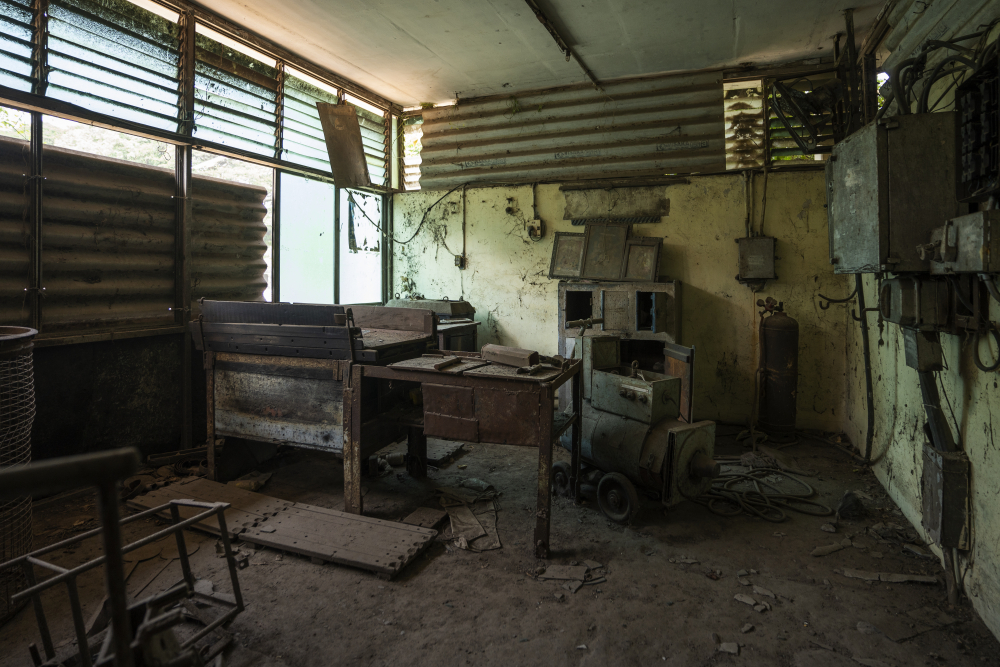
Interiors of the abandoned Anglo-French textile mills. (Picture Credits: Jubin Bennet)
While the future is considered, it is as crucial to consider how to preserve and attend to the existing mills. Although nowadays Puducherry is widely recognised for its tourism prospects, none of its century-old textile mills have been preserved or turned into museums, despite their important historical significance. These mills are not merely abandoned industrial buildings—they not only showcase unique Anglo-French industrial architecture, but also provide essential insights into the lives of workers who formed the core of the French-Indian economy. While the city is currently promoted as a heritage and spiritual destination to boost weekend tourism, these stories often hide its long-standing identity as a working-class city. The city's workforce has changed over the years, but Puducherry still attracts workers from all over the country and relies on their labour for its economy. Therefore, it is vital to preserve and highlight the contributions of these workers, past and present, to ensure that the city’s heritage reflects not only colonial aesthetics but also its vibrant labour history.
Bibliography
Annual Survey of Industries, 1970; 1971; and 1973–1974. Central Secretariat Library, New Delhi: Government of the Union Territory of Pondicherry.
Antony, Francis Cyril, ed. Gazetteer of India: Union Territory of Pondicherry. Vol. 1: Industries. Pondicherry: Administration of the Union Territory of Pondicherry, 1982.
Antony, Francis Cyril, ed. Gazetteer of India: Union Territory of Pondicherry. Vol. 2: Labour Welfare. Pondicherry: Administration of the Union Territory of Pondicherry, 1982.
R., Bharathapriya. ‘The British Firm in French India: Evidence of Colonial Dispute and Economic Dependence.’ Working Paper in History, Woxsen University, 2025.
Casey, P. The Story of TATA: 1868 to 2021. India: Penguin Viking, 2021.
Chapman, Jane L. Gender, Citizenship and Newspapers: Historical and Transnational Perspectives.London: Palgrave Macmillan, 2013.
‘Puducherry Plans IT Park, Textile Hub at Defunct AFT Mill Site.’ Construction World, March 25, 2025. https://www.constructionworld.in/policy-updates-and-economic-news/puducherry-plans-it-park-textile-hub-at-defunct-aft-mill-site/70785.
Harris, F. R. Jamsetji Nusserwanji Tata: A Chronicle of His Life. India: Rupa Publications, 1925.
Lala, R. M. For the Love of India: The Life and Times of Jamsetji Tata. India: Penguin, 2006.
Lobligeois, Mireille. ‘II. Ateliers publics et filatures privées à Pondichéry après 1816.’ Bulletin de l’École française d’Extrême-Orient 59 (1972): 7–75.
More, J. B. Prashant. Towards Freedom in Pondicherry: Society, Economy and Politics under French Rule (1816–1962). London: Routledge, 2022.
Periasamy, Somasundaram. Reconstruction of Anglo-French Textile. February 22, 2018.
https://reconaftpdy.blogspot.com/. Accessed February 27, 2026.
Roberts, Richard. ‘Guinée Cloth: Linked Transformations within France’s Empire in the Nineteenth Century.’ Cahiers d’Études Africaines 32, no. 128 (1992): 597–627.
Sridharan, M. P. ‘Trade Unions and the Liberation of Pondicherry.’ Proceedings of the Indian History Congress, vol. 58 (1997): 607–614.
Sruti, M. D. ‘Puducherry’s Grand, Century-old Textile Mills Shut Since 2020.’ NewsClick, October 5, 2022. https://www.newsclick.in/puducherry-grand-century-old-textile-mills-remain-shut-since-2020. Accessed February 27, 2026.
Stephen, S. Jeyaseela. Pondicherry under the French: Illuminating the Urban Landscape, 1674–1793. New Delhi: Primus Books, 2018.
Subbiah, V. Puduvai Manila Dhesiya Iyakkam 50 vathu Aandu Suthanthira Varalaru. Pondicherry: Swathantiram, Special Edition, 1985.
‘IT Park, Textile Unit Planned on AFT Mill Premises: Puducherry Minister.’ The Hindu, Puducherry Edition, March 20, 2025. https://www.thehindu.com/news/cities/puducherry/it-park-textile-unit-planned-on-aft-mill-premises-puducherry-minister/article69352579.ece. Accessed February 27, 2026.
‘Two French-era Textile Mills to Close Down in Puducherry.’ The New Indian Express, September 30, 2020. https://www.newindianexpress.com/states/tamil-nadu/2020/Sep/29/two-french-era-textile-mills-to-close-down-in-puducherry-2203590.html. Accessed February 27, 2026.
This essay has been created as part of Sahapedia's My City My Heritage project, supported by the InterGlobe Foundation (IGF).