
Puducherry is often famously spotlighted for its town-wide celebration of Bastille Day, yet its festive landscape extends far beyond this well-known commemoration. Across the year, the city’s calendar marks a range of popular celebrations by local communities. Many of these draw on larger traditions of faith in the subcontinent and beyond, with the town incorporating different and vivid elements of its own into existing regional and global festivities.
Not all of these celebrations are religious by definition, as in the case of the famous International Yoga Festival. Yet many festivals emerge from religious traditions and unfold into shared cultural events. They frequently extend beyond doctrinal boundaries to become occasions of social gathering, marked by fairs, food, music, and performance. Institutions such as the Sri Aurobindo Ashram, for instance, celebrate Christmas as they do Diwali. This essay details a set of festivals to draw out how the landscape, the local materials, and the arts are folded together into spectacular occasions that also bring together the people of Puduchery.
Maasi Magam
It is early March in Puducherry, and despite the supposed winter, the heat rises with the tide of people thronging the narrow coast of Vaithikuppam. Among them is Chitra, a mother of three and a vegetable vendor at the Grand Bazaar. She holds her youngest child close, asking the other two to clasp her tight as the crowd swells toward the Bay of Bengal. Around her, the air hums with devotional chants, drumbeats, and the fragrance of camphor and jasmine — all converging for the grand festival of Maasi Magam.
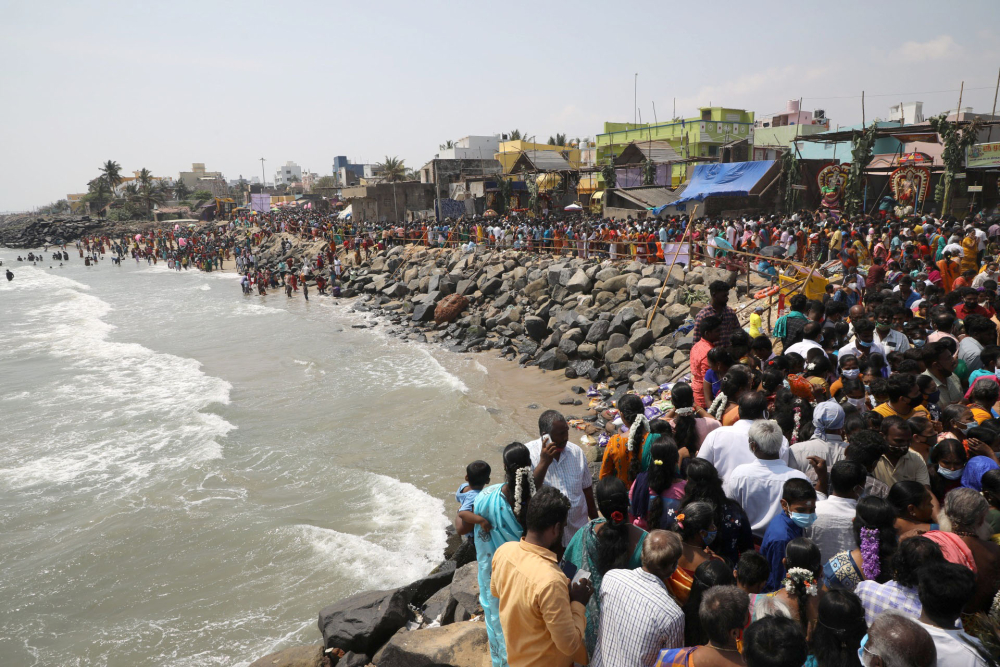
The crowd of devotees by the beach for Masi Magam. (Picture Credits: Pattabi Raman)
Celebrated during the Tamil month of Maasi (February–March) when the Magam Nakshatra (an auspicious star-constellation in the Tamil religious calendar) aligns, Maasi Magam marks one of the most auspicious days in the Tamil religious calendar. Rooted in ancient beliefs of purification and divine descent, the festival commemorates the moment when celestial deities are said to visit Earth to bless devotees. The highlight is the ceremonial procession of temple deities — richly adorned in flowers and silk — carried from various temples across Puducherry and neighbouring Tamil Nadu districts to the sea for a ritual bath. This symbolic immersion purifies the gods and, in turn, the devotees who take a holy dip alongside them.
Along the eroded coastline of Vaithikuppam, thousands gather to participate in this sacred cleansing ritual. The sea becomes a site of spiritual renewal — devotees enter the waves, praying for absolution, prosperity, and the blessings of their ancestors. Drummers and folk performers animate the procession, while vendors sell peacock feathers, jackfruit, watermelon, and buttermilk to quench the heat and sustain the faithful. Makeshift stalls, banana-leaf canopies, and idols lined along the shore transform the fishing hamlet into a temporary sacred fairground.
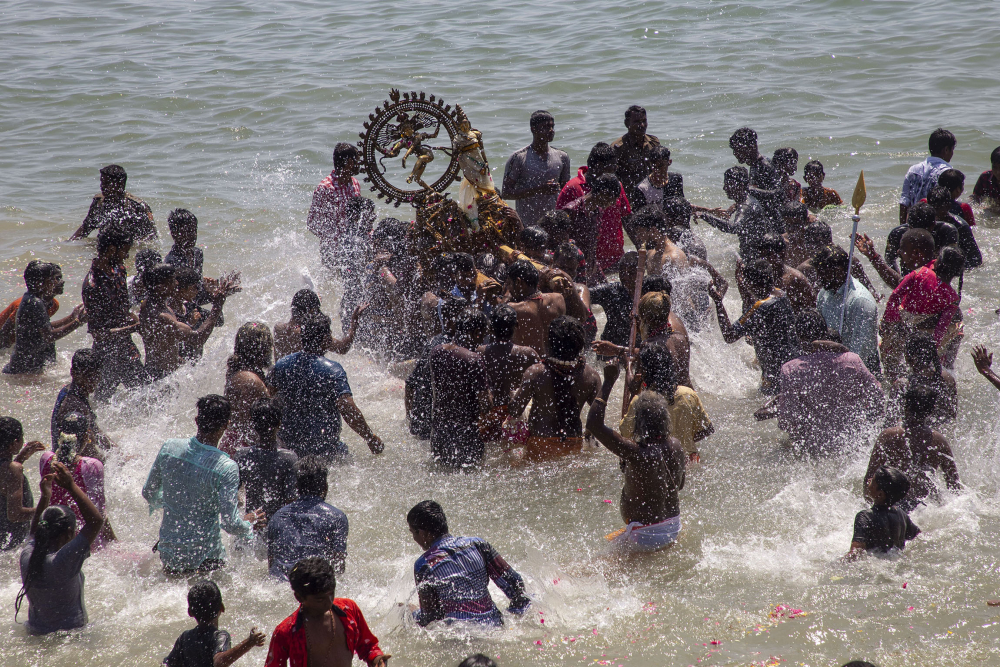
The sea-facing rituals performed as part of the Maasi Magam festival. (Picture Credits: Pattabi Raman)
Beyond its religious depth, Maasi Magam reflects the cultural pulse of Puducherry, where ritual, livelihood, and community coexist. For many like Chitra, the festival is not only a moment of devotion but also a renewal of belonging and faith — a reminder of how the sea, in its eternal rhythm, remains both witness and participant in the spiritual life of this coastal town.
Mangani Thiruvizha at Vedapureeswarar Temple
It is a singular, sacred sight only seen in the Tamil month of Aani (June-July), when hundreds of women gather around noon at the Vedapureeswarar Temple in Puducherry, their arms filled with bags of ripe mangoes. Under the blazing sun, they lay the fruits upon a temple chariot, adorning it with garlands and leaves. For an hour, the scene turns into a burst of yellow and green, as laughter, devotion, and the fragrance of mangoes fill the courtyard.
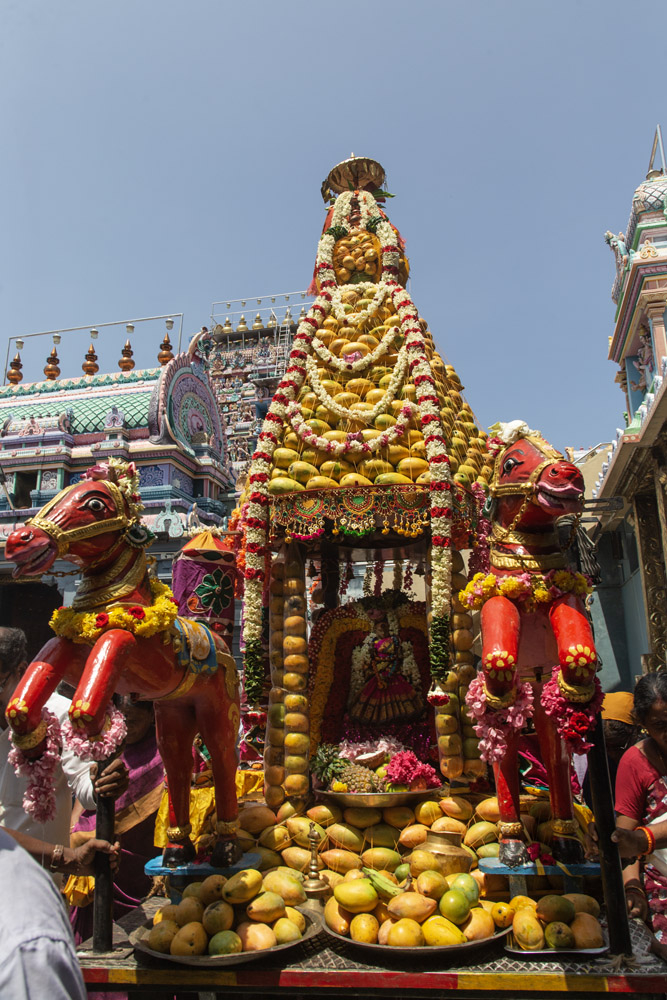
An offering of mangoes. (Picture Credits: Pattabi Raman)
This ritual marks the Mangani Thiruvizha, Puducherry’s own celebration that echoes the grand festival held in Karaikal in honor of Karaikal Ammaiyar, one of the 63 Nayanmars and the only woman amongst the revered Shaivite saints. The Puducherry observance, held for over two decades, venerates her spiritual legacy through an offering of mangoes — a symbol of devotion, fertility, and gratitude.
The festival’s highlight is the chariot procession. A car, beautifully decorated with mangoes, is drawn through the temple streets, accompanied by chants and the rhythmic beat of drums. Devotees both young and old pull the ropes with fervent energy, while mangoes and prasadam (religious offering, usually food) are distributed to all as blessings from the deity.
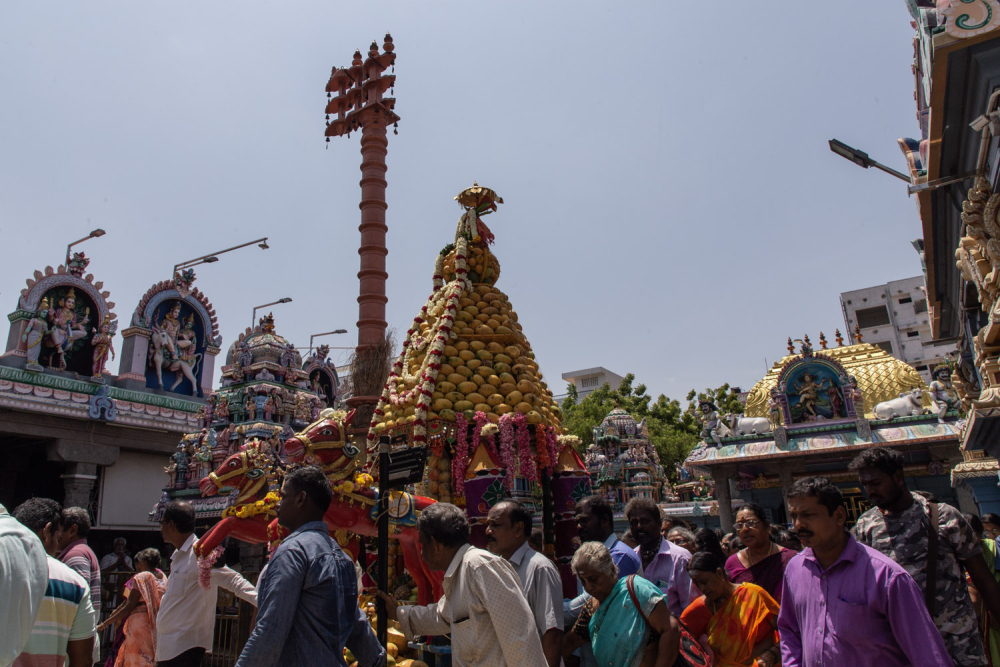
A chariot decorated with mangoes offered by devotees makes a ceremonial procession inside the Vedapureeswarar Temple. (Picture Credits: Pattabi Raman)
The Mangani Thiruvizha reflects Puducherry’s enduring link between faith and community, where a simple fruit becomes a sacred offering that unites people in celebration and remembrance.
Veerampattinam Car Festival
Every year in the Tamil month of Aadi (July-August), the coastal village of Veerampattinam, the largest fishing settlement in the Union Territory of Puducherry, comes alive with color, rhythm, and devotion. For six consecutive Fridays, Veerampattinam transforms into a vibrant pilgrimage site during the Sengazhuneer Amman Car Festival, honoring the guardian goddess of the local fishermen.
At dawn, the air fills with the smell of incense, the beat of temple drums, and the murmur of the sea. Families arrive from nearby towns and distant villages, some returning year after year. Three-year-old Govarthini visits the festival from her grandfather’s home with her mother, who originally hails from Veerampattinam — their annual journey marking a cherished family tradition. Among the returning visitors is Mohan Kumar, a Franco-Tamil living in the south of France. Originally from this very village, he revisits the festival after the long COVID-19 break, visibly elated as he reconnects with his cousin. Their reunion radiates a quiet joy, embodying the emotional pull the festival holds for those who have moved far from home.
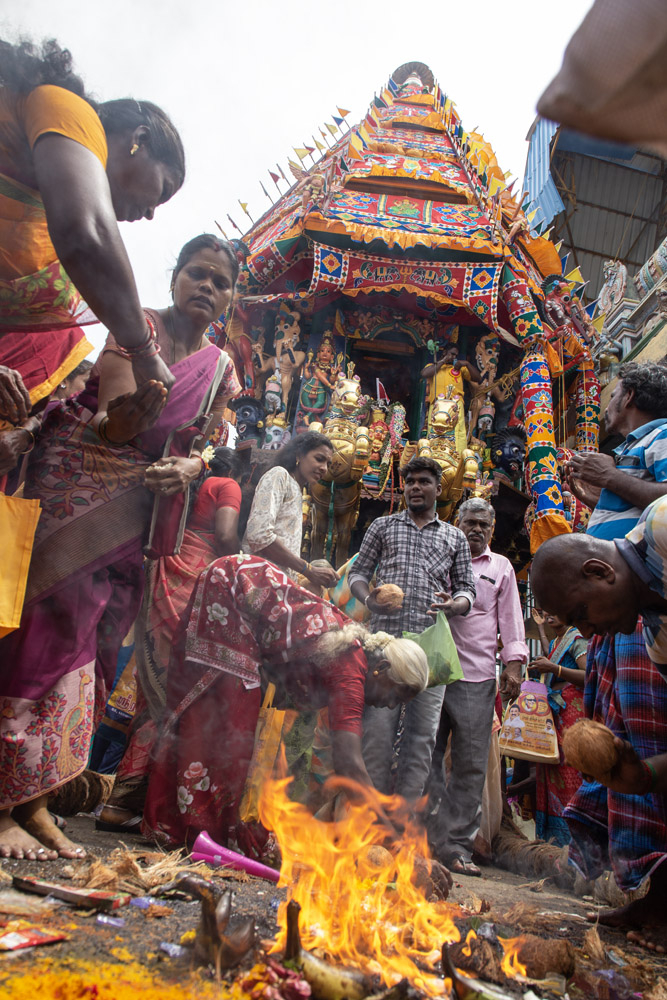
Devotees gathered in front of the chariot during the Veerampattinam Car Festival. (Picture Credits: Pattabi Raman)
The festival’s fifth Friday marks its grand culmination: the Car Festival (ther or chariot). The enormous wooden chariot, adorned with flowers, lights, and sacred cloth, carries the idol of Sengazhuneer Amman through the village streets. The Governor of Puducherry traditionally inaugurates the procession by pulling the first rope — a custom dating back to the French colonial era. Thousands of devotees join in to pull the car together amid chants, music, and rhythmic drums.
Beyond the rituals, the beach and temple grounds burst with the energy of a local fair: stalls selling bangles, sweets, and snacks; toy vendors; computerized horoscopes; and robotic fortune-tellers. Twin sisters in matching dresses play by the waves as the chariot rolls past, the scent of jasmine mingling with the sea breeze.
The Veerampattinam Car Festival is more than a religious celebration — it is a portrait of community, showcasing how faith and festivity flow together like the twin rivers that embrace this coastal village.
Corpus Christi Procession
It is a quiet Sunday afternoon along Rue Suffren in White Town, Puducherry. The Corpus Christi procession moves slowly through the narrow streets, hymns rising softly above the hum of life. Beside me walks Anita Rheeman, a French professor based in Puducherry, who explains the significance of the occasion as we follow the crowd. I spot Niranjan Das, my old schoolteacher and a guitarist, strumming gently to keep tune with the chorus. The procession pauses at two places — first at the Cluny Convent and then near Alphonse Liguori’s house — where the parish priest elevates the monstrance, a gilded vessel carrying the consecrated host, and offers prayers and blessings to the gathered devotees. “Usually, people go to church for Benediction,” Anita says. “But on Corpus Christi, God comes to bless you through the streets.”
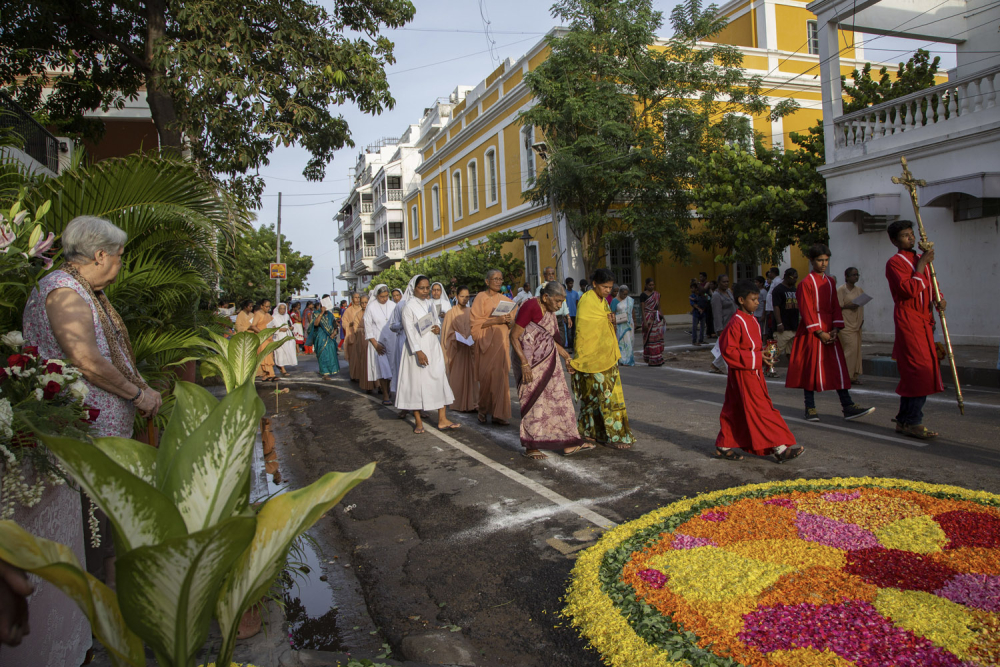
The Corpus Christi procession. (Picture Credits: Pattabi Raman)
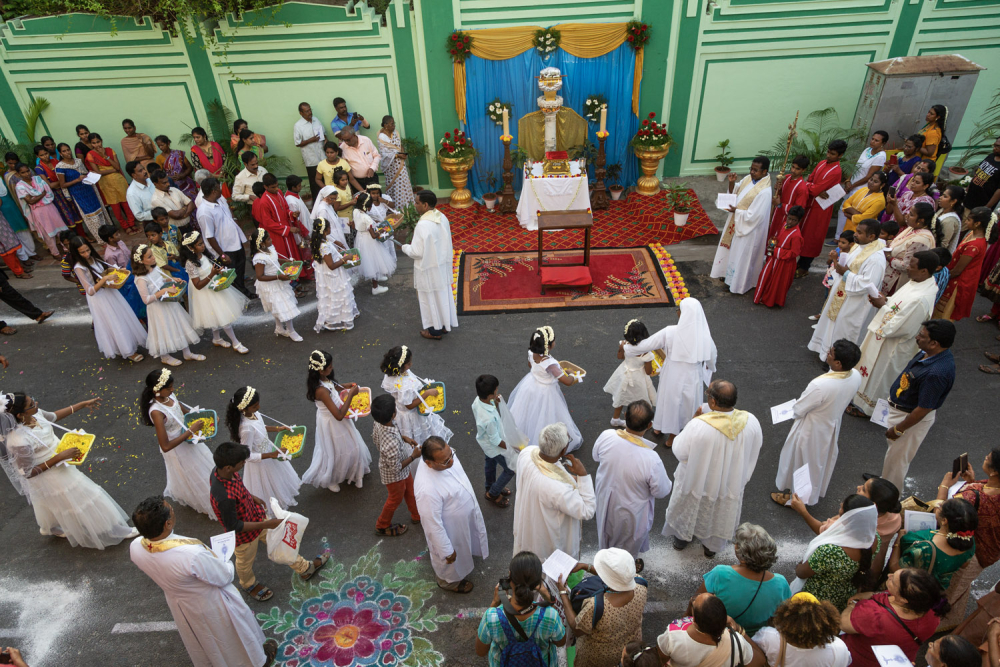
The procession pauses at two places — first at the Cluny Convent and then near Alphonse Liguori’s house. (Picture Credits: Pattabi Raman)
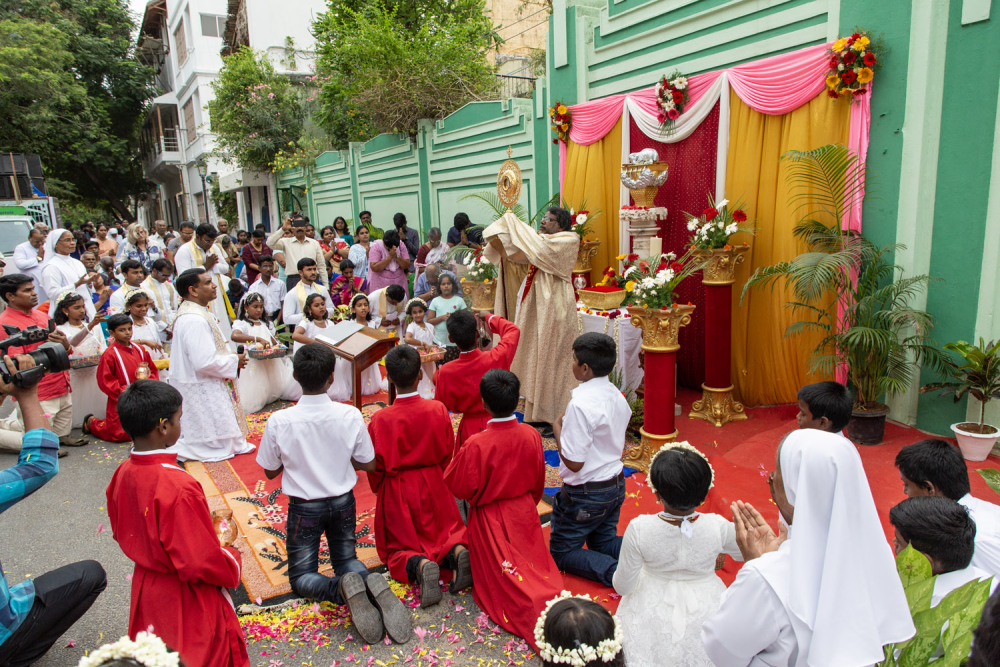
The parish priest elevates the monstrance, a gilded vessel carrying the consecrated host, and offers prayers and blessings to the gathered devotees. (Picture Credits: Pattabi Raman)
Corpus Christi, Latin for “Body of Christ,” is a major Christian feast that celebrates the presence of Jesus Christ in the Eucharist. It is the only time of the year when Catholics publicly proclaim their belief in the Eucharist, carrying the Blessed Sacrament through the streets in solemn procession.
In Puducherry, this day holds a special grace. At Our Lady of Angels Church (Église Notre-Dame des Anges) — a Greco-Roman style church built in 1855 during the French colonial era — on Dumas Street, the celebration begins with Mass offered in three languages: Tamil, English, and French. The trilingual liturgy, French hymns, and colonial architecture lend a distinct cultural character to the observance.
As the evening sun softens, the procession weaves through the lanes of White Town, where homes and corners are adorned with candles, flowers, and banners. Families kneel as the monstrance passes, whispering prayers of devotion. Little girls from the parish — the “flower girls” — walk ahead, scattering petals to welcome the Lord walking among His people. Corpus Christi in Puducherry is the sacred moment when divinity steps out of the church and walks through the everyday lives of its believers.
Draupadi Amman Temple Festival
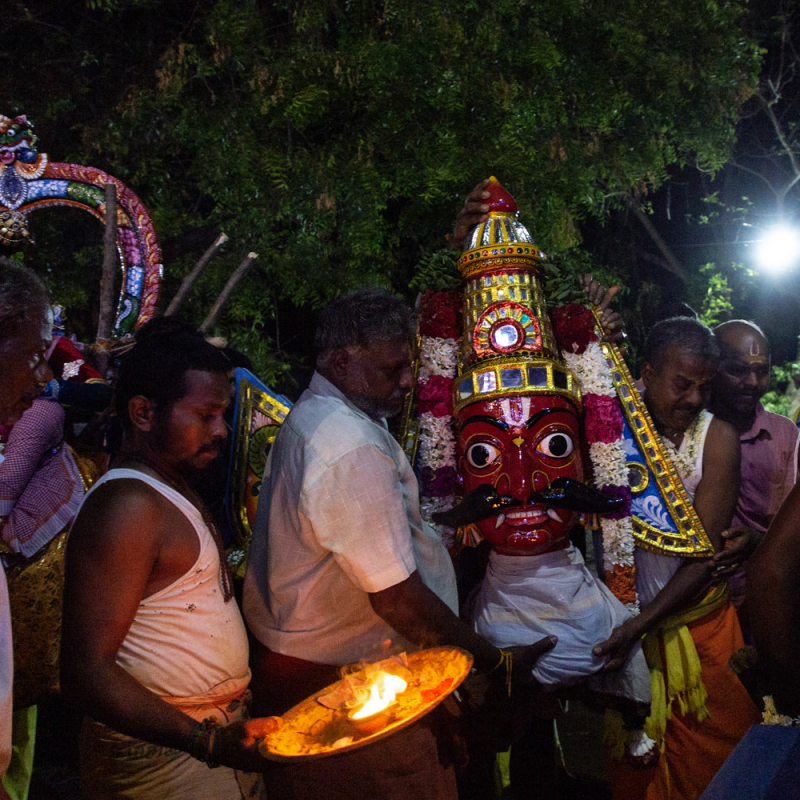
It is a warm summer evening in Murungapakkam, Puducherry. Jaya, Nandhini, Suguna, and Rajee — four sisters — lean over their balcony, waiting eagerly to catch sight of the Pakkasuran procession (a recreation of the slaying of the fearsome demon Bakasura by Bhima in the Mahabharata, symbolizing the triumph of righteous strength over tyranny). The streets below hum with drums, chants, and flickering torches as the community gathers around the famed Draupadi Amman Temple — dedicated to Draupadi, the goddess of fire and embodiment of feminine strength. The temple becomes a vibrant stage for a series of mythological performances and rituals that form part of the annual koothu (typically a street play) festival cycle.
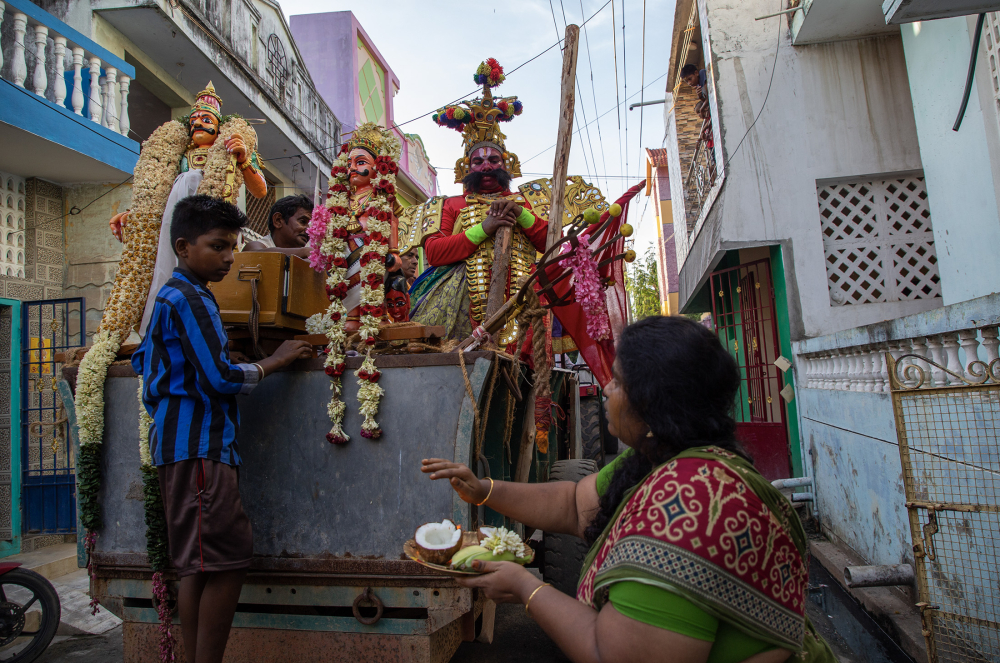
The traditional street procession. (Picture Credits: Pattabi Raman)
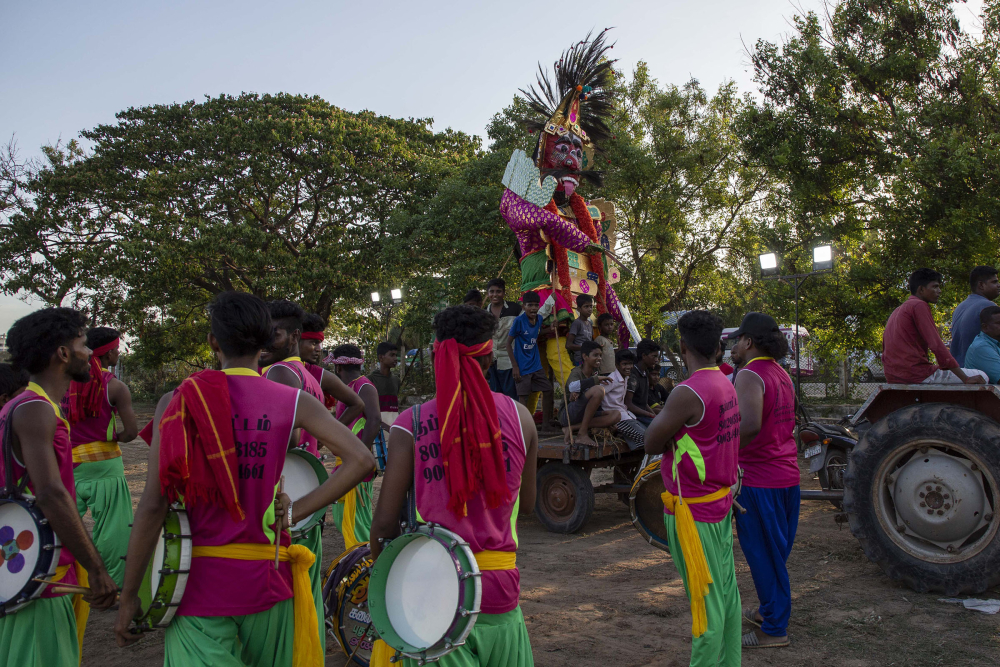
The traditional street procession with an effigy of a demon. (Picture Credits: Pattabi Raman)
As dusk falls, therukoothu (the age-old street theatre of Tamils) folk artists narrate the Mahabharata through song, dialogue, and dance, their painted faces glowing under the oil lamps. The night echoes with “Pakkasuran Vadham,” the slaying of the demon Bakasuran — a tale of courage and divine justice. At dawn, the performances shift to daylight rituals like ‘Pongal Vaithal’ where devotees offer freshly cooked pongal (sweet rice dish) to deities, symbolizing gratitude, abundance, and communal devotion and spectacular enactments. “Arjunan Tapasu,” one of the most striking sequences, depicts Arjuna performing severe penance to receive a celestial weapon from Lord Shiva — portrayed by an artist who climbs a 30-foot ladder, symbolizing Arjuna’s spiritual ascent.
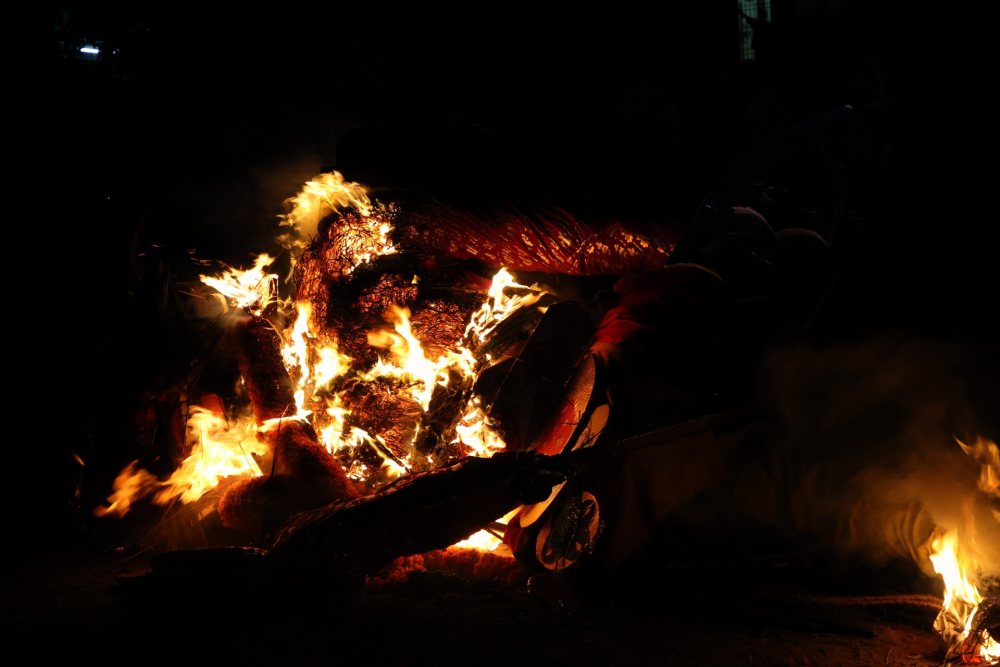
The slaying of the demon. (Picture Credits: Pattabi Raman)
The drama culminates in the “Padukalam,” the climactic battle between Bhima and Duryodhana. A ground nearby transforms into Kurukshetra, where a slain mud effigy of Duryodhana lies on the earth. The festival concludes with devotees walking barefoot across burning embers, the firewalk symbolizing purification, endurance, and faith. Hundreds of locals gather to witness this two-week summer festivity, where mythology, theatre, and devotion merge into one living tradition.
Pilliarkuppam Transgender Festival
Sheetal Nayak, a transgender activist and the president of SCOHD (Sahodaran Community Oriented Health Development Society), arrives with a group of transwomen on a vibrant evening in Pillayarkuppam, on the outskirts of Puducherry. One of her friends is getting ready to take part in the fashion show scheduled later that night, held alongside the symbolic wedding ceremony where temple priests tie the mangalsutra (auspicious thread signifying married status) for visiting transwomen.
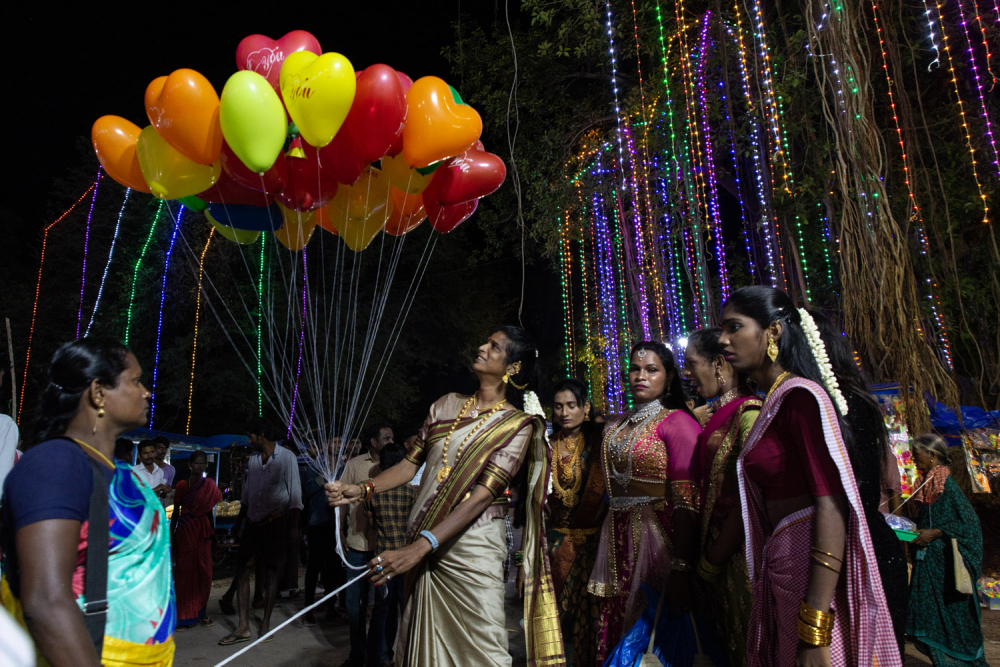
Sheetal Nayak, the transgender devotee holding the balloon, seen with other transwomen at the Pilliarkuppam festival. (Picture Credits: Pattabi Raman)
Sheetal has been coming to Pillayarkuppam for six consecutive years, returning each time both as a transwoman and as a committed trans-rights advocate. Ruby and Rosy, a pair of transwomen, walk gracefully past the makeshift shops, pausing to buy bangles as they chat excitedly about the Miss Pillayarkuppam pageant that follows the fashion show every year.
As these moments unfold, a group of villagers and temple priests begin their procession, carrying the idols of Aravan around the shrine amid bursting crackers, drumbeats, and rising anticipation in the night air.
At the centre of this celebration is the re-enactment of Aravan’s one-day marriage to Mohini — the feminine form of Lord Krishna — a ritual deeply meaningful to the transgender community. Rooted in the Mahabharata, the legend tells of Aravan, the son of Arjuna, who offered himself in sacrifice to ensure the Pandavas’ victory. Before his death, he wished to marry, but no woman agreed to wed a man destined to die at dawn. Krishna then assumed the form of Mohini and fulfilled his final wish.
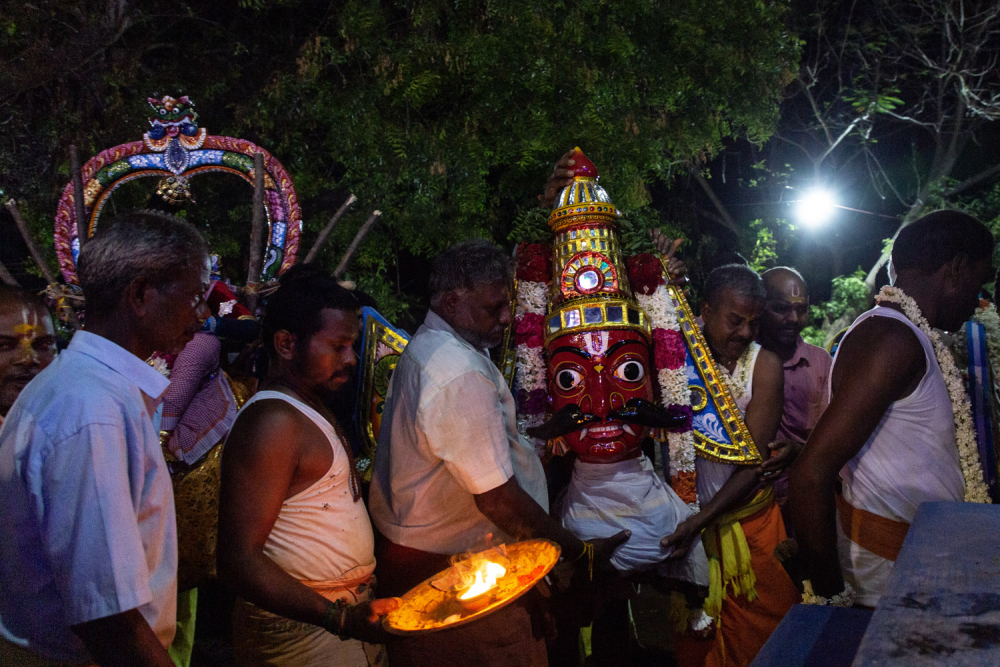
The idol of Aravan being taken in a procession. (Picture Credits: Pattabi Raman)
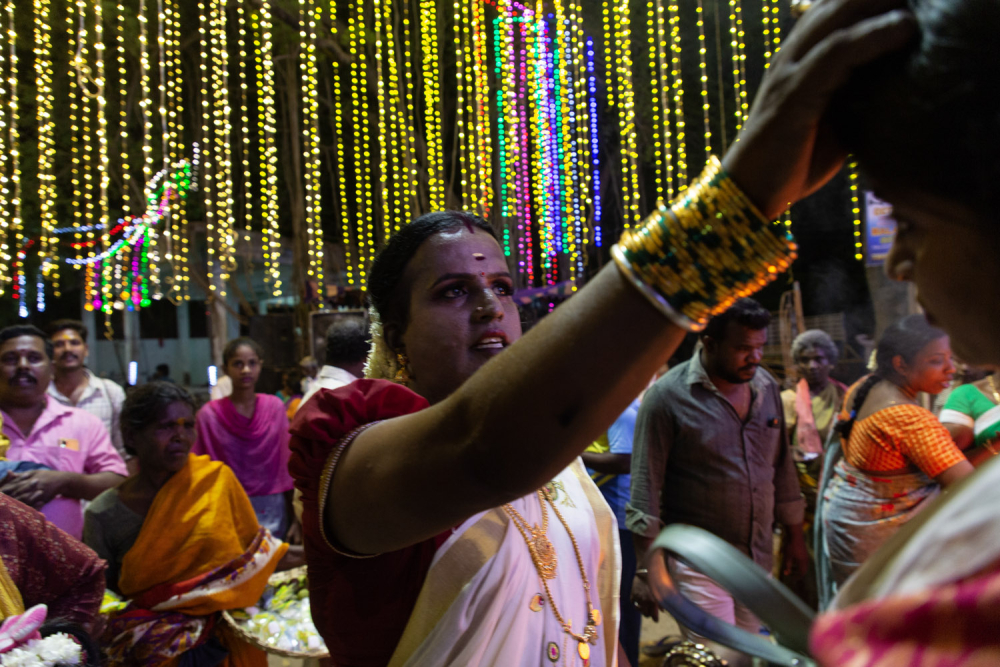
A transgender devotee offering blessings to a visitor at Pilliarkuppam. (Picture Credits: Pattabi Raman)
The Pillayarkuppam transgender festival spans several days and unfolds in three distinct phases: a lively beauty pageant, the symbolic marriage ceremony inside the Koothandavar Temple, and finally, the widowhood ritual that marks Aravan’s sacrifice. Each phase combines performance, devotion, and cultural expression, creating a space where gender identity is celebrated openly and without fear.
For the transgender community, this festival is much more than a religious observance — it is a space of belonging, solidarity, and spiritual affirmation, where the marginalized find visibility, connection, and sacred recognition within the region’s cultural fabric.
This essay has been created as part of Sahapedia's My City My Heritage project, supported by the InterGlobe Foundation (IGF).