
The Fire-Station Banyan Tree was brimming with excitement. He was eager to reach the enchanting Coconut Island of Thengaithittu before Auroville Banyan Tree had a chance. The low tide on the Ariyankuppam River filled him with delight, as he no longer needed to make the lengthy detour over the bridge to the Kali Temple, where the parliament would be held. As he crossed the river, he thought of the tale of the hare and the tortoise, remembering his own tendency to procrastinate, knowing that the Auroville Banyan Tree had a longer journey ahead. He had decided not to lose this time. This meeting was too important for him to let that pretentious tree win, which, under the pretext of being next to the Matrimandir, thought it was the king of trees. His pseudo-spirituality gave him an air of superiority.
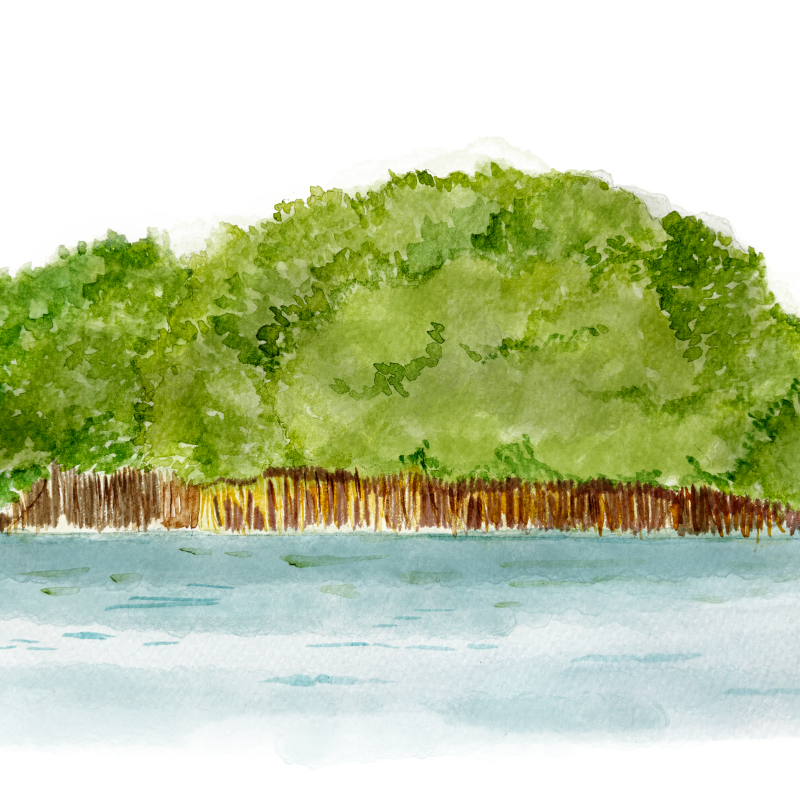
Thengaithittu was shrouded in a tranquil ambiance. The swaying palm trees, normally animated by the ocean air, seemed motionless and reverent. The atmosphere was solemn. Fire-Station Banyan Tree made its way through the mangrove swamp and caught sight of the Kali Temple. He was overjoyed to find it deserted. He sped up without disturbing Thoongumoonji Maram, who was, as usual, asleep. The Samenea Saman tree, also known as the “sleeping tree” because it closed its leaves at night, was a prominent figure in the city of Pondicherry because of his presence in the Sacred Heart Church opposite the railway station.
Without further ado, Fire-Station Banyan Tree settled in front of the temple and proudly spread out his vines. No one could challenge his authority today. In fact, the trees in the region followed a long-standing tradition: once every century, one specimen of tree was chosen to lead the Tree Congress. The earliest tree to arrive at the meeting was granted the honor of chairing the event. Once upon a time, the trees used to elect their leader fairly and democratically.
However, over time, they seemed to have forgotten this custom and started fighting for leadership based on factors such as seniority or fame. This was particularly true when it came to the Fire-Station Banyan Tree and the Auroville Banyan Tree. The trees of Pondicherry were depleted because of the fruitless rivalry between the two. One claimed leadership based on seniority and superiority, while the other boasted that its roots were embedded in the heart of Auroville, which was once part of a group of ancient settlements dating back to the Mio-Pliocene era. Auroville Banyan Tree claimed that his ancestors had rubbed shoulders with the fossilized trees of the famous Thiruvakkarai forest, whose petrified tree trunks were likened to the remnants of demons vanquished by the goddess Kali.
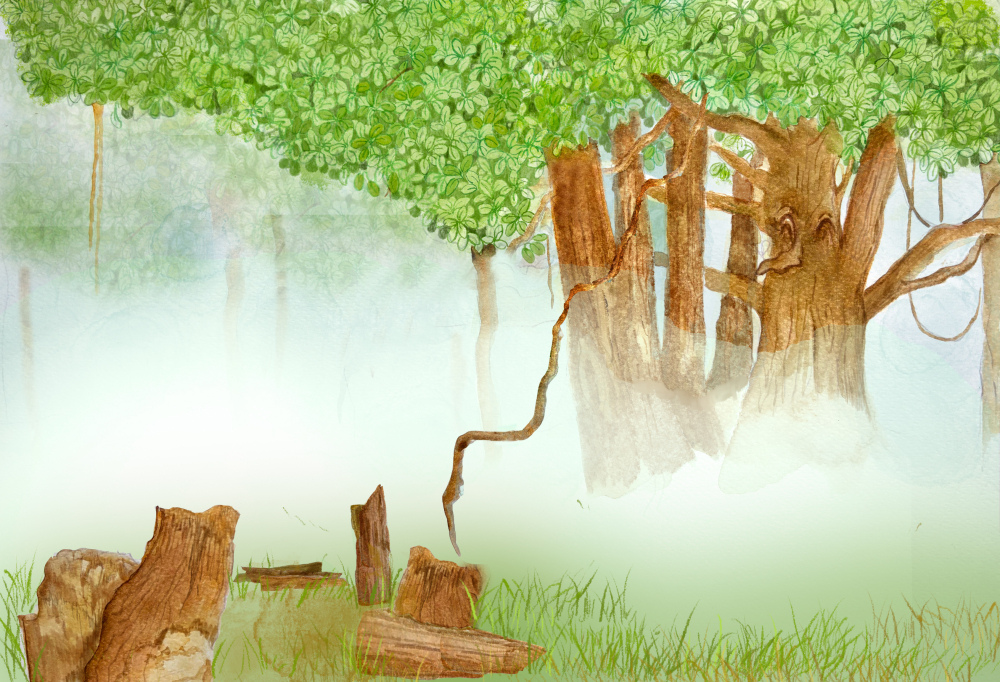
Illustration Credits: Jisha Unnikrishnan
***
When the other trees arrived, they witnessed the eternal quarrel between the two banyan trees without surprise. Auroville Banyan, still breathless and dripping with sweat from his long journey, initiated the hostilities. He launched into an argument, claiming as usual that his community hailed from the Mio-Pliocene era.
“I hail from the Thiruvakkarai plateau, where ancient trees, estimated to be 20 million years old, flourish. Do you know what 20 million years means, you idiot! We coexisted with unnamed trees, as they had already taken root in this forest long before language emerged. Those prehistoric trees, just like tamarind trees, have since turned into fossils due to petrification. One of my ancestors remains there, serving as a timeless witness!.”
Fire-Station Banyan Tree looked at him mockingly. “Liar!” he exclaimed. “Do you think I’m going to swallow your lies like that? The trees you’re talking about aren’t from Thiruvakkarai; some river that has now dried up, which flowed at that time, carried them there and deposited them near the bank. You, trees of Auroville, are nothing but deceivers!”
Caught off-guard, Auroville Banyan Tree remained speechless, frantically seeking a counter argument.
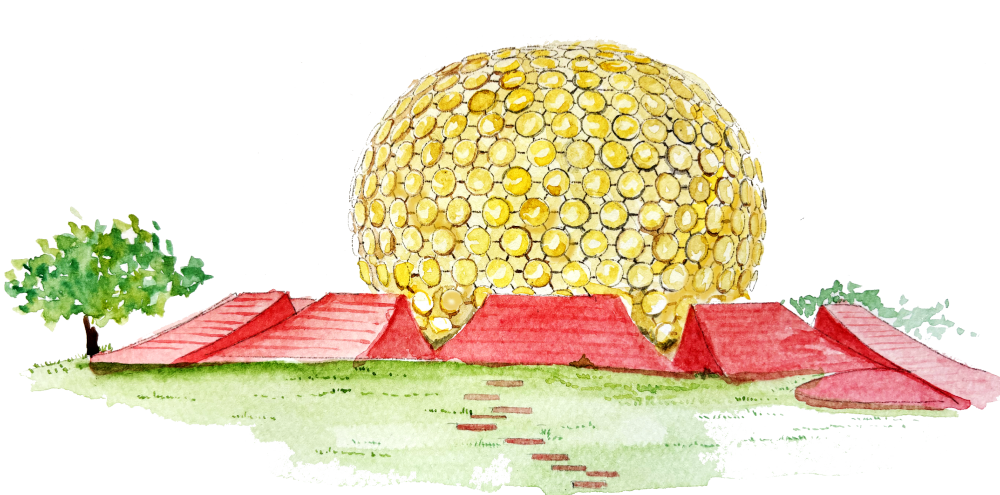
Illustration Credits: Jisha Unnikrishnan
“By the way,” Fire-Station Banyan Tree continued, “your ancestors lived with wild dogs and mindless monkeys. Mine knew merchants from ancient Rome and Greece, and great Arab adventurers who came to Arikamedu, which used to be a Buddhist and Jain center. You only need to see the old peepul tree called Ficus Religiosa next to the old Jesuit school and the ancient statue of Buddha in Kakayanthoppu to understand how religious and reverent we are—”
“All these stories are about firangis. Mine at least takes place in this country,” Auroville Banyan Tree interrupted its opponent with presumption. “The Muslim Bade Saibu Siddhar achieved self-realization while sitting under a Bakula tree in Kandamangalam village. Vannara Paradesi became a Siddhar under a Bilba tree in Odiyampattu Village!”
Fire-Station Banyan Tree ignored the remark. “The 30 Siddhars of Pondicherry attained Jiva Samadhi in different ways under a tree. This shows the importance of our role in Pondicherry! In addition, I saw a forgotten and abandoned chapter in the history of this city. Look around you: these buildings used to be warehouses. Indentured labourers would wait there to board ships and sail away to the Caribbean, the Mascarene Islands, and Fiji Islands to harvest sugarcane.”
“Fool! Do you know Kaduveli Siddhar? I doubt it, because you’re just a pretentious ignoramus. Anyway, Kaduveli Siddhar achieved Jiva Samadhi under the peepul tree in Irumbai temple. You might not be the only one with a pious presence. Additionally, we have Iron Age burial mounds. You see Kuylapalayam, right? There, we discovered tools dating back to the Neolithic and Megalithic periods…” Auroville Banyan appeared haughty, but he changed his attitude the next instant. He stopped being arrogant and started playing the victim, trying to win the sympathy of his peers. “My siblings were victims of ecocide, and I witnessed their deaths, helpless… I can still hear their cries of anguish and pain as they were uprooted and chopped down by these foreign executioners, who were outnumbered by us… They were barely a hundred. But they enlisted local loggers to cut us down. So began the ecocide and colonial complicity. Using our own brothers to kill us…. that man, Francois Martin, secured a modest parcel of land in Pondicherry, roughly ten kilometers from the current location. He claimed to be a trader, but upon his arrival, he proclaimed himself as ruler of the place, with the intent of establishing himself in the coastal region and transforming the existing fishing village into a town…”
“You have been unmasked!” Fire-Station Banyan exclaimed triumphantly. “For a long time, I’ve suspected that you were one of those decolonisers of the mind. Now I am certain.”
“I don’t have such pretensions. Even if there were ten thousand more Ngugi Wa’Thiongos, they couldn’t de-colonize this city.” Auroville Banyan took a brief pause, then resumed its tale. “But Pondicherry was already an established town with various coexisting communities and a dynamic textile industry. For many years, Muslims have lived in the area now called the “White Quarter”, while Hindus inhabited the “Black Quarter”. Now, I ask you: have you ever heard of a small fishing village anywhere in India with three large temples, two mosques, and a Muslim cemetery? Of course not. Well, that is what the colonial lie says to justify colonization!”
“Let me reiterate, barbarian! You and your tribe coexisted with primal individuals who lacked any understanding of civilization. You Cro-Magnon! Now that you’ve run out of arguments, do you want to play the part of the wronged one?” Fire-Station Banyan wanted to show off.
“I'm just pointing it out.” Auroville Banyan took offense. “This area, known as “Vedapuri” in ancient times, has witnessed the stewardship of several South Indian dynasties — primarily the Pallavas, Cholas, and Pandyas — who contributed greatly to its ecological diversity and the sacred significance of trees in local society. Before that, our ancestors thrived in the ancient and prosperous land of Aruva Nadu, one of the twelve regions that made up Tamizhakam. Our precolonial history in Pondicherry is intimately linked to the region’s rich dynastic, cultural, and ecological development. Pondicherry’s flora boasts an impressive array of plants due to its varied soil composition.”
“Here we go again with the armchair historian.” Fire-Station Banyan Tree feigned boredom.
“The Kovil Kaadugal, the sacred groves and temple landscapes, formed part of the spiritual infrastructure long before European arrival, with ancient inscriptions and local legend suggesting the presence of shrines dedicated to our village deities Ayyanar, Karuppussamy, and Sudalaimadan,” Auroville Banyan Tree did not let itself be tempered. “Living heritage sites, such as ancient temple groves and the still-extant centuries-old trees found in and around Pondicherry’s Kovil Kaadugal, provide a direct ecological link to the area’s pre-colonial past. It is well known that tree worship is a universal practice that has its roots in animism and ancient religions. My great-grand-father Sivaranthagam Banyan Tree is the most adored in the region. Across the world, cultures have embraced the spiritual connection with trees. And…”
“Silence, you two! Your juvenile squabbling is exhausting. I am the eldest! In any case, your term is coming to an end. We need to decide who will be the next leader.”
The trees focused their attention on the booming voice. The ancient Ficus Religiosa, fondly known as the elephant-headed tree of VOC Nagar due to its trunk’s resemblance to an elephant’s trunk, slowly made its way toward the group. It was the oldest of all the trees. The residents of the neighborhood had quickly started worshipping him as a reincarnation of a deity, associating him with Ganesha. However, now that he is old and his trunk is damaged, the trees no longer pay him any attention.
“We,” cried the Moringas of Murungapakkam, “We may not have your stature, but we feed an entire population.”
“No, it is our turn,” cried the Bilbas of Villianur. “This holy city of Villanur is named after us, the Bilbas.”
“Tsss...tsss...it is our turn...uh, me...no, it is our turn to take the lead now,” slurred the old tamarind tree of Muthialpeth, confused, drunk from the toddy shop below him. He was the only one of his kind there, for the tamarind trees had disappeared from the Pondicherry landscape. In the past, they stood proudly on the main road connecting Pondicherry to Villianur but they were sacrificed during the urbanization of the city.
“No, it´s us,” said Nellis. “Nellithope exists thanks to us. The church there was built on our land, which belonged to Jeanne Dupleix, the Nabab’s wife!”
“What about us?” retorted the trees in the Botanical Garden, which until then had not participated at all in the discussion.
“Shut up! Immigrants have no power here. Just be pretty. You have no function in this city. Take the trees in Bharathi Park as an example. You see, they don´t demand anything.”
“But aren’t we supposed to come together to obtain a legal personality, just like humans?” inquired the ancient Jamun tree from Kurussukuppam.
“Nah! I’ve had a change of heart. Rivers have been endowed with this right, and let me tell you, they resemble vast garbage heaps! People in this region don’t respect nature at all. I have decided that, starting today, we will grant ourselves the right to be photographed and shared on all social media platforms, just like those beautiful colonial mansions, traditional Tamil houses, bars, restaurants, plates filled with delicious food, croissants, cocktails, statues, policemen in kèpis, and other crap that tourists post on their profiles. I am tired of being overlooked in this way.”
Auroville Banyan’s eyes widened in disbelief as he confronted Fire-Station Banyan. “Are you serious?” He had always thought that the Suffren Banyan was self-centered, but now he had no doubts. However, to avoid confrontation and potential problems, he kept his thoughts to himself.
***
Fire-Station Banyan Tree was awakened by the excited voice of Thoongumoonji Maram.
“Hey, Fire-Station Banyan, your wish has been granted. Someone just tagged you on Instagram.”
“Wow, I will go check it out right away!” Fire-Station Banyan Tree logged onto Instagram, only to find that people were discussing him. However, he couldn’t find any images of himself. He scrutinized every photograph, yet none of them contained his likeness. He looked at the one he was tagged in, but still nothing. Instead, he only saw firefighters calmly smoking cigarettes in front of the station.
This essay has been created as part of Sahapedia's My City My Heritage project, supported by the InterGlobe Foundation (IGF).