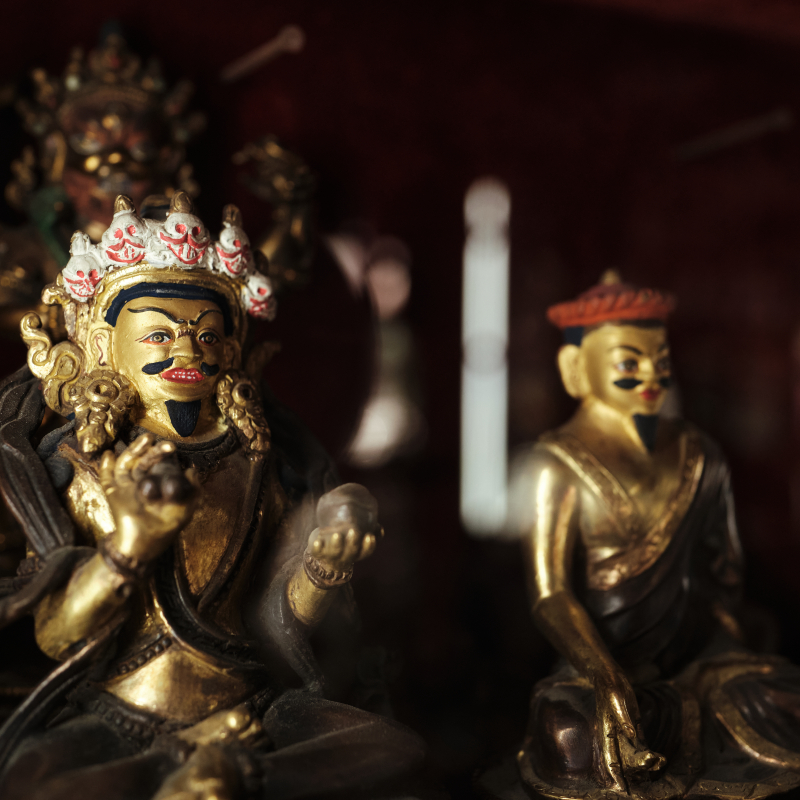

If one does not take their time gazing through the endless movement of people and many concrete buildings standing atop what is colloquially called the “New Market”, a stretch of area adjacent to the popular MG Marg that constitutes a large pedestrian section and a one-way road for cars passing along, they may miss the small curio shops that quietly sit in the market amidst — and unlike — the other shops with large LED sign boards. Gangtok is no stranger to curio shops that also function as souvenir shops, an integral part of a tourism economy. These stores exhibit “I love Sikkim” fridge magnets, Chinese women standing along bamboo trees, coasters reading “Sikkim,” momo magnets, compact versions of prayer flags, Buddha’s figurine, Green Tara, antiques, and collectibles of the region for tourists to take back home. Such shops with images from the Himalayas and Buddhist motifs and figurines are abundant across other hill-stations from Gangtok and Darjeeling to Himachal Pradesh. These collectibles are ubiquitous across these regions, often sourced from Nepal and China, with a few made locally. As these regions have been historically connected through trade, movement, and migration, it is no surprise that souvenirs across them appear similar. As Erberto Lo Bue (1981) observes, as replication and transmission are intrinsic to Tibetan and Himalayan artistic traditions, particularly in religious metalwork, the notion of “genuineness” cannot be equated with uniqueness. To assume so would impose post-medieval aesthetic values onto a religious art practice that prioritizes continuity, ritual accuracy, and lineage over individual originality.
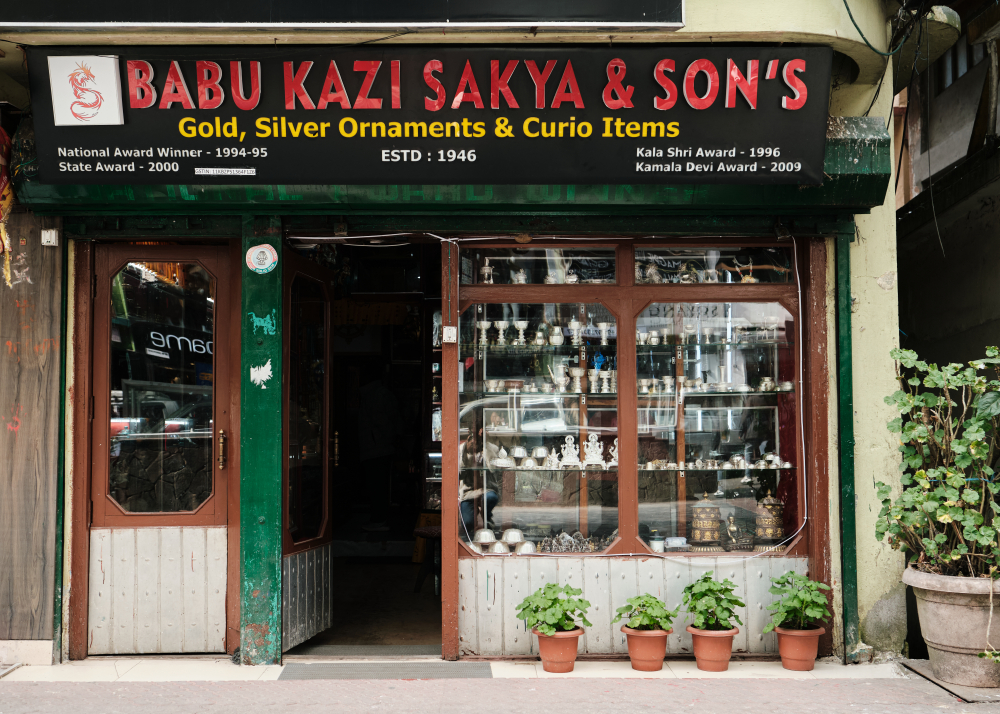
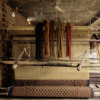
The Babu Kazi Sakya shop front at New Market area, Gangtok. (Picture Credits: Abhishek Anil)
The Metal-Work Store
Along the array in the pedestrian stretch of the New Market sits a curio and a silverware shop — as the name suggests, it houses curiously strange items and items that are almost exclusively handmade by the artisan of the shop. This shop fronts as a curio shop, but you will find that its history in metal-work in Sikkim is much longer.
The shop is a single-floor complex with a small opening, upon entering which you are transported into a warmer, almost timeless space. The smell of burning incense imbues the atmosphere and warmly decorated walls in the quietness. Upasana Sakya sits by the counter with a welcoming smile. Inside is a display of silver trinkets, silver jewelry, wooden masks of Mahakaal, Mount Khangchendzonga, Green Tara, brass items and antiques from the collections of fore-fathers, intricate metal work and ornaments — all parts of the cultural imagination of Sikkim. Further in lies a pathway to another open room, which displays master metal-worker Babu Kazi Sakya’s countless accolades and national prizes as well as statues of Buddha, brass work, and rare swords. Even further is a small chamber where you can see someone sitting and polishing a ring or a cup, depending on the day you enter the shop.
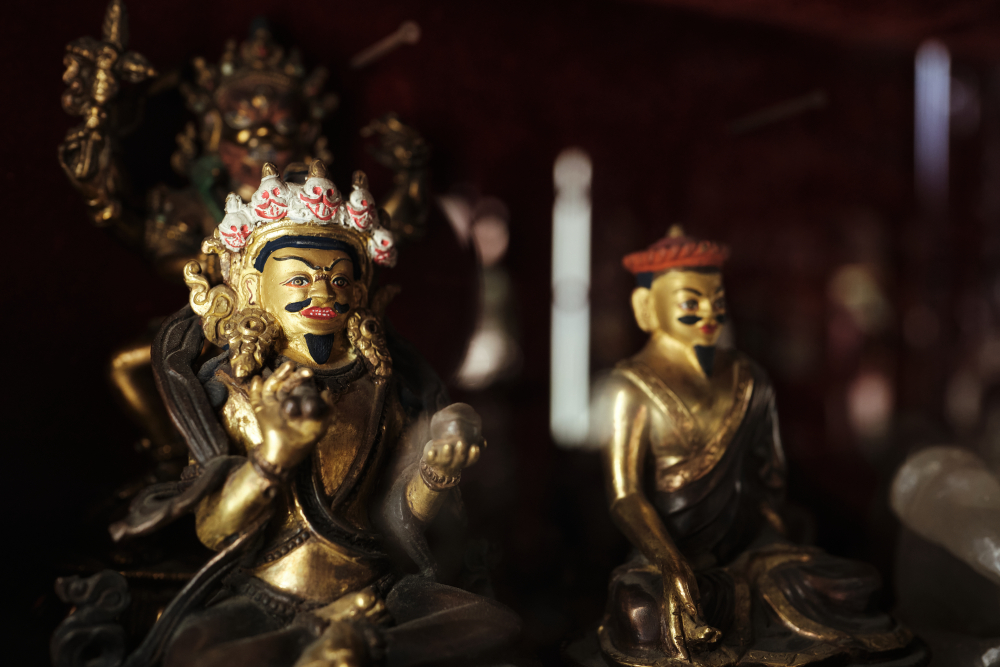
Brass sculptures of Guru Padmasambhava and other buddhist sculptures displayed inside Babu Kazi Sakya shop. (Picture Credits: Abhishek Anil)
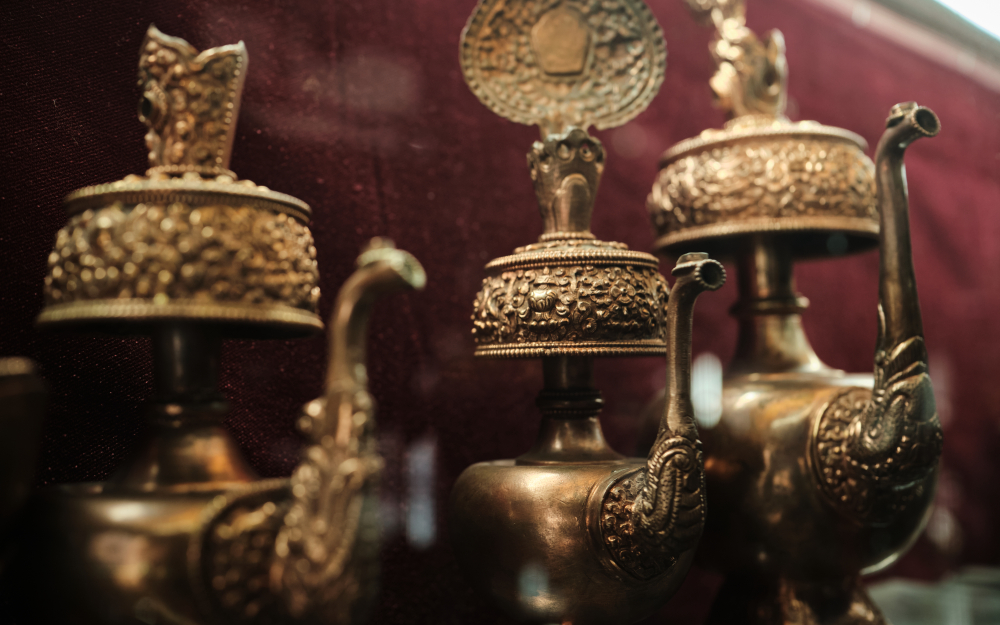
Variations of 'karuwa', an artefact for containing water and other liquids. (Picture Credits: Abhishek Anil)
The contribution of Nepali metal workers from Kathmandu has hugely influenced the Himalayan and Buddhist art form in particular. Metal work such as brass work, buddhist statues in monasteries, silver and copper work in Sikkim was primarily popularised after the influx of artisans from Nepal. Copper ores are also present in parts of Sikkim. The craftsmen produced ritual objects, sculptures, and jewelry for monasteries and royal patrons. The curio and silverware store is the product of such a lineage, currently owned by Mr Dhananjay Sakya, the descendant of a family of craftsmen who have been working in the metal craft for over nine-generations. His grandfather, Gyan Ratna Sakya, endearingly remembered as Sanu Bhai Sakya due to his short stature, was patronized by the Chogyal (king) of Sikkim to come and work for the royal court and places such as the Palace Gompa (Tsuklakhang), Namgyal Institute of Tibetology, and Chorten Gompa. From there, he opened a small goldsmith shop but worked with diverse materials like brass, copper, and bronze. He also received Sikkimese subjecthood, after which his family were also granted Sikkimese citizenship.
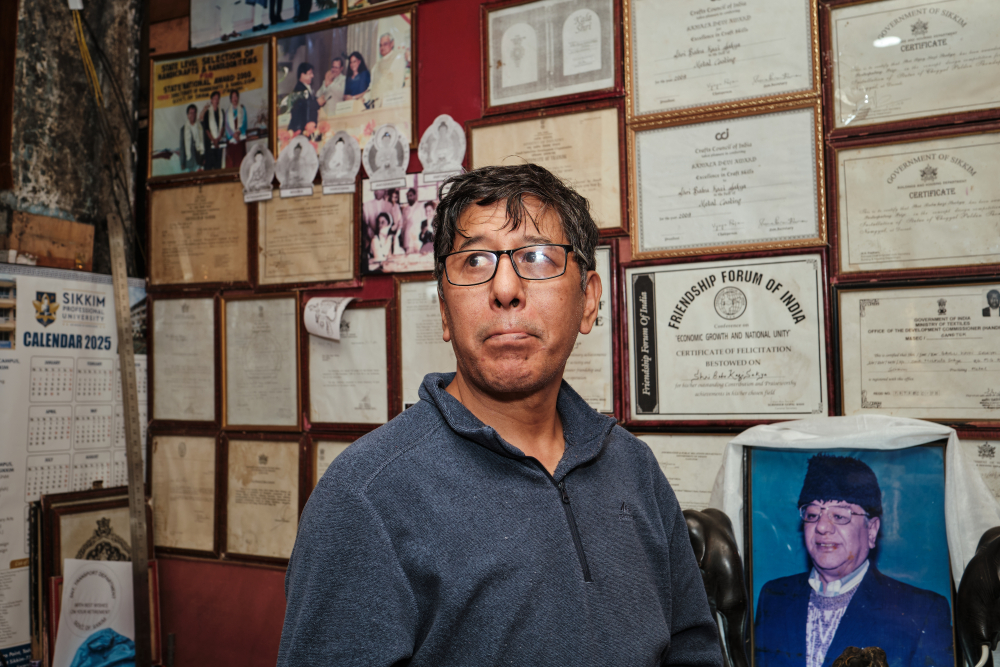
Dhananjay Sakya next to the image of his father Babu Kazi Sakya and a wall displaying Babu Kazi Sakya's accolades. (Picture Credits: Abhishek Anil)
Almost a decade after Sanu Bhai Sakya, Babu Kazi Sakya formally established his curio shop in 1946 in New Market. Dhananjay, youngest of four siblings, is the third generation working in jewelry and metalwork in Sikkim. His eldest brother works in larger monastery projects and has been associated with designing the Buddha sculpture of the Buddha park in Ravangla, which is an iconic Sikkimese image in tourism websites. Dhananjay only moved back to Gangtok eight years ago after the passing of his father, having spent almost 25 years in Russia working as an engineer. As the son of a highly respected metal craftsman, he grew up surrounded by a legacy of skill, devotion, and artistic lineage. Yet, in his generation, engineering emerged as a more desirable and aspirational path, carrying the promise of social mobility and modern success. Despite pursuing a different education, he explains that his return to India and the reopening of the shop and return to metalwork was a reconciliation with his own sense of self and inherited tradition.
When Dhananjay restarted the shop and hired the artisans again,he shifted the production unit and living quarters to his home in Gangtok, from Rumtek, to ensure that the transport did not damage the products. His passion is palpable.
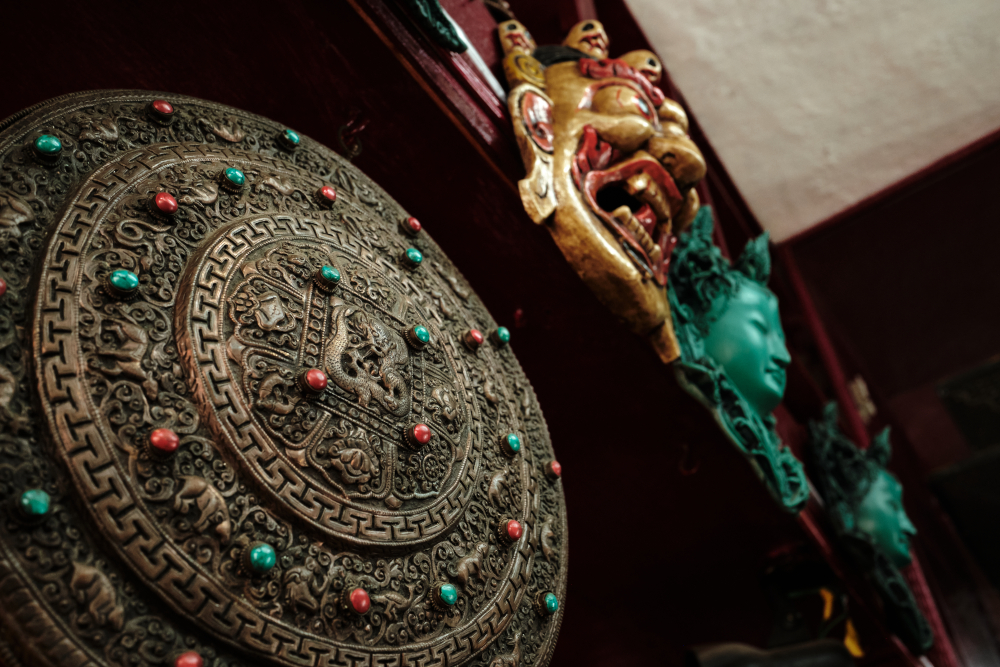
'Dhaal' or shield adorned with repoussé dragons and geometric borders with turquoise and coral inlays. (Picture Credits: Abhishek Anil)
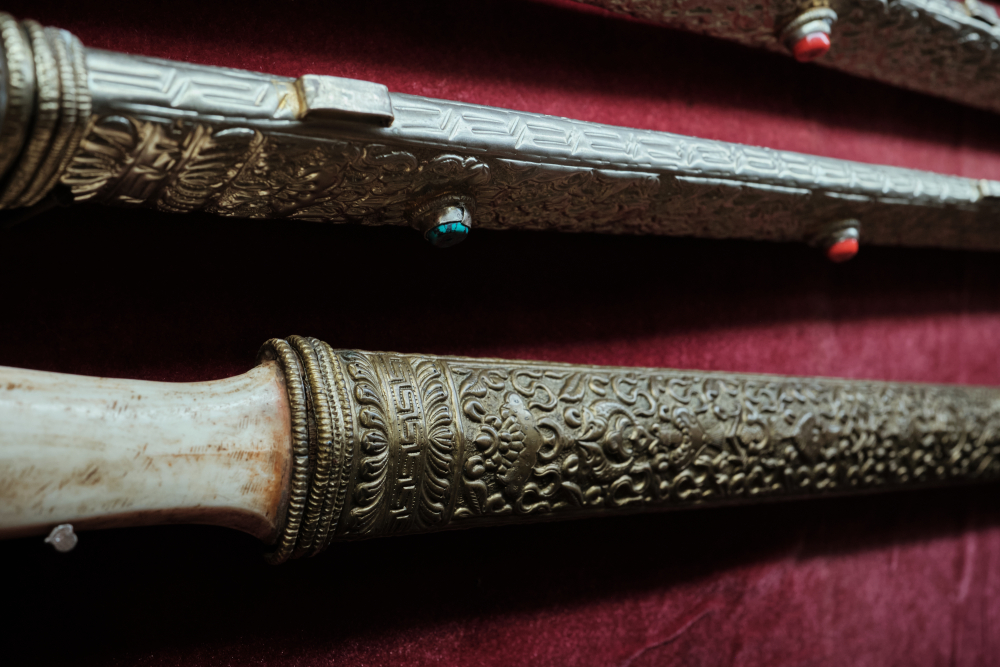
Sword with brass and metal sheath with geometric and floral repoussé and turquoise and coral inlays. (Picture Credits: Abhishek Anil)
With the turn of the century, as patronage shifts from strictly religious to market-driven productions, there is an increase in the production of sculptures for the market and the introduction of jewelry which may or may not be for ritual practice. The shop is dedicated not only for tourists to carry a souvenir back home, however, but also for the locals to honour their customs and festivals. Dhananjay showed me a list of eighteen sub-tribes and communities in Sikkim and the kind of ornaments they wear. Each community has its own type of jewelry that is inspired by a number of things. These works feature filigree style edging or wire work, hand-linked chain tassels, repousse or stamping. At present, besides silver jewelry, the shop also makes statuettes, plaques, and medallions for state functions.
Inside the Craft
The production unit is about a 15-minute walk from the shop which is at the centre of the town. Dhananjay’s home is a four-and-a-half-storey building, whose ground floor serves as the living quarters of the artisans and the semi-basement as the production unit that houses machines for silver sheets and strings.
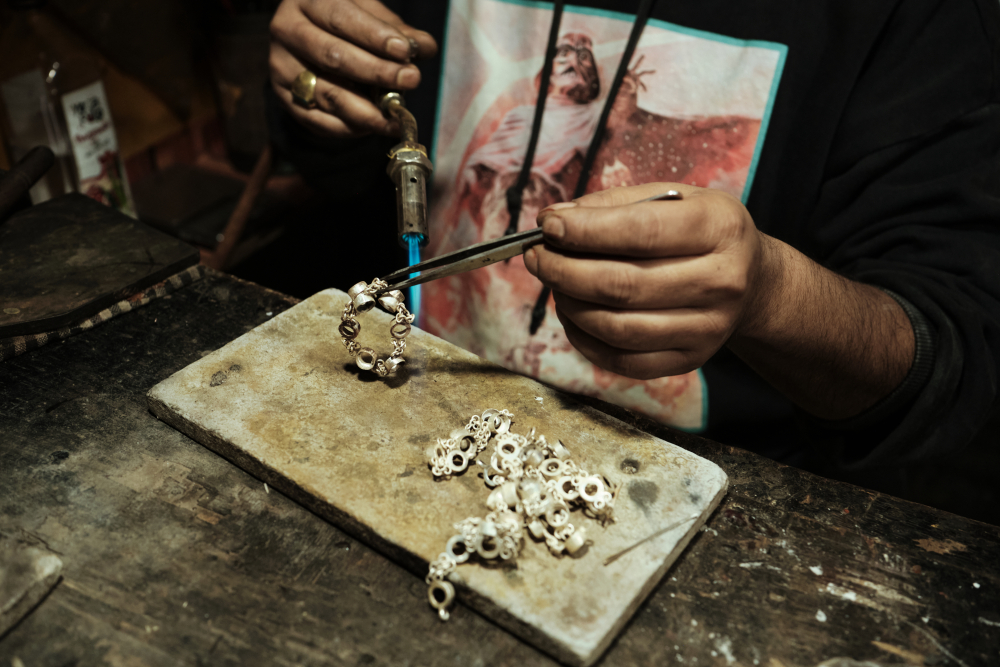
Firing and linking together silver chains at the shop. (Picture Credits: Abhishek Anil)
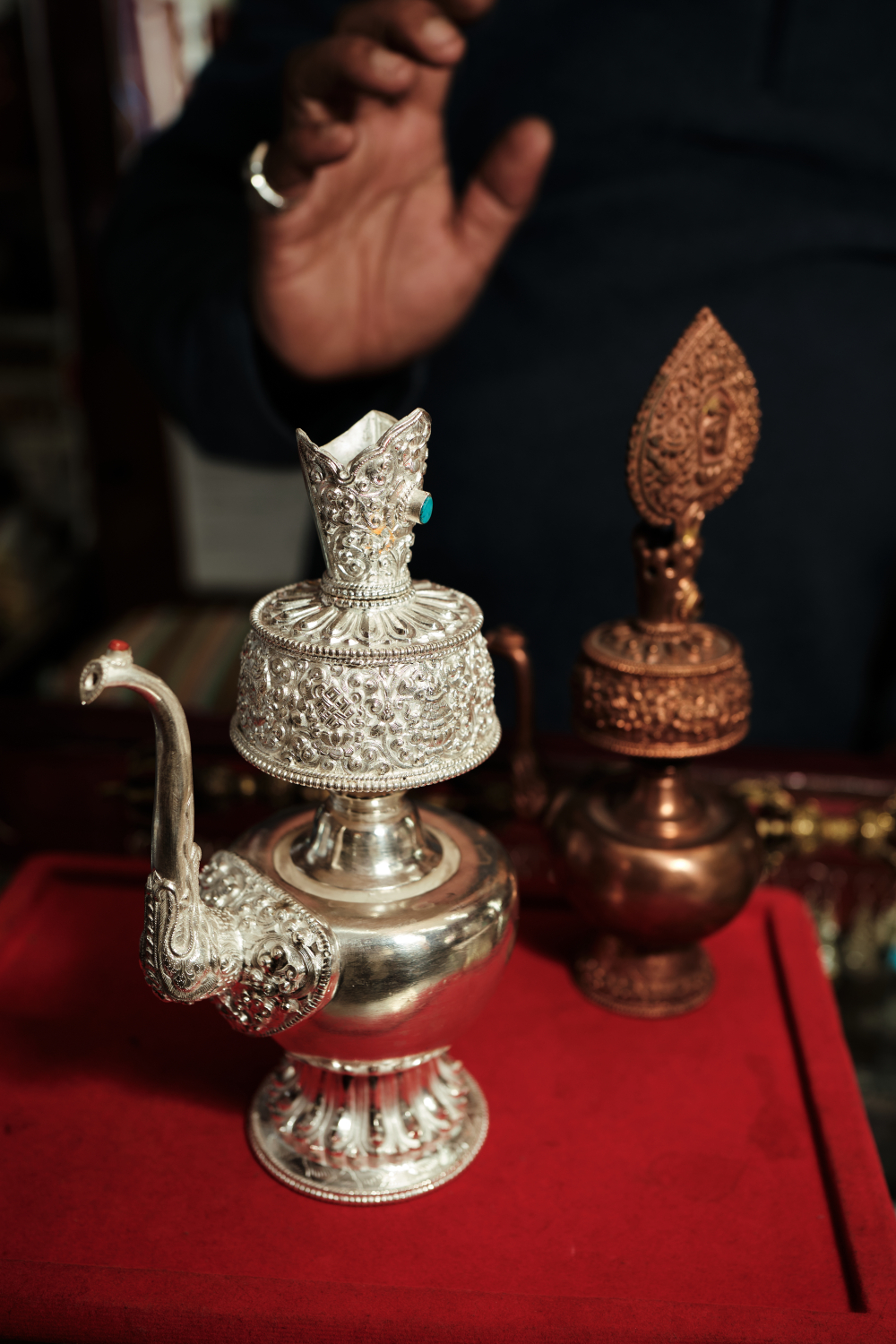
Dhananjay Sakya shows us a variation of the 'karuwa' in silver with gem inlays. (Picture Credits: Abhishek Anil)
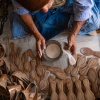
In the basement there are four artisans. The room barely gets sunlight, as is the case with lower-floors of buildings in the concrete jungle of Gangtok, and is lit with LED light bulbs. The artisans are all sitting down with their legs crossed, each working on something with their own meditative focus. They explain that it is important to be seated on the ground for metal work, as it requires not only precision, but also strength and force that are difficult to apply when seated on a workbench. However, the posture causes them all leg pain; upstairs, Dhananajay shows us a massager he bought for the artisans to come in and use to relieve themselves. Downstairs, they also have a large speaker to play music while they work. They are engraving and etching the silverware. As I watch, one of them, Raju, skillfully hammers a silver bowl with a wooden stick and works free-hand to carve floral patterns and designs on the silverware.
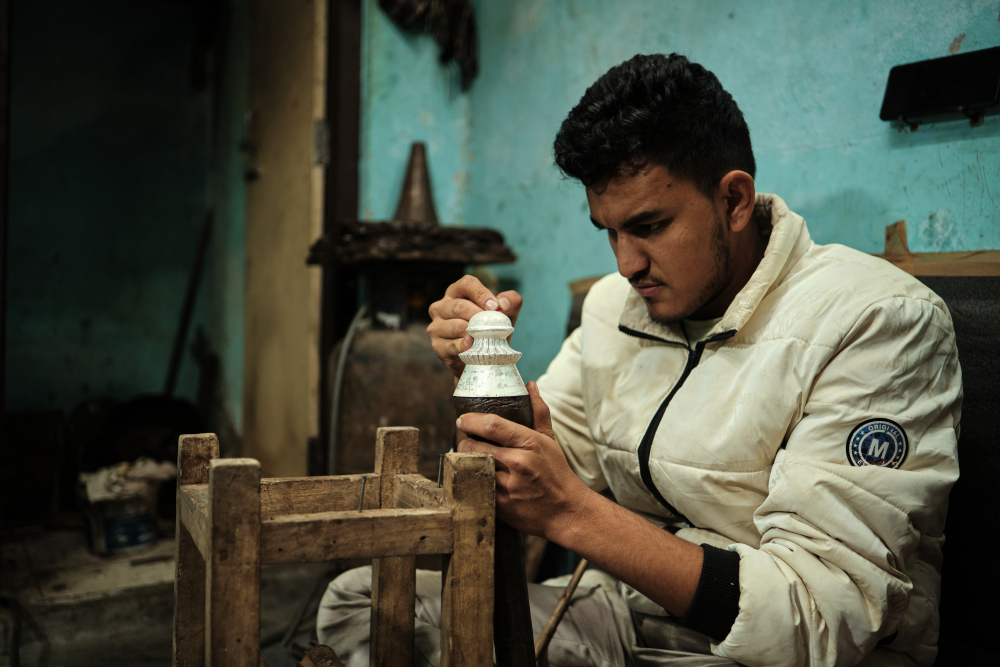
Metalwork artisan drawing on the silverware to mark the engraving points. (Picture Credits: Abhishek Anil)
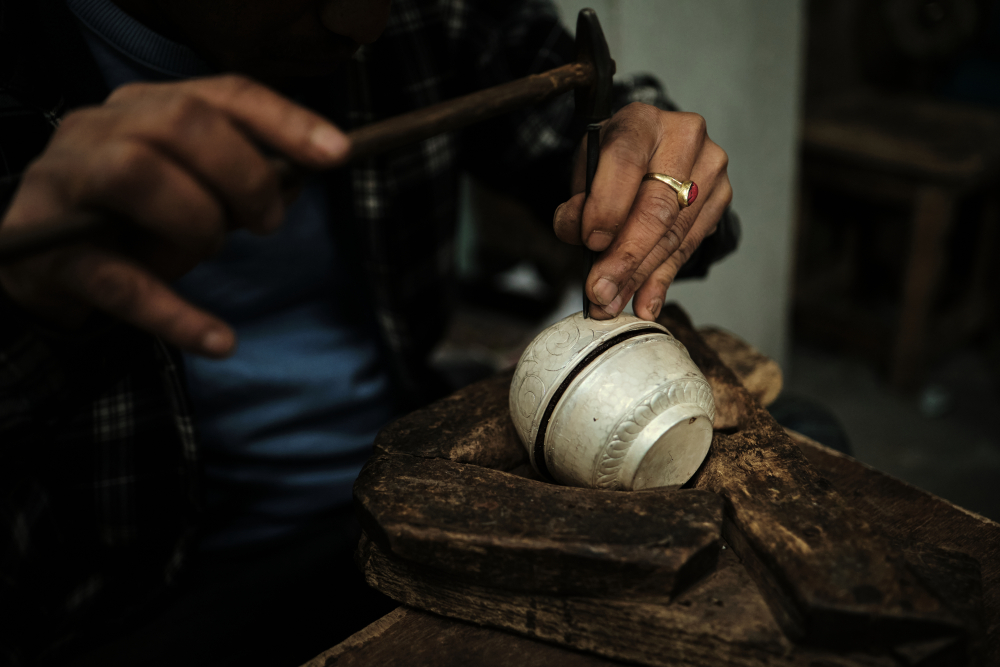
Hammer engraving on a silver bowl. (Picture Credits: Abhishek Anil)
All of the artisans are from Nepal. This production unit, albeit a small one, borrows from their techniques and skills. Some of the methods used include hollow/lost-wax casting, or the thajya in Newari language, which involves covering a wax model with clay and melting it away; the motel metal takes the place of the hollow space and creates solid casting. Newar metalworkers also use the term thajya for hammered work or repousse. Embossing, engraving, and so on are part of the different techniques used in this workshop. Metal-casting from Nepal has influenced a large area in the Tibetan Buddhist cosmic landscape, including Sikkim. Stories that almost read like legends, of the Nepali princess Brikhuti bringing brass and metal work to Tibet, are popular. While precious metal-casting is predominantly associated with the Newars and forges an elite narrative, one can see that a large section of artisans invited from Nepal are also people from historically subjugated castes, like the Kaami, who are known to be occupational blacksmiths, making knives of different kinds and working with leather. Ramesh Sunwar is one such artisan, referred to as the captain of the unit by Dhananjay. He moved from the Nuwakot region of Nepal about seven years ago with his wife and a child. He has been here the longest among the four artisans in the unit. Praksh is another artisan. When asked where else he has been, as he melts the silver with a torch blower, he recalls his time working at a monastery in Ladakh. When asked what place he prefers, he remarks “Kalakar ko desh hudaina”: an artist has no country/nationality.
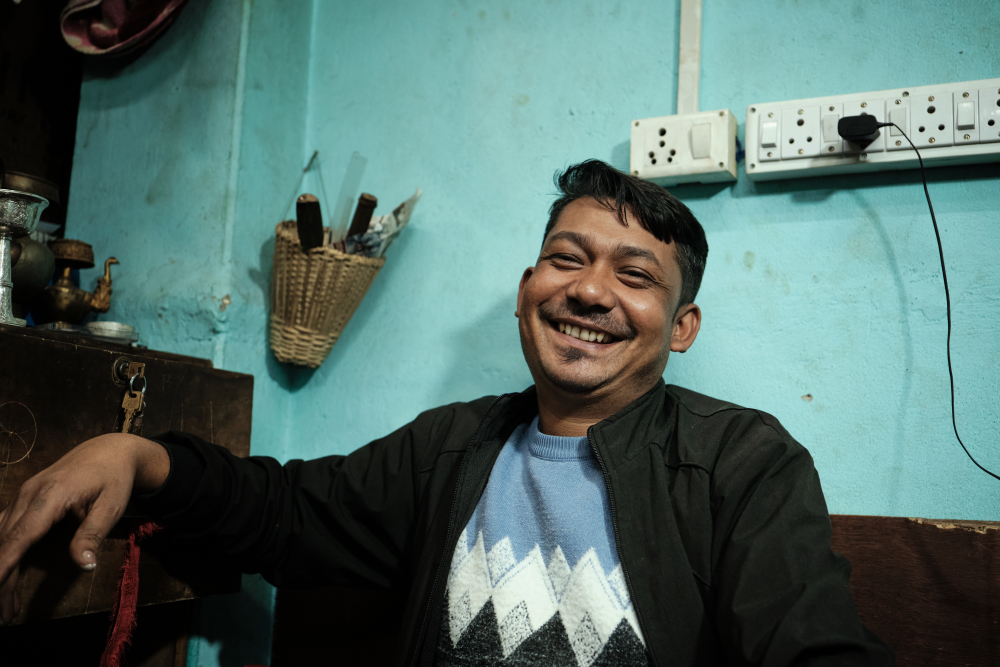
Ramesh Sunwar a.k.a the captain of the karigars (artisans) in the unit. (Picture Credits: Abhishek Anil)
Conclusion
The story of Babu Kazi Sakya shows us an interconnected history of art and craft in this region, a reminder of the intertwined and almost indistinguishable stylistic evolution of Newari and Tibetan art forms in Buddhist iconographies. Art is never static and is affected by a series of exchanges, borrowing and redoing. Finely wrought artistic traditions have moved across borders and endured through time and sit in quiet corners of our marketplaces and everyday lives. Through a long history of migration and cultural exchange, and the transmission of specialized skills, artisans carried techniques, motifs, and religious aesthetics from one region to another. These movements played a vital role in shaping Sikkimese Buddhist visual culture, where such inherited crafts are not merely decorative but foundational to its artistic and spiritual expression.
Supplemented by interviews with Dhananjay Sakya, proprietor of Babu Kazi Sakya Silverware and Curio Shop.
Bibliography
Lo Bue, Erberto. Himalayan Sculpture in the Twentieth Century: A Study of the Religious Statuary in Metal and Clay of the Nepal Valley and Ladakh. PhD diss., School of Oriental and African Studies, University of London, 1981.
‘Techniques of the Nepalese Metallurgist.’ Image. Patan Museum (Nepal), 2023. Accessed January 27, 2026. https://www.wisdomlib.org/gallery/patan-museum-nepal/6990.
This essay has been created as part of Sahapedia's My City My Heritage project, supported by the InterGlobe Foundation (IGF).