
If forts and palaces constitute Patiala’s architectural memory, then its food operates as the city’s aftertaste, carrying forward histories that architecture alone cannot contain. Situated within the Malwa region of Punjab, part of the cis-Sutlej tract, the culinary landscape of the city of Patiala reflects both the agrarian abundance of its surrounding hinterland and its courtly refinement. Punjab is often reduced to a vocabulary of wheat fields, canals, and mandis (a traditional wholesale marketplace or bazaar), but in Patiala, this agrarian base translates into a culinary culture that moves fluidly between field, kitchen, and court.
My engagement with this culinary history has extended beyond documentation into interpretation. This has been possible through my work with Ikk Panjab, where archival fragments and oral histories are translated into dishes that can be experienced in the present; also critical was the process of writing Delectable Punjab, an initiative that traces culinary memory across the region, where the name of Patiala recurs with notable frequency. Patiala, with its reputation for excess and theatricality, offered an expansive framework within which to think about food — not as static heritage, but as something that could be reconstructed and served without losing its historical weight. What became evident early on was that these recipes rarely existed as fixed instructions; they circulated instead through memory, often tied to households that had moved between princely service, Partition displacement, and resettlement across the city and its surrounding towns.
At Ikk Panjab, this translated into a deliberate incorporation of dishes associated with the Patiala Durbar (court), approached not as relics but as living expressions of a culinary temperament. Preparations such as tandoori bater, drawing from hunting traditions, and kibti chicken, slow-cooked and layered, entered the menu not only for their flavour but for the histories they carry. These dishes reflect a culinary language shaped as much by royal kitchens as by the wider Malwa region, where richness and scale are not exceptional but expected: there is an insistence on generosity — of fat, of spice, of portion — that mirrors the ethos of the court itself, where food functions as indulgence and assertion. Recipes were often conveyed in gestures rather than measures, with instructions such as “add ghee until it feels right,” pointing to a form of knowledge grounded in repetition rather than standardisation.
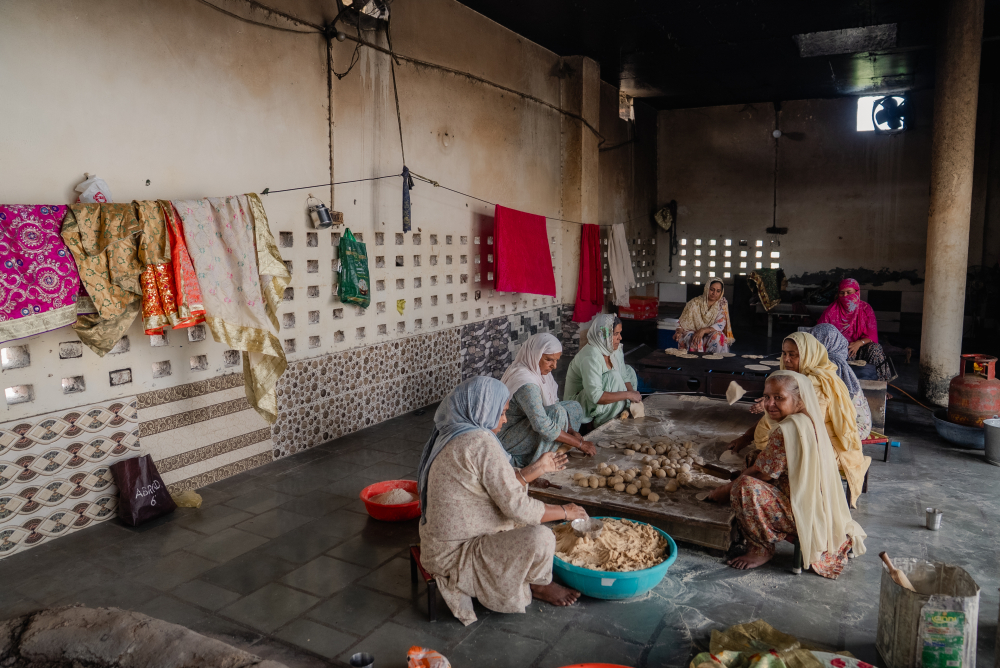
Generosity is embedded in Sikhi's values around langar (community kitchens) where cooking and eating are shared without prejudice. (Picture Credits: Meenal Upreti)
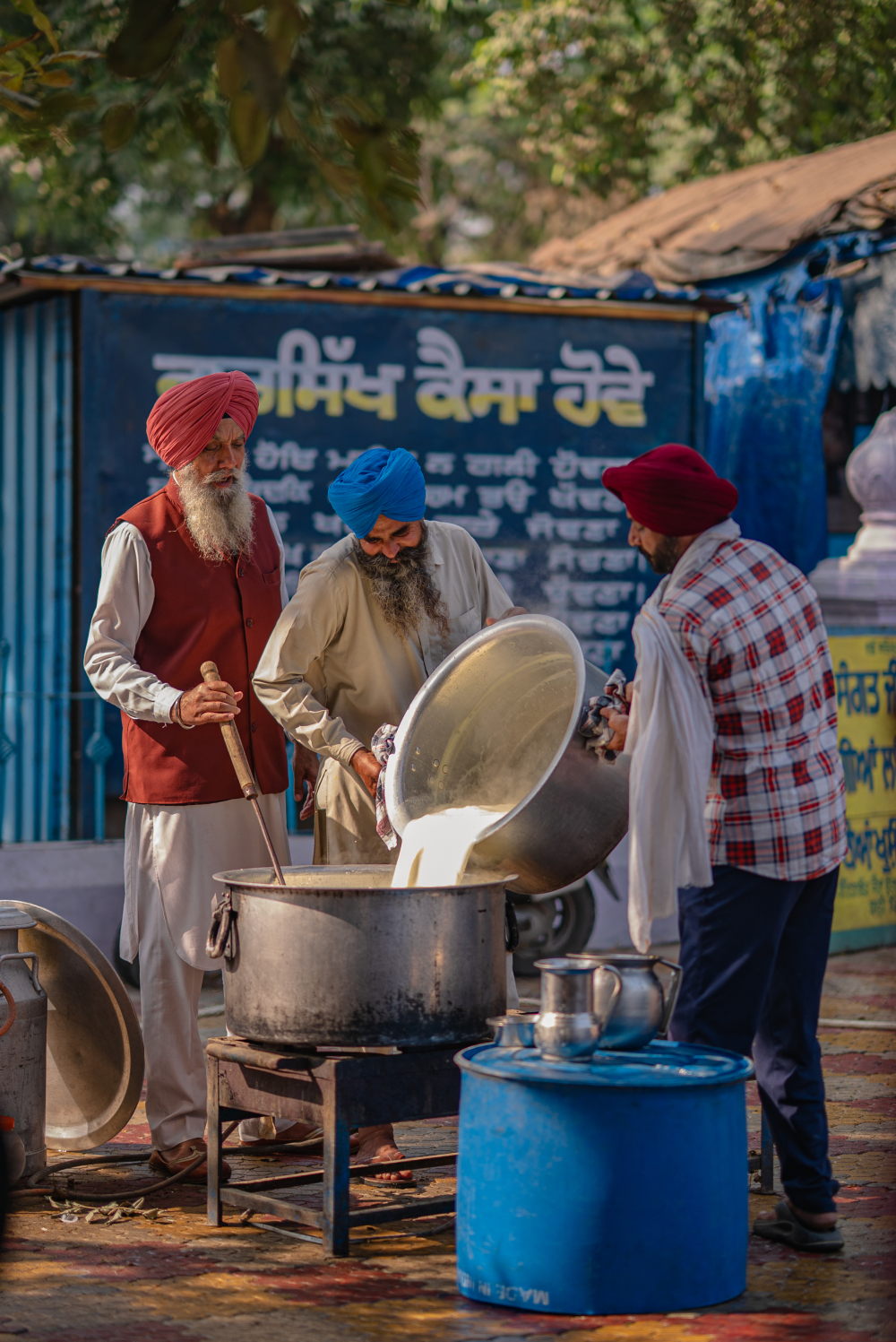
Generosity is embedded in Sikhi's values around langar (community kitchens) where cooking and eating are shared without prejudice. (Picture Credits: Meenal Upreti)
This approach finds resonance in the work of chefs such as Chef Parvinder S. Bali, whose engagement with the culinary traditions of the Patiala court has been shaped by access to a family-held collection of recipes from the royal household, shared with him by Captain Amarinder Singh (son of the last ruling Maharaja and titular head of the royal family of Patiala). Written in Gurmukhi and marked by now-obsolete systems of measurement — units such as masha and rati, or references to ingredients priced in annas — the text resists direct translation into contemporary culinary language. Instructions were often elliptical, with measures conveyed through embodied approximations such as “four anghoothis,” requiring not only linguistic interpretation, but a deeper understanding of technique and proportion.
Chef Bali’s work offers a glimpse into the culinary traditions of Patiala’s royal kitchens, reconstructing menus that reveal how food operated within the frameworks of power, hospitality, and spectacle. The intention here, however, is not replication but translation — retaining the density and character of these dishes while allowing them to exist within a contemporary dining context. Reconstructing these dishes, then, becomes an act of interpretation rather than replication. It involves translating not only ingredients and techniques, but a way of thinking about food — one that privileges time, sequencing, and a calibrated richness built through layering rather than excess alone. In working through similar questions of translation, the challenge probably is not in reproducing these dishes exactly, but in understanding the logic that held them together.
What emerges from this process is less a fixed compendium of dishes and more a record of a culinary sensibility. The recipes reflect a cuisine that remained anchored in Punjabi ingredients — seasonal produce, dairy, and game — while absorbing influences from Mughal, Afghan, and later European traditions. The range of preparations, from slow-cooked meats and dum (slow cooking in a sealed pot over a fire) techniques to puddings and continental dishes, points to a kitchen shaped as much by movement and encounter as by locality. The manuscript itself, with recipes attributed to rulers, head cooks, bakers, and associates, suggests that the kitchen functioned as a space of exchange rather than hierarchy alone.
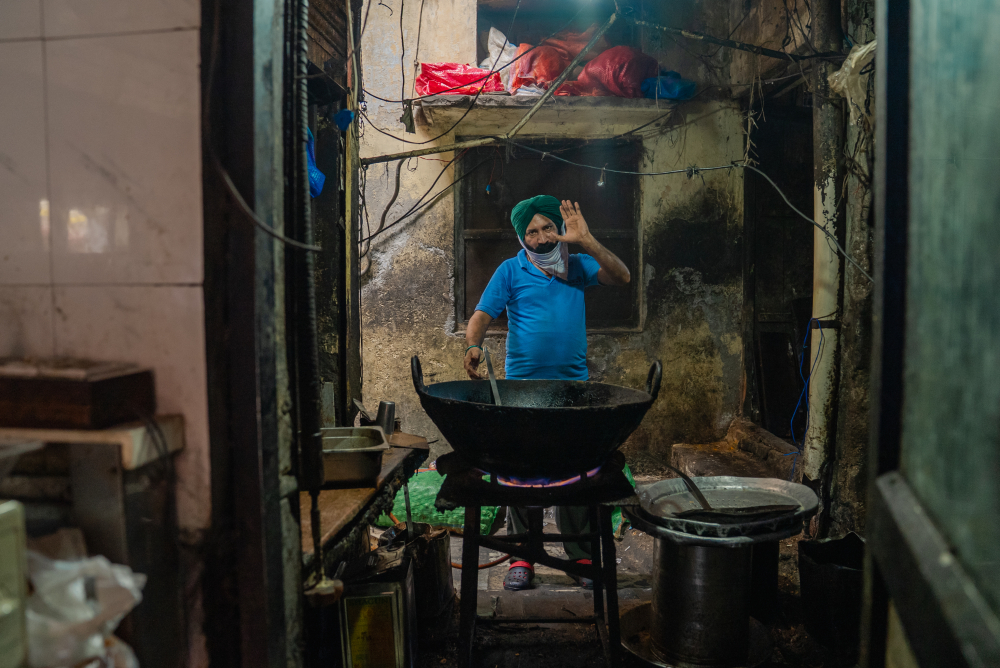
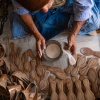
Local halwai starting the work. (Picture Credits: Meenal Upreti)
In many ways, this logic extends beyond the kitchen into the social life of the court. The oft-repeated story of the Patiala peg — associated with Maharaja Bhupinder Singh and his reputation for extravagant hospitality — is less about the measure of whisky itself and more about proportion. Said to be defined not by standard units but through the span of a hand or the gesture of pouring, the peg becomes an index of a broader cultural disposition in which abundance is deliberate rather than incidental. Like the use of “four anghoothis” in cooking, where ingredients are measured through the body rather than calibrated tools, it reflects a shared sensibility across domains — one that privileges instinct, scale, and generosity over precision.
What emerges from such work is an understanding of culinary practice as something shaped through circulation — between court kitchens, domestic spaces, and professional cooks who moved across regions. In this sense, the Patiala repertoire resists easy categorisation, reflecting instead a composite tradition informed by both local Malwa sensibilities and wider north Indian influences.
Beyond curated menus, Patiala’s food culture asserts itself most clearly in its everyday spaces, where the distance between royal and vernacular collapses without ceremony.
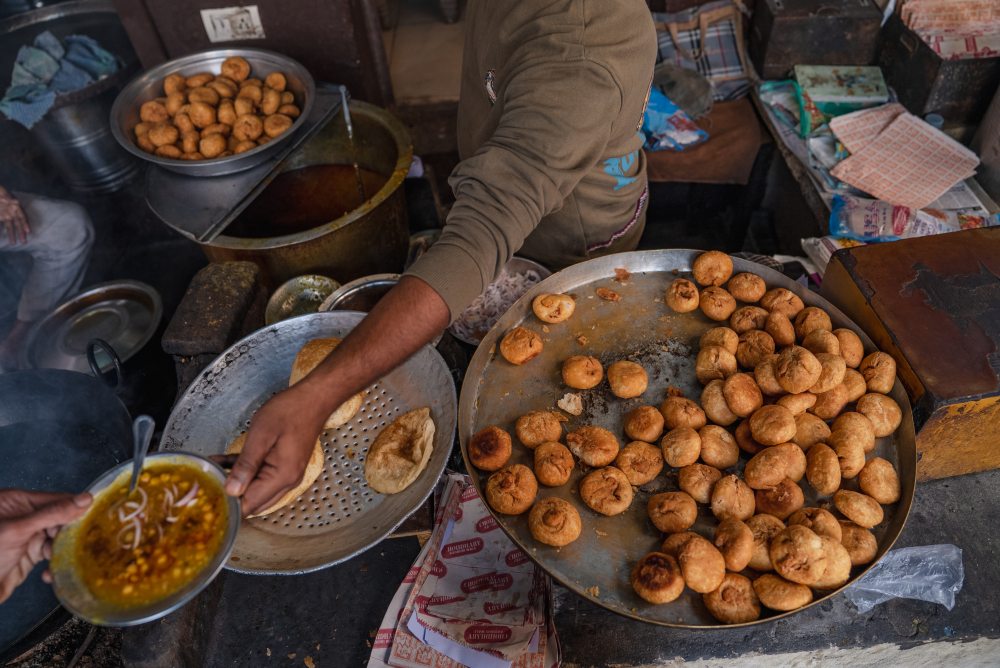
Local eateries offer both volume and taste. Picture of Sadhu Ram Kachori. (Picture Credits: Meenal Upreti)
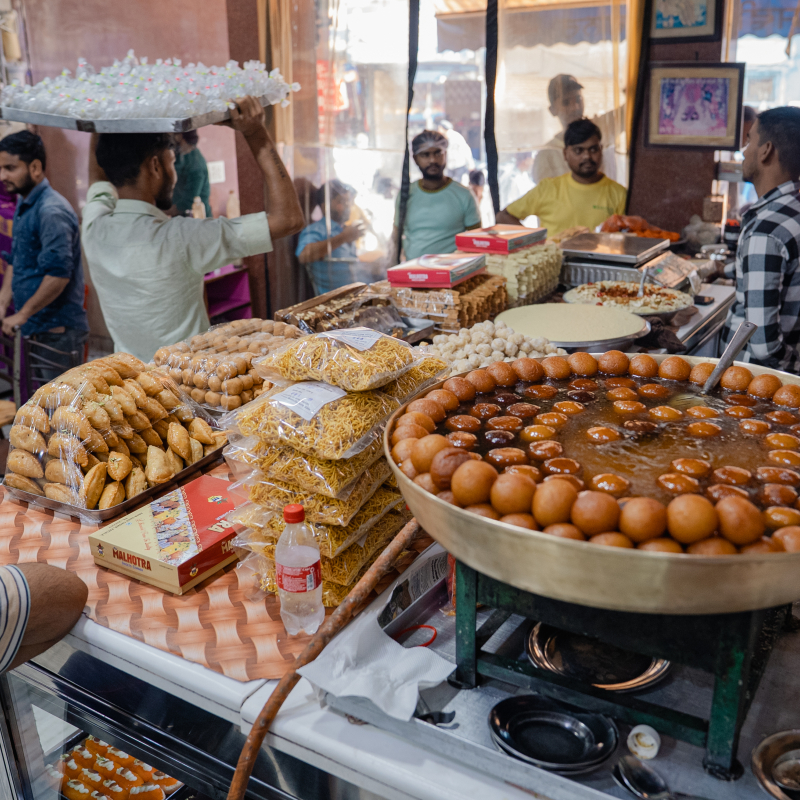
The besan ki barfi at Jaggi Sweets remains one of the city’s most recognisable expressions of this continuity — dense, slow-cooked, and carrying the deep, almost toasted aroma of besan (gram flour) worked patiently over heat. Standing at the counter, one notices a steady flow of customers from nearby bazaars, many of whom have been coming here for decades. The sweet resists embellishment, relying instead on technique and proportion, and in doing so reflects a broader preference for substance over ornament.
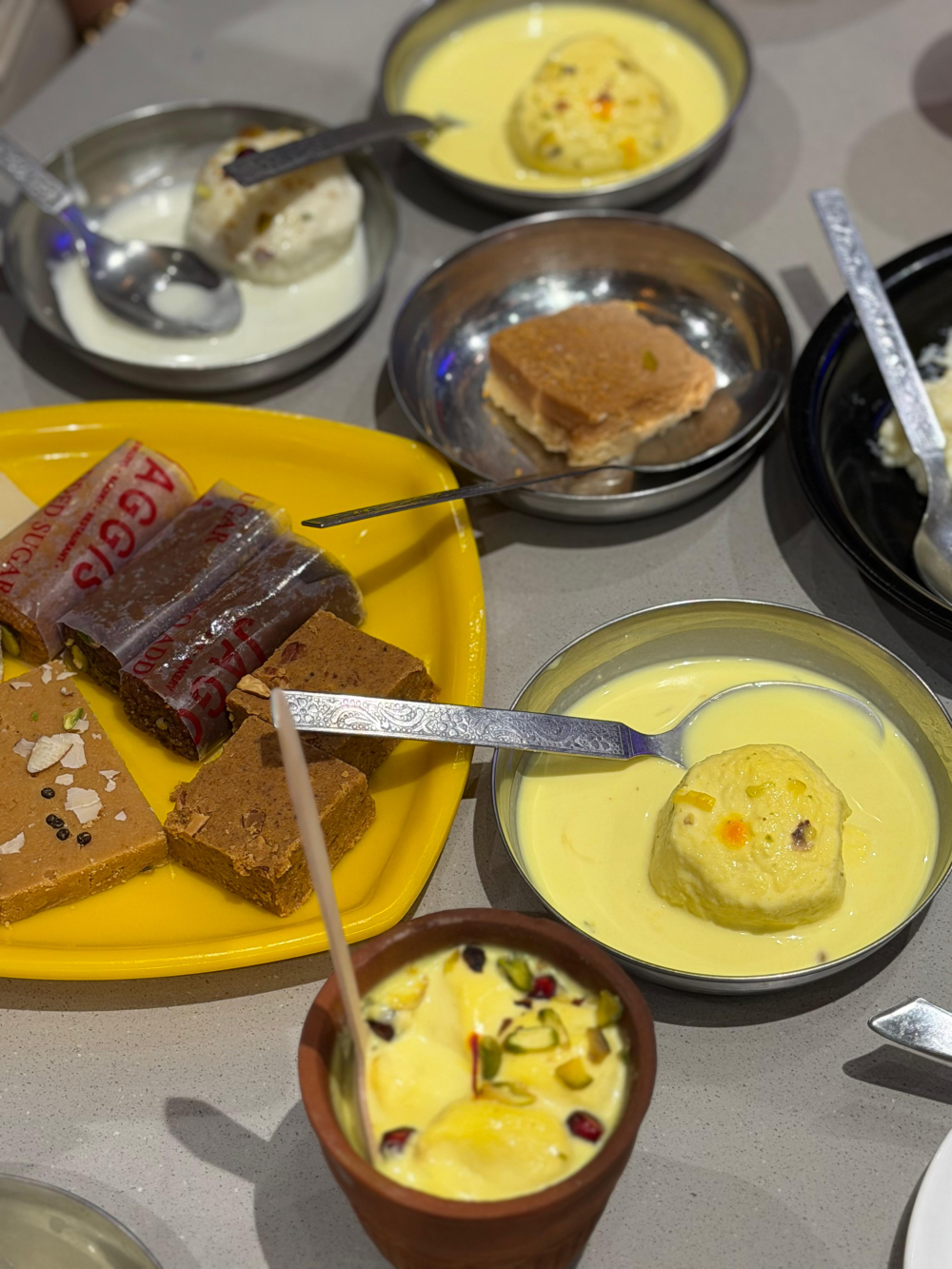
The spread at Jaggi Sweets. (Picture Credits: Vernika Awal)
Equally central are the dhabas (eateries) clustered around older commercial areas and arterial roads leading out of the city. At Saini Dhaba, the food arrives without mediation — mutton and chicken curries built on deeply reduced gravies, dals finished with ghee, and breads that move directly from tandoor (traditional clay oven) to table. There is no attempt here to aestheticise or reinterpret; the food is structured around appetite, repetition, and familiarity, and it is precisely this lack of intervention that gives it its staying power.
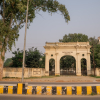
At another level, there has been a parallel effort to reintroduce elements of royal cuisine within the very spaces that once housed it. Ran Baas The Palace, within the restored Qila Mubarak complex, draws upon archival references to recreate dishes associated with the Patiala court. Dining in such a setting extends beyond the plate, positioning the meal within a larger narrative of place, where architecture, history, and food operate in alignment.
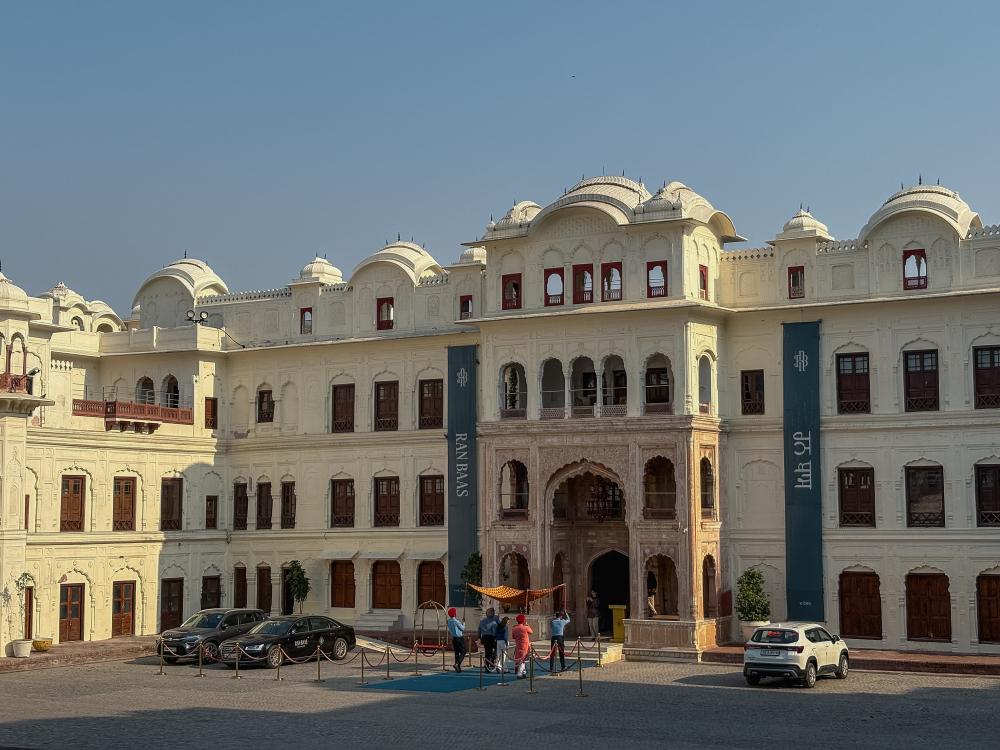
Ran Baas The Palace in the Qila Mubarak Complex. (Picture Credits: Meenal Upreti)
Moving between these contexts, from dhaba to sweet shop to palace dining room, it becomes evident that Patiala’s culinary identity is not organised around binaries. The princely kitchen and the street-side eatery exist within the same continuum, bound by a shared inclination towards richness, scale, and an unambiguous approach to flavour, shaped as much by the city as by the landscape that surrounds it.
This understanding has shaped how I have approached menu development at Ikk Panjab. Rather than isolating royal cuisine as something elevated or separate, the intention has been to position it within the broader spectrum of Punjabi food, allowing dishes such as kibti chicken to sit alongside more familiar preparations without hierarchy. In doing so, the menu attempts to reflect what Patiala, and Punjab at large, itself demonstrates: that excess and everyday abundance are not opposites, but part of the same cultural logic.
Note: This essay draws upon the author’s ongoing engagement with Punjab’s culinary heritage through the ‘Delectable Punjab’ project and her work with Ikk Panjab, where archival recipes, oral histories, and living food traditions continue to inform and shape the understanding of Patiala’s culinary landscape.
References
Dhillon, Amrit. “No Such Thing as Punjabi Food.” The Hindu, November 24, 2022. https://www.thehindu.com/features/metroplus/Food/no-such-thing-as-punjabi-food/article6617767
Ponnapa, Kaveri. “The Royal House of Patiala: A Culinary Legacy.” UpperCrust India. Accessed June 5, 2026. https://uppercrustindia.com/v3/posts/69/the-royal-house-of-patiala-a-culinary-legacy.
“Find Out What Makes the Royal Cuisine of Patiala So Special.” Vikhroli Cucina. December 4, 2017. Accessed June 5, 2026. https://www.vikhrolicucina.com/prints/industry-insights/find-out-what-makes-the-royal-cuisine-of-patiala-so-special.
Ray, Debolina. “Rivaayat-e-Patiala at Le Jardin.” She Knows Grub. December 28, 2018. Accessed June 5, 2026. https://www.sheknowsgrub.com/rivaayat-e-patiala-le-jardin/.
“Rivaayat-E-Patiala: The Royal Cuisine of Punjab Recreated at The Trident.” Foodaholix. March 2018. Accessed June 5, 2026. https://www.foodaholix.in/2018/03/rivayyat-e-patiala-trident.html.
This essay has been created as part of Sahapedia's My City My Heritage project, supported by the InterGlobe Foundation (IGF).