
A tille wali jutti, a traditional leather shoe embroidered with metallic gold thread, announces itself through its surface. Gold embroidery catches the light immediately, drawing the eye before the form of the shoe is fully registered. Across Punjab, this silhouette is familiar and recognisable, carrying with it generations of familiarity with its making. When one spends time with the craft beyond the finished appearance of the product, differences between juttis (also commonly spelled as juti) begin to surface. These differences do not lie only in design, but are embedded in materials, labour, and the social structures that sustain the craft.
As the trade developed, several jutti-making centres across Punjab surfaced, most notably in Patiala, Fazilka, Sri Muktsar Sahib, and Ludhiana. Among these, Fazilka and Patiala stood out for the contrast they offered. Fazilka, located close to the Indo-Pakistan border, continues to practise jutti-making within family homes, rooted in long-standing materials and techniques. Patiala, an urban centre with a strong market presence, reflects a more fragmented and commercially driven mode of production. Studying these two locations together makes it possible to trace how the same craft responds differently to geography, scale, and economic pressure. When one spends time with the practice beyond the finished appearance of the product, differences between juttis begin to surface. These differences do not lie only in design, but in materials, labour, and the social structures that sustain the craft.
Fazilka’s Juttis
In Fazilka, situated along the national Indo-Pakistan border, jutti-making takes place within the home, usually under a single roof shared by members of the same family. The work is divided, but each part remains closely bound together.
A display of hand-embroidered tille wali juttis at Maniran in Fazilka. (Picture Credits: Nandini Agarwal)
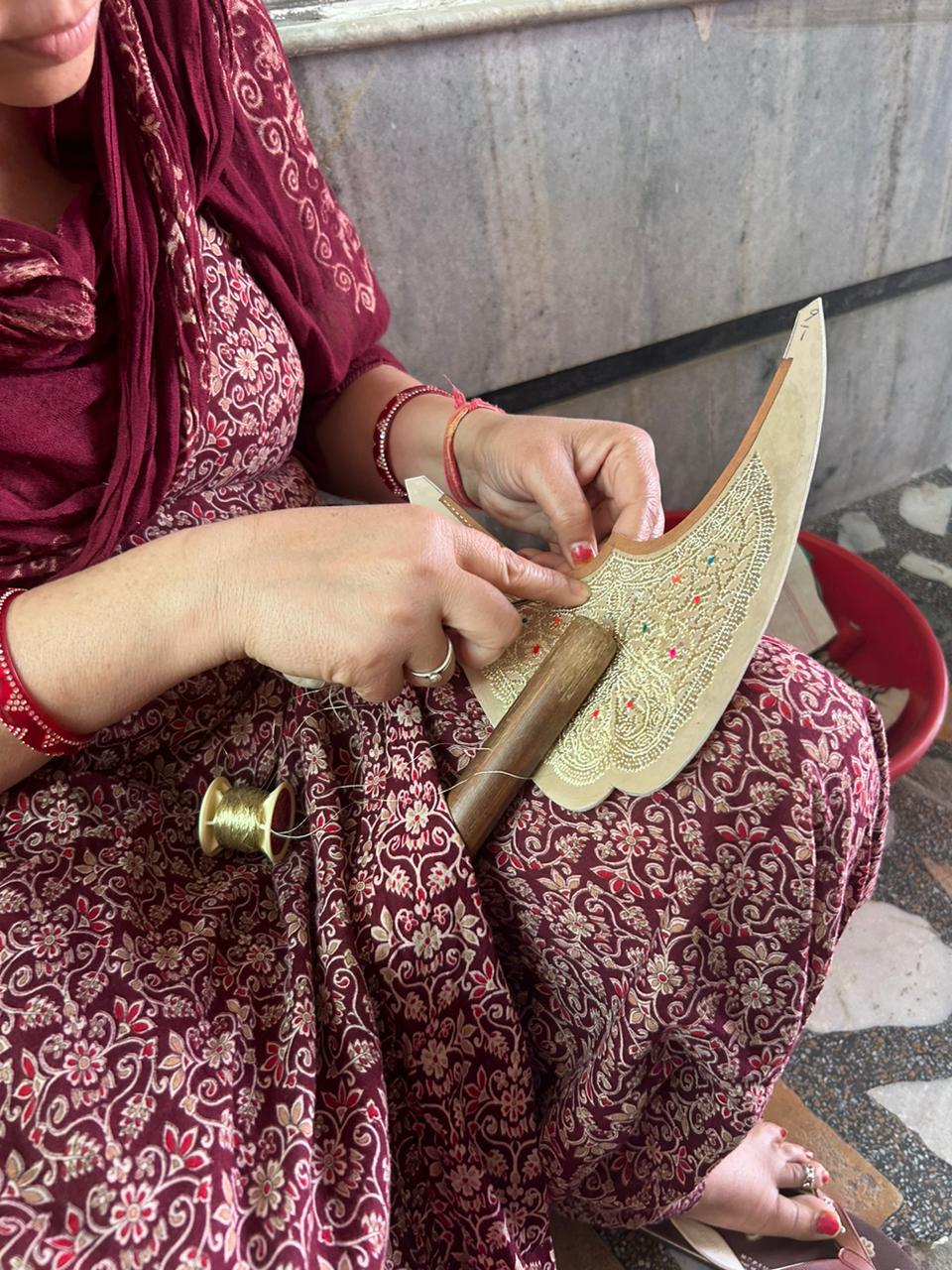
A woman from the Maniram household in Fazilka embroidering a jutti upper in tilla using the aari technique. The leather is held steady with a wooden danda (rod) placed between her legs, allowing her hands to move freely across the surface. (Picture Credits: Nandini Agarwal)
Men of the Mochi community cut the leather and construct the jutti, while the women of the household embroider the upper surface. This division is not just practical, but social, woven into the fabric of everyday life. It is often said within the community, half in jest and half in seriousness, that men marry only women who know how to embroider. “Varna hamare kis kaam ki?” (Otherwise, what use is she to us?) they ask. The statement reveals how inseparable a knowledge of embroidery is from domestic life and identity in Fazilka.
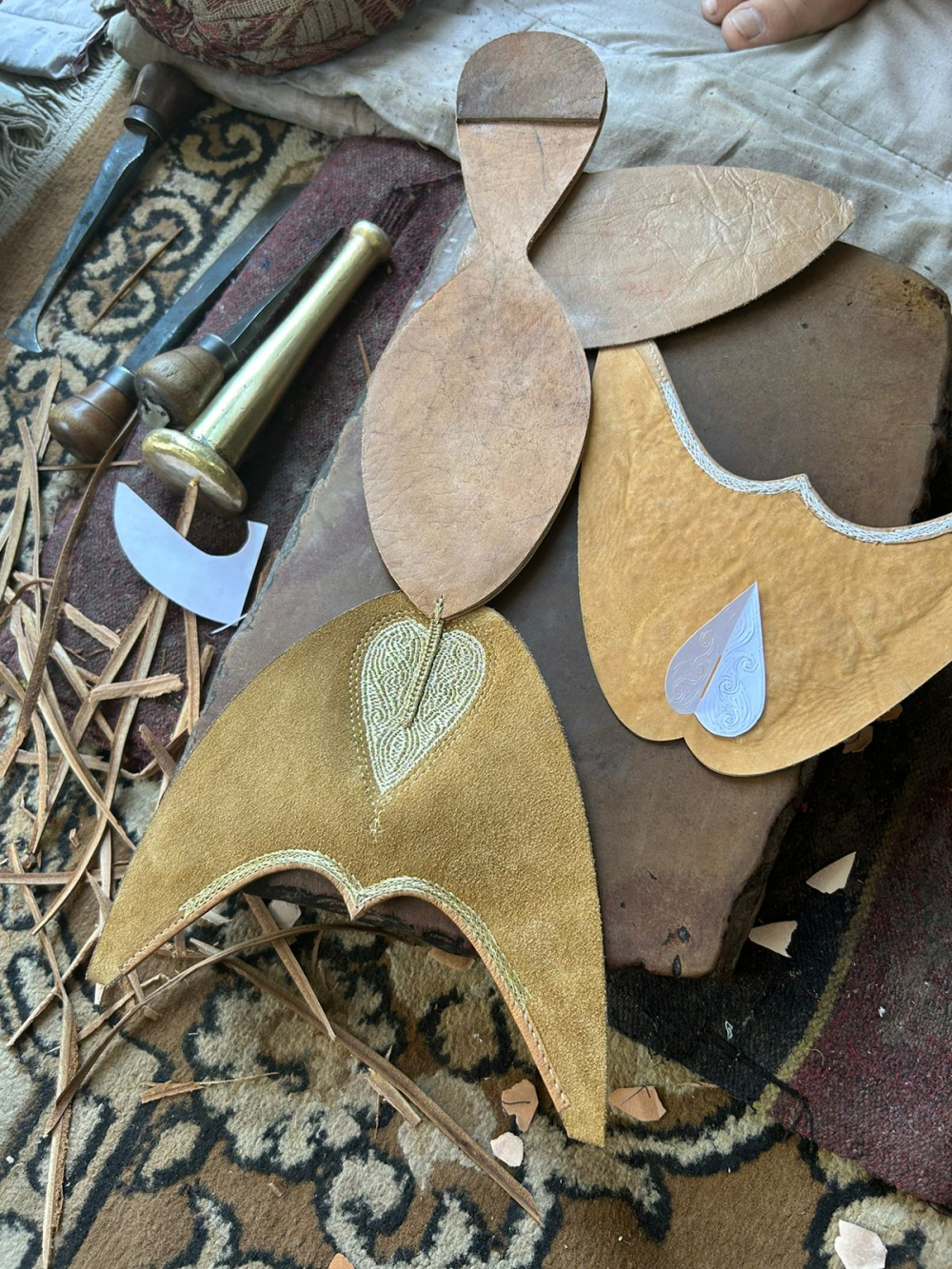
A paper stencil placed alongside its embroidered translation on leather, showing how a delicate cut motif is transformed into tilla work by the women of the household. (Picture Credits: Nandini Agarwal)
Embroidery here is done entirely by hand by women using aari (hook) embroidery. A sharp, needle-like aari tool is used to work tilla (metallic gold thread), along with cotton thread, onto leather. The embroidery is dense and richly packed, leaving very little blank space on the surface. Patterns repeat rhythmically, guided by paper stencils that are drawn and cut by hand. These stencils are not removed after their use. Instead, all embroidery is done directly over the paper while it is still placed on the leather. The paper remains permanently trapped within the embroidered areas, with only the excess portions carefully pulled away by hand once the embroidery is complete. This method adds both structure and weight to the surface; the paper stencil becomes an invisible yet integral part of the jutti.
Materials used in Fazilka juttis are authentic and traditional. Soles are made from thick buffalo hide, cut by hand. The upper surface and aeda (back or heel portion) are crafted from cowhide. These materials are chosen not only for durability but for how they respond to the body over time. A jutti made of these traditional materials adapts to the wearer’s foot, gradually softening and shaping itself with use. There is also a traditional practice of resizing worn juttis. When a foot size changes, a Mochi jutti-maker will soak the jutti in water, insert a larger last, and allow it to air-dry. Through this technique, the jutti stretches and reshapes without losing its integrity. Repair and adaptation are built into the life of the object.
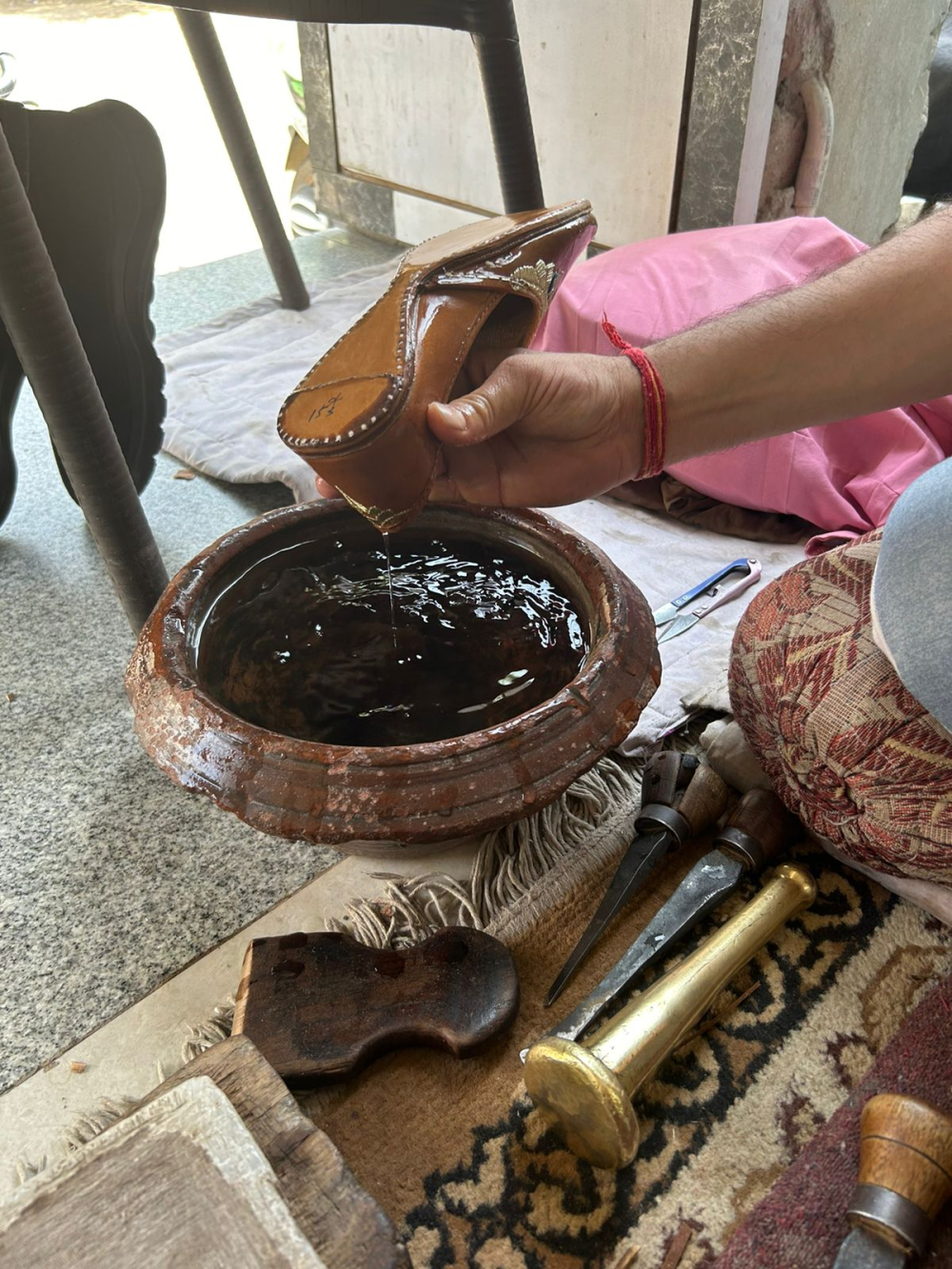
The process of reshaping a worn jutti begins by soaking it in water, allowing the leather to soften and become pliable. (Picture Credits: Nandini Agarwal)
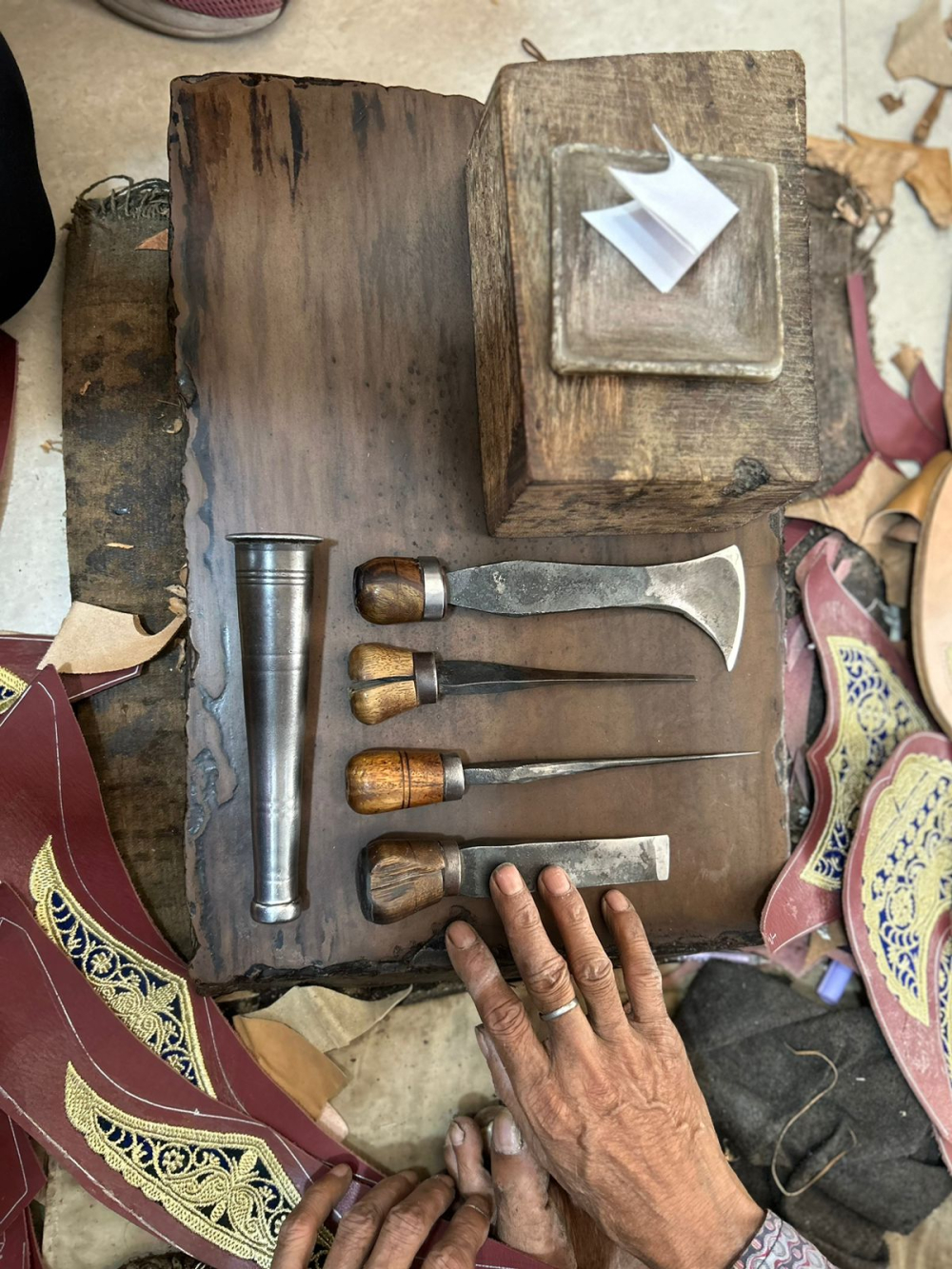
Hand tools used in the making of traditional tille wali juttis reflect a handcrafted process specific to Fazilka, in contrast to Patiala. (Picture Credits: Nandini Agarwal)
The process of construction in Fazilka is deliberate and slow. The thick buffalo hide sole is paired with a thinner layer of leather and adhered using proper leather adhesive applied by hand. Stitching is strong and functional, meant to hold the jutti together through years of wear rather than seasons. The finished jutti feels firm and structured. These juttis are expensive, usually ranging between 2000-5000 rupees, often going higher depending on the embroidery. Their cost reflects not just labour and material, but their significance. Traditionally, Fazilka juttis symbolise a special occasion and auspiciousness. They were worn for weddings, festivals, and important ceremonies, rather than being used as everyday footwear.
Patiala’s Juttis
On travelling to Patiala, it became evident that many jutti makers in Patiala trace their origins to Rajasthan. On asking about this migration, it emerged that their ancestors were brought to the region under royal patronage and gradually settled there over generations. This movement continues to be reflected in the craft. The jutti shares affinities with the mojari, a style of footwear associated with Rajasthan, particularly in its use of leather and surface embellishment. Over time, however, the form has adapted within Punjab, taking on a distinct shape and identity shaped by local materials, techniques, and systems of making.
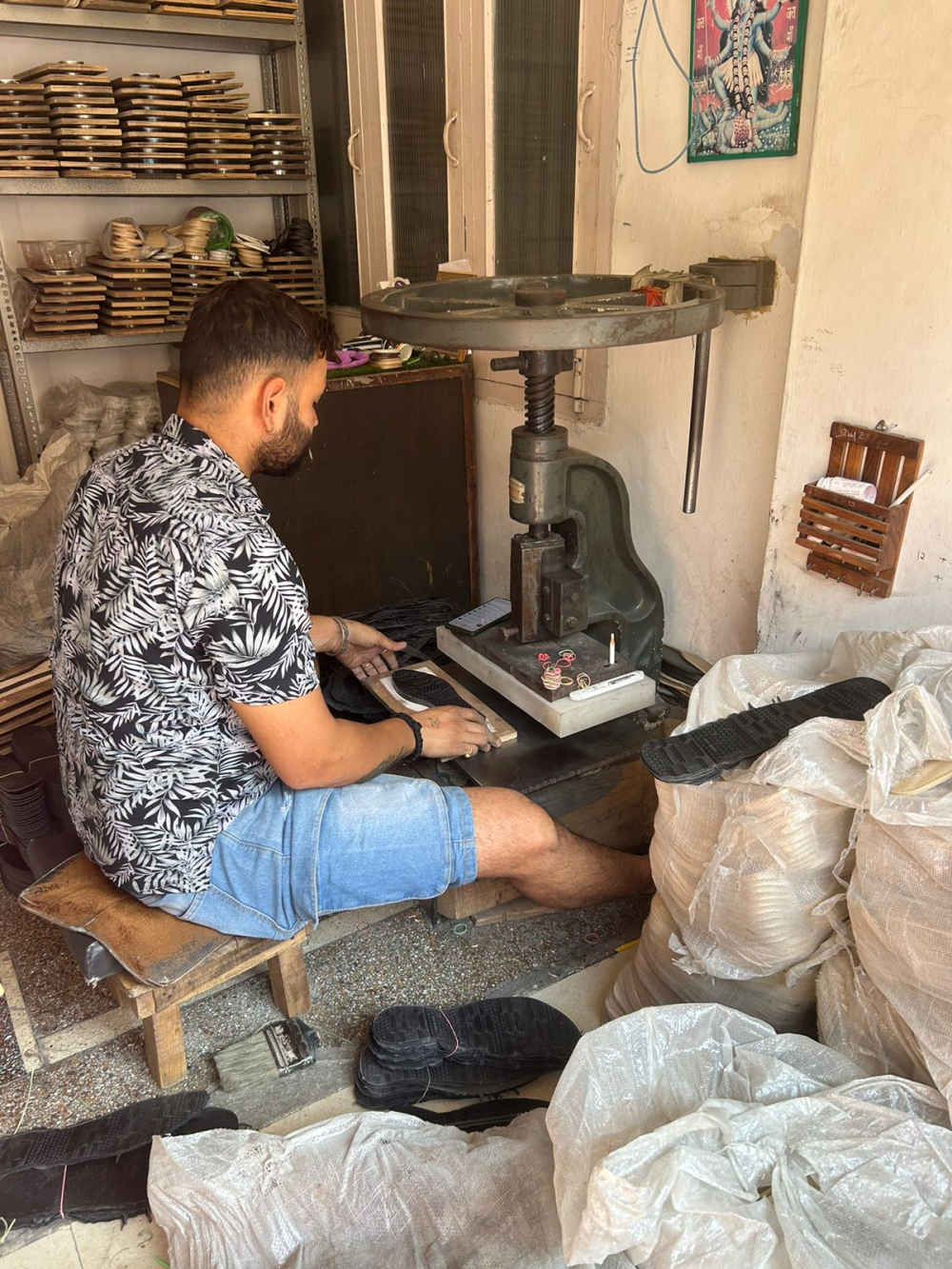
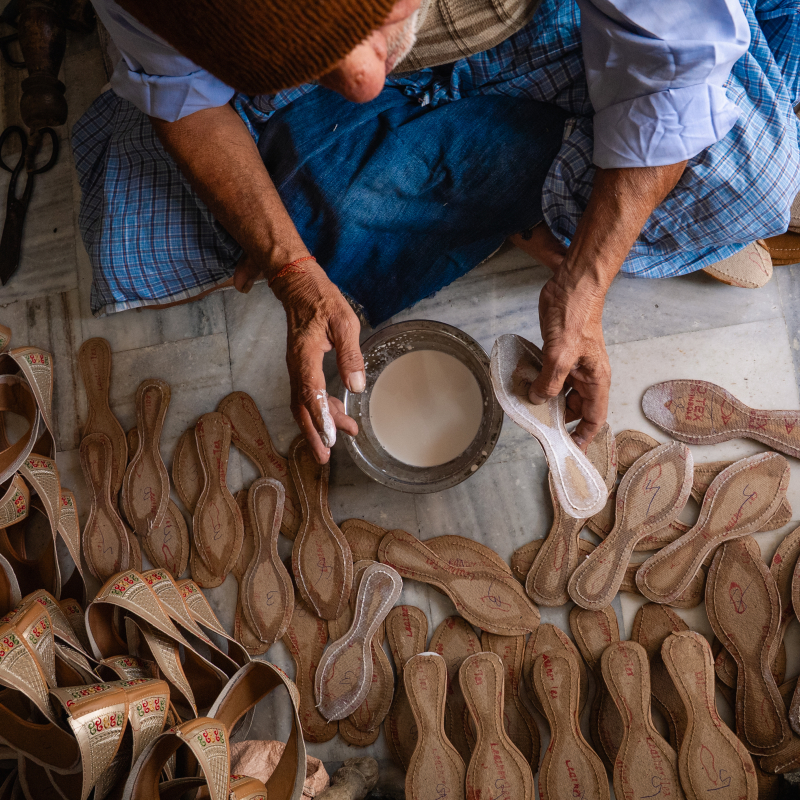
A more mechanised mode of production in Patiala. Stacks of identical jutti soles signal speed, repetition, and scale. (Picture Credits: Nandini Agarwal)
In Patiala, the making of juttis follows a very different rhythm. Here, production is organised through an assembly-line-like system. Each family is typically involved in only one step of the process, and knowledge remains limited to that specific task. One household cuts soles, another prepares piping, another handles partial assembly. Unlike Fazilka, where most stages are carried out by the men within a family and embroidery by the women, Patiala’s system fragments the craft across many homes.
The organisation of labour in Patiala is mediated through companies. Families live and work within the same localities, but they function as individual units commissioned to complete specific tasks. Materials made by people in the locality first go to the company. The company then commissions a few families, often from the same locality, to assemble the jutti by hand. While final assembly still happens within these neighbourhoods, it takes place only after materials circulate through the company. Workers are compensated per piece, according to the task they perform. Payment is low, reflecting the reduced value assigned to isolated stages rather than to the craft as a whole.
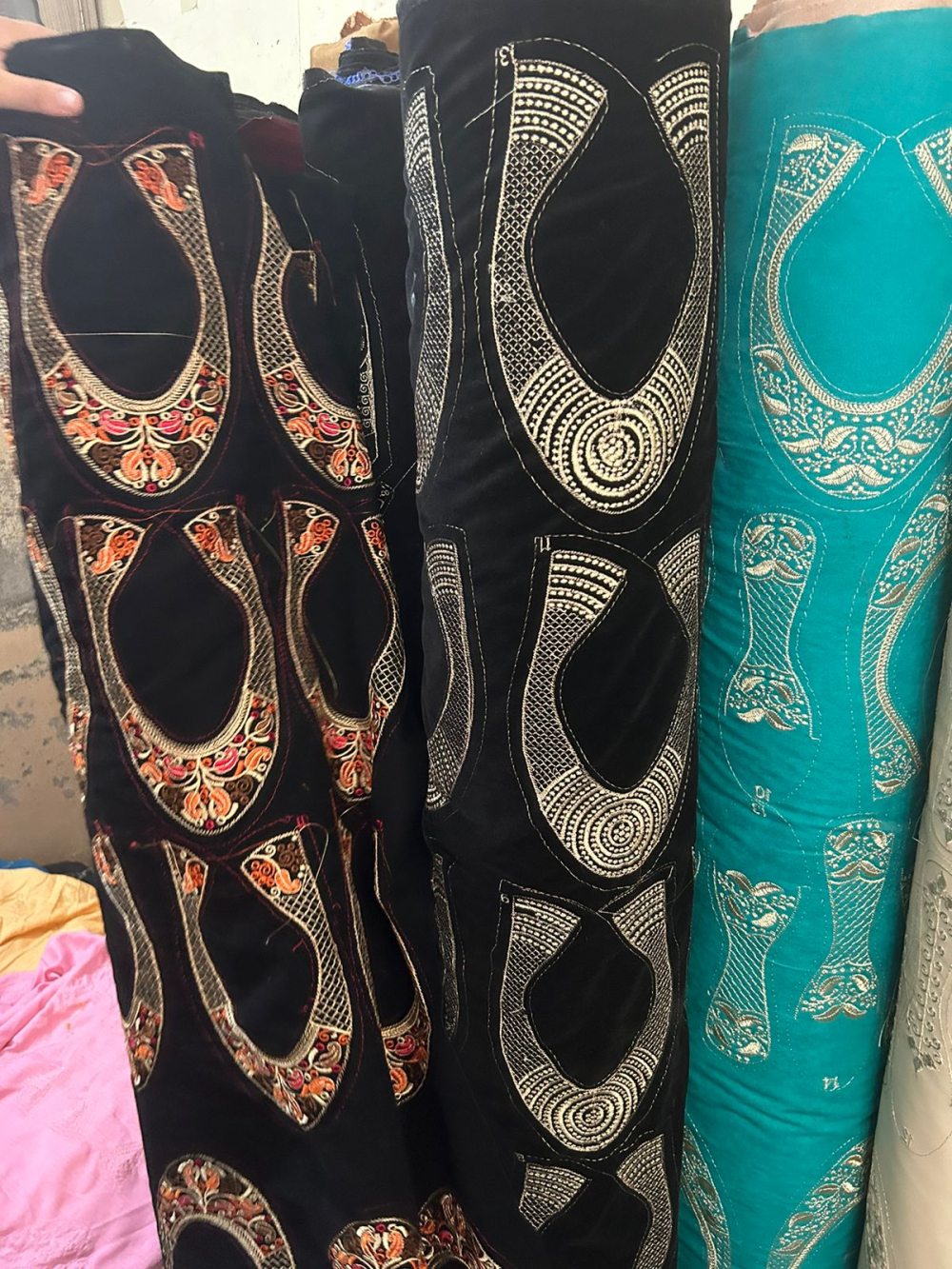
Machine-embroidered jutti uppers sourced from Lucknow and Bareilly. (Picture Credits: Nandini Agarwal)
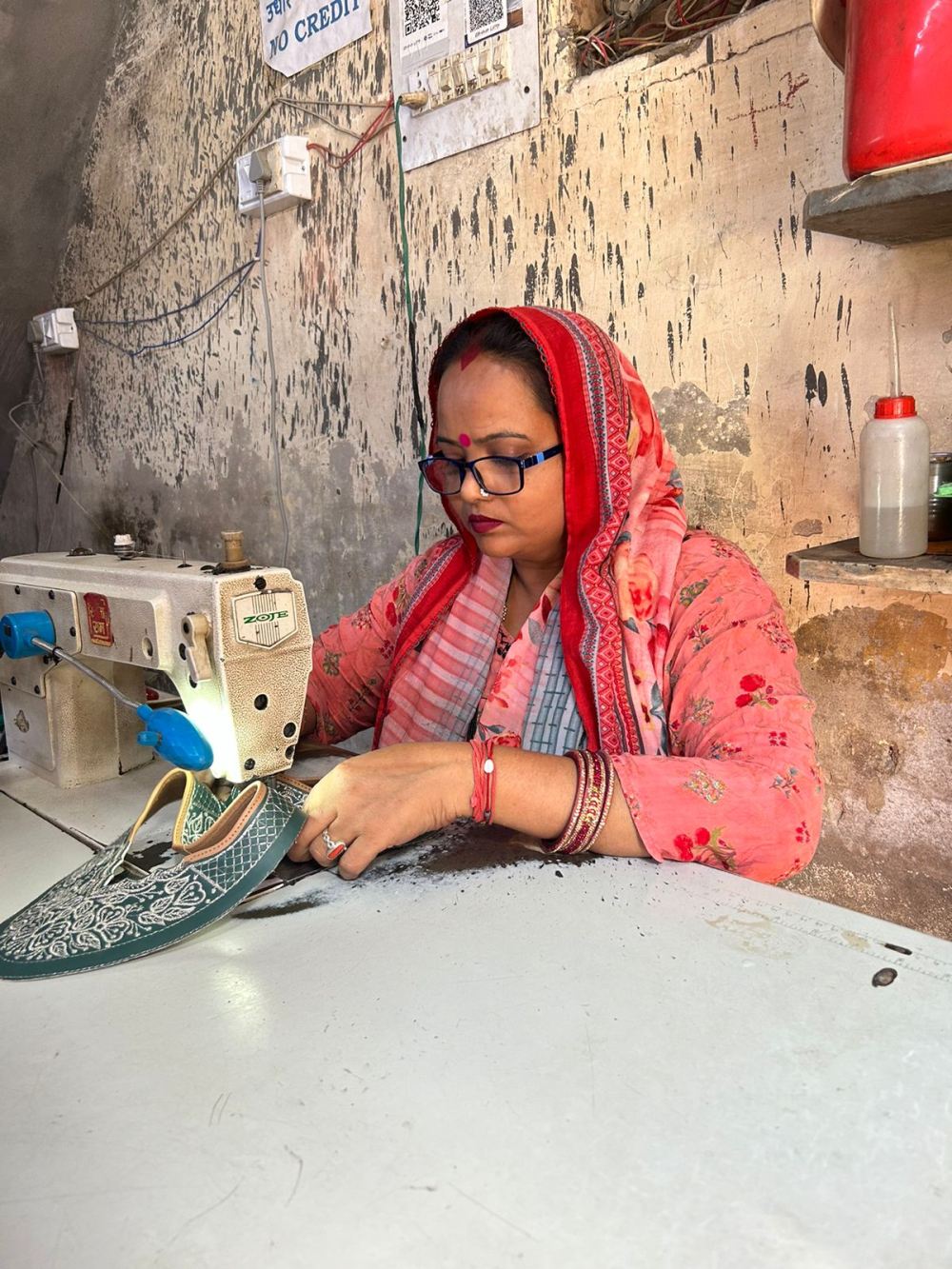
Inside the craftsman’s home, his wife pipes the jutti uppers on a sewing machine with remarkable speed and precision. (Picture Credits: Nandini Agarwal)
Embroidery in Patiala has also undergone a major shift. While women are involved, they no longer embroider the upper surface from scratch. Their work is limited to piping pre-embroidered uppers using rexine piping. These uppers are largely machine-embroidered using polyester thread and are sourced from Bareilly and Lucknow in Uttar Pradesh. Only in rare cases, based on specific orders, are hand-embroidered uppers used, and these are usually sourced from Rajasthan rather than being made locally. Embroidery here becomes a detachable and outsourced component, disconnected from the locality where the jutti is assembled.
Materials in Patiala have also largely shifted to more affordable substitutes. Thick buffalo hide soles are replaced with rubber soles, cut by machines. Cowhide uppers and aeda are replaced with rexine, also machine-cut. Where Fazilka relies on hand-applied leather adhesive, Patiala uses “doodh,” a locally used glue, applied using latex machines. These changes make production faster and cheaper, but significantly alter the weight, flexibility, and lifespan of the jutti.
The pricing of Patiala juttis reflects this structure. Finished juttis usually range between 400 - 1500 rupees. They are designed to be affordable, lightweight, and suitable for frequent use. These juttis cater to fast-moving markets and budget-conscious buyers. Their design language is contemporary, shaped by speed, scale, and shifting consumer demand.
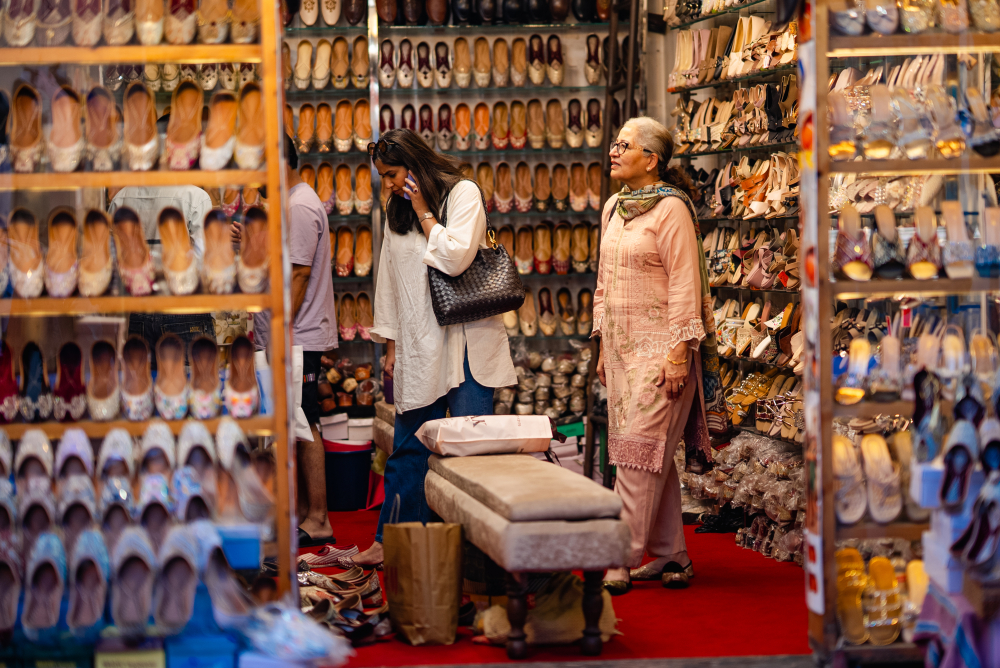
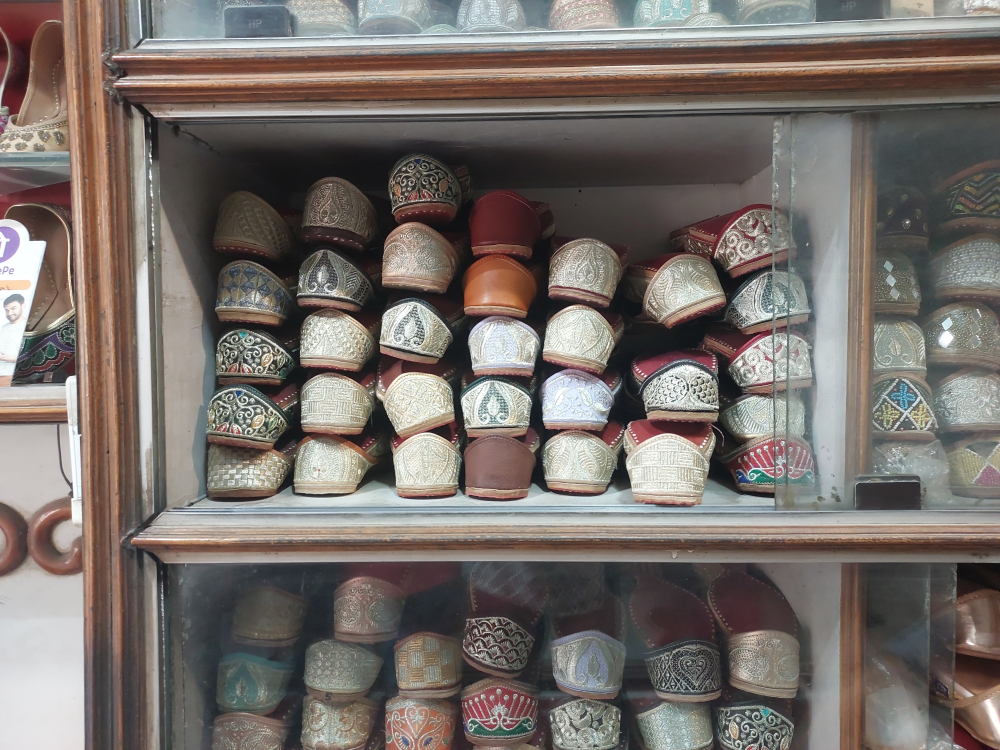
An extensive display of machine-made juttis in Patiala, stacked tightly across shelves, showcasing a wide range of colours, embellishments, and surface treatments. (Picture Credits: Meenal Upreti)
Placing juttis from Fazilka and Patiala side by side reveals more than stylistic differences. It exposes two fundamentally different relationships with tradition. In Fazilka, the jutti remains an object tied to ritual, durability, and continuity. In Patiala, it becomes a commodity shaped by speed, cost, and scale. Neither exists in isolation from the present. Both respond to economic realities, but they do so in contrasting ways.
This contrast raises a question that continues to linger. If the materials, tools, and processes are entirely transformed, is it still the same craft? Or does it only carry the essence of what it once was?
Note: This essay draws on fieldwork carried out in Fazilka and Patiala, Punjab, as part of an academic documentation project.
This essay has been created as part of Sahapedia's My City My Heritage project, supported by the InterGlobe Foundation (IGF).