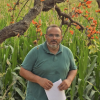
Patiala stands out for its artisans and knowledge traditions, but upon visiting the city, what becomes apparent is how green it is. In addition to the Baradari Bagh, its universities boast of botanical gardens and it is surrounded by Bir forest reserves, with the nearest being adjacent to Moti Bagh Palace. So when Gurpreet Sunny Singh founded RoundGlass to foster plant resilience and sustainability within the Punjabi community, Patiala and its surrounding areas became launch-pads for their projects. RoundGlass is going pan-Punjab with their Billion Tree Project this year, so Aalekh Dhaliwal (City Curator of Patiala, My City My Heritage) sat down with Dr Rajneesh Kumar, who is leading this project, to talk more about his experience and the details of what he has designed alongside his team.
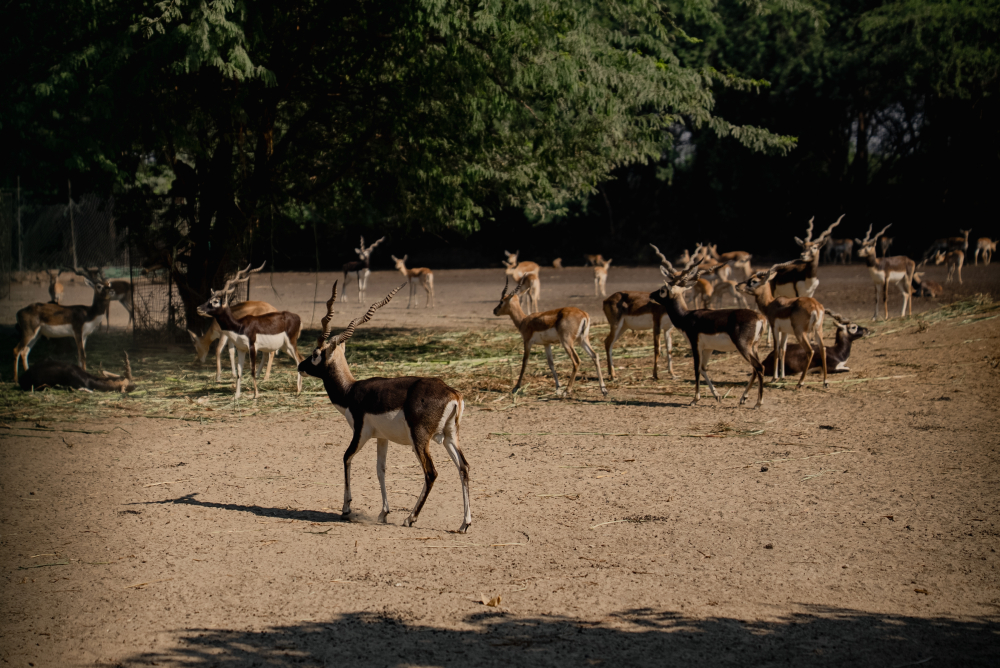
Bir Moti Bagh. (Picture Credits: Meenal Upreti)
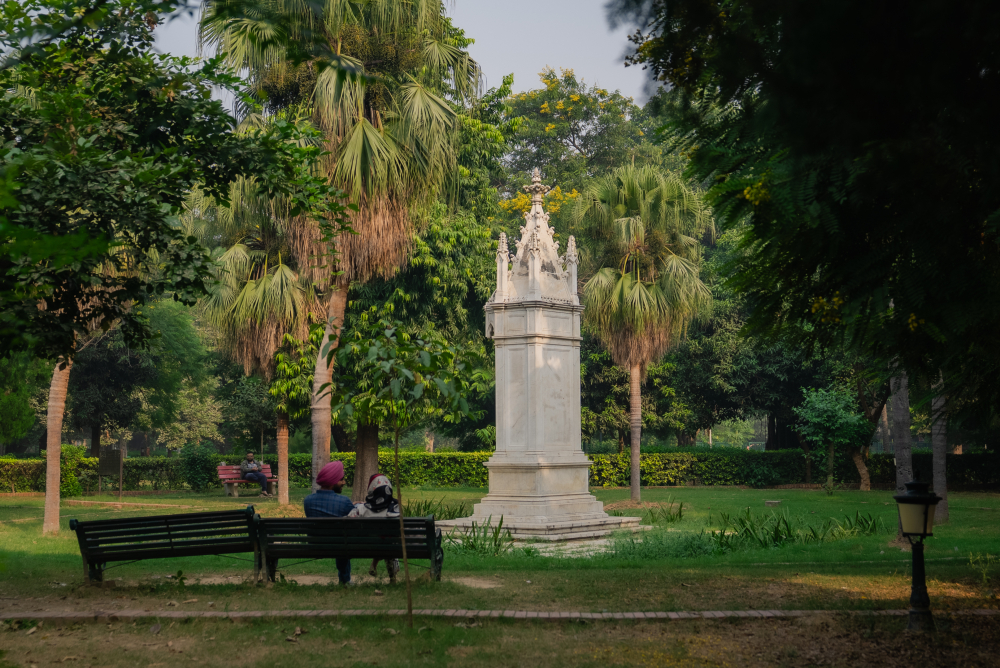
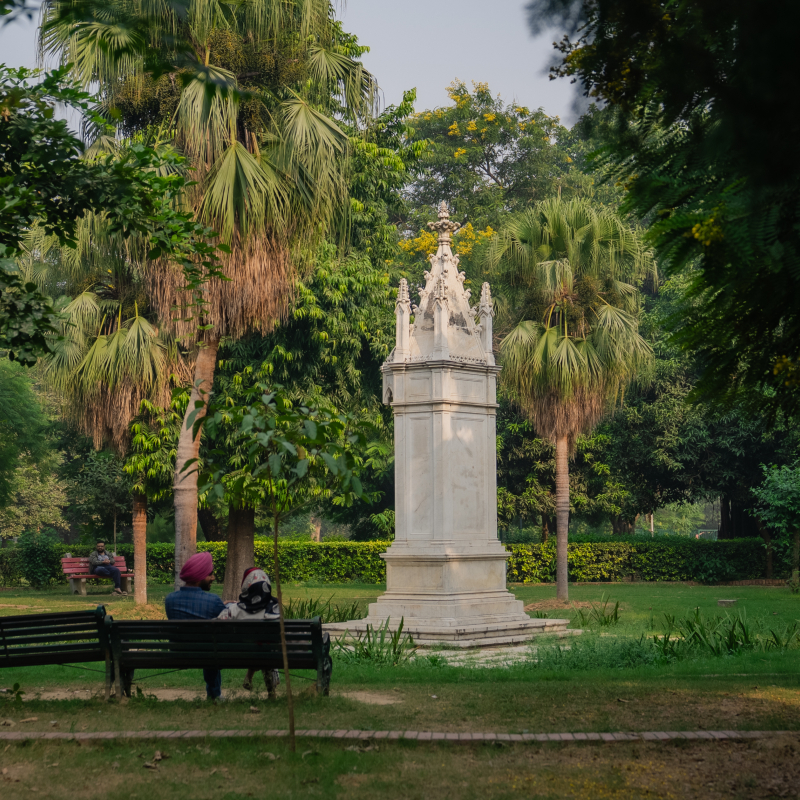
Baradari Bagh. (Picture Credits: Meenal Upreti)
Aalekh Dhaliwal (AD): How did your involvement with the RoundGlass Foundation begin? Where were you before taking on the first project with the foundation?
Rajneesh Kumar (RK): Around 2015, I was undertaking my PhD in biotechnology from Thapar University Patiala and leading the Paryavaran Welfare Society on the Thapar Campus. Although I had begun my academic career as a teaching associate at Thapar and continued in that vein for about two years, I wanted something more engaging in the field, which would put my education to use. So in my personal capacity, and by tapping into the resources made available through the Society, we carried out various activities in Patiala city — there are more than a thousand press notes in my record that briefly capture the work we were doing. My car would be a workshop and nursery of sorts: it had everything from saplings to tools in case these were needed on the job. For another project, we undertook spot-fixing for bus stops, wherein 18 bus stops were beautified and the public space around them cleaned. Through consistent efforts, 350 cleaning campaigns were undertaken in the city in a short span of time. In the early years, we were successful in creating a 2 kilometre nature park and trail along Nabha Road, the boundary of which was delineated in collaboration with the State Forest Department, who took care of taarbandi (delimitation) and fencing. As a result of the many conservation activities and revival efforts we undertook in and around the campus, the state government conferred me with the Green Punjab Mission State Award in 2016. It was amidst such activities that, in 2017, I was approached by the newly-founded RoundGlass Foundation who wanted someone to lead a solid waste management project. It was this opportunity that has now culminated in over eight years of engagement with RoundGlass.
AD: What has work looked like since you began with RoundGlass?
RK: I have designed and led two projects, starting with solid waste management and then transitioning to the Billion Plants for Punjab Project. We began with a seed idea in the Patiala region and this year we are scaling to two more zones, Doaba and Majha, hence fulfilling the aim of going pan-Punjab with this initiative. There were many reasons for beginning with Malwa — in addition to my experience here in the Thapar years, there were a large number of land banks available, which we could use to plant saplings.
Our nursery in Village Lang, Patiala is spread across four acres and functions as a research centre. Any mass-scale planting project needs nurseries where saplings are not only experimented with, but indigenous varieties can be given favourable conditions to grow before being transplanted into the land bank. Just like the State’s Forest Department has nurseries near areas fed by nahrs (canal waterways), we learnt from this model and designed a similar structure. So this nursery has gradually developed into a seed bank for Punjab’s native tree species. We conduct research on fruit varieties: for example, when is a good time to sow the many jamun varieties and how long does each one take to sprout, how long does the paneeri (sapling) take to form. Amla is a two-day process, whereas some jamun varieties can take 15 days. Across Punjab, 29 acres have been dedicated to such nurseries in the villages of Patiala, Bathinda, Firozpur, and Faridkot. With the expansion of this project to Doaba and Majha, we are allocating more space to nurseries in Amritsar and Hoshiarpur. Interestingly, Hoshiarpur is Punjab’s hub for greenery due to its proximity to the Shivalik foothills, so we are eager to bring it into our Billion Plants for Punjab project! The aim is to plant 10 lakh saplings in these zones this year.
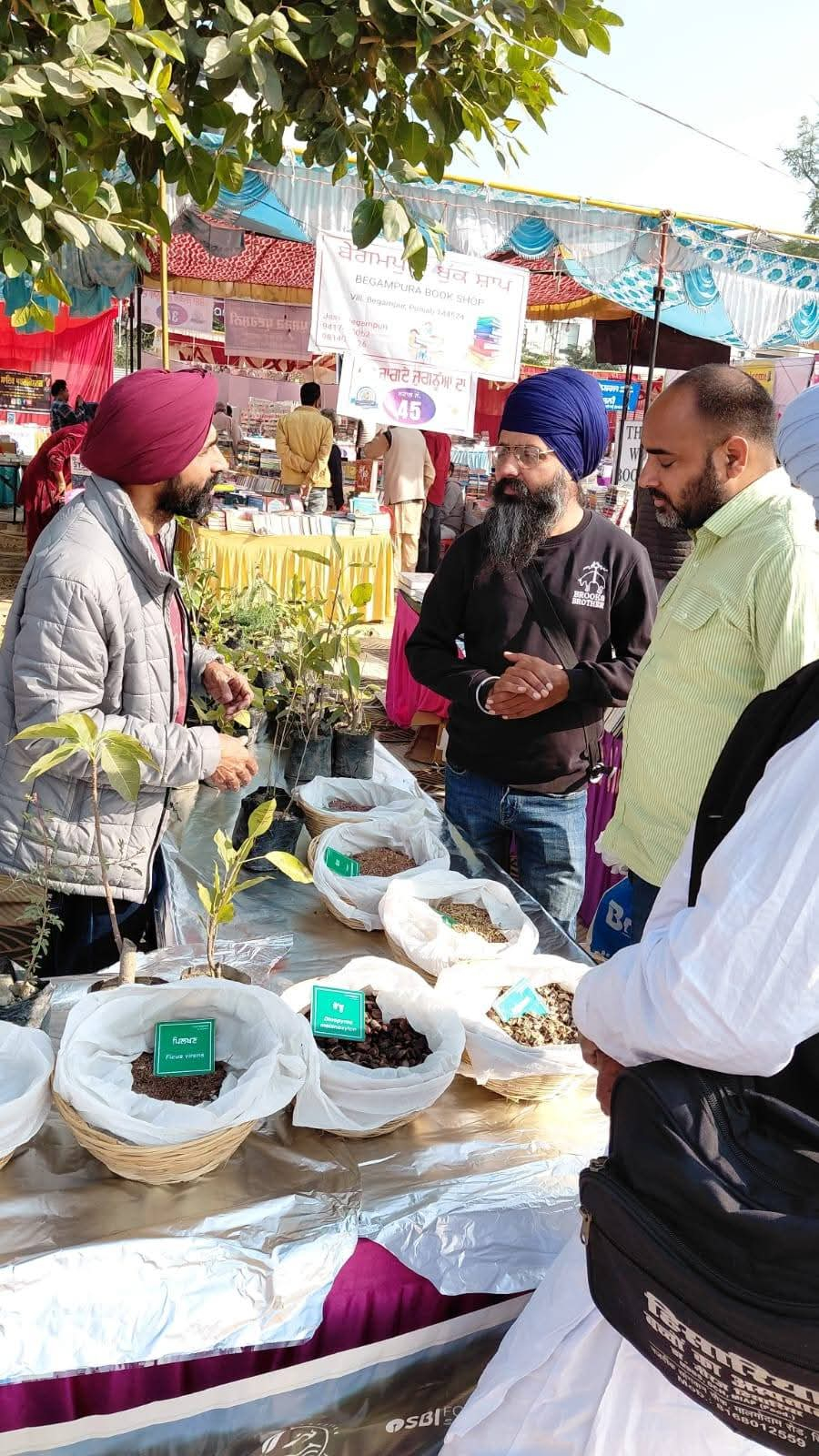
Information sessions about plant species and varieties for the public. (Picture Credits: Dr Rajneesh Kumar)
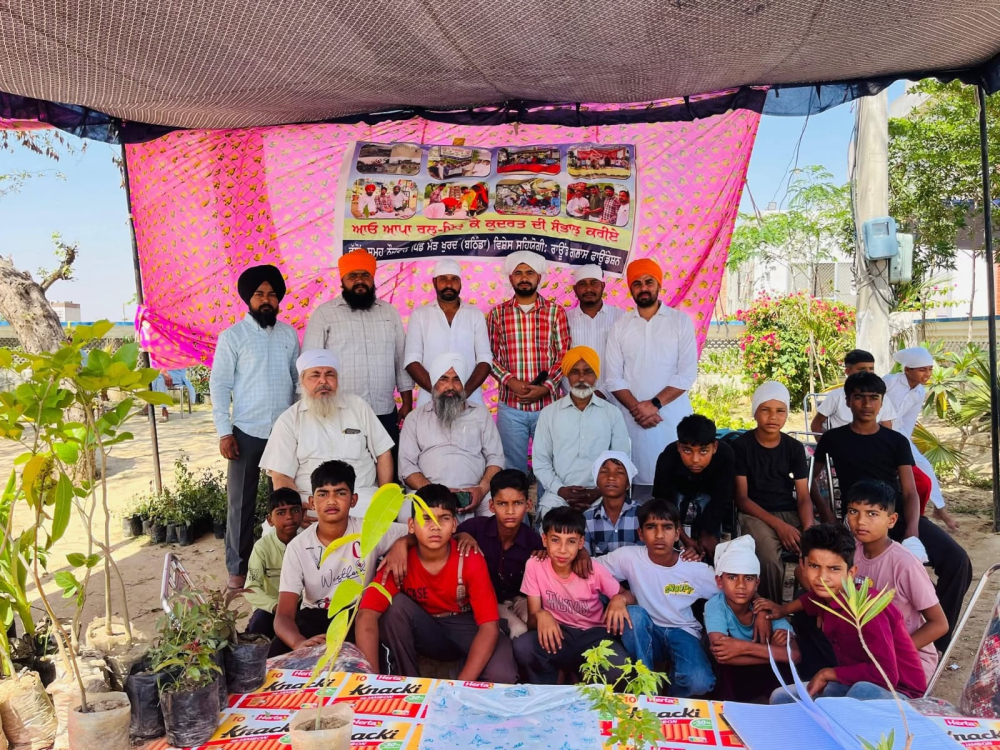
A 'langar' (community kitchen) of indigenous plants on the occasion of Vaisakhi. (Picture Credits: Dr Rajneesh Kumar)
AD: Let’s talk about the land bank process that you briefly mentioned.
RK: This is a fairly top-down process, wherein the Deputy Commissioner (DC) and Assistant Deputy Commissioner (ADC) at the district levels are involved alongside the Block Development Officers (BDOs) of blocks, and finally village sarpanches [are involved] wherever the land bank has been demarcated. Once the District Nodal Officer informs us of pockets that can possibly qualify for land banks, we conduct our own surveys by going from village to village and interacting with sarpanches, even finding spaces that may have been missed by the BDOs. Our survey is an extensive 3-step process:
-
Is there a water source that is easily available and accessible?
-
Can permission be granted to install a boundary wall or barbed wire?
-
What is the availability of labour in the village which can then be made available through Mahatma Gandhi National Rural Employment Guarantee Act (MGNREGA)?
Once we have findings that can support the above pre-conditions and we have the go- ahead from state departments, RoundGlass provides JCB, tractors, and other machinery support to level the ground and create pits for saplings to be planted. Local village labour is allocated through MGNREGA and passed through BDOs. RoundGlass ensures they have a local monitoring team on-ground while this process is underway.
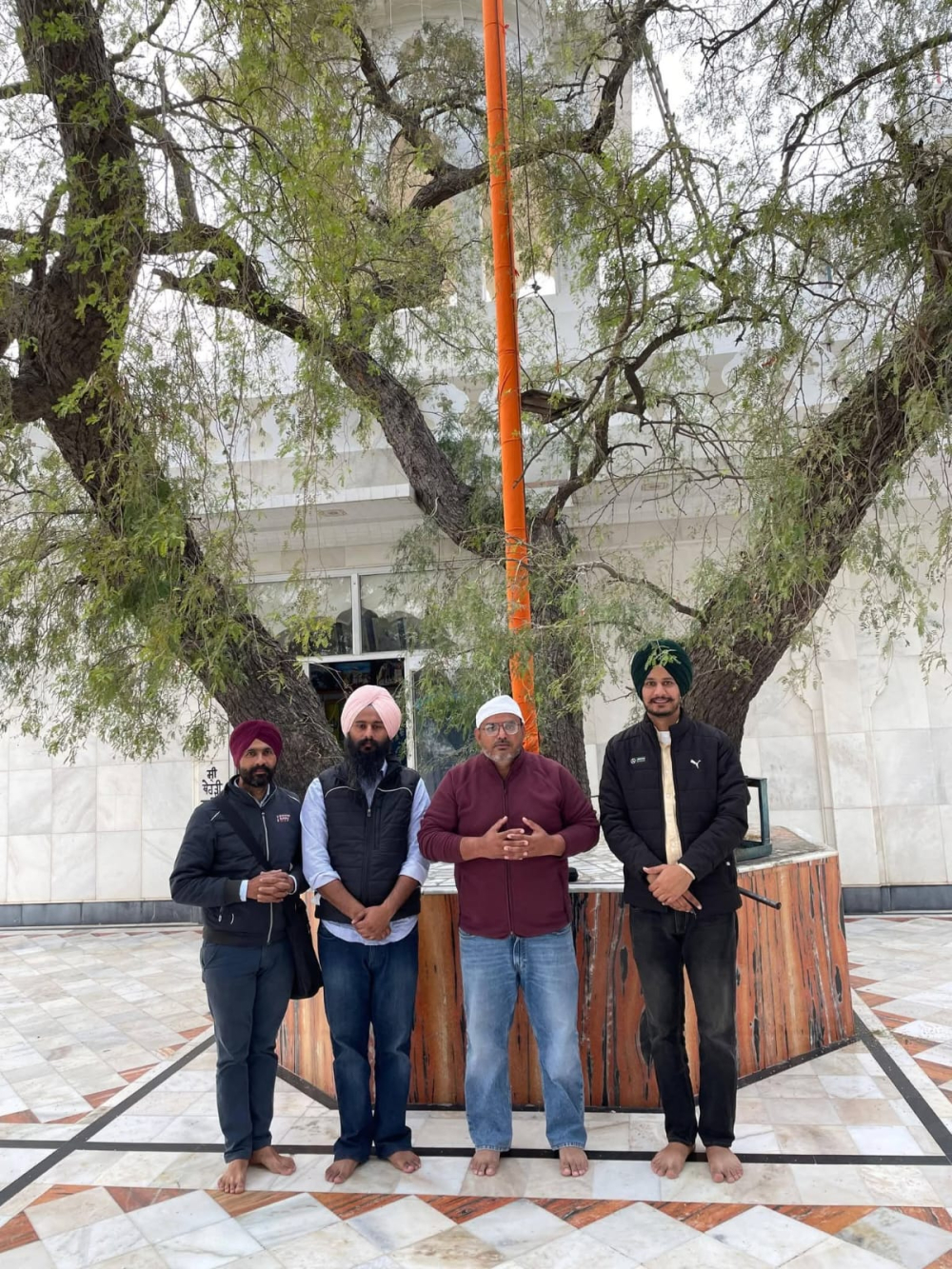
The Roundglass team on their fact-finding trip. (Picture Credits: Dr Rajneesh Kumar)
AD: How is the above protocol being altered with the centre government having scrapped MGNREGA?
RK: Although the Punjab state government has opposed the killing of MGNREGA, they are going to have to accept it post-March when the G RAM G 2026 scheme comes into implementation. A transition phase will ensue from March to June, for which funds will be allocated. It remains to be seen how the state government will work around it: they must ensure job opportunities are allocated, as time is of the essence. Two big changes that are also challenges are that the employment guarantee has changed from 100 to 125 days of guaranteed wage employment, and shared funding between the state and centre is now split in the ratio of 60:40, with the state’s share of sponsoring increased from 10 per cent to 40 per cent. We are looking to sign an MoU with the government, specifically the forest department, so that RoundGlass on its own can be a nodal agency (much like the forest department) and can formally work on the district level with an accelerated pace. If this were to be accepted, we have suggested maintaining a Live Sheet that would reflect where we are in the land bank process and whether or not things are moving forward, all recorded in real time and reviewed on a weekly basis. ADC and DC will be a part of this sheet and so will the Joint Development Commissioners at the state MGNREGA level.
AD: In addition to this protocol and the official channel you must take for land banks, is there a way individuals can offer their zameen (land) for RoundGlass to plant indigenous varieties in?
RK: Yes, we have had about 200 individuals and families do that in the last few years. We have been offered land measuring one kanal to eight acres and there is a trend among some NRIs to offer land to plant forests rather than offering it on theka since the latter could be a more lengthy and hands-on process. Through these offers, we have expanded the amount of land where native seeds are being raised and raised awareness around how to sow them. We are also able to conduct more planting campaigns and activities, so more people can join in with us. We have two considerations when accepting such offers of land:
-
water availability, and
-
the availability of labour for upkeep and maintenance, since MGNREGA cannot be allocated for private land.
As with government land banks, we assist with the design, digging, plantation, and machinery.
AD: Coming back to Patiala, why was this district a top choice for RoundGlass to begin its projects?
RK: After Chandigarh, Patiala is the greenest city. There are birs all around and so many botanical parks in the city itself. More than a royal city, it is baaghan da shehr (city of gardens). Since beginning our operations here, we have covered many villages all around. Rajpura block has been covered to a great extent as well. A nursery — our research centre — has been established, which is the core of our projects. After three years of robust planting, we are at the stage of land banks being turned into self-sustaining forests. In our annual reviews, we are trying to incorporate an exit strategy, wherein we formally hand these spaces over to village panchayats and ensure their responsibility to the plot of land. This is not to say that we have not faced setbacks:- as we move towards Rajpura, the biggest issue we are now facing is that of water availability. Despite the availability of land banks, the water table is very low. This problem is only compounded as we move towards Mohali. Builders and construction companies have left no stone unturned with their heavy-lifting to use up as much of the underground water as possible for their individual projects. If you take a trip around villages near river Ghaggar, you will find people being forced to use toxic water. Punjab’s water toxicity is not a secret.
AD: I was hoping to find out more about research and projects you have undertaken in a personal capacity. What has kept you busy other than RoundGlass?
RK: For RoundGlass activities and the informational videos we release on our platforms, I research and read everyday for at least two hours. That leaves me little time to draft the research I have done previously, but there is a book project in the pipeline. From our travels and work in so many villages, we have collected significant information on the native tree species of Punjab. Much of this was passed to us orally from older folks in the village whom we then interviewed. Interestingly, so many new varieties of the same trees were introduced to us, things we would not have otherwise known. So while there is a book on all of this, we have also put concise information out in a booklet format.
Another important project that we aim to complete is a ‘Tree Directory,’ wherein trees older than 50 years have their location recorded; the directory will be reviewed every three to five years to find out if the trees remain or they have been cut. I am hoping this can impact decision-making to protect these trees and a copy of the directory for each village will be given to the Panchayat and the local gurdwara sahib. Once the government marks these trees for protection, there can be a fund allocated for its upkeep and one villager placed in charge of its maintenance and recordkeeping.
AD: We have spoken previously about information you collated on gurdwaras and villages of Punjab that are named after trees? Can you talk more about that?
RK: In total, we have found 319 villages — 34 in Patiala — that are named after trees. Although in some cases, authentication at the village level remains to be completed, there is a strong indication that many of these trees have existed for centuries. For example, there is a Deluana Village in Mansa district and a Deleya da pind in Faridkot district, both of which take their name from the tree that grows the red-green dela berry. Dela achaar is an important pickle we use in Punjab. An interesting story from the research for this project is that we undertook a yatra, a sort of pilgrimage, from Keshgarh Sahib (Anandpur Sahib) to Damdama Sahib (Talwandi Sabo), tracing Guru Gobind Singh Ji’s journey with his Singhs. It has been recorded that as they halted in a small village to rest, their party was divided so no one household would be burdened with the responsibility of feeding them all. Times were tough for people, drought conditions were prevalent, and this happened to be a village of poor folks. When they got together the next day to continue their journey and Guru Sahib asked his Singhs what they had eaten in the homes where they rested, they replied that they had been served falliyan and peelaan — a local variety of beans and potatoes. So, by going from village to village and engaging with oral history, we have come across varieties and species that were part of the stories that we now tell about our Sikh history.
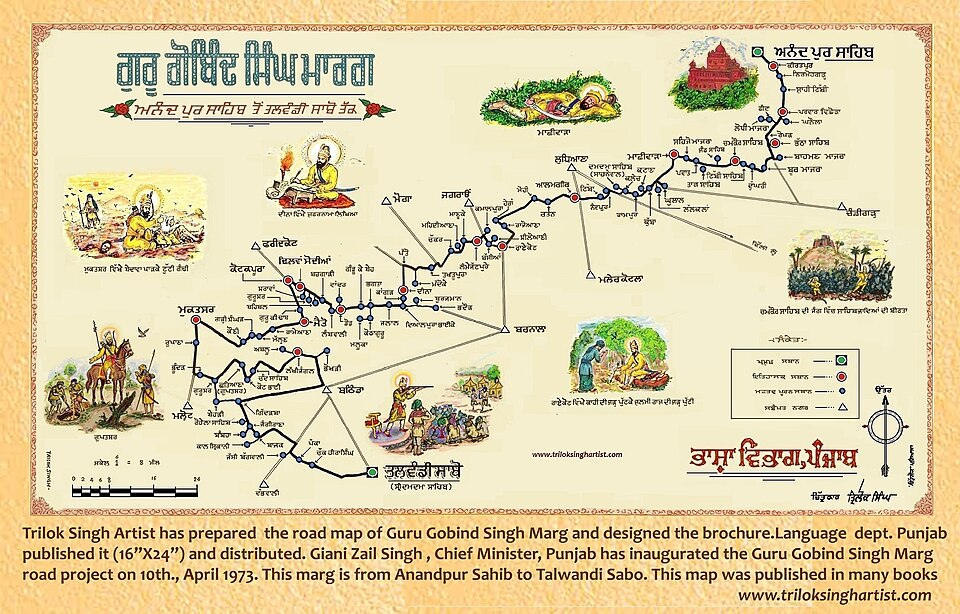
Guru Gobind Singh Marg is the route taken by the Tenth Guru, Sahibe-e-Kamal Guru Gobind Singh from Anandpur Sahib to Talwandi Sabo covering about 600km in 1704. (Picture Courtesy: Wikimedia Commons)
AD: Dr Rajneesh, thank you for your time and for the work you are doing for us! Is there something you would like to share, now that we have reached the end of our interview?
RK: Ten years ago, I did not think this was plausible. We are going pan-Punjab now, we have raised self-sustaining forests in so many villages, and everyday more people are becoming connected in such fruitful ways. I am grateful to have reached the place that I have. A memory from childhood comes back to me and I am humbled each time it does. My grandfather would run a cement shop in Hathur, a town in Ludhiana which is also my hometown. Everyday, without fail, I would observe him walk from the bus stop to his shop and he would use one hand to spread the daane (grains) he had brought along. I grew up seeing this everyday, so in some part I have continued in this vein and now I have a community and more resources to fulfil these actions. In my life, I have experienced nature very closely and have persevered even when I was disappointed with some circumstances. Every test offered by nature must be passed, and I find myself here today!
This essay has been created as part of Sahapedia's My City My Heritage project, supported by the InterGlobe Foundation (IGF).