
Art Deco emerged in the early decades of the twentieth-century within a world recalibrating itself after rupture. Across Europe and the United States of America, architects, designers, and craftsmen turned away from the elaborate historicism of the nineteenth-century, seeking instead a visual language that could articulate confidence in a mechanised, electrified age. Art Deco expressed this shift through abstraction, geometry, and order. Symmetry, repetition, stepped profiles, and streamlined surfaces replaced florid ornament, while new materials such as aluminium, chromium, reinforced concrete, and plate glass lent architecture and objects a distinctly modern sheen. Together, these formal and material choices projected a belief in progress, efficiency, and technological mastery.
In India, Art Deco arrived during a period of social and political transition, in the decades leading up to independence. Indian architects, patrons, and craftsmen encountered it not as a rigid European import but as a language open to negotiation. The result was a spectrum of hybrid forms, often grouped under the term Indo-Deco, that combined geometric abstraction with indigenous motifs, climatic adaptations, and established craft practices.
Art Deco proved especially well-suited to the princely states within India, which were invested in cultural self-fashioning. Architecture, dress, interior design, and material culture became instruments through which rulers articulated authority in a world where they had limited power. The adoption of new styles was rarely wholesale or uncritical; rather, it involved careful assessment of what global aesthetics could signify within local frameworks of power and legitimacy. Art Deco embodied a visual renaissance — celebrating the new age while signalling a departure from nineteenth-century historicism. Its emphasis on order, abstraction, and geometry offered an aesthetic of progress that resonated with rulers seeking to position themselves as modern without disavowing tradition. Crucially, Deco was flexible. It did not prescribe a singular visual identity but allowed interpretation across materials, scales, and functions. This adaptability made it especially attractive to princely patrons navigating the dual demands of continuity and change. For the princely elite, Art Deco’s disciplined yet flexible formal language allowed rulers to signal refined taste and international awareness without appearing derivative or beholden to colonial models.
Princely patronage played a decisive role in extending the reach of Art Deco beyond metropolitan centres such as Bombay. While Bombay’s apartment buildings, cinemas, and Marine Drive are often foregrounded in narratives of Indian Deco, it was princely commissions — circulating through networks of travel, exhibition, and luxury consumption — that helped popularise the style across diverse regions. Jewellery, interiors, and institutional buildings commissioned by royal courts acted as conduits through which Deco entered smaller cities and regional capitals, acquiring local inflections in the process.
Wearing Deco in Patiala
In Patiala, the encounter with Art Deco did not begin with architecture. It began with the body.
Long before streamlined façades or clock towers reshaped the city’s skyline, Art Deco arrived through jewellery — objects that were portable, intimate, and performative. Under Maharaja Bhupinder Singh (r. 1900–1938), Patiala cultivated a cosmopolitan court deeply embedded in international circuits of luxury and design. The Maharaja’s engagement with European jewellery houses was not driven by mimicry but by collaboration. Parisian maisons such as Cartier and Boucheron were invited not merely to supply ornaments, but to reimagine Indian gemstones within a modern visual idiom.
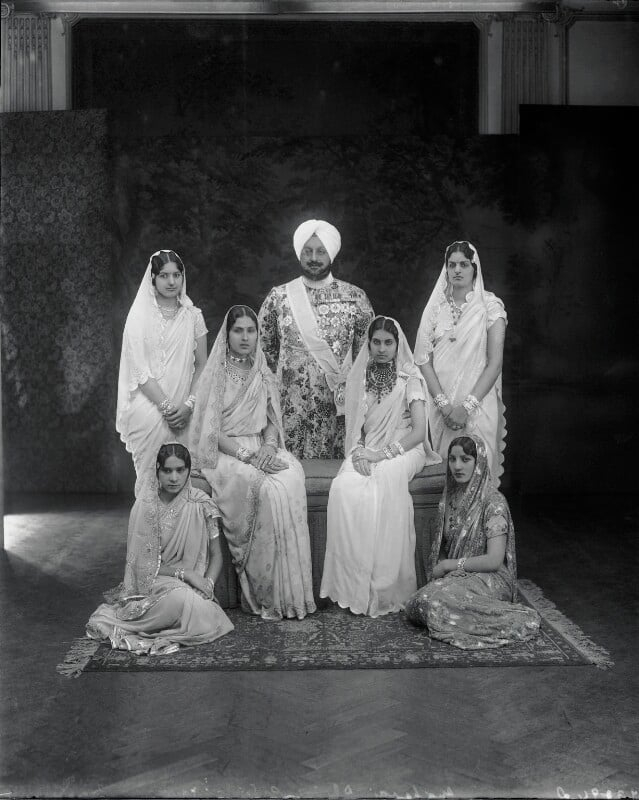
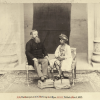
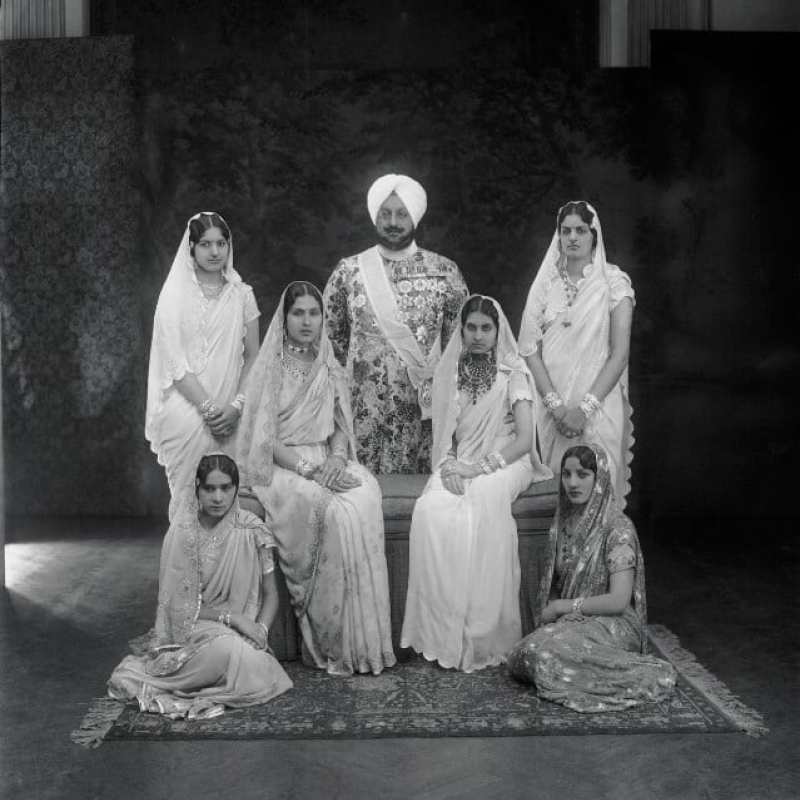
A picture of Maharaja Bhupinder Singh with members of his family by Vandyk, 1931. (Picture Courtesy: National Portrait Gallery, London)
This exchange reached its most dramatic expression in the mid-1920s. In 1925, Bhupinder Singh placed what would become the largest single commission ever executed by Cartier. Vast quantities of rubies, emeralds, sapphires, and diamonds from the Patiala treasury were sent to Paris to be dismantled and reset. These stones entered a design process shaped by Art Deco’s commitment to geometry, symmetry, and restraint.
European jewellery design before this period had largely privileged diamonds and platinum, favouring luminosity over colour. Indian commissions disrupted this aesthetic and expanded the possibilities of Deco, introducing bold contrasts and volumetric richness without abandoning abstraction. Geometry remained central, but it was animated by colour and mass — Art Deco itself was reshaped. The Patiala Ruby Choker, commissioned from Cartier in 1931, exemplifies this synthesis. Composed of 292 ruby beads arranged in graduated rows and punctuated by pearls and diamonds, the choker’s structure is governed by repetition and symmetry, while platinum settings provide a restrained framework that allows colour to dominate without excess. The piece occupies a liminal space — neither wholly Indian nor European. Recent reappearances of these jewels underscore their enduring relevance. Cartier’s Art Deco diamond choker, once part of the Patiala necklace, was worn at the Met Gala in 2022, reinserting the object into a contemporary fashion narrative.
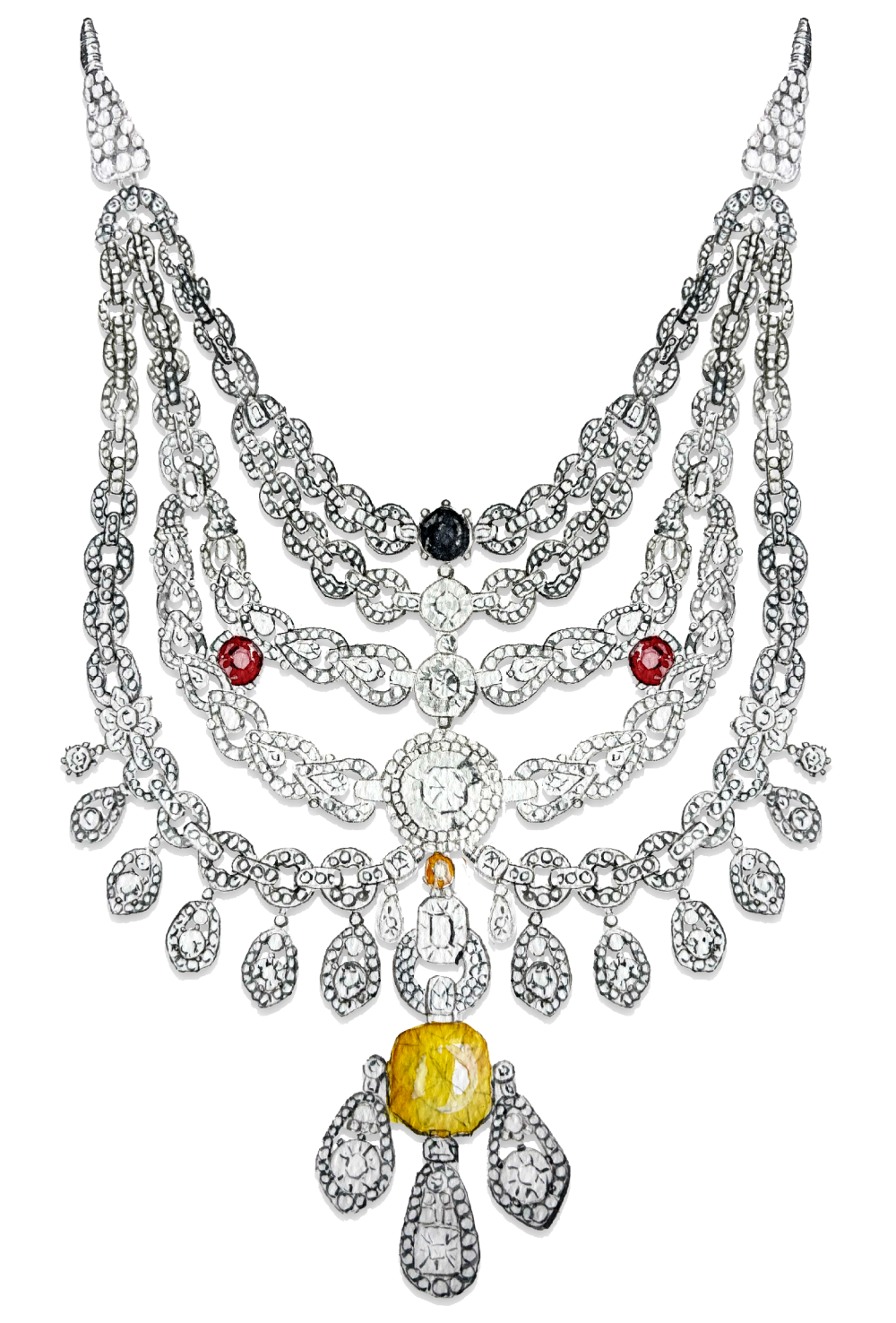
The Patiala Necklace. (Illustration Credits: Jisha Unnikrishnan)
Cartier’s commissions, however, did not exist in isolation. During Bhupinder Singh’s visit to Paris in 1928, he entrusted six iron chests of precious stones to Louis Boucheron. Contemporary accounts record how the Maharaja caused a sensation in Paris, travelling with a retinue of forty servants and a collection that included over 7000s of diamonds and more than 1400 emeralds. These were transformed into 149 pieces of jewellery, ranging from traditional forms such as sarpech and bazuband to necklaces and earrings, all executed in a distinctly Art Deco idiom.
Deco Builds in Patiala
The transition from jewellery to architecture was gradual. Jewellery allowed modernity to be tested at a personal scale — mobile, intimate, and reversible. Architecture, by contrast, demanded permanence. When Art Deco entered Patiala’s built environment, it did so cautiously.
The most confident architectural articulation of Art Deco in Patiala appears with Phul Cinema, inaugurated in 1947. By this time, Bombay had firmly established itself as the epicentre of Art Deco in India. Movement between Bombay and the princely states intensified in the decades between the two World Wars, as rulers travelled for business, leisure, and participation in the Chamber of Princes. It was through these circuits of encounter that Art Deco entered Patiala’s architectural imagination. W. M. Namjoshi, the architect of Phul Cinema, was deeply embedded in Bombay’s Deco milieu. His work on cinema architecture across India positioned him as a key mediator of modern design. When he was commissioned in Patiala, he brought with him a vocabulary shaped by Bombay’s urban modernism.
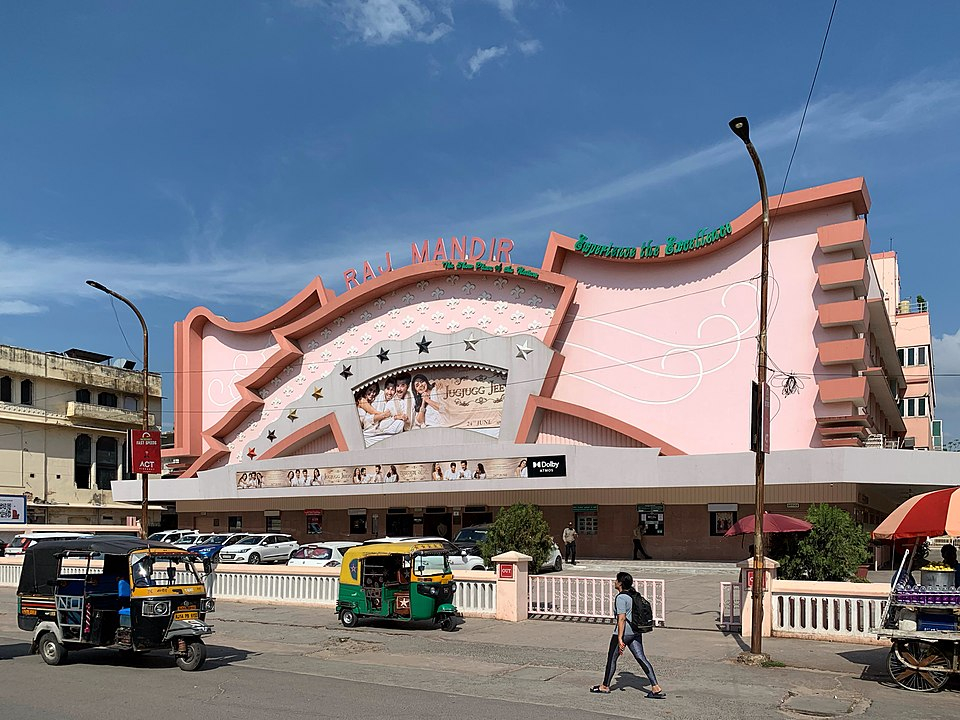
Raj Mandir Cinema in Jaipur, also designed by W. M. Namjoshi. (Picture Courtesy: Wikimedia Commons)
Phul Cinema situates Patiala within a national network of Deco theatres that transformed film-going into a collective modern ritual. Its façade, articulated through vertical fins and rhythmic fenestration, emphasises height and movement while decisively rejecting historical reference. Vertical fluting runs across the façade, drawing the eye upward and softening the solidity of the wall. Stepped roof profiles reinforce this vertical emphasis, producing a silhouette aligned with Deco’s fascination with ascent and dynamism.
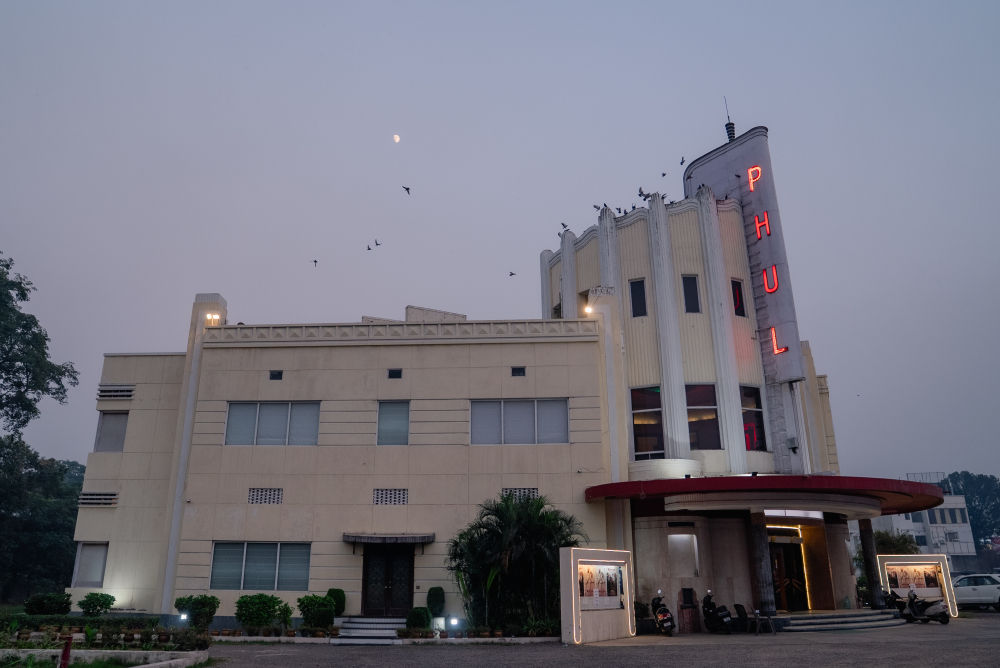
The façade of Phul Cinema. (Picture Credits: Meenal Upreti)
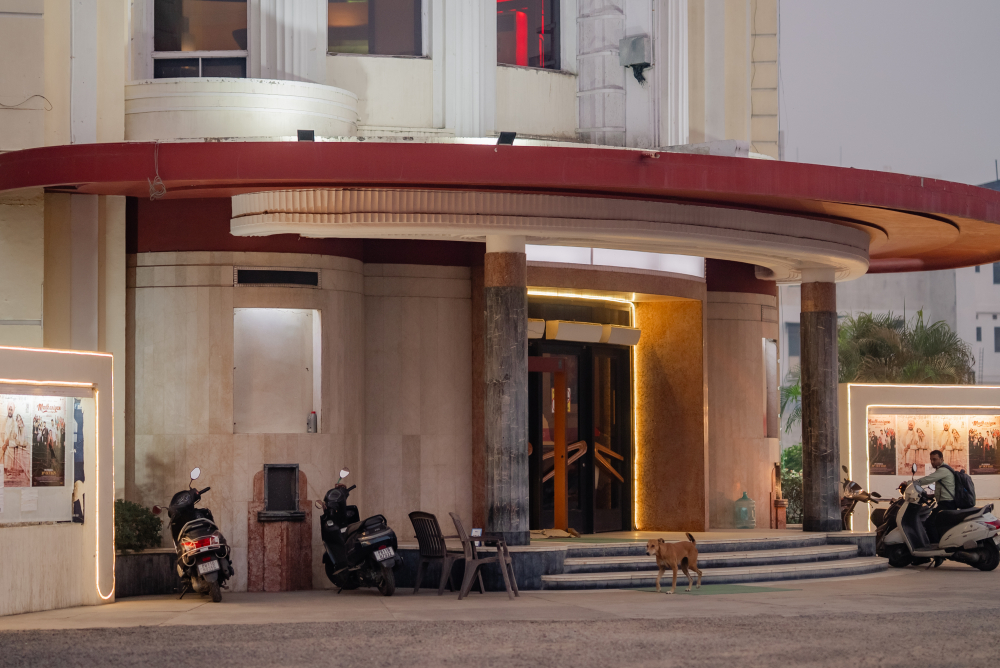
Entrance to Phul Cinema Theatre. (Picture Credits: Meenal Upreti)
Inside, the language of Deco becomes immersive. Sunburst reliefs embedded in the flooring operate as abstracted radiations, anchoring movement while evoking light and renewal through geometric repetition. Balcony details introduce stylised lotus motifs — flattened, symmetrical, and governed by geometry — absorbing indigenous symbolism into a modern formal framework. Boundary walls echo this language through stepped, recessed profiles articulated by fluting and shadow rather than applied ornament. Together, these elements reveal a coherent architectural grammar in which European Deco principles are carefully adapted to local scale and sensibility.
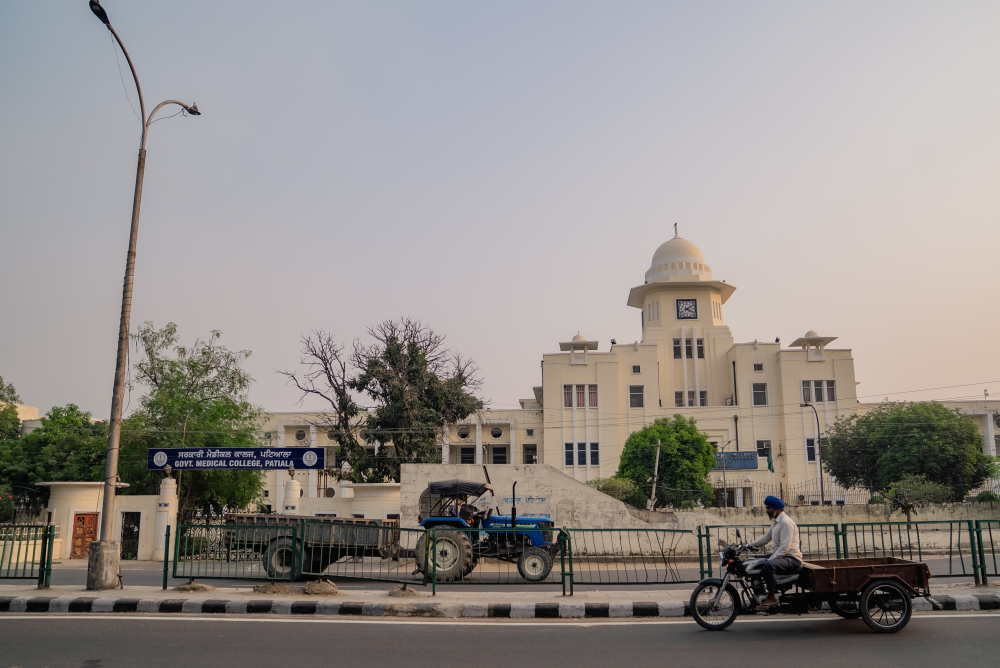
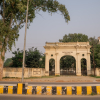
Government Medical College Patiala. (Picture Credits: Meenal Upreti)
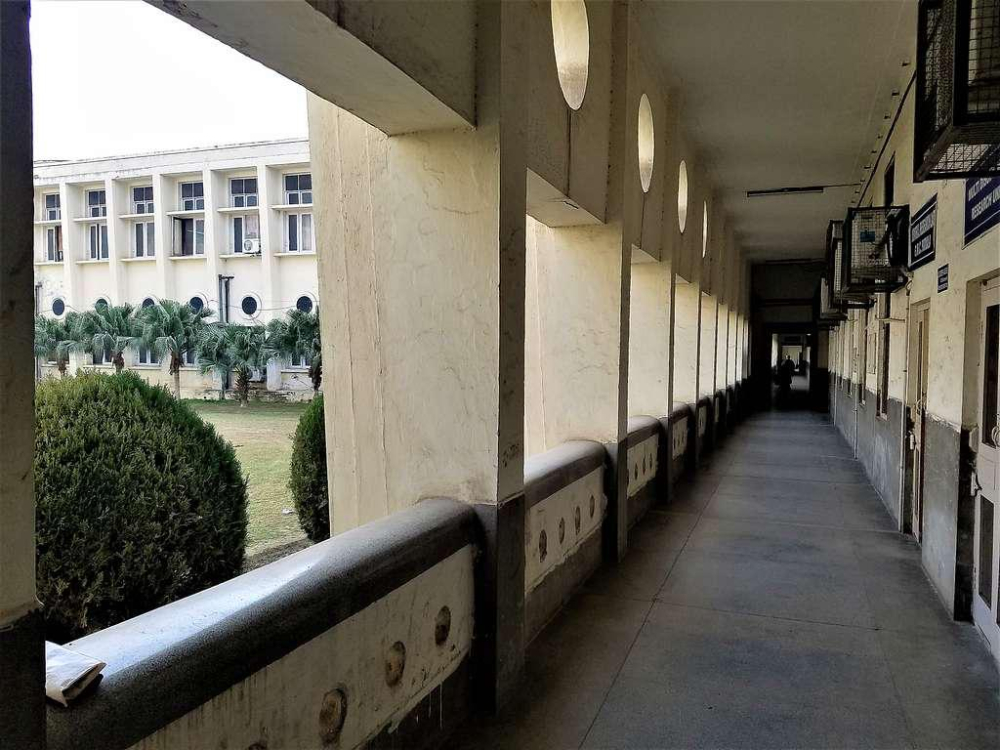
Main corridor of the Government Medical College, Patiala. (Picture Courtesy: Wikimedia Commons)
In the years following Independence, this architectural vocabulary was recalibrated for institutions of public welfare. The Government Medical College and Hospital, established in 1951 in Patiala, reflects this shift. Organised around a dominant central tower, the building employs vertical emphasis, recessed planes, and stepped massing to convey institutional authority. Circular windows introduce geometry without theatricality, while simplified domes and softened edges allow the building to negotiate between modern form and established symbolic conventions.
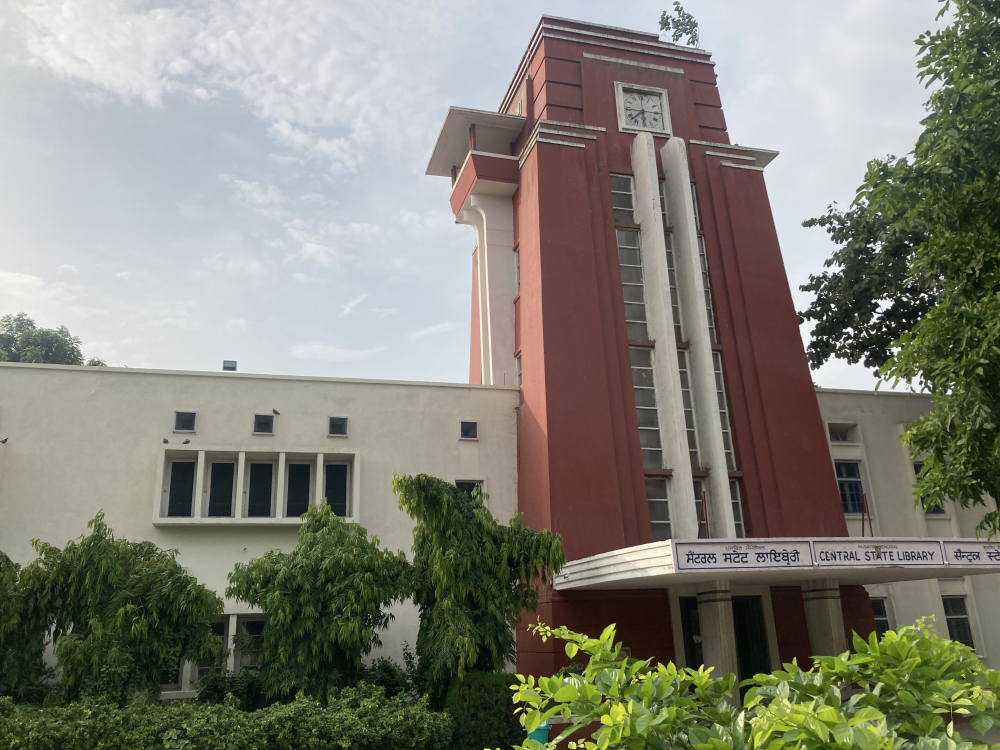
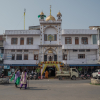
Central State Library. (Picture Courtesy: Wikimedia Commons)
The Central State Library, completed in 1955, marks the most resolved expression of Deco in Patiala’s civic architecture. Its central clock tower, defined by vertical reeding and successive setbacks, embodies modern time — regulated, shared, and public.
Together, these buildings trace a coherent narrative. From the courtly reassembly of jewels to the institutional articulation of architecture, Art Deco in Patiala unfolds as a process rather than a moment. In Patiala, Art Deco was about negotiation — between object and building, between court and city, between global modernity and local authority. Worn first on the body and later inscribed onto the urban fabric, Deco became a means of inhabiting modernity on Patiala’s own terms.
Conclusion
Art Deco in Patiala was not a static style adopted in a single moment, nor a uniform architectural movement imposed upon the city. Architecture translated the logic of jewellery — symmetry, repetition, abstraction — into mass, surface, and space. Cinemas, hospitals, and libraries became sites where Art Deco moved beyond elite display to structure everyday experience. What had once adorned the royal body was now inscribed into the urban fabric, shaping how modernity was seen, inhabited, and shared.
This movement from court to city was not linear but cumulative. Each site retained traces of its predecessor, allowing Deco in Patiala to function as a connective tissue between princely patronage and civic life. The style’s flexibility — its capacity to absorb local motifs while maintaining formal discipline — enabled it to bridge these domains without rupture.
Seen in this light, Art Deco in Patiala represents less a stylistic episode than a process of visual exchange. It reveals how modernity in a princely state was crafted through negotiation — between global and local, tradition and abstraction, adornment and architecture. Patiala did not merely adopt Art Deco; it transformed it into a language through which courtly authority and urban identity could coexist, marking the city’s passage into the modern world.
Bibliography
Jaffer, Amin. Made for Maharajas: A Design Diary of Princely India. New York: The Vendome Press, 2006.
Marroquin, Denise, Indian Art Deco: An Ambivalent Feeling Towards Western Modernity, Master’s Thesis. University of Zurich, 2013.
This essay has been created as part of Sahapedia's My City My Heritage project, supported by the InterGlobe Foundation (IGF).