
The political geography of the British Indian Empire was never as stable as imperial cartography implied. Alongside the provinces under direct British rule existed a constellation of princely states, whose rulers governed internally while tethered to the Crown through treaties, protocol, and the elastic doctrine of paramountcy. This arrangement produced what might be called a layered sovereignty. Princes were neither colonial subjects in the ordinary sense nor independent monarchs in the European mold. Their authority was recognised, yet constantly framed, supervised, and spatially disciplined.
Within this system, territory became the grammar through which sovereignty was made legible. After 1858, when the Crown assumed direct control from the East India Company, they grew increasingly attentive not simply to what princes did, but to where they were visible. A series of executive instructions, culminating in the Circular of 1891, discouraged Indian rulers from acquiring immovable property within British-administered districts. The concern was not administrative tidiness, but political clarity. If princes established architectural footholds in British territory, the distinction between direct and indirect rule, so carefully maintained in imperial theory, risked becoming spatially blurred.
Yet Patiala crossed this precise line.
The explanation lies in a legal distinction that most accounts of the princely states of India overlook. As Sirdar D. K. Sen observed in The Indian States: Their Status, Rights and Obligations, the Phulkian states of Punjab — Patiala, Nabha, and Jind — enjoyed guarantees of “all powers and rights internal and external,” a formulation rarely extended with such breadth to other princely houses. Patiala maintained diplomatic agents and posts within British India and other states. Its treaty position, forged in the late eighteenth and early nineteenth-century, afforded it a degree of recognised autonomy that would prove crucial in the spatial manoeuvres of the late nineteenth-century. The legal latitude existed. What remained was to translate that latitude into built presence.
Moving Towards the Mountains
Long before the formal consolidation of Shimla as the summer capital of the British Raj, Patiala had already begun to appear in the Himalayan landscape that the British would later claim as their own seasonal domain. In 1830, Maharaja Karam Singh entered into a land exchange with the British around Jakko Hill and the village of Barauli. This was not yet the Shimla of vice-regal processions and imperial files, but it was the terrain that would soon acquire that role. Patiala’s insertion into this geography predated its formal imperialisation. The state’s presence in the Shimla hills was therefore not a reaction to British occupation, but preceded it. This early exchange reads, in retrospect, like a prelude to the much larger spatial drama that would unfold half a century later at Chail.
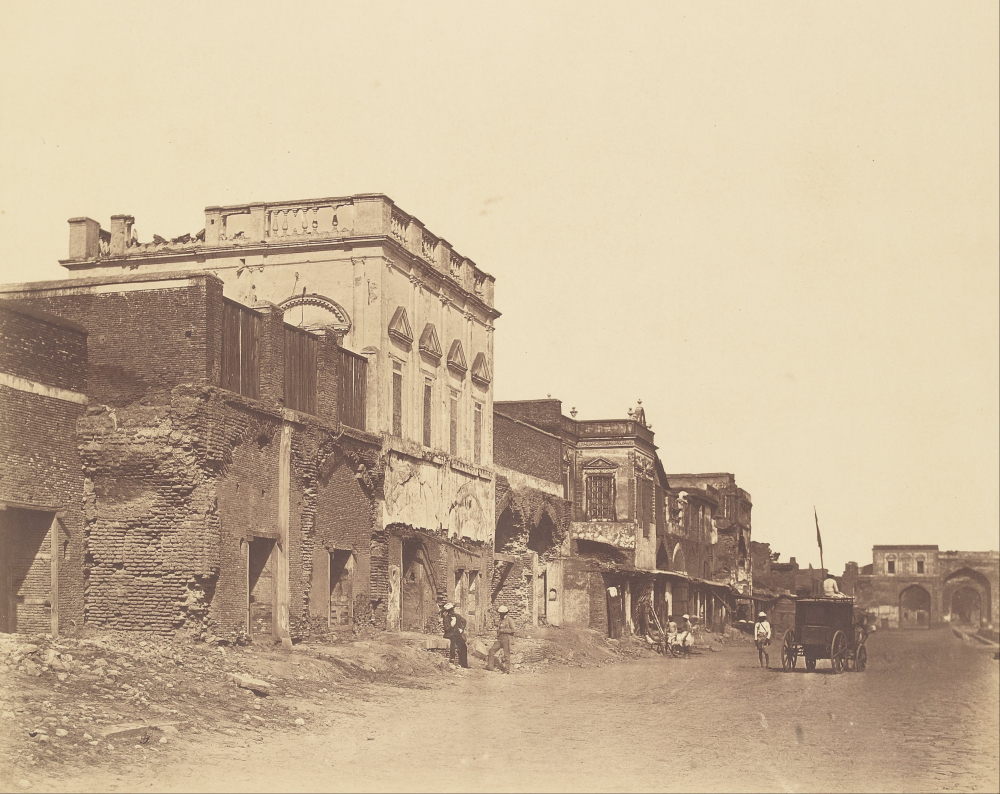
Zeenat Mahal in Lal Kuan (Old Delhi) captured by Felice Beato, 1858. (Picture Courtesy: Wikimedia Commons)
The events of 1857 provided the first unmistakable instance for Patiala’s architectural presence to take political form beyond its borders. When both Bahadur Shah Zafar and the British sought support during the Revolt of 1857, Maharaja Narendra Singh of Patiala aligned firmly with the latter. The reward for this allegiance was territorial expansion in Punjab, as well as architectural possession in Delhi: Zeenat Mahal, or Begum Kothi, the palace associated with the Mughal court in Lal Kuan was granted to Patiala. Patiala’s first architectural presence outside its state during this period was therefore inseparable from its political alignment with the British.
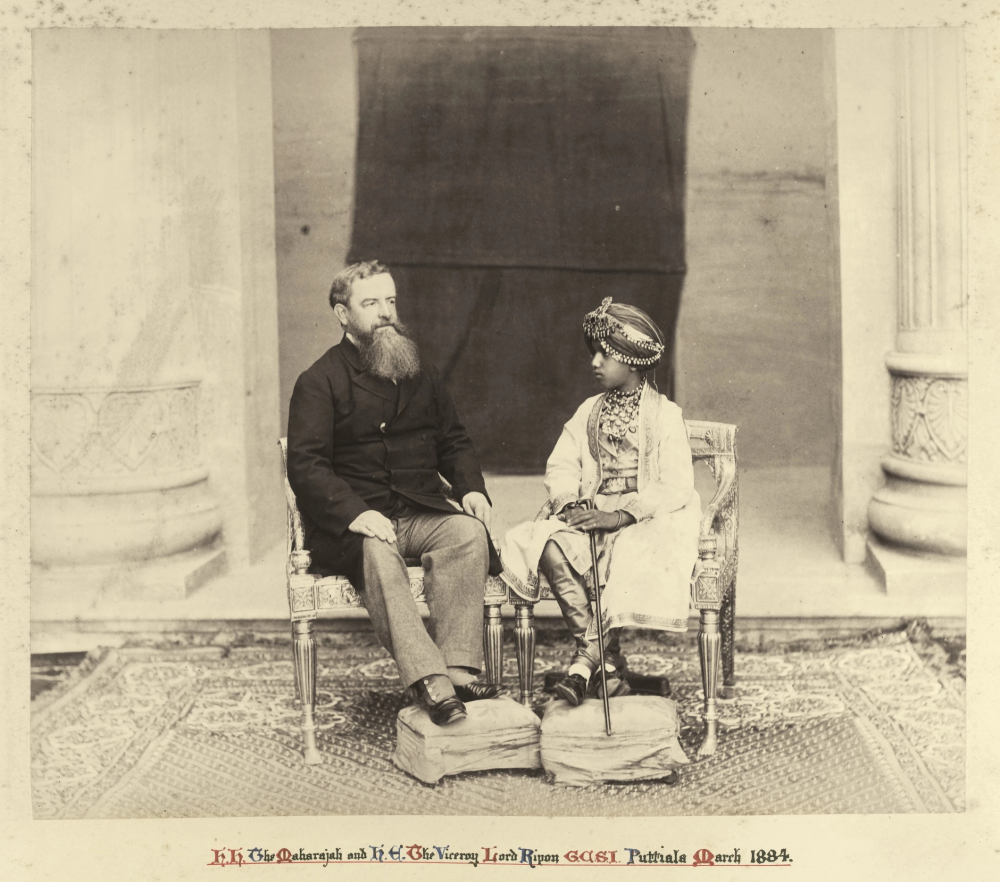
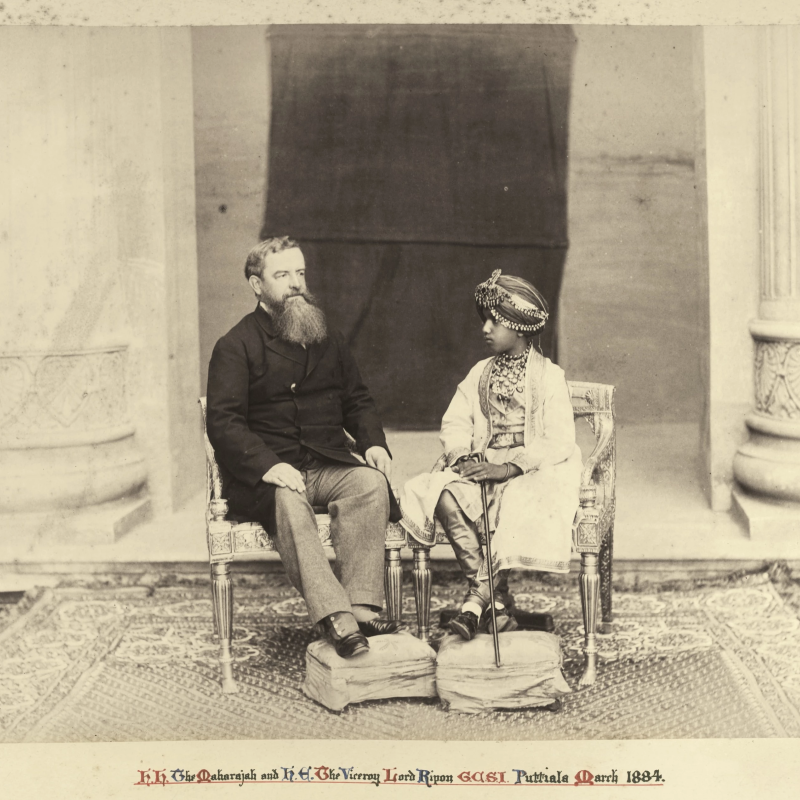
Maharaja Rajinder Singh of Patiala with Viceroy Lord Ripon, on the occasion of the inauguration of the Mohindra College in Patiala, 1884. (Picture Courtesy: Wikimedia Commons)
By the late nineteenth-century, however, the terms of alignment had altered. Shimla had become the summer capital of the Raj, a hill environment whose access, land ownership, and building patterns were increasingly regulated. At precisely this moment, restrictions on princely acquisition of property within British districts were being clearly articulated. When Maharaja Rajinder Singh was denied permission to construct a residence in Shimla, his response was neither protest nor retreat. It was displacement.
Chail, situated roughly twenty-four miles from Shimla yet outside its administrative jurisdiction, offered what Shimla refused: proximity without requiring permission. Until the early 1890s, Chail consisted largely of forested hills and a small temple. Between 1891 and 1892, the Maharaja transformed this landscape. An electrically lit villa arose on Rajgarh, surrounded by cottages, a billiard room, guest accommodation for European visitors, waterworks, a post office, a sub-treasury, and even telephone connections linking the palace to its ancillary buildings. A bazaar of fifteen or sixteen shops, tennis and badminton courts, reproduced the sociability of the hill station of Shimla. Administrative and sanitary supervision lay with the Maharaja’s Medical Adviser. Chail thus became not merely a retreat but a fully serviced seasonal capital that echoed Shimla’s environment.
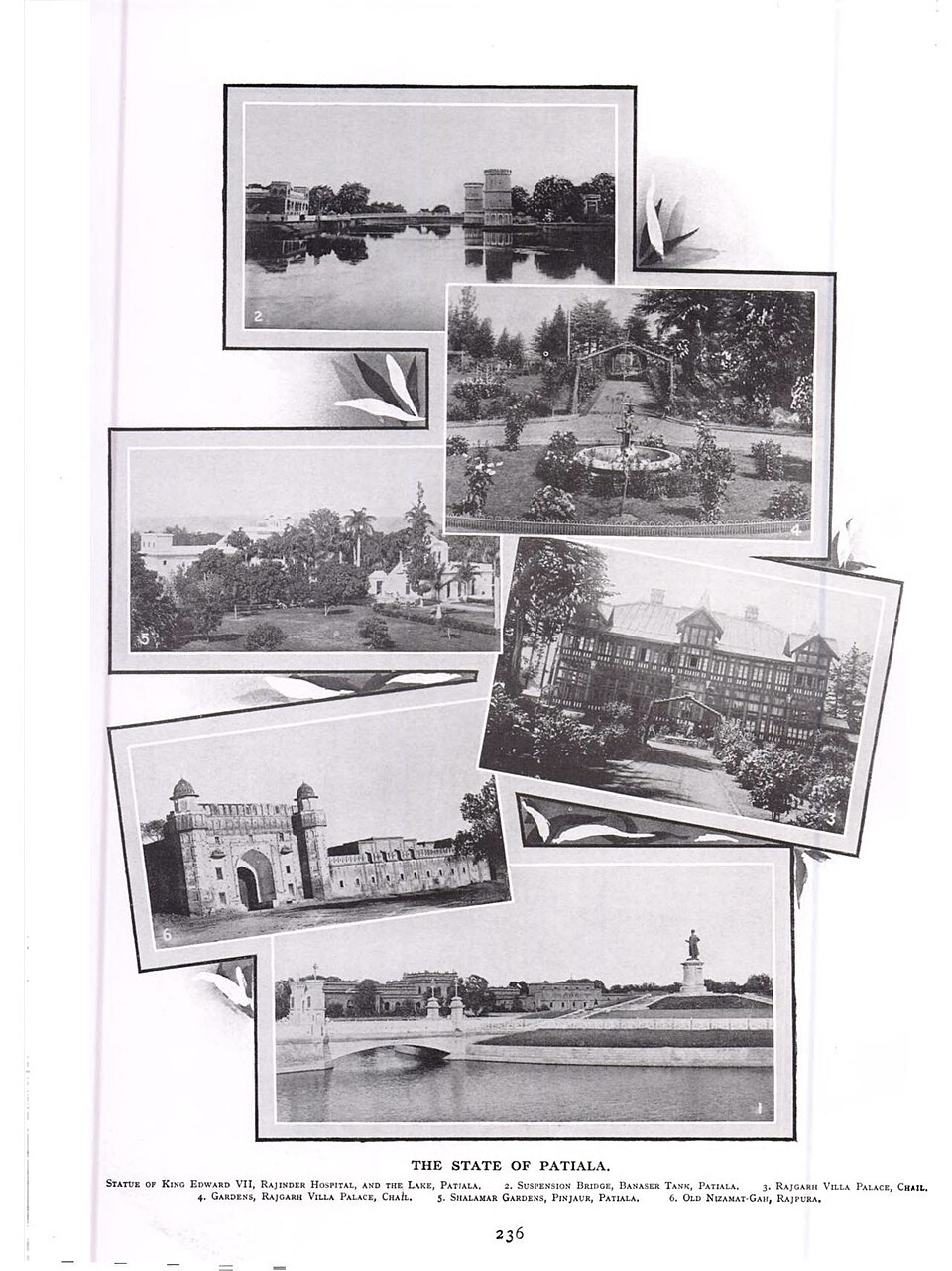
Photographs of architecture and infrastructure related to Patiala State, published in 'Indian States, A Biographical, Historical, and Administrative Survey' (1922). Picture Courtesy: Wikimedia Commons)
The timing is significant, the events taking place just as the Circular of 1891 was passed. Patiala’s effective establishment of an alternative hill station just beyond British sovereignty was a neat manoeuvre around the border limits laid by the Raj.
This success unsettled the colonial administration more than open defiance. The Viceroy deputed Maxworth Young to speak with the Maharaja about what was perceived as indifference to administrative duties and financial caution. Young questioned not only the Maharaja’s prolonged residence in Chail but also the company he kept there. The Maharaja’s response was telling. Such society, he remarked, was the only kind available to him in Patiala “if, for instance, he wanted to have a fancy dress ball or such like amusement.” Young advised him to spend less time in Chail, Shimla, and Calcutta, and more in Patiala attending to governance. This exchange reveals the deeper anxiety: Chail had become a parallel courtly sphere close enough to the imperial centre to hold significance, yet solidly beyond its administrative discipline. What the British had intended to ensure spatial containment instead produced a sovereign enclave operating in their immediate vicinity.
Under Maharaja Bhupinder Singh, this method of utilizing space and geography evolved. The flamboyant construction of Chail gave way to a quieter strategy: acquisition. Properties were purchased in Shimla from British owners, a residence acquired in Bombay from a Parsi family, and garden houses obtained in the bungalow district of Dalanwala in Dehradun. These were not architecturally conspicuous gestures, instead blending into existing residential patterns and attracting little scrutiny. Yet they ensured Patiala’s continued presence within the key urban and hill geographies of the Raj.
The implicit negotiation of space and architecture between colonial authority and princely states emerged with the announcement of the new imperial capital: New Delhi. After the announcement of the shift in 1911, provision was made for princely residences in the capital. In 1915, Patiala was allotted a plot at J-Circus, but no construction followed. This was not a failure, but strategic patience. After Bhupinder Singh became Chancellor of the Chamber of Princes in 1926, the opportunity for a more prominent site arose. At Princes’ Park, eight acres were granted on a preferential basis to Patiala at the rate of 1800 rupees per acre with a total of 14400 rupees paid. The Government of India, although it did give lands for the princely states to construct their palaces in the Princes Park, had imposed restrictions on the style and architectural design of the palaces. To maintain uniformity, it was decided that the government would “furnish the design for the entrance and the compound walls but the design of the main buildings will be prepared by the State architects in consultation with the Chief Engineer, Raisina, Delhi. Before preparing a design the State architect will have to ascertain from the Chief Engineer, Raisina, the focal point and other important conditions which govern the construction of buildings.” In 1933, a boundary wall was thus erected around the site which was designed by Edwin Lutyens. It was thus clear that the palaces around Princes' Park had to conform to the ‘imperial vision.’
But given the worth of Patiala State, it was still expected to erect a grand palace in New Delhi since Zeenat Mahal in Old Delhi was in ruins. In 1932, Bhupinder Singh purchased a residence at 5, Prithviraj Road from Rai Bahadur Lala Sultan Singh, treasurer of the Imperial Bank at Delhi, naming it Patiala House — but that too was later sold to the Bhavnagar Durbar (court). The new‘Patiala House’ was designed with careful restraint as a simple brick and mortar palace in pristine white. The palace was completed in 1940 under Maharaja Yadavindra Singh who employed Sardar Bahadur Sardar Ranjit Singh as the main contractor for the palace and Sardar Jagdish Nath as in charge of the building while the work was supervised by A.C. Malhotra as chief engineer of Patiala State. Its butterfly plan, chhatris, chhajjas (sloping sunshades), and balconies invoked regional vocabulary, but it was bereft of the dome that dominated all other palaces in Princes' Park. The building aligned itself with the visual discipline of Lutyens’ Delhi while quietly asserting princely identity.
Afterlives: From Princely Presence to Public Institutions
If the creation of these residences reveals the subtlety with which Patiala negotiated colonial constraints, their later histories reveal how naturally these sites slipped into the institutional life of independent India.
Chail Palace now operates as a heritage hotel, its hilltop quietude marketed as a retreat. Yet the arrangement of cottages, the service infrastructure, the recreational grounds, and the commanding vantage over the surrounding landscape betray the original logic of the place. This was not conceived as leisure architecture. It was a carefully serviced seasonal headquarters, positioned within sight of the imperial summer capital. What is consumed today as picturesque isolation was once calibrated political proximity.
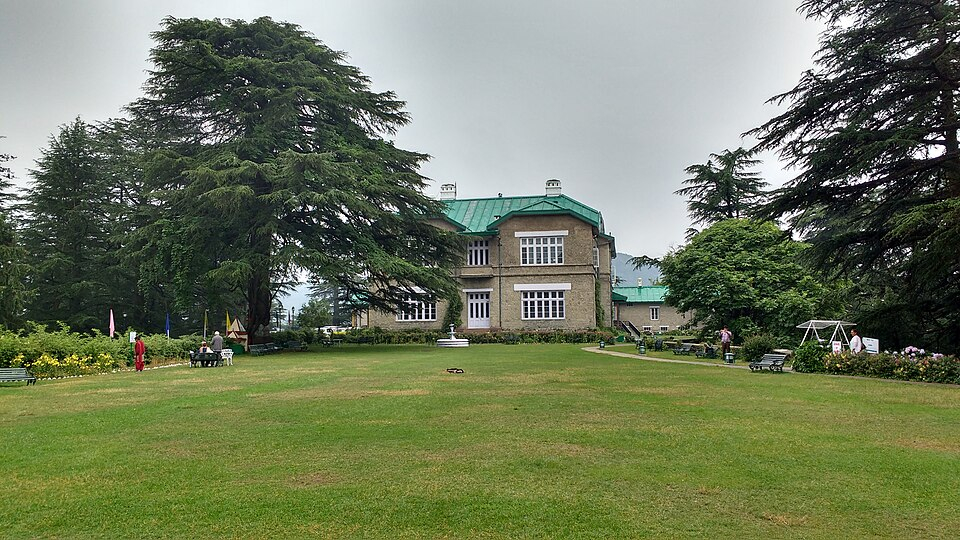
The Palace, Chail. (Picture Courtesy: Wikimedia Commons)
In Dehradun’s Dalanwala, the Patiala residence, later known as Tel Bhawan, underwent a transformation that appears almost seamless in retrospect. In 1956, it became the headquarters of the Oil and Natural Gas Commission. The summer garden house of a princely court turned into a nerve centre of India’s developmental bureaucracy. This shift was enabled not by architectural modification but by location. The bungalow already stood within a landscape long associated with administrative circulation between the plains and the hills. Its suitability for bureaucratic occupation had been inscribed into its geography decades earlier.
Patiala House in New Delhi presents the most layered of these transitions. At the outbreak of the Second World War in 1939, the palace was placed at the government’s disposal free of rent under emergency provisions. By October 1946, when it was returned to the Patiala Durbar, its condition had altered irreversibly, and the question of compensation remained unresolved for years. During the war, the Maharaja himself was allowed only a small corner under the staircase on the ground floor and the entire first floor for residence, while the rest of the building functioned as War Office space. The palace had, in effect, ceased to operate as a princely residence even before the formal end of empire.
In 1949, as New Delhi struggled with a severe shortage of accommodation for government departments, Patiala House began to shelter officials. Among those who lived and worked within its rooms was Amrita Pritam, then employed as a radio speaker at All India Radio and gradually emerging as a major literary voice. The building conceived as an assertion of princely stature had quietly begun to house the everyday machinery of a new nation.
Its role during and immediately after Partition further altered its meaning. It sheltered refugees displaced by violence. In the same year, the Southeast Asia Regional Office of the World Health Organisation began functioning from its premises, with the first World Health Day observed there in 1950. In February 1949, representatives of nine Asian nations assembled within its halls to establish the Asian Games Federation under the chairmanship of Maharaja Yadavindra Singh. For a brief moment, the palace became a site of postcolonial internationalism.
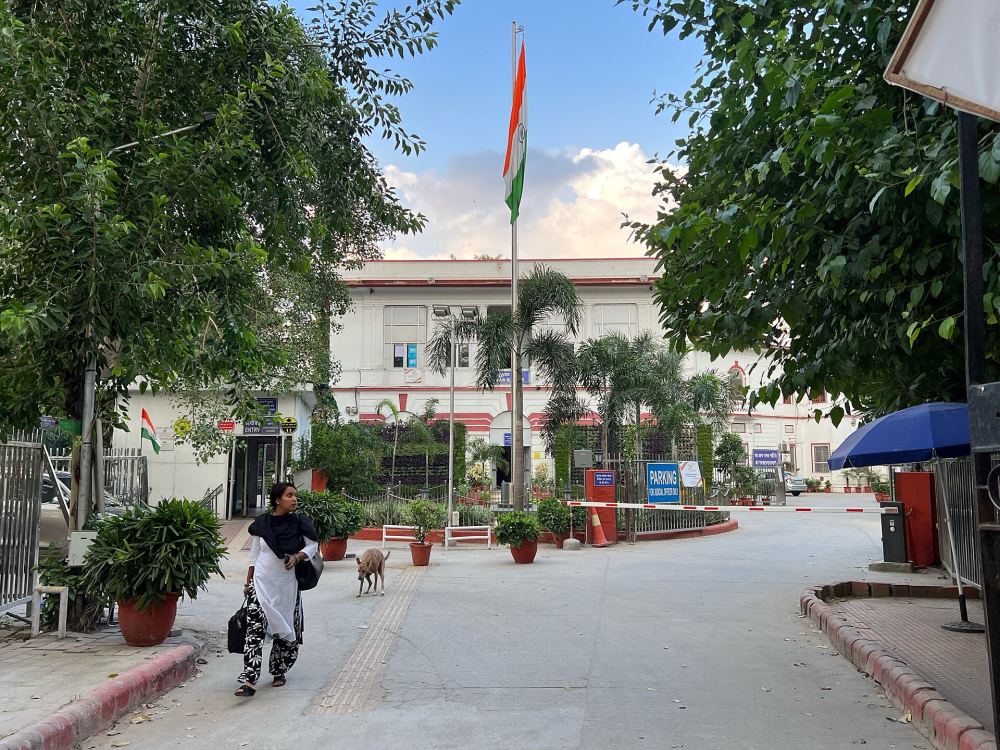
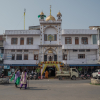
Patiala House in the present day. (Picture Courtesy: Wikimedia Commons)
By 1978, Patiala House had acquired yet another identity: the Patiala House Courts. The chambers of princes became chambers of justice. The large rooms, verandahs, and gardens now accommodate courtrooms and lawyers’ chambers, serving citizens who arrive not as guests but as litigants. The spatial arrangement remains largely intact, but its occupants and purposes have shifted entirely.
These buildings did not drift into decorative nostalgia after the end of princely rule. They were absorbed, repurposed, and naturalised into the working fabric of the Indian state. Their functions changed dramatically, but their spatial authority did not diminish. In retrospect, the afterlives of Chail, Dehradun, and Patiala House confirm the remarkable precision with which these sites had been chosen. They were never peripheral retreats. They stood within geographies that remained central to power — first colonial, then republican.
Colonial policy sought to confine princely sovereignty within territorial limits. Patiala responded not through overt defiance but through placement. Through land exchange, acquisition, delayed construction, calibrated design, and geographical foresight, the rulers of Patiala ensured that their presence endured wherever authority, imperial or Indian, was most visibly performed.
Bibliography
Bhowmick, Sumanta K. Princely Palaces in New Delhi. New Delhi: Niyogi Books, n.d.
‘The Tribune, Saturday Feature.’ The Tribune, July 10, 1999. Accessed February 3, 2026. https://www.tribuneindia.com/1999/99jul10/saturday/head2.htm.
Gazetteer of the Simla District, 1904. Calcutta: Government of India Press, 1904.
Imperial Gazetteer of India, Provincial Series: Punjab, Vol. I. Calcutta: Superintendent of Government Printing, 1908.
Imperial Gazetteer of India, Vol. XX. Oxford: Clarendon Press, 1909.
NAI/Foreign/Secret 1/October 1891/No. 1-2.
Ramusack, Barbara N. The Indian Princes and Their States. Cambridge: Cambridge University Press, 2003.
Sen, D. K. The Indian States: Their Status, Rights and Obligations. Calcutta: n.p., 1925.
Singh, K. Natwar. The Magnificent Maharaja: The Life and Times of Maharaja Bhupindar Singh of Patiala 1891-1938. New Delhi: HarperCollins, 1998.
This essay has been created as part of Sahapedia's My City My Heritage project, supported by the InterGlobe Foundation (IGF).