
A long time ago, ltbu-moo, Mother Creator, created Kongchen Kongchlo, i.e. Mount Khangchendzonga, the world's third highest mountain peak. To complement this glorious creation, she then created lakes and rivers. But something seemed amiss. Then, she created Fudongthing, the first man, and gave him his companion-sister, Nazong Nyu. The two went on to become the guardian deities of the Lepchas. This folklore ‘Children of the Snowy Peaks’ is a creation tale, the Lepcha story of genesis.
This is a mere story for the world, but for the Lepchas, it is part of their sacred belief and their lived emotions. Mount Khangchendzonga is deeply revered and considered the most sacred peak of the Lepchas. Since they believe themselves to have originated from Mount Khangchendzonga (ltbu-moo’s first creation), they even regard the mountain as a sibling, their elder brother. Another iteration of the tale believes they were created from its snow.
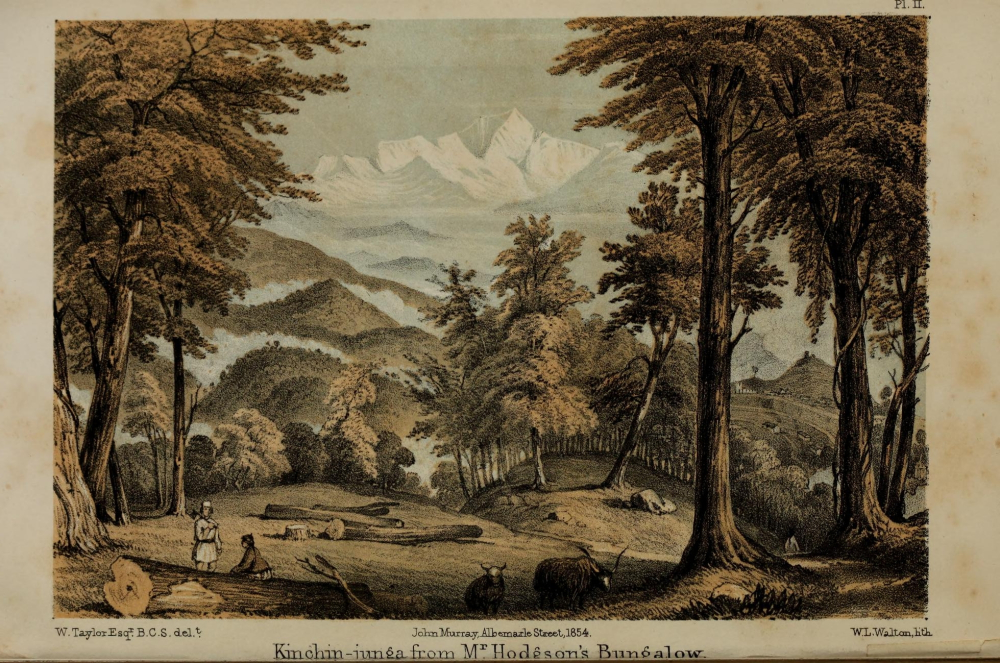
View of Kanchenjunga from Hodgson’s Bungalow, 1854. (Picture Courtesy: Illustration by W. Taylor from J.D. Hooker’s Himalayan Journals/Wikimedia Commons)
The sacred mountain guided itself into the imagination of several indigenous communities across the valley, and eventually, into their mythologies, but remains firmly rooted in the Lepcha cosmology. A great number of natural elements like caves, rivers, lakes, forests, etc. are worshipped by the indigenous people of Sikkim. The sacred meanings of these stories and practices have been integrated with Buddhist beliefs and constitute the basis for Sikkimese identity. Many rituals celebrate and uphold a reverence of nature as a continuous reminder of human kinship with earth elements. This includes, for instance, agriculture. For example, the Lepchas believe that the proper time for preparation of the rice fields is guided by specific birds who are supposed to have been sent by the invisible residents of Mayel Lyang (hidden paradise) (Siiger, 1967). Expounding on their kinships with elements of nature, the grandmother of the rice is called zo nyo kung, with the Lepchas regarding both rice and millet as family. The new seed of the millet is a daughter-in-law, the new seed of rice is the son-in-law, and their grain regarded as children. This also extends to myths about other natural elements. Halfdan Siiger, during his field work in Tingvong village in Dzongu in the late 1940s and the following years, recorded this with the help of his local guides: “…we came to a large rock named kam li or kam li gen. The family of the neighboring house (House No. 6) is in some way intimately connected with it, and believe that all human beings originate from kam li; others, however, believe that it is only the people of Tingvong (or Tingbung) who stem from this rock.”

Khangchendzonga range as seen from Gangtok. (Picture Credits: Abhishek Anil)
Lepchas also have protective gods for grains, land, vegetables, animals, and very importantly, mung (angry gods). A bongthing or mun (male and female Lepcha shamans or priests) performs many rituals, making sacrificial offerings to obtain blessings from mung. They pray to distinct mungs for receiving specific blessings for each animal or farm-field. For example, Sha So Ro K Rok is the creator and protector of minor domestic animals such as goats, pigs, and hens. Many of these prayers exist as songs. Beyond the gods and spirits, Mount Khangchendzonga is also believed to behold sacred ‘hidden lands’ by Buddhists and Lepchas alike. Such hidden lands or beyuls exist all across Sikkim and the entire Himalayan region, including Ladakh, Nepal, Tibet, and Bhutan. Buddhists call such hidden lands Beyul and Lepchas Mayel Lyang, also meaning ‘the land of hidden paradise’ and ‘land blessed by God’ in the Lepcha language. According to the Lama Gongdu terma (hidden teachings), Sikkim’s beloved Guru Rinpoche came to this region in the eighth century and concealed a great number of major and minor terma texts and religious objects across Sikkim’s rich biodiverse landscapes. So it is that Sikkim also came to be known as the land of terma. Buddhist teachings prophesied that certain Buddhist masters would come and discover these ‘treasures’ that were concealed by Guru Padmasambhava.
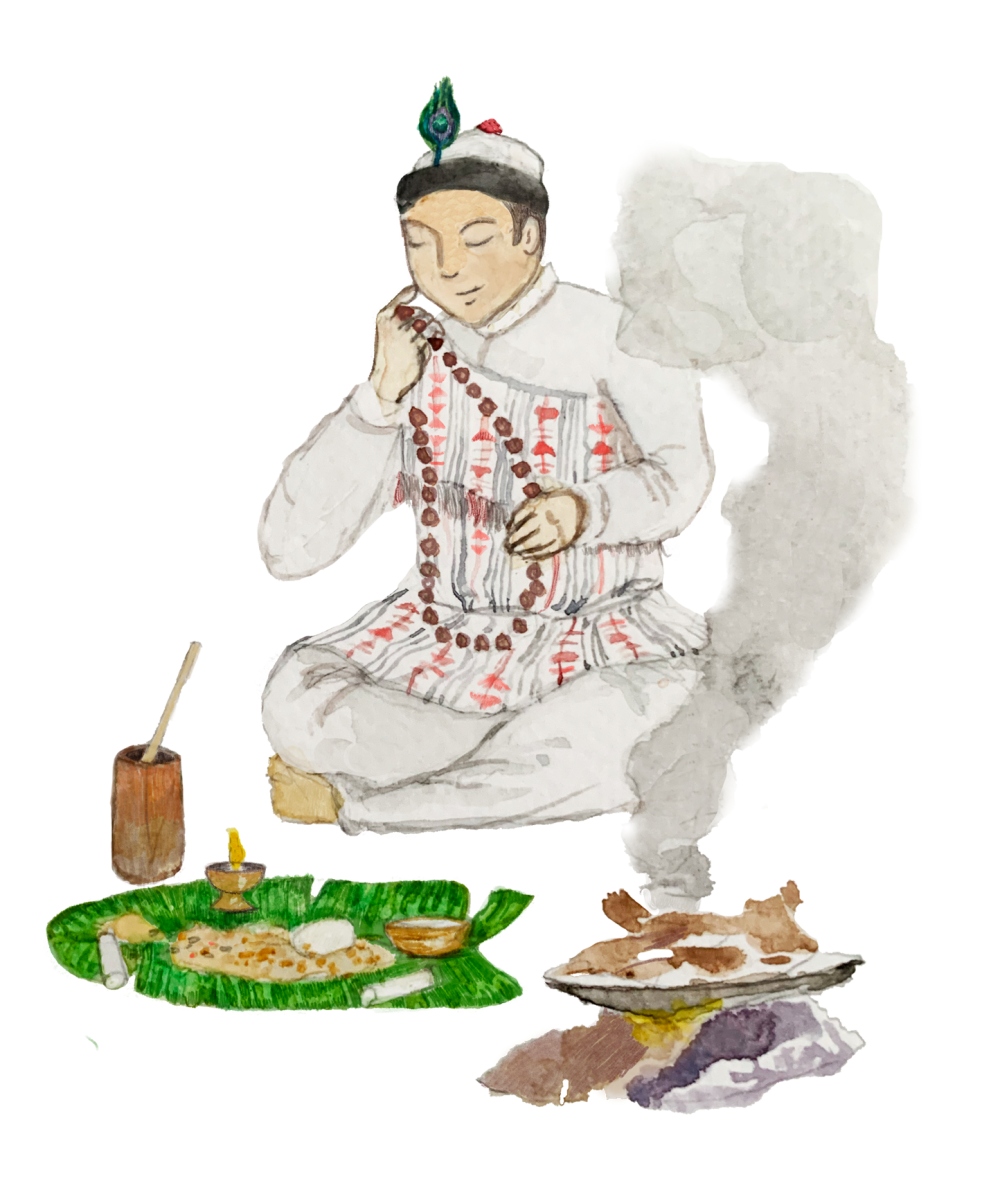
Bongthing. (Illustration Credits: Jisha Unnikrishnan)
On the matter of Guru Rinpoche’s visit, the works of Dorje Dechen Lingpa, the reincarnation of Yongdzin Jinpa Gyatso, the founder of Domang Monastery, states: “This hidden land of Sikkim, where formerly even the Buddhas would not have dared to set foot, was surrounded by forest and rocky terrain which was difficult to pass through. It was the home for apes, wild animals, cave demons, dreadful Nagas, and evil spirits where not even a single human species lived. It was then visited by Padmasambhava. He blessed these terrifying and dangerous places of deep recess, steep rocky formation, impassable trail, empty caves, a dwelling place of demon and vampire as a centre of meditation and spiritual practice by converting the harmful spirits inhabiting these landscapes into the protectors of Dharma.”
Spirituality and Ecological Welfare
While the rationalists might feel compelled to contest the existence of hidden valleys and lands as such sightings, if ever, are extremely rare, the idea holds significant meaning for everyone. At the immediate level, it makes people respectful of the myriad elements of nature. They believe that nature—rocks, caves, forests, lakes, valleys, rivers — are abodes for spirit guardians protecting something sacred and thus have agency. Any interference or destruction of such sacred spaces is met with significant opposition, leading to the conservation of nature. This enables living in harmony with nature with optimum human-nature connectedness, as opposed to buying the capitalistic narrative of considering land as ‘property.’
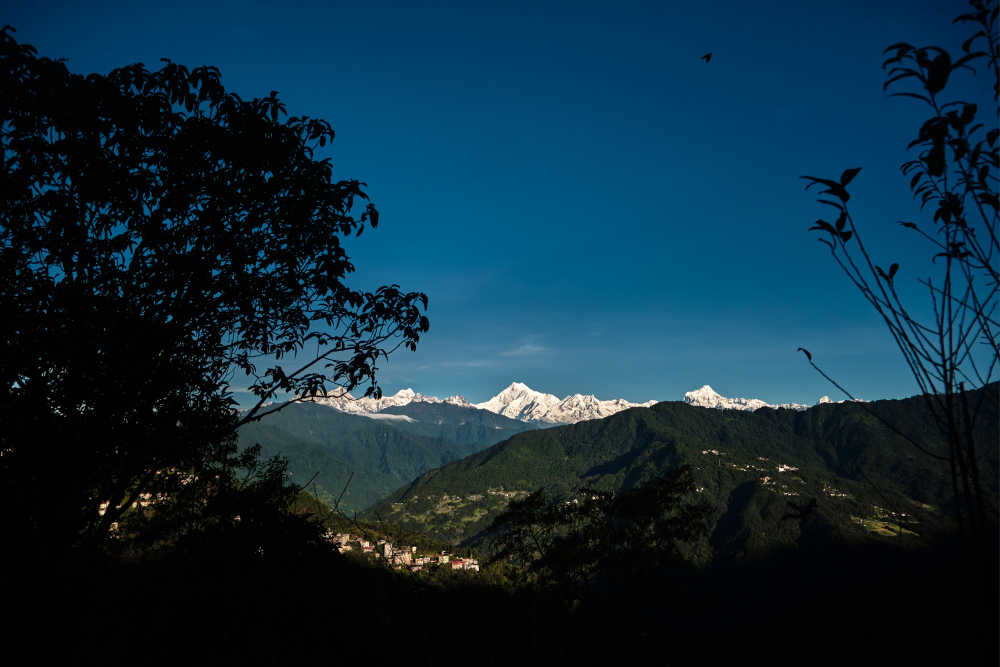
Kanchendzonga and adjoining peaks as viewed from Tashi View Point during sunrise. (Picture Credits: Abhishek Anil)
Such a reverent orientation towards nature has defined many political, economic, and ecological moments in Sikkim. In 2025, when a climbing expedition took place on Mount Khangchendzonga, it was considered sacrilegious by both Bhutia and the Lepcha community. They believed the expedition had polluted the sacred landscape, potentially upsetting its guardian deities. Purification rituals were organized and forgiveness was sought, requesting ongoing divine protection and seeking future blessings. Sujal Pradhan for India Today NE reports, “The purification ritual followed a structured three-phase approach designed to restore spiritual balance. The first stage involved seeking forgiveness from guardian deities for environmental disturbances, including tree cutting and the sacred mountain's desecration. The second phase requested continued divine protection for Sikkim and its inhabitants, while the third sought blessings to prevent future misfortunes.”
This complex context explains why the area around the mountain, the Khangchendzonga National Park (KNP), which covers 25 per cent of Sikkim, was inscribed on the UNESCO World Heritage list in 2016 as a ‘mixed heritage site,’ recognising both its natural and cultural values.
In the early 2000s, when the Sikkim State Government proposed and attempted to construct a series of 27 hydro-power dams over the river Teesta and its tributaries, several were located inside Dzongu, a sacred Lepcha reserve in North Sikkim (which occupies the buffer and transition zones of the Khangchendzonga Biosphere Reserve). The entire Lepcha community rose to protest under the banner of the Affected Citizens of Teesta (ACT) in 2007, taking to the streets of Gangtok and continuing a 915-day peaceful nonviolent relay hunger strike. Many young people joined the protest. Three youths–Dawa Lepcha from Lingdong, Tenzing Lepcha from Hee Gyathang in lower Dzongu, and Gyatso Lepcha from Passingdong–emerged as iconic figures from this protest movement (read Prava Rai’s article 2021 to know about them). Lepcha youths who until now were drawn to the cities, paused to reflect on their ancestral heritage–their culture, land and stories passed down by their elders. Pride was restored, and a generation reinvigorated to emerge as custodians of their sacred lands. This turned out to be a watershed moment in modern Lepcha history, galvanising them for a common cause — their reverence for nature, their kin.
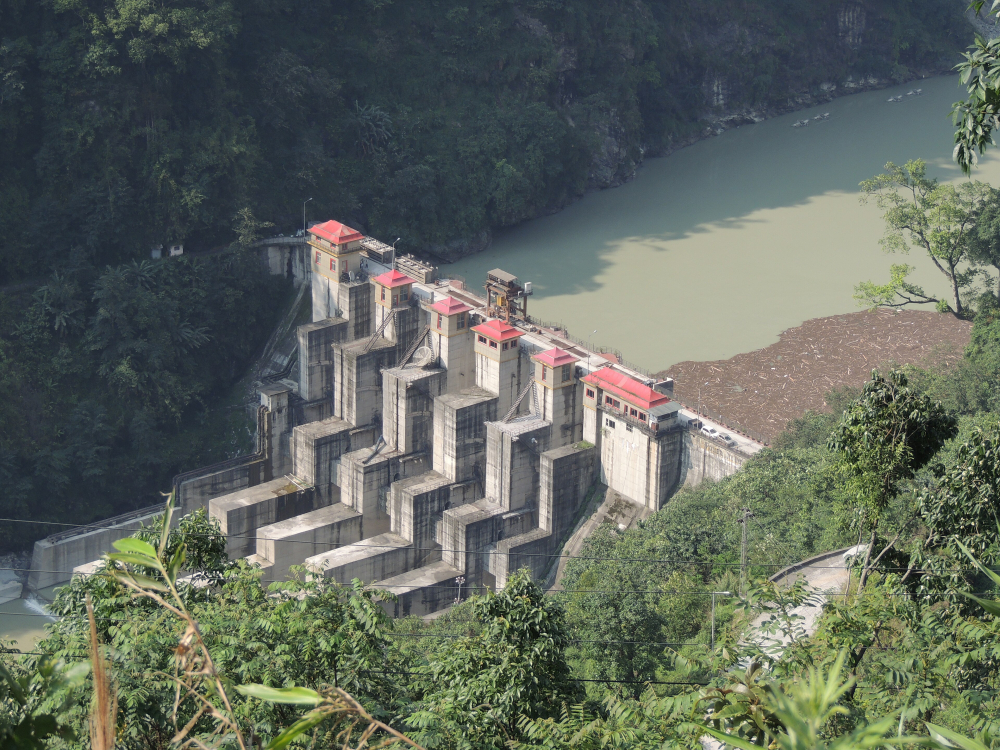
Hydel project on the Dikchu, a tributary of Teesta. (Picture Courtesy: A. J. T. Johnsingh for WWF-India and NCF/Wikimedia Commons)
The sustained resistance of the Lepchas, along with Buddhist communities in the region, eventually led to the scrapping of four dams which had been proposed within the National Park and on its peripheries. This remains one of the world’s most inspiring and successful anti-dam protests till date. Gyatso and Tseten Lepcha, key members of ACT, write for World Heritage Watch Report 2018, “We are striving to keep the river flowing free as after death our souls will travel all the way up the Rongyoong to their final resting place in the mountain.” Rongnyu, or alternatively Rongyoong, the river, originates in the Khanchendzonga range, and flows through the deep gorges and densely forested valleys of Dzongu before it meets the Teesta. Their arguments are not solely spiritual or premised on mythical beliefs, but also firmly rooted in ecological understandings, awareness of the region being seismically sensitive, Rights of Nature (RoN), and the preservation of Dzongu (the only reserved land for the Lepchas). Kerry Little, who closely followed the movement, writes, “It was the jungle that held the old stories from a past time; stories told by shamans and hunters ... .The sacred stories from the elder’s time became protest narratives when the activists referenced their mythology to prove their ownership of the land”.
Prava Rai, the founder of Sikkim Project in an article “Making of a Sacred Land and its Guardians” writes, “What was unique about this experience was that it reaffirmed the Lepcha ancestors’ belief in deep ecology…The stories that have been traditionally passed down from generation to generation were repeated and re-learnt.” Many young people had moved away from Dzongu; being educated in institutions outside had exposed them to external influence. The threat that was exemplified by dam-building opened their eyes to the value of their ancestral land and the urgent need to preserve it, and to prevent its desecration in the name of development. Since the very existence of Lepchas is based on their land, Dzongu once more became a sacred place of pilgrimage, even to Lepchas from Darjeeling and Kalimpong.
Sikkim till date remains a largely peaceful state, where most natives cohabit with nature and stand as custodians of a sacred land. Despite being India’s smallest state, it was the first to ban plastics as well as the use of pesticides in farming. Outsiders cannot buy land here either. This small state in the Eastern Himalayas has been ahead of the rest of the country in many ways, though not without challenges and its own pitfalls. Though it is largely celebrated as India’s 100 per cent organic farming state, the locals living in Gangtok and other cities and towns have to largely depend on the vegetables and fruits transported from the plains, most of which are grown using pesticides. Though free from litter and overtaking or honking vehicles, and still a welcoming Himalayan town, Gangtok has mushroomed exponentially, much of it randomly. Tall concrete buildings erected next to one another now jostle for space and sunlight; an undisrupted view of the mountains, if any, has become a selling-point for tourists. Here, the conception of land is now turning into property, an ailment most Sikkimese had for long-resisted with great aplomb. The fabric of human-nature relationships here is gradually witnessing a strain.
Norwegian scholar Arne Naess, the founder of the term ‘deep ecology,’ writes, “The ecological self of a person is that with which this person identifies.” Post-humanities scholar Eduardo Kohn postulates, “how other kinds of beings see us changes things…Understanding the relationship between distinctly human forms of representation and these other forms is key to finding a way to practice an anthropology that does not radically separate humans from nonhumans.” The people of Sikkim have long shared such a deep relationship and identification with nature, which has bolstered and encouraged thoughtful ecological decisions in the face of capitalism and greed. However, material aspirations appear to be gradually taking over.
Dr Miles Richardson, School of Psychology, University of Derby, in an important study titled Modelling Nature Connectedness Within Environmental Systems: Human-Nature Relationships from 1800 to 2020 and Beyond revealed, “The reduction in exposure to nature and the decreasing affinity for it, create a cycle that weakens the human-nature relationship, referred to as ‘extinction of experience.’ Human-environment interactions, or the human-nature relationship, are increasingly considered through the psychological construct of nature connectedness, which is critical for fostering pro-environmental behaviours and enhancing human wellbeing. Yet historical processes like urbanisation and environmental degradation have likely driven its long-term decline…” While this reminder is gravely important for the people living in the Indian plains, it is equally necessary that the Sikkimese people continue resisting succumbing to these temporal temptations and remain in pursuit of a balance that enables multispecies cohabitation.
Bibliography
Little, Kelly. ‘Lepcha Narratives of Their Threatened Sacred Landscapes.’ Transforming Cultures eJournal 3, no. 1 (2008): 227-255.
Lepcha, T., and Gyatso Lepcha. ‘Undermining Cultural Values: An Indigenous Perspective on the Khanchendzonga Nomination.’ In World Heritage Watch Report 2018. Published by World Heritage Watch e.V., 2018.
Parvaiz, Athar. ‘Locals in Sikkim Are Fighting to Save Their Community and the Environment from Hydropower Projects.’ Scroll.in, January 27, 2017. Accessed January 16, 2026. https://scroll.in/article/827635/locals-in-sikkim-are-fighting-to-save-their-community-and-the-environment-from-hydropower-projects.
Pradhan, Sujal. ‘Sikkim Communities Hold Sacred Purification Ritual after Khangchendzonga Expedition.’ India Today NE, June 15, 2025. Accessed January 16, 2026. https://www.indiatodayne.in/sikkim/video/sikkim-communities-hold-sacred-purification-ritual-after-khangchendzonga-expedition-1229345-2025-06-15.
Richard, Miles. ‘Modelling Nature Connectedness within Environmental Systems: Human–Nature Relationships from 1800 to 2020 and Beyond.’ Earth 6(3), 82, 2025.
Siiger, Halfdan. The Lepchas: Culture and Religion of a Himalayan People. Part 1. Copenhagen: The National Museum of Denmark, 1967.
Thupten Tenzing. ‘The Legacy of Guru Padmasambhava in the Dissemination of Buddhism in Sikkim.’ Sahapedia, 2019. Accessed 26 February 2026. https://www.sahapedia.org/legacy-guru-padmasambhava-dissemination-buddhism-sikkim
This essay has been created as part of Sahapedia's My City My Heritage project, supported by the InterGlobe Foundation (IGF).