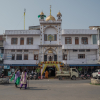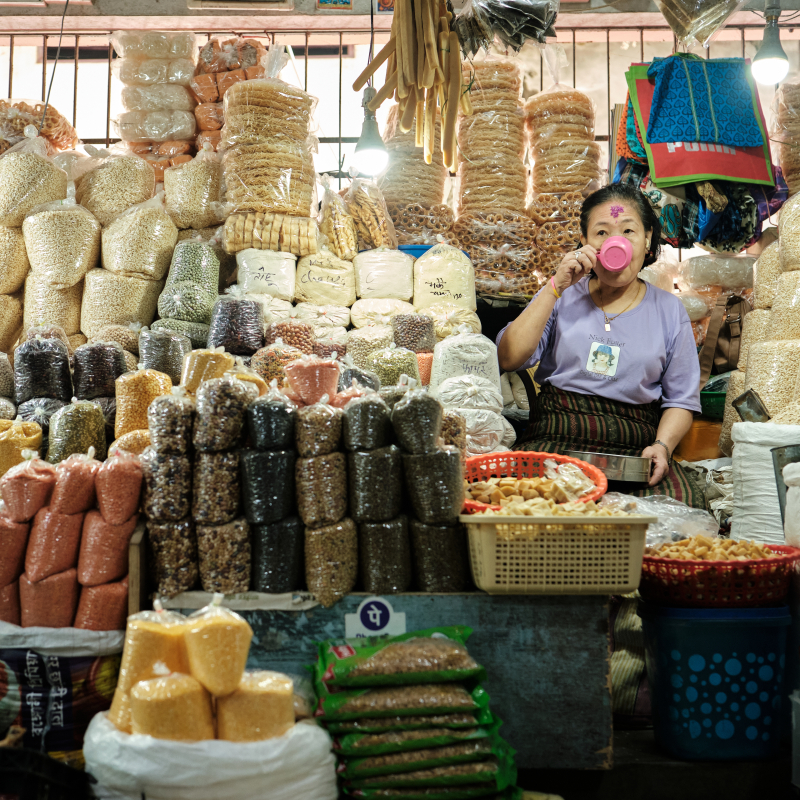

From the outside, Lall Bazaar looms as a striking landmark in Gangtok, its facade decked in red tiles that immediately catch the eye. Contrary to popular belief, the "Lall" derives not from the Hindi word for red, but actually refers to a dewan (minister) of the Chogyal (king) of aeons past, illustrating how language evolves across time and space. New meanings are made and circulated; oftentimes, histories blur.
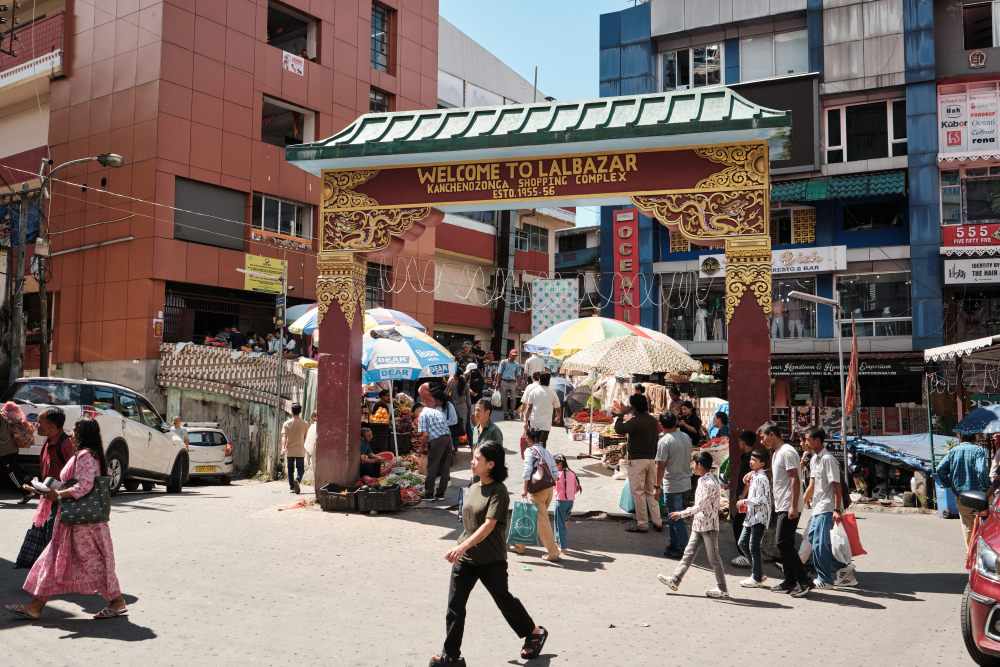
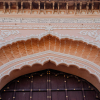
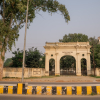
Lall Bazaar gate/entryway. (Picture Credits: Abhishek Anil)
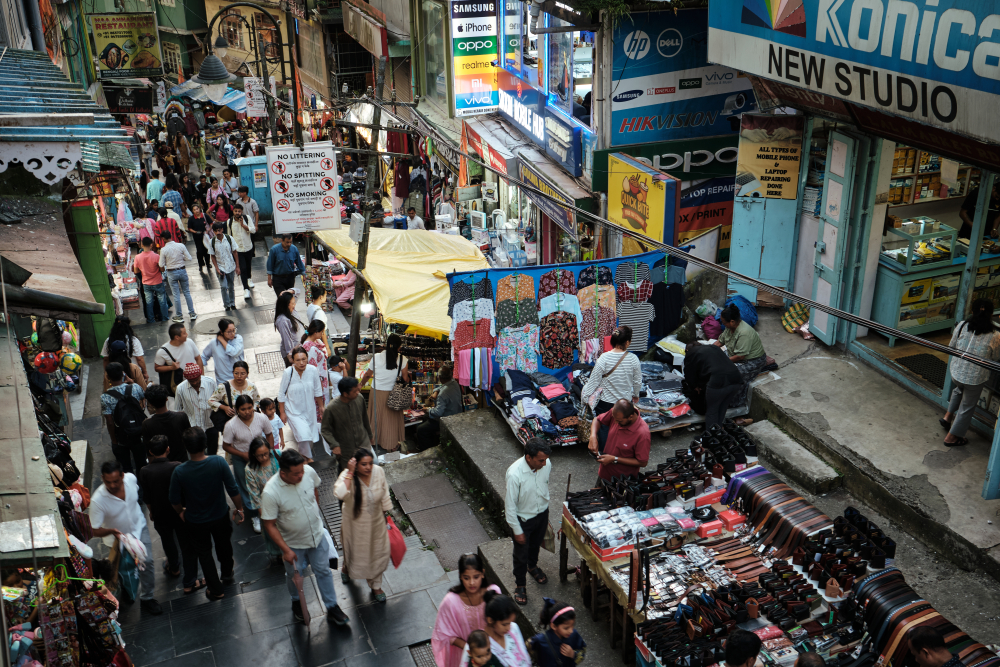
A busy Tharo Line market in Gangtok. (Picture Credits: Abhishek Anil)
In a few descriptions of the market, Lall Bazaar is the name given to the entire area where the Kanchendzonga Shopping Complex (the largest shopping complex situated in the Lall Bazaar locality, a name that refers both to the broader area and to the vegetable market within it), the Denzong Cinema Hall (one of the oldest cinema halls in Sikkim), the Thado Line (Nepali for “Erect Path,” referring to the stairway that links Lall Bazaar and MG Marg, which sits at a higher elevation in the town), and parts of the supermarket complex are located. This naming puzzle only hints at deeper layers, as Gangtok's market history remains sparsely documented, which sets the stage for a closer look at Lall Bazaar's origins.
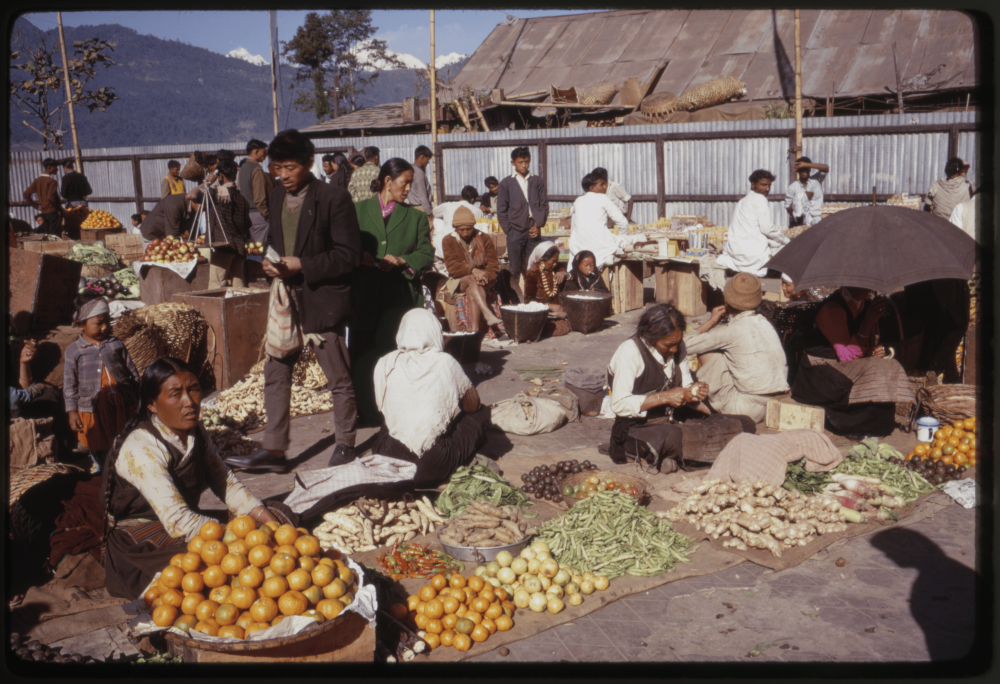
A market in Gangtok. (Picture Courtesy: Alice Kandell/Library of Congress)
Across Borders: The Southern Silk Route
Sikkim’s marketplaces constitute an inseparable story of an older, trans-Himalayan traffic. Documentations of the Central Asian Silk Route are amassing, but a lesser-known trail, known as the Southwest Silk Road, or the Sikkim Silk Route, passed through the mountains of Sikkim and Tibet, and served important trade functions between India and Tibet. Approximately 2000 km long, this route connected China’s Yunnan province to Tibet and Northeast India. However, due to its steep inclines, freezing winters, and the unpredictable mountainous terrain, it became one of the most challenging branches of the Silk Route. Despite it all, traders, monks, and muleteers traversed it long before the arrival of colonial surveyors.
This route facilitated trade in an array of items: Tibet traded in musk, wool, borax, gold, and fur; China traded silk, Sichuan pepper, Shu embroidered cloth, brocades, bamboo handicrafts, ironware, and most notably, horses and tea; India bartered in local grains, spices, cotton, and salt came from India. These items traversed long distances before reaching their destination. Due to the arduous nature of their travels, traders often halted in small villages and set up shop to sell some of their trade goods. On the stretch between Changthang in Tibet and Kalimpong, the traders stopped at points like Gangtok and Rhenock in Sikkim to rest. Rhenock transformed into a bustling halting station due to its geographical closeness to Kalimpong. Researchers trace back the history of haat bazaars in Sikkim to this long-forgotten trading tale.
These haat (temporary market, often regularly held) bazaars eventually grew in popularity. Having been around for over two millennia, these markets are set up in specific locations at regular intervals to offer a low-cost selling system for primarily rural populations. According to Deogam, these are the oldest marketing channels in India and continue to contribute significantly to the rural economy even today. Popular also for the generally lower prices of products that are overcome by the increased traffic, haat bazaars benefit both the customers and the vendors, where purchases and sales can be made in huge quantities. In addition, these markets also become a bustling hub of cultural exchange, where people introduce each other to foodstuffs, accessories, tools and equipment used by different cultures or cultural groups, and these grounds transform into a socialising field.
History of Lall Bazaar: From Caravan Routes to a Central Marketplace
Amidst this backdrop, Gangtok, which was located at a geopolitically significant point, not only catered to the needs of its internal population but also acted as a hub for trade and exchange with its rural hinterlands, neighbouring cities like Siliguri and Darjeeling, as well as bordering countries like Tibet and China.
When the Treaty of Tumlong was signed in 1861, Sikkim became a de facto protectorate of the British EIC. This led to them controlling Sikkim’s external affairs, including trade, bringing the army and the British officers to Sikkim. During the nineteenth-century, a North Indian businessman, Jethraj Bhojmal, arrived at Gangtok as a cashier for the British forces. His new office functioned as a pay office, the state bank, the state treasury, the public exchequer, and even a departmental store. Situated close to the palace, it became the first of several such commercial establishments that soon appeared in the area. When Claude White arrived in Gangtok as its political officer in 1887, his team pitched tents on the ridge near the palace and set up various shops and offices, including the post and telegraph offices, a rest house, as well as a hospital and dispensary.
By 1925, this shopping district had shifted to what is now the Old Market area to reduce congestion around the palace. That year, the Chogyal (king) of Sikkim granted permission to ten individuals to open businesses and allotted them sites in Gangtok in what is present-day MG Marg — the beginning of its market culture.
By 1951, many new shops bedecked the two sides of MG Marg, slowly growing into a major market centre. Subject to the closure of trade between India and China during the first Indo-China war, the markets shifted to cater to a more regional, local customer base. Weekly markets were now designed to meet the needs of the regional population, and haat bazaars became an essential means of sustenance for both the buyers and sellers. These weekly bazaars or haat bazaars are now primarily situated in the Lall Bazaar area.
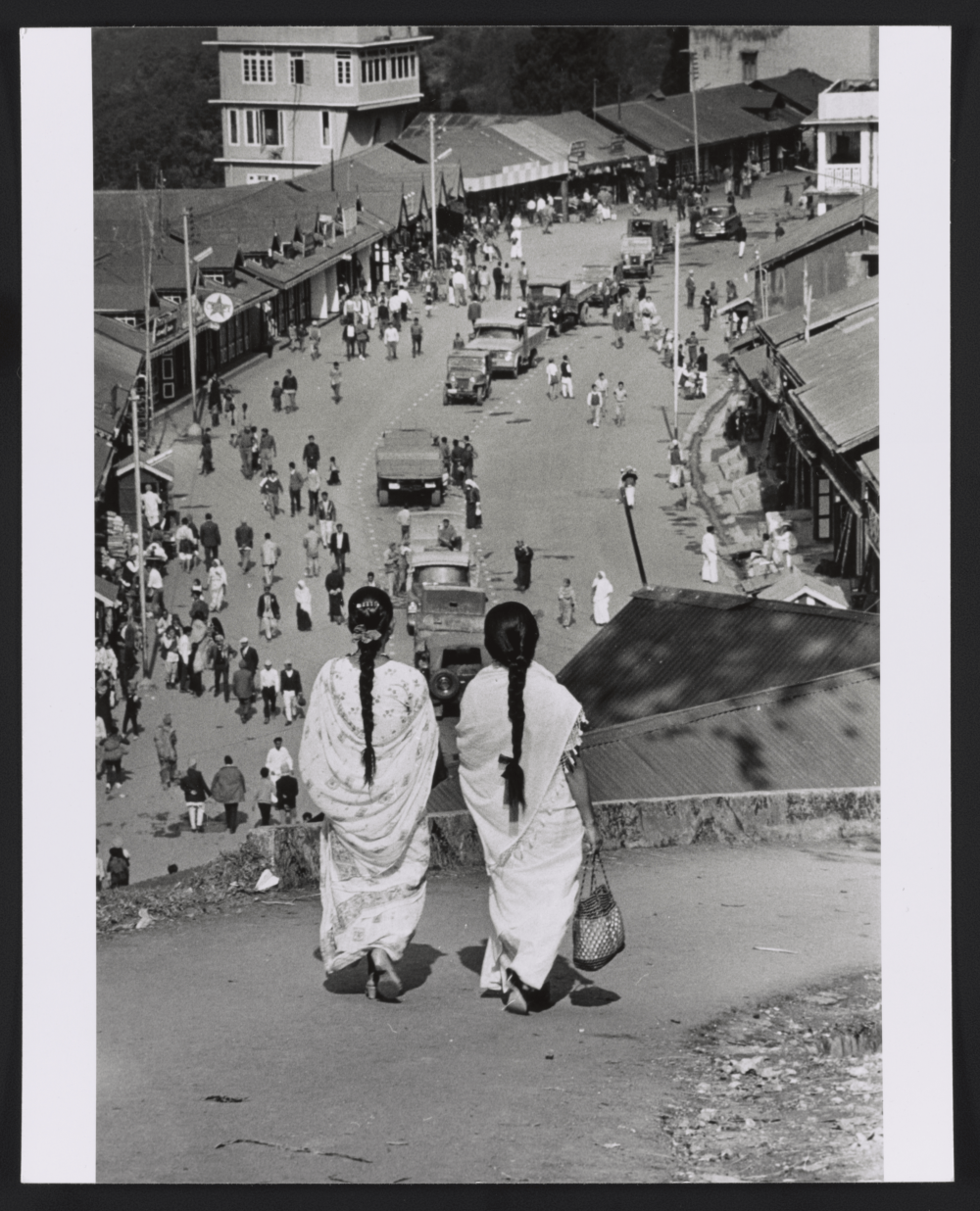
Market in Gangtok, present day MG Marg. (Picture Courtesy: Alice Kandell/Library of Congress)
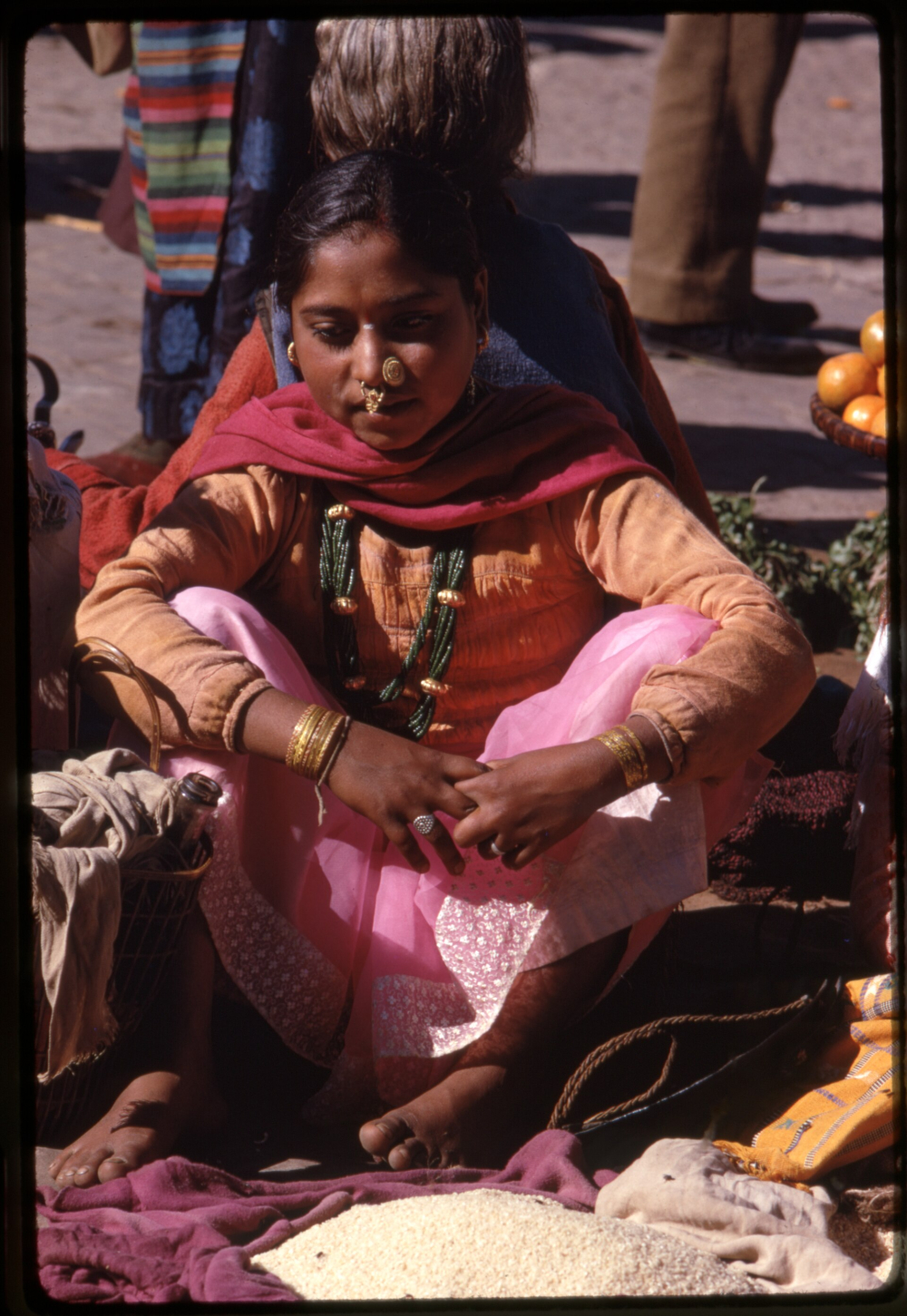
A lady selling rice in a market in Gangtok. (Picture Courtesy: Alice Kandell/Library of Congress)
First built in 1956, Lall Bazaar is named after John S. Lall, the first Dewan to the Chogyal of Sikkim. This market began as a modest, open-air street bazaar, located just below the southern section of MG Marg. The outer rows were primarily occupied by multistoried buildings with shops on the ground floors and residential quarters above. During the aitabaarey haat (Sunday market), the sellers would lay out their products on the open roads and in the vacant spaces within the market area, creating a vibrant and lively market scene. It featured several rows of shops, where people from all around would converge with produce such as wheat, maize, lentils, vegetables, fruits, livestock like chickens, pigs, and cows, as well as traditional attire and jewellery.
In 2003, this open-street bazaar was temporarily shifted to Children’s Park, while the construction of the now Kanchendzonga Shopping Complex commenced.
Lall Bazaar Today
What began as a humble shopping square has now evolved into a bustling complex. Lall Bazaar’s transformation has been remarkable, even in just these past few years. Today, Lall Bazaar stands five stories tall, the ground floor of which is dedicated to parking and a local taxi stand. On the first floor is the lively sabji bazaar (vegetable market). The second and third floors have shops that sell everything one might ask for–clothes, shoes, household supplies, tools and equipment, traditional attire and jewellery, food, tailor shops, and thrift stores.
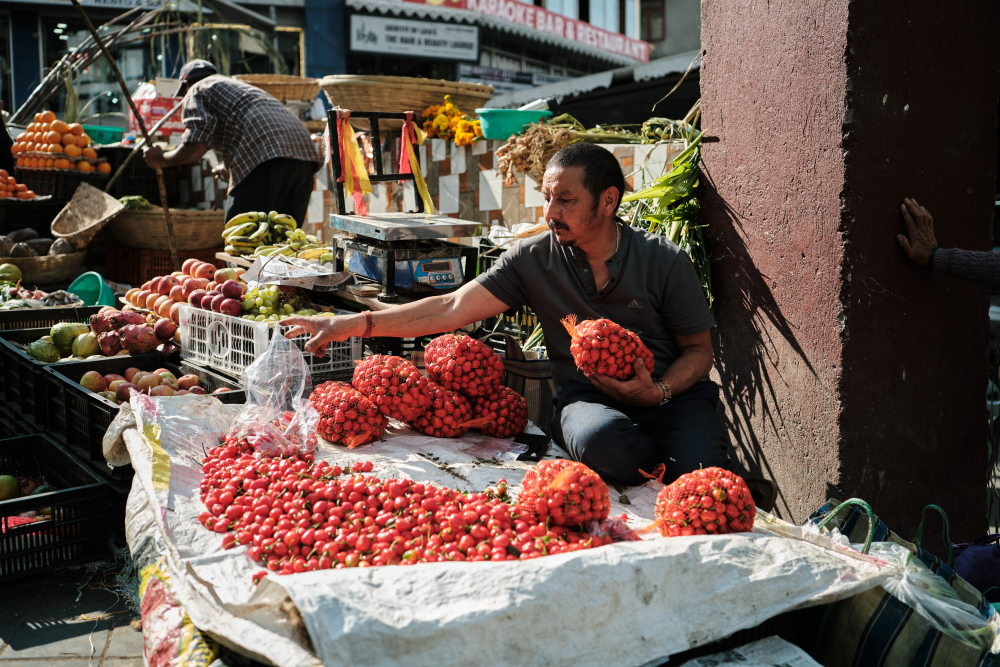
Man selling dalley chilly. (Picture Courtesy: Abhishek Anil)
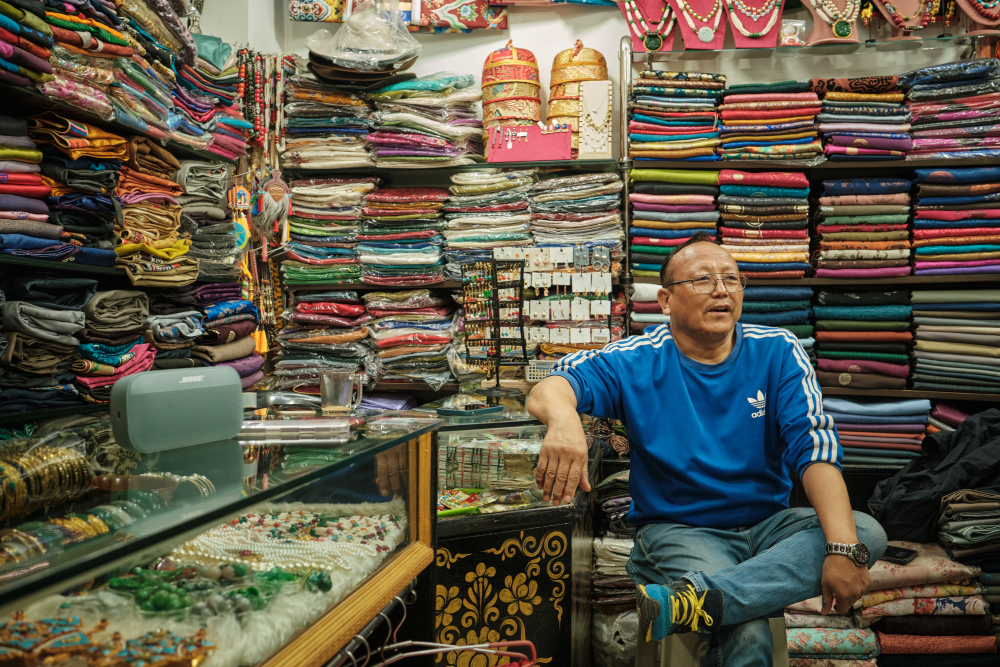
A shop selling traditional clothes and jewellery in Lall Bazar. (Picture Credits: Abhishek Anil)
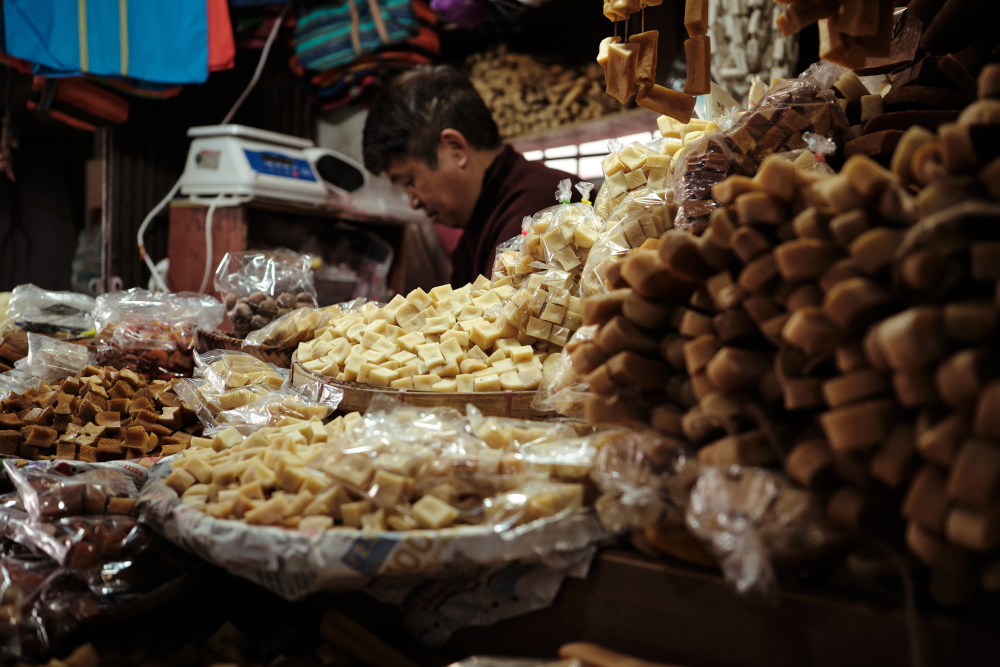
Shop selling a variety of hard chhurpi. (Picture Credits: Abhishek Anil)
Lall Bazaar has an array of shops in its care. The shops together capture the quintessence of Gangtok’s diversity and ethnic fabric. From stores selling traditional attire to those offering fast fashion, faster and cheaper, Lall Bazaar is a shopping hub for the vast majority of the working-class population, extending its reach beyond Gangtok itself. School and college students, the younger members of the workforce, and even people from well-off families frequent the Lall Bazaar. Among its many attractions, the range of products and prices remains the most compelling. One might find thrift stores alongside shops selling newly produced clothes priced under 500 rupees, along with quick and inexpensive snacking points that serve as spaces of congregation and interaction for people on short lunch breaks or taking brief pauses from walking around and shopping in Lall Bazaar. From alu-chewra snack stores to momo and thukpa points, interspersed with small cafés, the food outlets cater to both the visiting and the cohabitating populations of Lall Bazaar and, by extension, Gangtok. Locals and tourists alike often remark on the lack of space to comfortably set foot in Lall Bazaar due to its popularity, yet still find themselves there. For tourists, Lall Bazaar also offers access to a variety of stores that sell traditional attire and Sikkimese, Tibetan, and Nepali crafts, such as bamboo handicrafts, carpets, clothes, jewellery, utensils, etcetera, without breaking the bank.
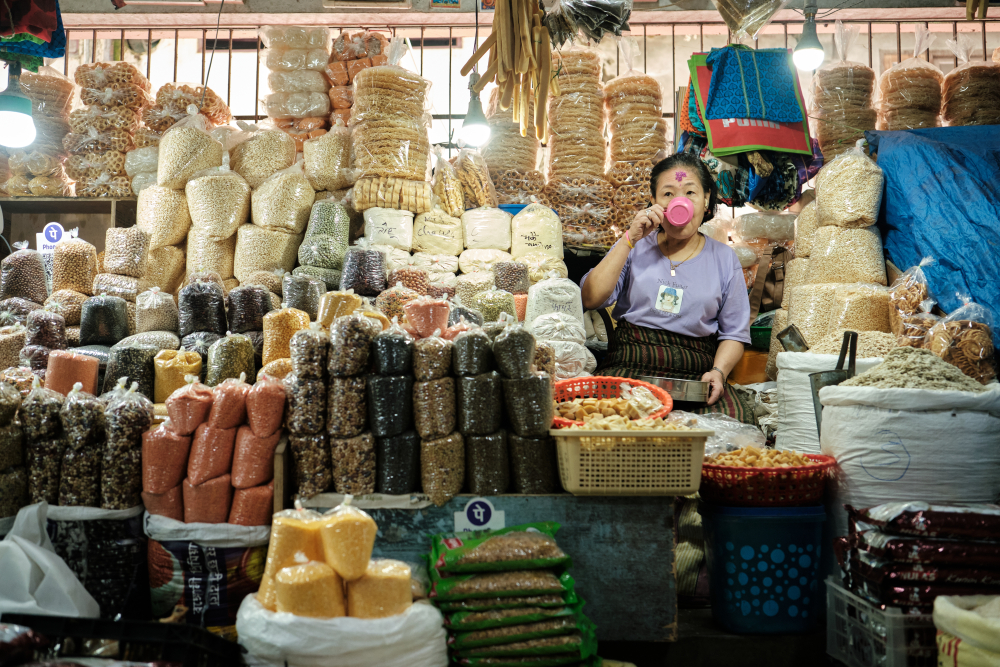
A shop in Lall Bazaar selling khaptsey, zeyro, and festive snacks along with grains and pulses. (Picture Credits: Abhishek Anil)
The affordability and accessibility of goods in Lall Bazaar make it a relatively democratic market. Lall Bazaar is also sustained by a mix of communities. Women from self-help groups run the majority of the sabji bazaar shops that sell organic produce like Raya ko saag (Himalayan mustard greens), spinach, watercress, fenugreek, iskus (chayote), and seasonal fruits; cheeses like the local chhurpi, tofu, and paneer, dried fish, namely sidra and sukuti, and festive foods like kyabzay, zeyro, siraula, chewra, and selroti that are used in households during festivals like Losar (the Tibetan New Year), Losoong (the Sikkimese harvest festival), Dassain (Dussehra), Tihar (Diwali), and Saga Dawa. The Marwari mercantile population sells a wide range of items, including spices, clothes, pots and pans, upholstery, and food. Older Tibetan women sell Tibetan food like phalay, gyathuk, phambi, laphing, pine-leaves incense colloquially called sang, as well as clothes sourced mainly from Bangkok, Siliguri, Delhi, and China. Sections of the Nepali population also sell traditional and handcrafted jewellery and accessories in small curio shops, some of which date back to the time of the Chogyal, when Sikkim was still a Himalayan kingdom.
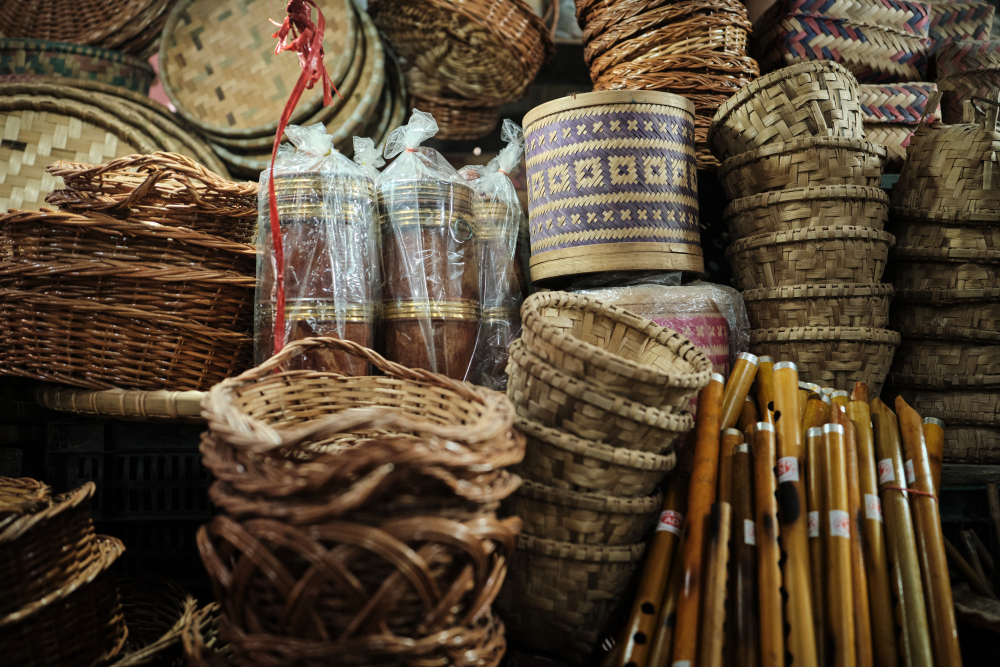
Handicrafts for sale in Lall Bazaar. (Picture Credits: Abhishek Anil)
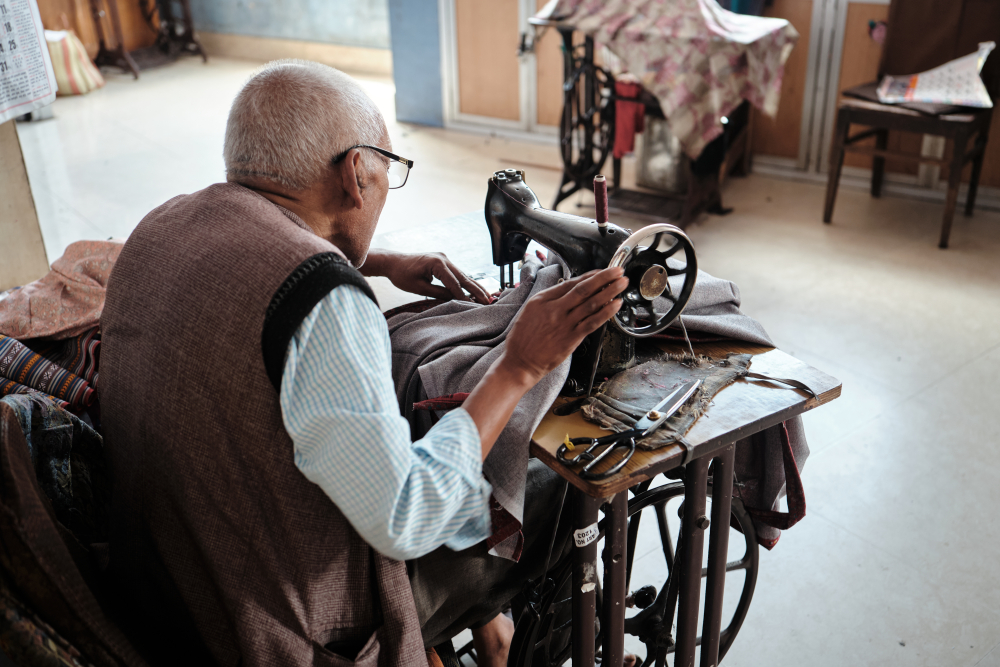
Tailor shops in Lall Bazaar. (Picture Credits: Abhishek Anil)
The Lall Bazaar terrace also served as a public space in the ever-urbanising city of Gangtok, presenting a solution for the dearth of open and public spaces. Here, we once found skateboarders and rappers practising and performing, contributing to the proliferation of urban subcultures in Sikkim. Additionally, this terrace has also provided space for trade fairs and expos in the past. With the building of a skate park in Gangtok, the Lall Bazaar terrace now opens the way to new shops.
One of the reasons why Lall Bazaar stands out in sharp contrast to the rest of Gangtok bazaar is that it exists as a sensorally rich experience. From the colours of the vegetables and fruits that fill the shops and alleys, to the different smells one catches, one arrives at Lall Bazaar even before setting foot in it. These smells and fragrances are interjected with sounds of various products like the clanking of kitchen and field tools, the rustling of plastic and paper, the thudding of crates, and the lively mix of people’s voices. Spilling all the way outside the gates, Lall Bazaar teems with sellers setting up shop and buyers stretching their bags even before the shops open. Reflecting the lives and livelihoods of Gangtok’s residents, Lall Bazaar is thus popular among both the local population that finds their everyday needs met by this market, and the tourists seeking souvenirs that recall both the urban and rural spaces and imaginations of Sikkim.
Heritage in Practice: Everyday Life and Memory in Lall Bazaar
Markets play a significant role in the production of cultures amongst the citizens of any town. Unlike with other districts and towns in Sikkim, people come to Gangtok, the capital city, for its markets.
In Gangtok, Lall Bazaar serves as a site for interaction. Using Gary Alan Fine’s idea that local culture is “a set of meanings tied to a specific space of interaction,” I use the term local in a way that goes beyond ethnic identity in Sikkim. It includes not only Nepalis, Bhutias, and Lepchas, the major communities in the state, but also those who settled in Sikkim before it became part of India, such as the traders and merchants who arrived upto the 1970s and have lived here since. This broader view is important because, as Fine argues, while culture grows out of everyday interactions, it also provides the foundation that makes those interactions possible. In this setting, boundaries and borders shape who is included or excluded, depending on people’s access to relationships, resources, and knowledge of the space. But the interactions that do happen can open up pathways for more people to take part over time.
Neoliberalism has become a globally recognised way of thinking and organising economies, reshaping societies in powerful ways by driving economic changes while also weakening many of the spaces where opposition could take root. Yet people always find ways to push back. Lall Bazaar fits into this story because even as it is connected to the expanding markets shaped by neoliberal policies, it has also become a space where resistance and alternative ways of living and trading continue to thrive.
Lall Bazaar facilitates more than the movements of goods, becoming a site where memories, relationships, traditions, and skills are shaped, exchanged, and determinately preserved. To view Lall Bazaar as cultural heritage, one must shift the gaze away from seeing it as merely a cultural property. Upon close inquiry and inspection, one confirms that Lall Bazaar is a living archive of everyday trade routes and rituals that bring people together, shaped by generations of vendors, customers, migrants, and traders. It has evolved into a monument of allegories and anecdotes, livelihoods, oral histories, skills and navigations, subcultures, as well as memories, all having survived political and geographical shifts and the pressures of the neoliberal market. Much like Sikkim, one must imagine Lal Bazaar as a heterogeneous entity rather than a homogenous one, often bringing together the urban and rural pockets of Sikkim.
Concluding Thoughts
Lall Bazaar makes an exuberant display of solidarity and a sense of community. A recurring theme in Lall Bazaar is helping other vendors sell. During the aitabaarey haat, individual shopkeepers often look after their neighbouring shop’s produce too. The whole haat operates as a family, with community as the foundation of their success. It is through these social connections and collective efforts that the vendors at Lall Bazaar have been able to sustain and grow their businesses.
It is difficult to use the term Sikkimese, knowing full well that there is no one definition to it; it exists in my imagination, and through my usage, hopefully, it urges the reader to nudge at their imaginations of Sikkim and the term Sikkimese too. Sikkim is a multi-ethnic state. From Nepalis to Bhutias, Lepchas, and Marwadis, Sikkim has been a home for all castes, classes, ethnicities, and regional and linguistic groups. Out of all the markets in Gangtok, it is least surprising that Lall Bazaar is where one locates people of all demographics. Additionally, the diverse range of products and prices makes Lall Bazaar an attractive option for people of most demographics.
A shopkeeper there recently expressed something striking: “Our products are not only for one group or another. We celebrate the shared heritage of all communities and castes in this region.” Her use of “our heritage” stands out, especially in a landscape where harmonious heterogeneity is rarely acknowledged over the presumed homogeneity often projected onto the region.
Today, multibillion-dollar chains like Reliance threaten the Lall Bazaar economy. With subsidised prices, customers often prefer these marts for weekly or monthly purchases. Ironically, it is the very diversity of products and prices at these marts, which were long offered by Lall Bazaar, that draws them there. The local population’s consumerist tendencies, in an ever-expanding market based on capitalist principles, certainly threaten markets like Lall Bazaar. Yet markets like Lall Bazaar, especially the Haat, offer what marts cannot: organic, seasonal produce rooted in ecological and cultural traditions, foods tied to ancestral practices. Its role is expansive, from sustaining livelihoods to preserving knowledge and nurturing customs across generations.
Lall Bazaar is ever-giving, a repository of knowledge, histories, experiences, anecdotes, customs, and practices—all while providing people with affordability, diversity, and a connection to our roots.
Note: Parts of this article were originally published in the anthology From Saigon to Shillong: Marketplaces as Crossroads of Culture, edited by Dr Etawanda Saiborne, Freddie M. Majaw, and Dr Amanda C. Tongper and published by Northeast India AV Archive, St. Anthony’s College, Shillong.
Bibliography
Bourdieu, Pierre, and Loïc Wacquant. ‘Neoliberal Newspeak: Notes on the New Planetary Vulgate.’ Radical Philosophy 105 (2001): 1–6.
Deogam, Moti. ‘Haat: An Instrument of Cultural, Social, Economic and Political Socialization.’ International Journal of Trend in Scientific Research and Development 7, no. 1 (February 2023): 1332–1337.
Fine, Gary A. ‘The Sociology of the Local: Action and Its Publics.’ Sociological Theory 28, no. 4 (2010): 355–376.
‘Silken Roads of Sikkim | Indian Culture.’ Indian Culture. Accessed 26 February 2025. https://indianculture.gov.in/stories/silken-roads-sikkim.
Thatal, Aakriti. ‘Café Culture: Exploring the Roles of Cafés in Cultural Production among the Urban Middle Class in Gangtok, Sikkim.’ MA Dissertation, Tata Institute of Social Sciences, 2023.
———. "Echoes of Memory and Time: The Changing Landscape of Lall Bazaar." In From Saigon to Shillong: Marketplaces as Crossroads of Culture, edited by Etawanda Saiborne, Freddi M Majaw, and Amanda C Tongper. 1st ed. Shillong, Meghalaya: The Northeast India AV Archive, St. Anthony's College, 2025.
This essay has been created as part of Sahapedia's My City My Heritage project, supported by the InterGlobe Foundation (IGF).