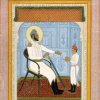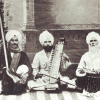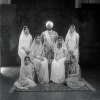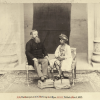

Gangtok’s transition to an urban centre happened alongside the changing political landscape of Sikkim, while it was still an independent kingdom. After the British political office was established in 1889, it slowly began to indicate urban characteristics, marked particularly by the building of roads by the British to make access to trade and diplomatic relations with Tibet easier.
Historian Sunita Kharel explains that in its earliest phase, Gangtok was initially a military cantonment for the British Armed Forces. The British East India Company was handling Sikkim’s internal administration, which led to the construction of Raj Bhawan, the British residence in Gangtok. This prompted administrative, economic, and social changes in the then kingdom, both stimulating bazaar growth and resulting from it. Some of the major changes that took place were the emergence of the merchant class and an increase in self-employment through craftsmanship in handicrafts, tailoring, and carpet-making. The Public Works Department emerged in the late nineteenth-century, and by the twentieth-century, the place slowly grew to have urban qualities.
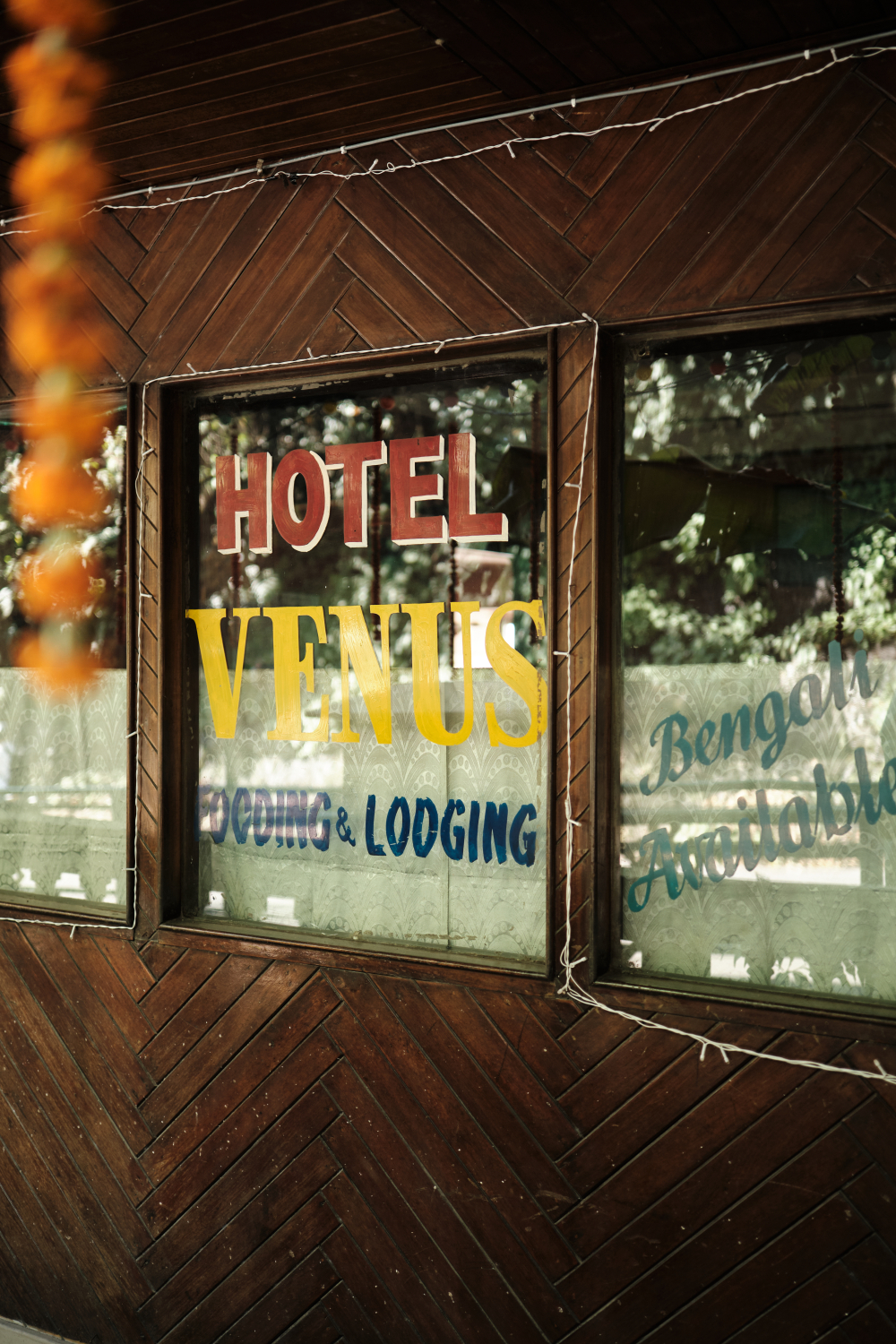
One of countless hotels in Gangtok. (Picture Credits: Abhishek Anil)
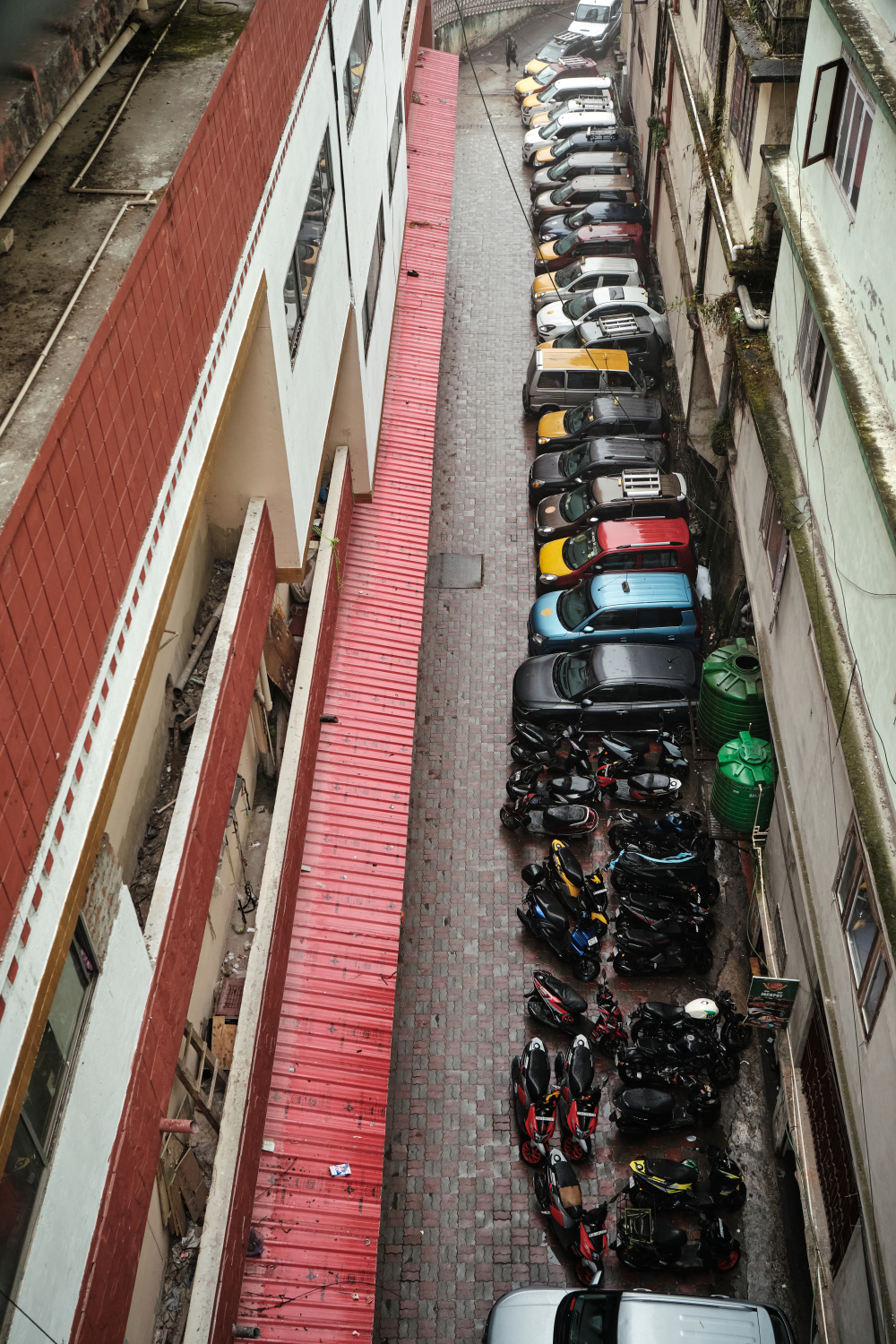
Parking lots in Lall Bazaar market. (Picture Credits: Abhishek Anil)
Even after the merger with India, Gangtok has only slowly matured into its present urban character—always under constant change due to multiple urban development projects, such as the building of malls and large-scale housing complexes.
Youth, Belonging and Expressions in Cafés as “Third Spaces”
Urban Gangtok sits on a hilly terrain marked by winding roads, Reinforced Cement Concrete (RCC) buildings, large parking lots, sprawling green construction sheet cover, countless hotels, restaurants, and marketplaces. What is markedly missing are accessible, open public spaces for recreation or congregation for people in the city. So a public life is often lived inside other spaces that exist neither in the public nor inside the home; these are the third spaces that have emerged not simply as an exclusive leisurely activity for the elite, but as a necessary site for people to come together. A case of these small in-between places is that of the café. In this essay, we are looking at two cafés that have emerged as important cultural hubs in urban Gangtok: Rachna Books or Café Fiction and The Travel Café.
Rachna and The Travel Café have emerged as spaces where people pursue pauses as well as activity. Besides being a space where people come to sit alone or with friends, they are also spaces that cater to a growing population with their feet dipped into the arts, hosting live music, open mic poetry nights, book-readings and signings, and workshops. Informal cultural labour unfolds here through conversations, music sessions, readings, zines, and performances. Rachna, along with its sister companies, Café Fiction, a café on the first floor of the establishment, and a bed-and-breakfast on the floor above the bookshop, and the Travel café, a company under Tag Along Backpackers, are among the two most community-engaged spaces in Gangtok.
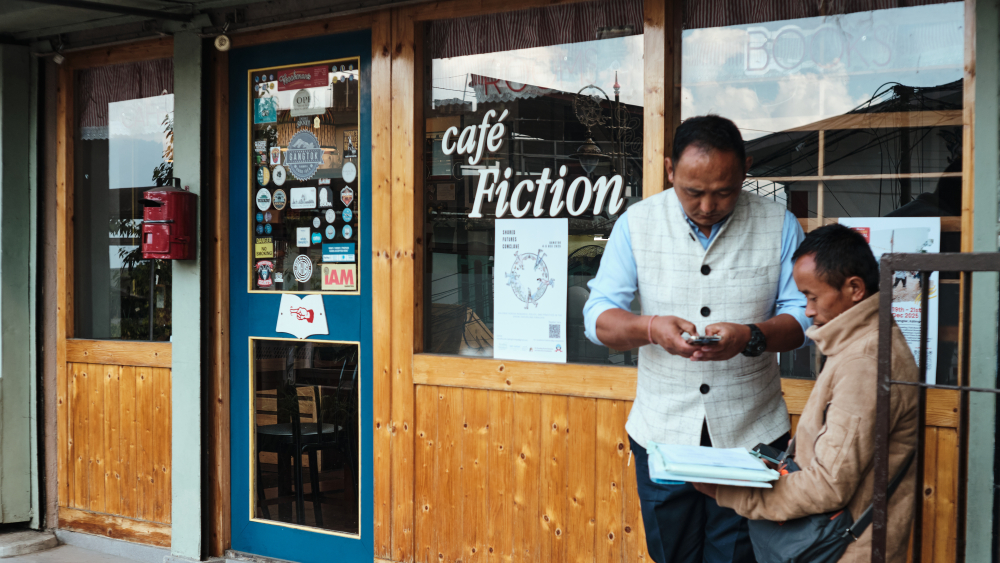
Café Fiction shop front, Development Area. (Picture Credits: Abhishek Anil)
These cafés are located in the Development Area in Gangtok, approximately a 15-minute walk from MG Marg, the heart of town. The Development Area is marked by people, buildings, a parking lot, and the cafés, which function as alternative sites of gathering for the urban middle class, especially the youth. As public outdoor spaces become less accessible, social life increasingly moves indoors. Rachna and The Travel Café sit in the presence of two major cultural institutions in the same locality—the Manan Bhawan and the Nepali Sahitya Akademi.
Rachna: Coffee, Reading Culture, Remote Working Hub
Marking the entry to the Development area, Rachna Bookstore has been one of the most prominent cultural landmarks of Gangtok since 1976. Immersed deeply in the pursuit of making reading a popular activity among the youth in Gangtok, Raman, the bookman at Rachna, describes the place as, “Essentially a bookshop, quintessentially Gangtok.” This space serves multiple functions—as a bookstore and a congregation site for events or workshops on the first floor, as a café and a workspace on the ground floor, and also as a bed-and-breakfast upstairs for those visiting Gangtok. Always warmly lit and smelling like coffee, this space allows a quiet comfort in its ambience. Rachna describes itself as “essentially a bookshop, quintessentially Gangtok.”
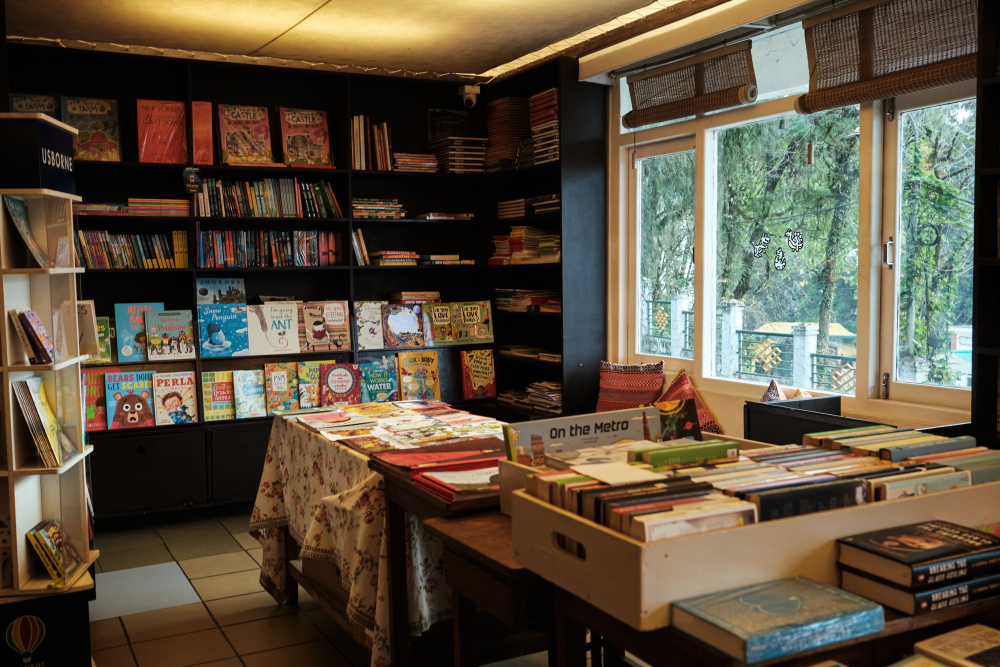
Inside Rachna Books. (Picture Credits: Abhishek Anil)
While originally established by his father, Rajiv S Shrestha, Rachna has undergone many evolutions over the years. Centering reading and storytelling as their ethos, Raman Shrestha, who currently runs the place, makes a point to note that it was his mother and grandmother who were the real storytellers in his family—that the legacy of storytelling in Rachna comes from them. The place has undergone an evolution from being a book trade to being a significant part of the urban Gangtok landscape. Popularly known as the bookman, Raman Shresta proudly calls himself a bookseller and runs the present-day store with its new addition, Café Fiction, which Sarvada (spouse of Raman Shrestha) started. Today, Rachna Books serves multiple functions as a fluid bookshop, which provides space for congregation and discussions such as book releases, musical programs, poetry and storytelling sessions, and workshops.
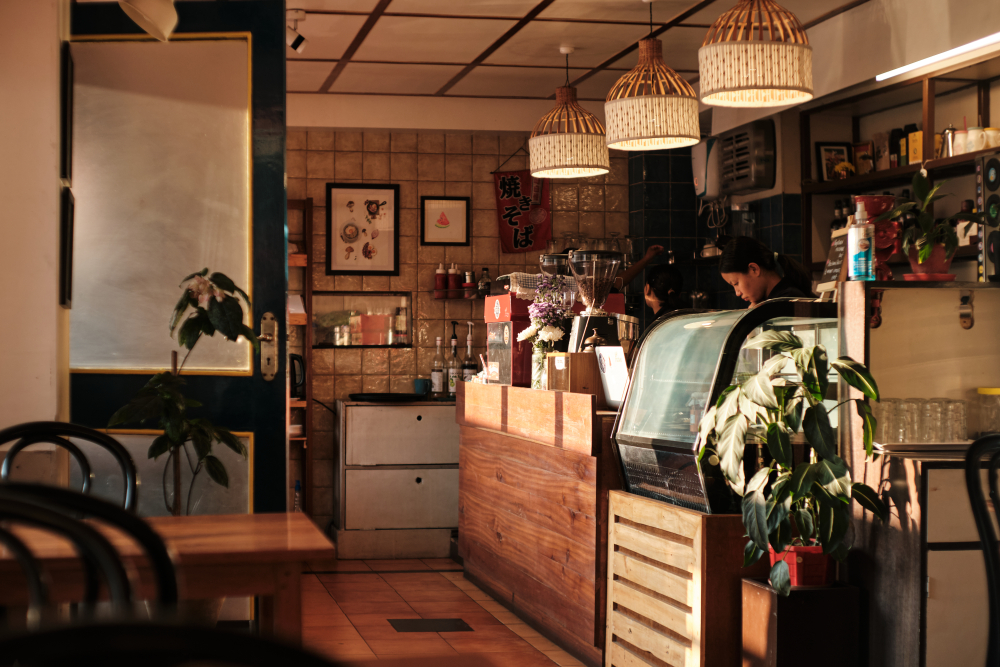
Inside Café Fiction, Rachna Books. (Picture Credits: Abhishek Anil)
In 2019, Rachna entered publishing under its own banner, Rachna Books, a significant development that seeks to centre narratives from Sikkim and the Darjeeling-Kalimpong hills of the Eastern Himalayan region, and make them accessible.
Rachna has been part of book fairs across the country as well as literary festivals such as the Jaipur Literature Festival and the International Booksellers conference. Raman also curated the Sikkim Literature Festival with the Culture Department of Sikkim. Rachna Books was also awarded the Bookstore of the Year in 2015 in the Publishing Next Industry Award. Recently, it has hosted two writers' residencies in collaboration with Villa Swagatam (a cross-residency program by the French Institute and the French Embassy in India), and expanded its corpus of publications to eleven books, encompassing, novels, academic readings, graphic novels, poetry anthologies, and research articles. This is a stunning realisation of the need for publication houses in the region, for artists within the region who were often unable to publish their work owing to the distance from publishing houses, generally located within a city.
The Case of Travel Café
In the same locality, the Travel Café, run by Manisha Sharma, Bhavana Sharma, and Saran Rai is growing into an important site of cultural engagement among the youth of Gangtok. The café was started in 2018 as part of Tagalong Backpackers, as a space where travellers and locals could meet and interact with each other, facilitating direct cultural exchange through these encounters.
Located right below the hostel, where travellers stay, the café is always abuzz with chatter. They have been hosting annual Tagalong Sessions, a musical event where they bring together several musicians from within Sikkim, and recently Nepal, in intimate sessions. Their work as Tagalong Backpackers has been rooted in community-driven efforts and cultural preservation. They have also conducted tourism training programs for the Government of Sikkim, even starting the first cycling tour to Nathu La Pass with Ride The Silk. They were also part of the Goldman Sachs 10000 Women program at IIM-Bangalore.
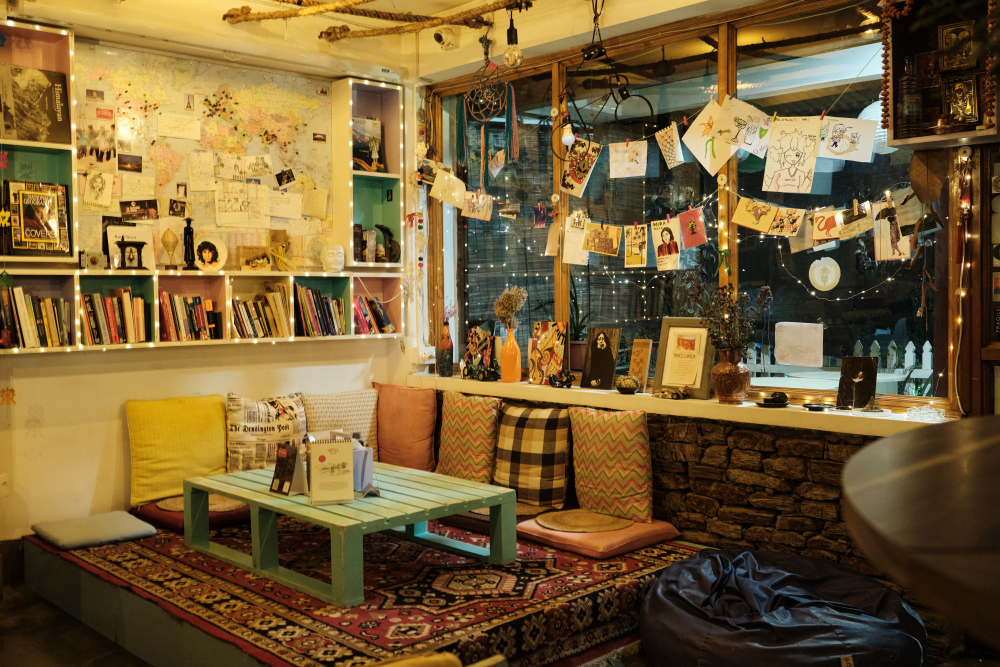
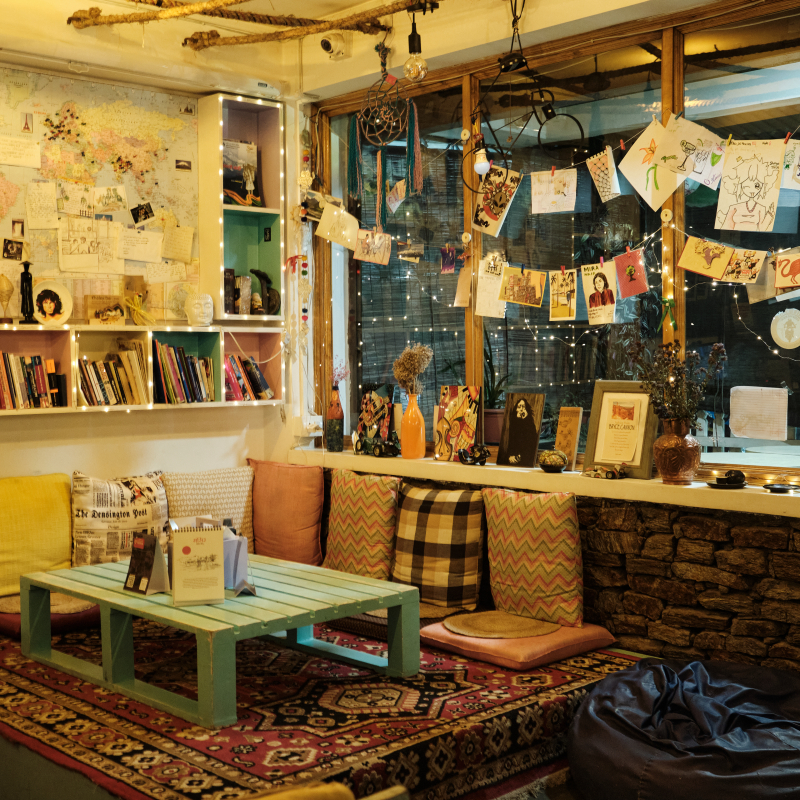
Inside Travel Café. (Picture Credits: Abhishek Anil)

A performance by Aman Karna and Ankit Shrestha from Nepal at Travel Café. (Picture Credits: Abhishek Anil)
Travel Café has an air of youthful energy, prompting people who enter the space to be sociable and interact with others in the café. There is always the possibility of a chance encounter with travellers and/or other locals. Through tag sessions, conversations, and these encounters, stories are shared, allowing people to find a place to be and to tell the stories of Gangtok and Sikkim in their own words, thereby subverting the narratives presented in tourist brochures and other media.
Cafés as Cultural Nodes of Urbanisation
Through the cultural production in these cafés that encompasses art, literature, poetry, music, workshops, and exhibitions, participants engage in conversations that evoke a sense of community and belonging among them. The people gathered are engaged in leisure and conversations that help share the image of Gangtok and Sikkim, even though it is predominantly of the urban middle-class lot of Gangtok.
These cafés have welcomed students, writers, filmmakers, travellers, tourists, researchers, artists, musicians, and major sections of the middle-class population in Gangtok, who gravitate towards these spaces for a few reasons.
First, these spaces have acted as a private-public space, both in terms of ownership and characteristics, providing people with a much-needed space away from home and work. The infrastructure of Rachna and Travel Café allows for a space to congregate publicly, albeit in a closed space, while also having the choice of sitting alone. Patrons of these spaces often remark that they feel at home in these cafés, somehow finding the space more private than necessarily public.
Second, these spaces allow for a remarkably constant flow of interaction between individuals, both locals and travellers. In these exchanges, one shapes an imagination of Sikkim and the people there. The Travel Café has aimed to provide good food and a comfortable space for travellers to meet locals. Similarly, known nation-wide, independent bookshop Rachna has attracted lots of tourists, researchers, artists, and travellers to the state.
Leisurely consumption and rest are other reasons why Gangtokians find these cafés attractive. The primary reason, however, for the popularity of Rachna and Travel Café is the culture that they produce and support. By culture, one must think of the collective of art (music, painting, literature, theatre, writing, photography, film), knowledge, skills, rituals, and the total way of life of people in Gangtok. Rachna, especially, has been the vanguard for conversation and the exchange of knowledge for over 40 years.
In both these cases, we can see that integration of cafés into an already existing ethos, be it reading or travelling, has truly helped these spaces engage with the youth. As Raman also mentions, it may be due to the lack of public spaces where the young can gather that they seek reprieve in the cafés, warm, welcoming, with a brew.
Submerged deeply in the denseness of social life, these cafés offer not just space for people, but also a realisation of these individuals’ and society’s urban aspirations. Gangtok is still a young city—access to these kinds of spaces is a relatively new concept and practice amongst the Gangtokians, going back only about a few decades. Although curated based on the preferences and allowances of certain sections of society, influenced by factors such as class and access to the English language, cafés keep alive the tradition of being a place for congregation and public discourse. And while cafés are not neutral spaces, they are places of resistance and doing culture.
Supplemented by interviews with Raman Shrestha.
Bibliography
Appadurai, Arjun. ‘The Capacity to Aspire: Culture and the Terms of Recognition.’ In Culture and Public Action, edited by Vijayendra Rao and Michael Walton, 59–84. Palo Alto, CA: Stanford University Press, 2004.
Kharel, Sunita. Review of Gangtok: Metamorphosis of a Stereotype—Sikkim Urban Conglomerate into a Colonial Hill Station (1889–1950): A Historical Construct. n.d. University of North Bengal. https://shodhganga.inflibnet.ac.in/handle/10603/149094?mode=full.
Thatal, Aakriti. ‘Café Culture: Exploring the Roles of Cafés in Cultural Production among the Urban Middle Class in Gangtok, Sikkim.’ MA Dissertation, Tata Institute of Social Sciences, 2023.
This essay has been created as part of Sahapedia's My City My Heritage project, supported by the InterGlobe Foundation (IGF).