
We often hear our grandparents say, ‘hami tah jungle ko baato hirdai ka-ka pugthyo’ (we used to walk through forest areas to reach places), implying that they did not have pakka (concrete) roads at the time. In contemporary times, these ‘old’ forest trails, pivotal in mapping ‘local’ routes, have been replaced by meandering roads that run parallel to our beloved Teesta river that runs through Sikkim, cutting across sharp mountain curves and at times running alongside the clouds up to the mountain top. For many of us, these Himalayan roads lead us to our home – hamro ghar jaane baato – while also inviting people from afar to experience and witness the grandeur and humbleness of the high mountains that are bound to embrace you in peace and serenity. As the roads take you through bustling small towns in the valley and up the mountain top, we witness vignettes of people chatting in their aangans (courtyard), drying dallae khorsani (Himalayan chillies), running wayside hotels or simply observing ramita (an act of observing the mundane everyday as it unfolds; almost like zoning out) as vehicles pass – offering a momentary portal into ‘locals’’ everyday lives. Visually, these roads that are couched within the physical landscape of our tiny Himalayan state leave an impression of beauty and charm despite the recurring landslides, exacerbated due to unsustainable forms of developmental practices. Socio-culturally, these roads tell us stories of a bygone past and a dynamic present – stories that cement the roads of Sikkim as heritage in themselves.
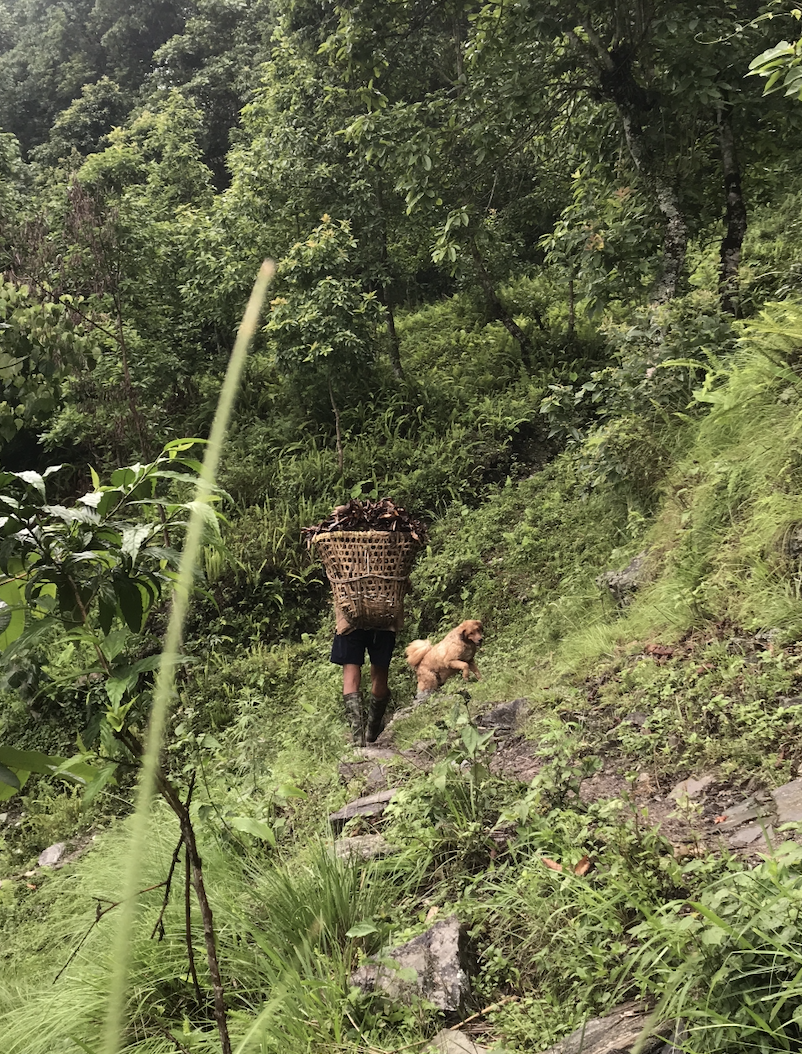
A person carrying firewood in a doko, a bamboo basket, up a trail in West Sikkim. (Picture Credits: Animesh Gautam)
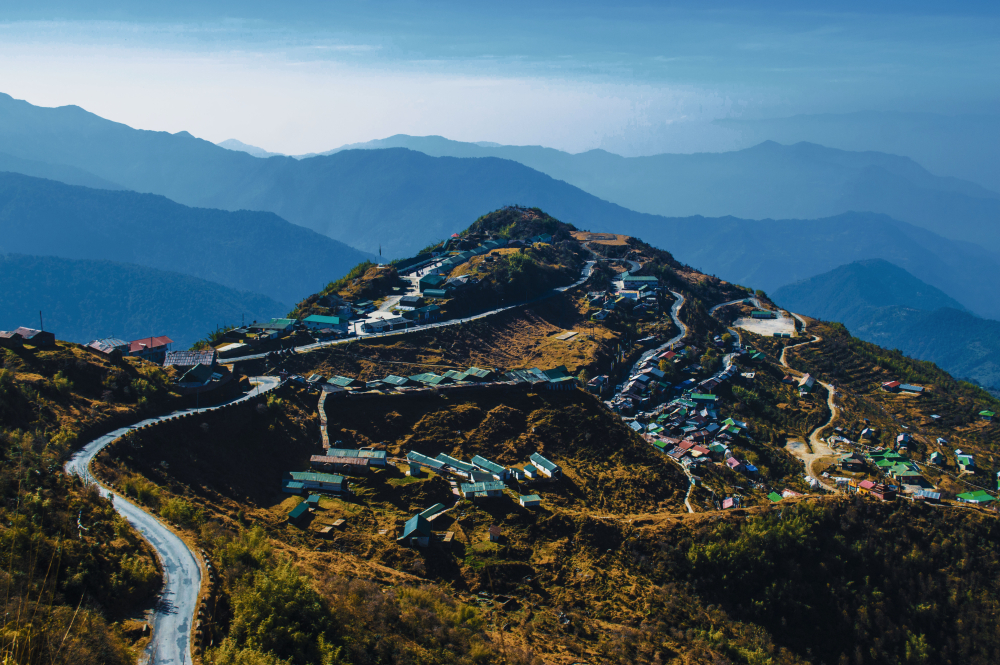
Dzuluk/Zuluk village. (Picture Courtesy: Linus Pradhan/Wikimedia Commons)
This article reimagines the roads of Sikkim by considering how they are grounded in vernacular narratives, beyond the romanticisation of a commodified natural landscape that has come to dominate the contemporary tourism industry. We use the term vernacular to situate heritage in informal, everyday, ancestral and inter-generational processes as opposed to more dominant forms of state, colonial, and marketized tourism narratives. We situate heritage with Laurajane Smith’s understanding that heritage is a “cultural and social process, which engages with acts of remembering that work to create ways to understand and engage with the present” and we explore how memories and everyday practices attached to these roads serve as significant forms of cultural and social expressions. We bring together stories from Eastern and Western Sikkim, where different kinds of engagements with roads have facilitated different kinds of trans-Himalayan cultural, spiritual, and economic exchanges, each with their own implications for the present. We synthesise stories and insights, particularly from East and West Sikkim, drawing on our ongoing research and interests in these regions.
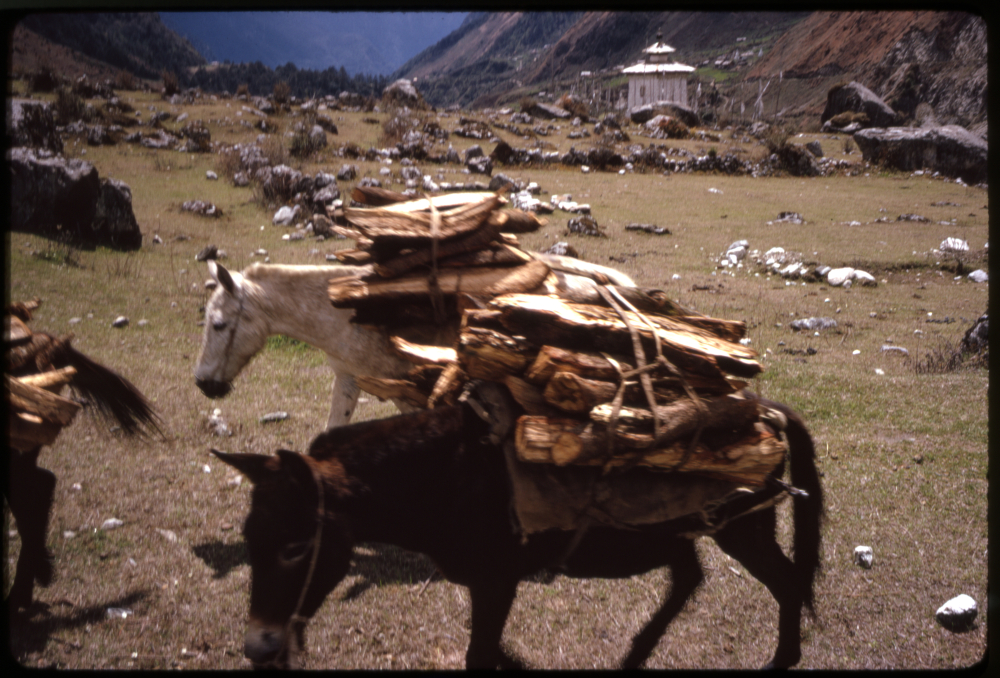
Mules carrying wood in Lachung. (Picture Courtesy: Alice Kandell/Library of Congress)
Vernacular Perspective on East Sikkim’s Old Trade Routes
The old forest trails that our grandparents and their ancestors used to tread have, for centuries, facilitated trans-Himalayan trade amongst diverse Himalayan communities, even before the “opening-up” of the trade route to Tibet by the British via Sikkim. The advent of British (military) expeditions in the late 1800s, and especially that of British officer Francis Younghusband in 1903-04, however, channelled a spur of traders (Indian and European) from the Himalayas and beyond towards Tibet, following the Nathu La and Jelep La road in East Sikkim. Along the trade route, smaller and lesser-known village roads of Sikkim — such as that of Rhenock, Aritar, Rongli, Phadamchen, and many more — served as halting stations, rest houses, and camping grounds for the traders and their mules. While the imperialist construction of these cart roads demanded the labour of Himalayan men and women, these tiny villages witnessed how the forest trails that once connected them to their relatives and friends from other villages turned into cart roads serving as a pivotal corridor for trans-Himalayan trade. Additionally, they also witnessed their land being used to construct dak bungalows (rest houses) for the Indian, European, and American traders to spend the night and fuel their stomachs while on an arduous journey from Kalimpong to Lhasa.
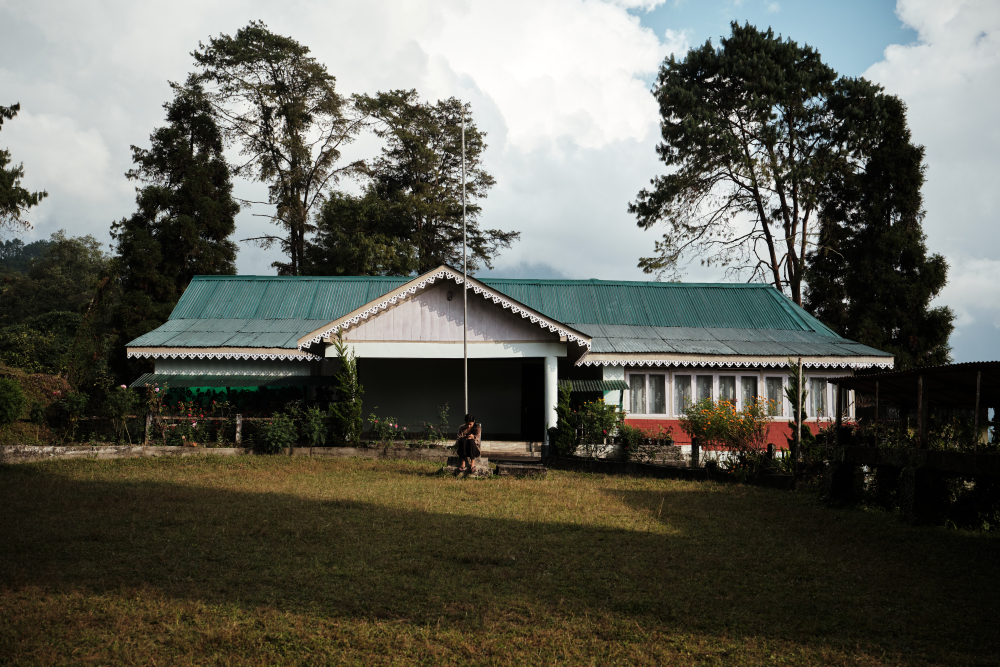
Aritar Dak Bungalow in Rhenock. (Picture Credits: Abhishek Anil)
While the easily accessible trade route to Tibet via Sikkim raised significant revenue for the Sikkim government from transit duties, the labourers (of Sikkim and Darjeeling hills) who carried the traded goods were often lowly paid and mistreated. Stories of our ancestors’ lived experiences of kaalo bhari and jharlungi reveals the dark past of the often romanticised Old Silk Road — one of forced labour, involving the exploitation of the physical and emotional labour of Himalayan workers who carried the traded goods on their back. With such an imperialist, feudalistic, and exploitative past that has historically encapsulated the ancient trade route, how do we then understand and acknowledge our roads as a heritage worth celebrating and preserving? The answer lies in understanding how heritage itself can engage with acts of remembering and how such memories translate into the present.
Today, memories of a road that flourished in trans-national trade almost a century ago have come to evoke a sense of revivalism through the prism of tourism in conjunction with Sikkim’s natural scenic landscape. The tourism industry has dominantly evoked the trope of a romanticised Old Silk Road to sell a touristic itinerary as an act of remembrance and a source of income. However, reimagining these roads as heritage pushes us to rethink them not just as a trade route of historical importance that was “opened up” as a result of a British officer’s (military) expedition, but also as a notion that is embedded in the way locals engage with the history of these roads. Thus, the heritage of our road lies in the smaller acts of remembering that is rooted in vernacular narratives – one where a local is able to aptly pinpoint Sikkim’s first police outpost in Aritar without it being distinctly identified and barricaded with state-sanctioned hoardings. The heritage of these roads is in the way locals have honoured the unidentified traders who lost their lives along the trade route.
Remnants of Sikkim's first police outpost in Aritar. (Picture Credits: Praveen Chettri)
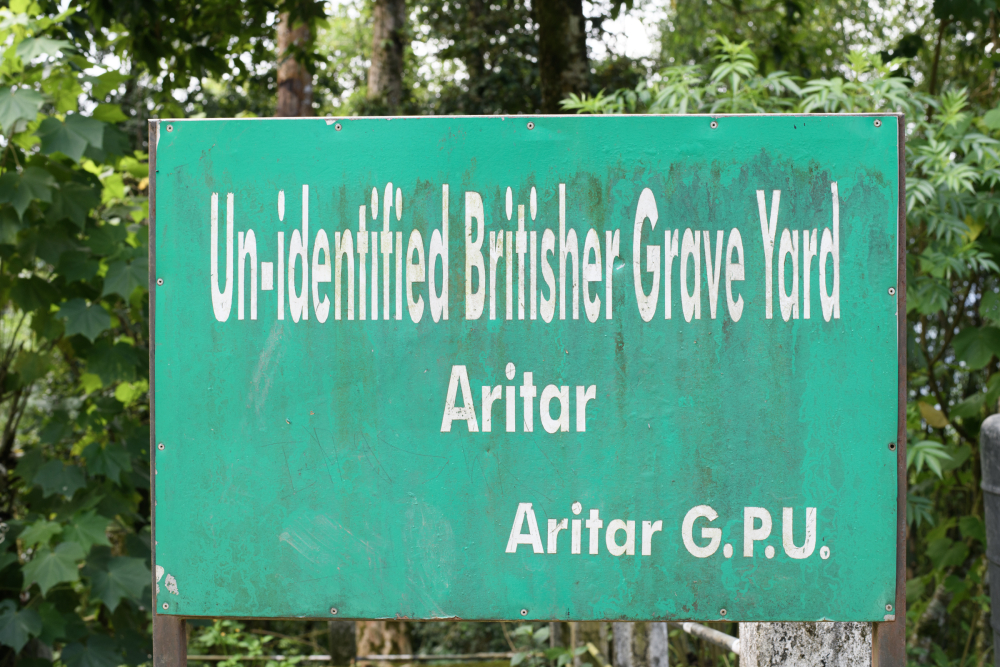
Unidentified British Graveyard in Aritar. (Picture Credits: Praveen Chettri)
Heritage lies in acknowledging that while using the trope of Old Silk Road or Southern Silk Road draws in revenue through tourism, the merchandise that dominated the trade amongst other items was, in fact, wool and not silk! As an elderly resident, Shri Sunder Pradhan of Rhenock, Sikkim’s first halting station along the Jelep-La road, recalls and reiterates that during those times, the Jelep-La road was popularly also called the Wool Road. Now 102 years old, Sunder aja (grandfather), recounting his younger days (in 2022), tells me (Stuti) about how he would place an order for health-related books from Mathura and Gujarat through one of Sikkim’s oldest post offices in Rhenock, where he functioned almost as a medicinal practitioner, with people still coming to see him for health-related queries till a few years back. Renowned for the variety of orchids, especially nurtured by Chandra Nursery in Rhenock, and an abundance of cardamon, smaller villages in Sikkim were able to make use of these trans-Himalayan and trans-national trade routes to connect to the cosmopolitan centres of the world through institutions such as the post office. Just recently, when I told my father that I am writing about the Jelep-La trade route, he recalls and excitedly tells me about how the old wooden house in Rhenock Bazar that is now a shoe shop used to function as a bank during the early 1900s – a piece of [his]tory right in the middle of our small Bazar that I didn’t know about until now. It is these memories which are passed down to the next generation as acts of remembering that uphold the essence of the vernacular heritage of the place we live in.

Dendrobium nobile orchid. (Illustration Credits: Jisha Unikrishnan)

Cardamom. (Illustration Credits: Jisha Unikrishnan)
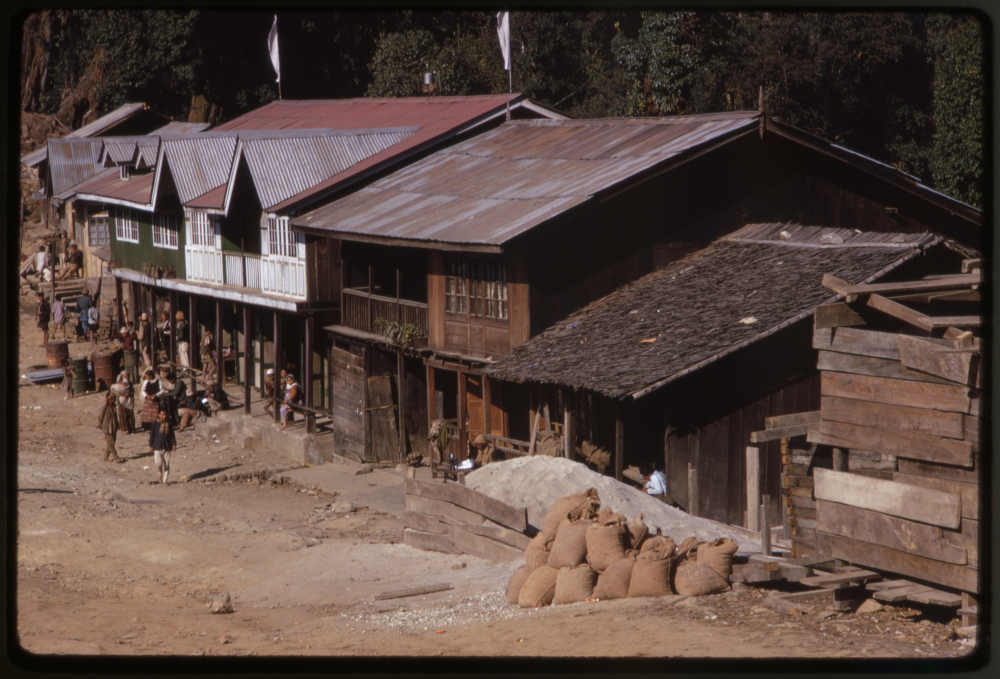
Buildings along a street in West Sikkim. (Picture Courtesy: Alice Kandell/Library of Congress)
Spaces like museums, state-facilitated and private, like Ram Gauri Sangralaya in Rhenock, uphold and preserve our past. However, it is the personal stories, experiences, and memories of the people – those who still use the forest trails that have not yet been replaced by modern roads – that allows us to reimagine Sikkim’s roads as heritage in themselves. This goes beyond the nostalgia for an ancient trade route to also include complex networks of trans-Himalayan forested trails in Western Sikkim that facilitated local connections, ecological, cultural, and spiritual exchange through pilgrimage, as cultural heritage.
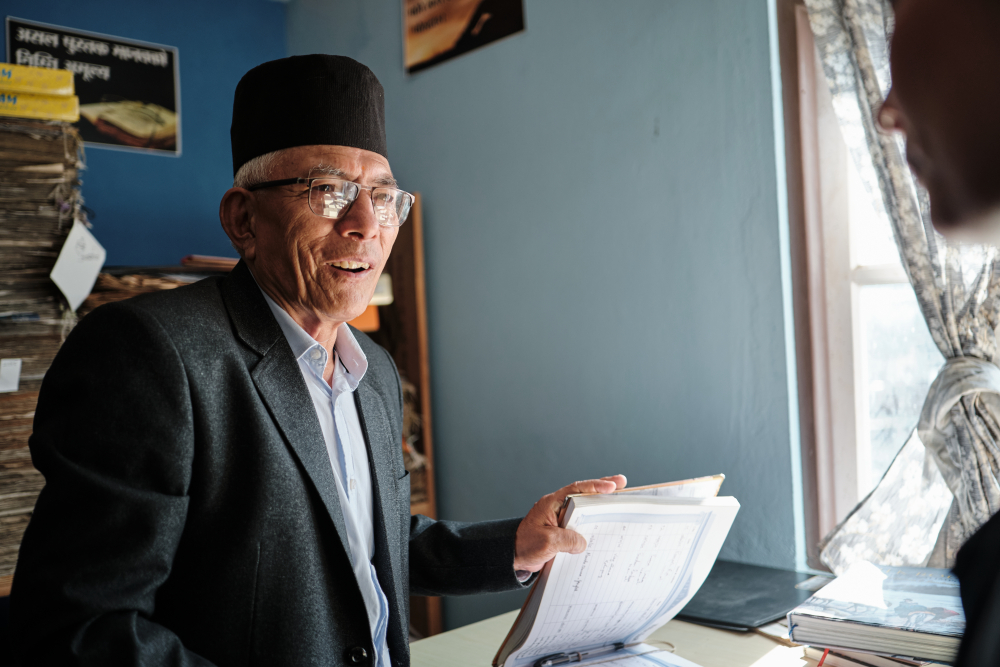
Ganesh Pradhan showing old files and records from his private museum collection in Ram Gauri Sangralaya. (Picture Credits: Abhishek Anil)
Exploring the Capillaries and Layers of West Sikkim
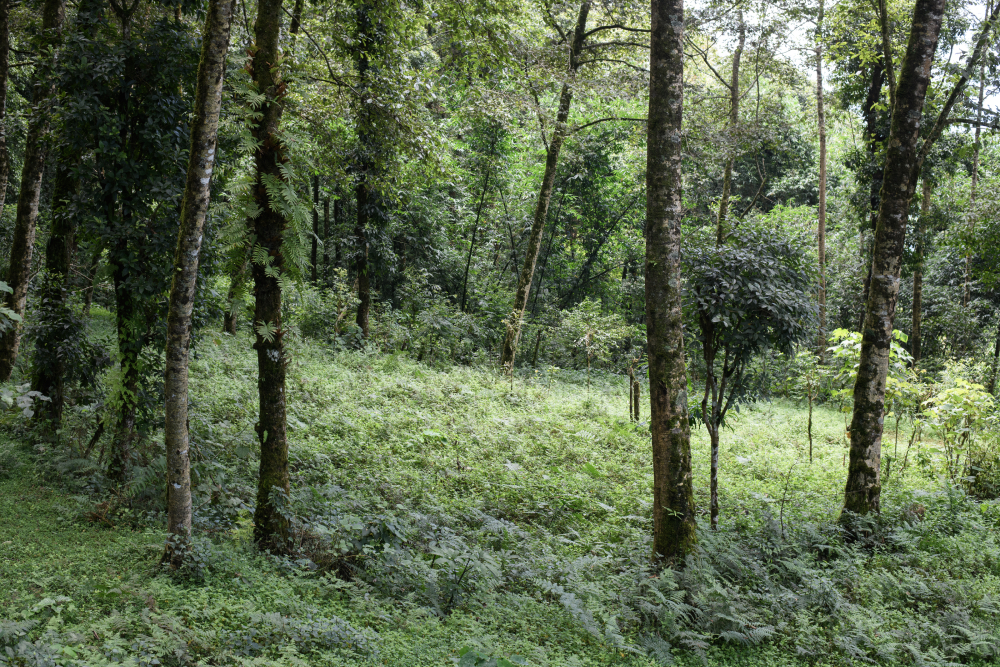
As an illustration of the trans-Himalayan forest trails, I (Mesh) will now take you through my personal experience of these unmapped paths during the COVID-19 pandemic lockdown. I spent a few quiet months living with my sister in my paternal village of Omchung, a village located near Gyalshing town, with a population of 2035. Resembling much of the Eastern Himalayan landscape, houses are scattered across the hill slope, with Gyalshing on the upper reaches and Legship on the lower reaches, where the slope eventually meets with Rangeet river and its tributary Kalej khola. While paved roads that serve vehicles curve through and dissect these slopes, forest and unpaved walking trails form a widespread system of capillaries. In contrast to roads that are controlled by state agencies and represented on physical and online maps, the knowledge of these trails is (re)made and held in the memories, oral (his)tories, and everyday (livelihood) practices of residents and seasonal visitors alike such as pilgrims and tourists.
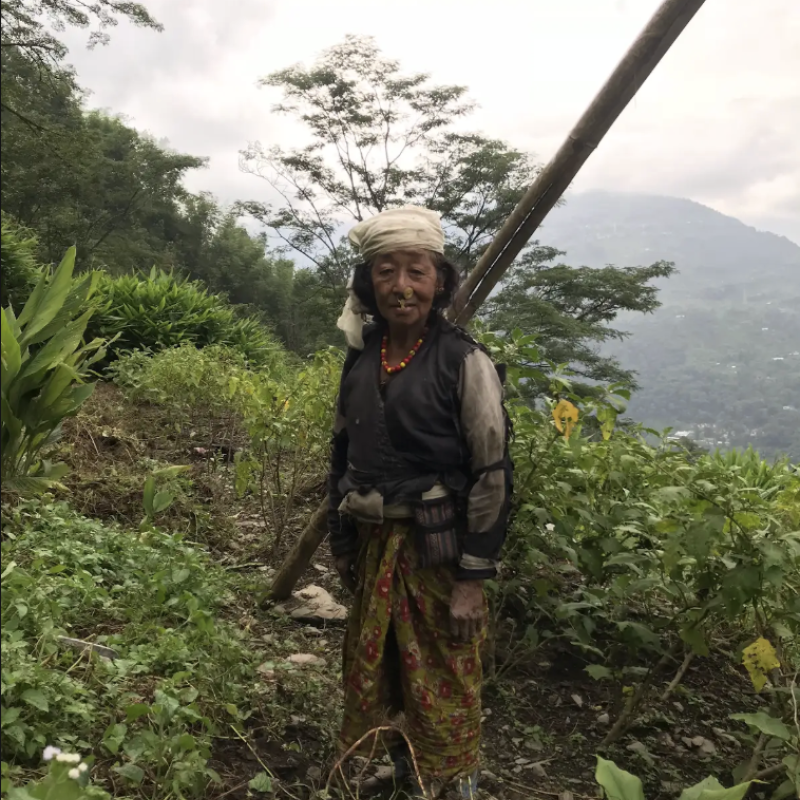
I spent most clear afternoons following the trails and ghorey saraks (unpaved horse/mule trails) that connected our house in 4th mile to other households, villages, and even towns that were scattered across the hill slope. As I met with and introduced myself to people along the way, I noticed that everybody knew each other and everybody engaged in all kinds of exchanges with one another. It was these widespread networks of forest trails that had historically held and facilitated these exchanges. From Omchung 4th mile, the trails climb through streams, landslides, beautiful waterfalls, breath-taking deoralis (hilltops), grazing fields, siru bari (cogon grass groves), devithans (spirit dwelling place), and water springs, all in turn giving shape to local ecologies. One village elder from Rethang, Dhan Maya Limboo, remembered locally as Bijuwani boju (grandmother), relied on these trails over many years to sell her vegetables at Gyalshing haat (farmer’s market) for her livelihood.
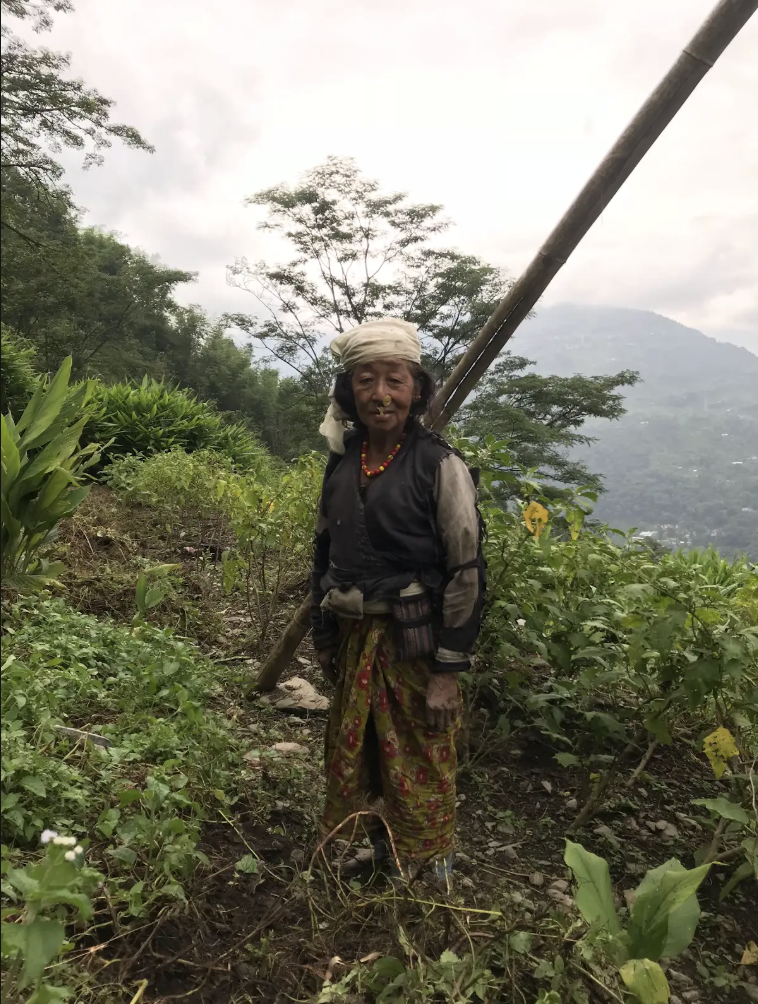
Dhan Maya Limboo or Bijuwani Boju. (Picture Credits: Animesh Gautam)
As the vegetation starts to resemble lek side (higher altitude temperate vegetation), I knew I was approaching Tashi Ghang Heritage resort above Rethang village, 3 km from Gyalshing town, which appears atop our hill when viewed from our house below in the mid-hills. The trails from that point further connected people onwards to sacred pilgrimage sites of Western Sikkim. These trails are therefore also a crucial part of wider spiritual geographies connecting the historic Buddhist pilgrimage sites of Pemayangtse monastery, Dubdi monastery, Norbu Gang chorten, Rabdentse ruins, Khechuperi lake, and Tashiding monastery falling within the sacred Beyul Drémojong landscape, as recognized by the Lhopos.
Another layer that unfolds in the contemporary landscape of Western Sikkim is a range of nationally protected areas such as the local reserve forests, Barsey Rhododendron Sanctuary, and the UNESCO World Heritage Khangchendzoenga Biosphere Reserve. The emergence of nature conservation, particularly through ecotourism, has given these trails a novel purpose of becoming trekking, hiking, and heritage trails. The sacred site and village of Khecheopalri Lake, popularly known as the wish-fulfilling lake, is one such epicentre where layers of the spiritual, conservation, and tourism landscapes converge and become tied together by these roads. Khecheopalri’s global ecological and cultural importance is manifold—as Sikkim’s first globally significant wetland Ramsar site, as an important halt in the Buddhist and Hindu pilgrimage routes and, more recently, as a significant (eco)tourism destination. Ecotourism outfits such as Latop Bhutia’s Khecheopalri Sanctuary homestay embody the globalised space that happens to host the only ‘authentic’ pizza oven, Latop’s Pizzeria and Eatery, in Sikkim made by an Italian chef. Local youths in the village like Latop and Bhaichung Bhutia (who runs Sonam Homestay), who run independent ecotourism businesses, rely on these forest trails and paved roads to operate their (everyday) ecotourism activities. Yet, given growing environmental and cultural concerns from ecotourism activities, they are also selective about what local sites are suitable for such activities, thus making roads and routes an important aspect of heritage-(re)making.
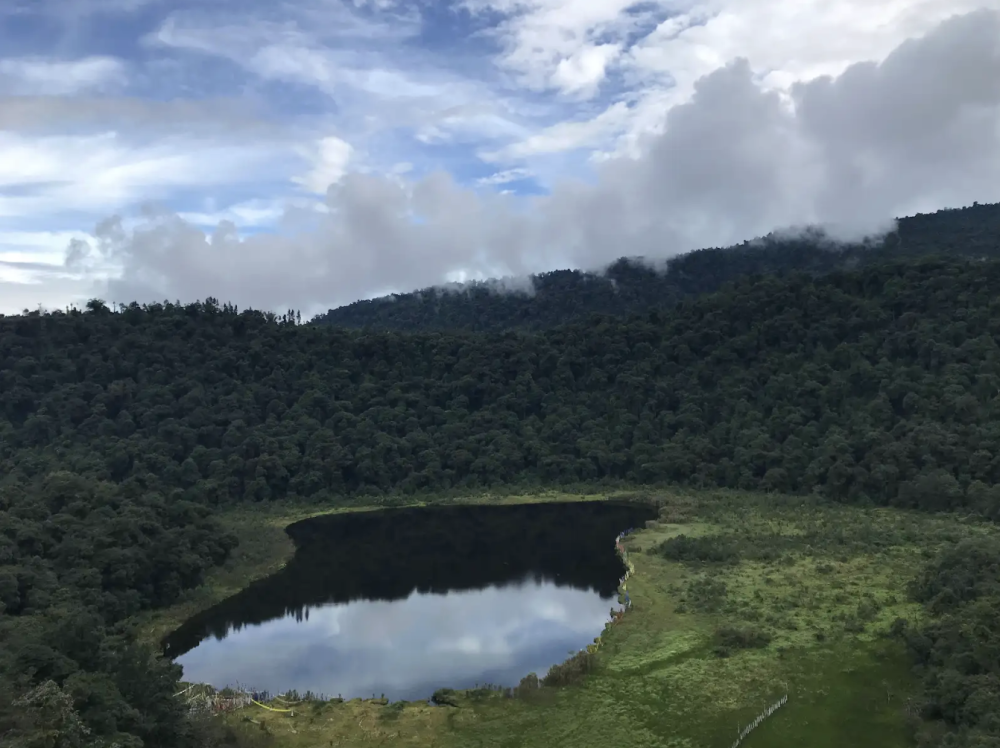
A view of Khecheopalri lake. (Picture Credits: Animesh Gautam)
Conclusion
In this article, we engage with a bottoms-up local perspective to reimagine heritage beyond dominant colonial trade route narratives or romanticised tourism narratives. Our engagements with these roads through the lens of economy, culture, ecology, and spirituality thus embeds the roads of Sikkim into an intersectional understanding of vernacular heritage-making. Far from simply being a recollection of the past, memories emerging out of the historic Silk Route corridor offer vernacular perspectives from the communities living in the former halting station as we illustrate above. These everyday acts of remembering become ways to (re)articulate their alternative narratives of place, belonging, and heritage. This has led us to appreciate roads of Sikkim as heritage in ways that include vast networks of trans-Himalayan forest trails that have long anchored layers of cultural, economic, and spiritual exchanges. While these trails continue to be (re)made or repurposed in times of growing environmental concerns, they retain importance as integral parts of local ecologies. Reimagining the roads of Sikkim as cultural heritage is thus an intimate and important process of remembering our past through vernacular perspectives that emerge from below.
Acknowledgement
This article is written in memory of Dhan Maya Limboo of Rethang, fondly remembered as Bijuwani Boju in Omchung and Rethang. She spent much of her life raising farm animals, tending her vegetable patches, foraging medicinal plants, making teen pani raksi (a traditional Himalayan distilled alcohol), and gathering firewood as part of her livelihood. Her husband was a respected bijuwa (village shaman), and she walked the forested trails of Rethang twice a week to sell her vegetables. Her life and labour sustained Sikkim’s forest pathways and embodied the everyday practices through which cultural heritage continues to endure.
Bibliography
Bhutia, Kikee Doma. Mythic History, Belief Narratives and Vernacular Buddhism among the Lhopos of Sikkim. PhD diss., University of Tartu, 2022. Accessed February 10, 2026. https://dspace.ut.ee/server/api/core/bitstreams/a06d1023-4e39-4994-9ffb-d66d4bc16082/content.
Gautam, Animesh. The Making of the ‘Ecotourism Subject’ in the Himalaya: Political Ecology and Multiple Environmentalities at the Peripheries. MSc thesis, Wageningen University & Research, 2021. Accessed February 10, 2026. https://edepot.wur.nl/557737.
Pradhan, Stuti. ‘Rhenock: The First Halting Station on the Silk Route.’ Sikkim Project, July 22, 2022. https://www.sikkimproject.org/rhenock-the-first-halting-station-on-the-silk-route-2/.
Sen, Jahar. ‘Sikkim and Himalayan Trade.’ University of Cambridge Repository. Accessed February 10, 2026. https://www.repository.cam.ac.uk.
Smith, Laurajane. Uses of Heritage. 1st ed. London: Routledge, 2006.
This essay has been created as part of Sahapedia's My City My Heritage project, supported by the InterGlobe Foundation (IGF).