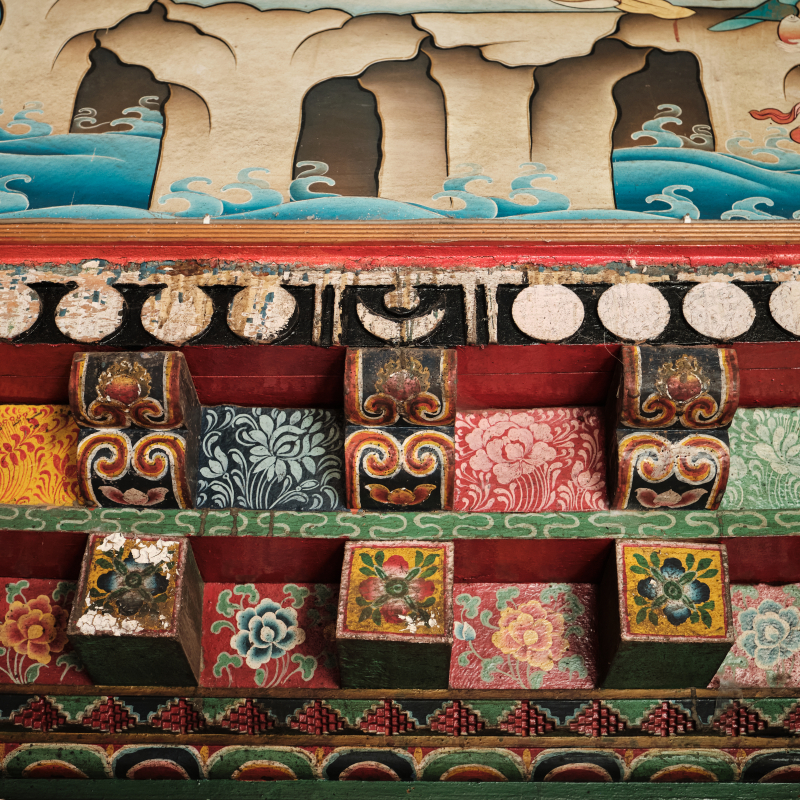

On entering a Buddhist monastery in Sikkim, you hear the incantation of mantras (prayers) by the lamas (monks) alongside the sound of musical instruments. You see devotees doing kora (the act of walking around a sacred object) in a clockwise direction around the monastery and performing prostrations following the spinning of prayer wheels. You smell sang dhoop (incense derived from dried juniper leaves) drifting in the air and see prayer flags fluttering in the air. All contribute to the sacred atmosphere.
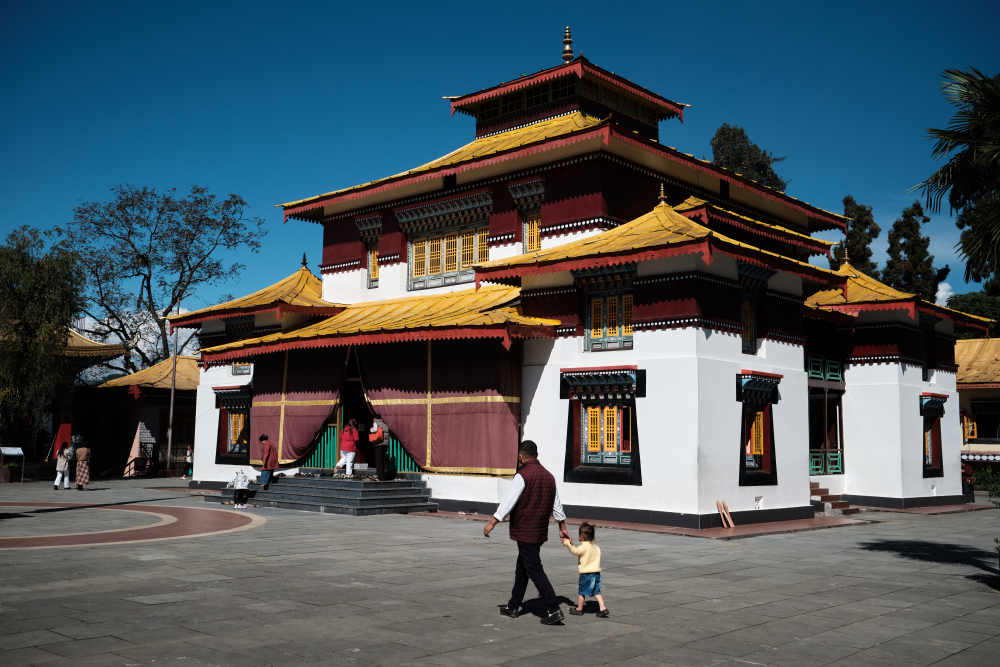
Enchey gompa in Gangtok. (Picture Credits: Abhishek Anil)
Monasteries come alive with the offerings and prayers of the devotees. Important festivals like Loosong (New Year), Losar (Tibetan New Year), Phang Lhabsol (celebrated to offer respect and homage to Mount Khangchendzonga as the guardian deity of the state) are celebrated in monasteries, giving the people a sense of belonging, identity, and community. Sikkimese monasteries preserve centuries of Buddhist tradition, influencing social and spiritual life. They display unique Himalayan artistry that is both symbolic and functional. They act as living museums, preserving Himalayan Buddhist art in its authentic form. Every visual element is not just decoration: it embodies religious symbolism, cultural identity, and aesthetic mastery.
The form of Buddhism practiced in Sikkim is Tibetan Lamaism, part of the Mahayana tradition. It has four sects — Nyingmapa, Kagyupa, Gelupa, and Sakyapa — with most Sikkimese monasteries belonging to the Nyingmapa and Kagyupa sect. There are a total of 111 Buddhist monasteries in Sikkim. A monastery, or gompa, is a large residential institution that houses a community of monks or nuns, whereas a lhakhang is a smaller temple or shrine. A lhakhang often serves as the main prayer hall within a monastery complex or as a place of worship for a local village.
The most important monasteries, from a religious and historical perspective, are Dubdi, Pemayangtse, Sangachoeling, and Tashiding, which are located in West Sikkim. The other important monasteries are Phensang in North Sikkim, Rumtek and Enchey in East Sikkim and Ralang in South Sikkim. The monasteries are important centers of spirituality, learning, culture, and community. The Ecclesiastical Affairs Department is a unique institution in Sikkim dedicated to the upkeep and care of monasteries, temples, and other religious institutions in the state.
Sacred Layouts and Materiality
The monasteries of Sikkim are inspired by Tibetan monasteries, but have been adapted to the region. The monasteries are usually built on a hilltop, secluded from towns. The old monasteries of Sikkim, such as Dubdi Monastery in West Sikkim, are usually two-storeyed and thatched-roofed. The walls are made of stone laid in traditional mud mortar. The main front facade of the gompa usually faces east, with a courtyard at the front where events take place, alongside a yabring, a covered structure that provides seating for the high lamas, flanking one side of the courtyard. The supporting structure of the building is corbelled. It is made up of wooden pillars, main beams, and cross beams, all decorated with beautiful motifs. In many monasteries, separate chambers are built on the first floor for performing tantric rites. Such rooms are easily identifiable by the demon head motifs painted on the entry doors of such chambers. The ground floor is the dukhang (the prayer hall), which houses the altar of gods and where the rituals and prayers take place. The staircase in the entrance of old monasteries leads to the rapshay, or first floor, that opens into a daily ritual room where the Kangyur and Tengyur texts (collection of ancient Tibetan Buddhist texts) are kept. The wooden balconies and other projections of these gompas (monastery) are finely carved and detailed. The open attic space, called the sangdopalri, represents the space for god. The building's defined roof form is usually stepped into three layers. The sloping and tiered roofs with upturned eaves, which withstand the excessive rainfall in Sikkim, are an important and unique feature of Sikkim Buddhist monasteries. The wooden windows, doors, and pillars are intricately carved, coloured vibrantly, and heavily ornamented. Mani khorlo (prayer wheels) encircle the monastery. The monasteries have residential complexes in their surrounding area for the monks.
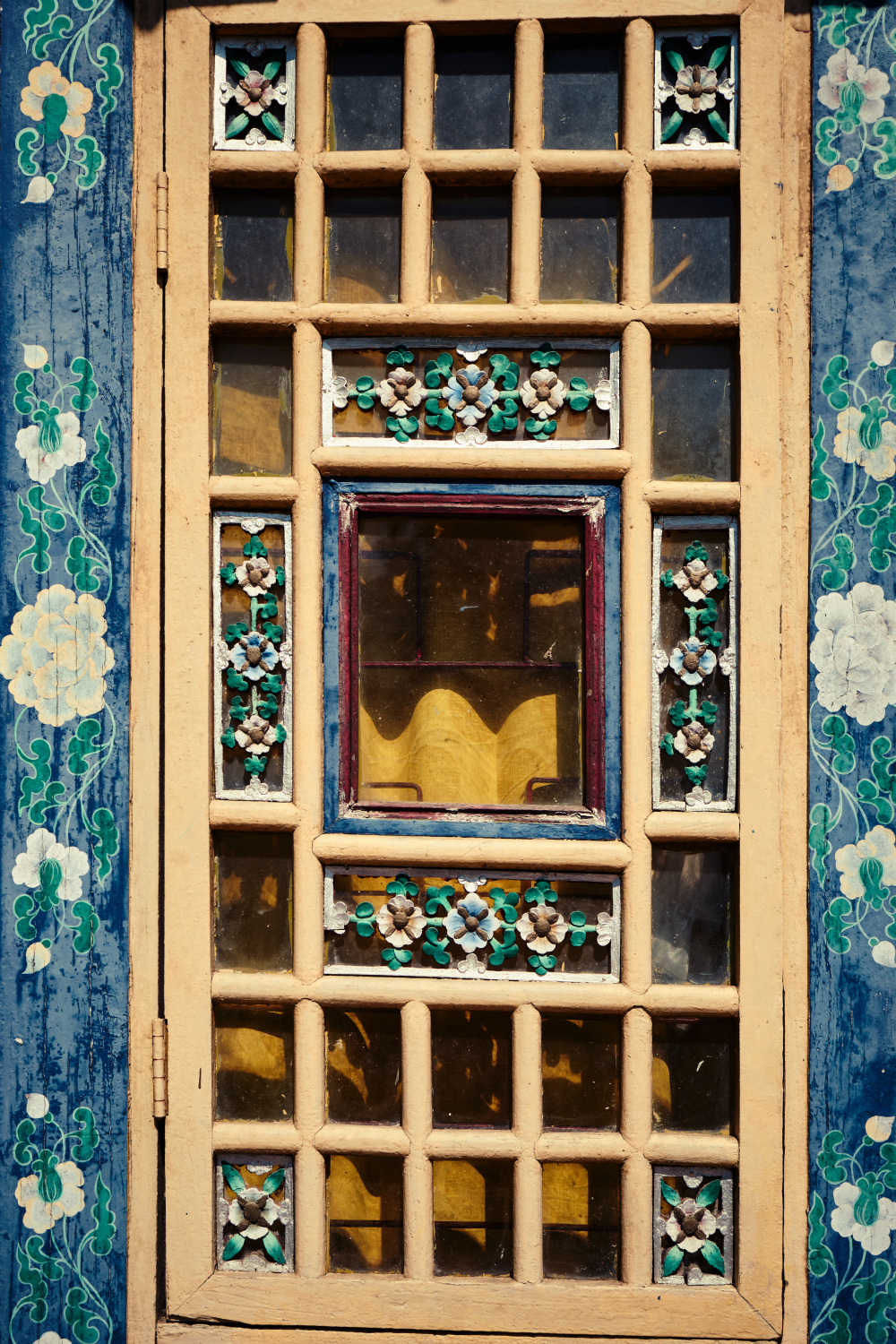
Carved wooden window with floral motifs at Tsuklakhang. (Picture Credits: Abhishek Anil)
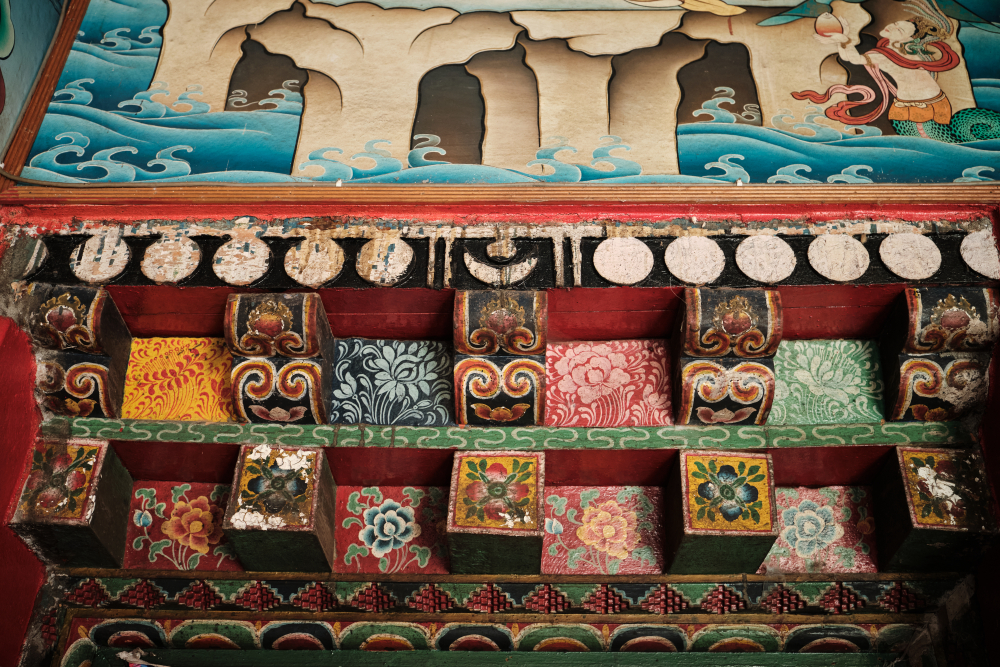
Carved wooden columns of a doorway painted in floral motifs at Enchey gompa, Gangtok. (Picture Credits: Abhishek Anil)
Specially trained artisans and workers perform the construction work, while trained monks and artisans undertake intricate decorative work in the monasteries. The monasteries are much simpler than Tibetan monasteries and are currently undergoing a series of transformations according to the region, weather, terrain, and population. In recent years, concrete structures have replaced wooden ones. Initially, priority was given to locally available materials, such as timber and stone. The old monasteries were constructed with random rubble and stone masonry walls supported by interior timber frames. Many old monasteries, built with traditional methods and materials, have however been damaged or destroyed by fires and earthquakes and then rebuilt with new construction materials. The dressed stone masonry walls have now been replaced by concrete block masonry. One of the monasteries that has retained its original stone structure is the Rinchenpong monastery in West Sikkim. Over time, we witness change and development, and we see the monasteries of Sikkim evolve in line with functionality and preferences while still maintaining their purpose and rituals.
Forms and Traditions of Monastic Art
The door of the monastery is enormous, sometimes carved and ornamented with brass. The door opens into two halves to give entry into the temple. The monastery has a large prayer hall, with a double row of pillars separating it into a nave and two aisles. The whole of the interior is coloured richly, the walls to the right and left covered with frescoes of deities, saints, and demons, generally life-size, and the beams mostly painted red, embossed with lotus rosettes and other emblems. The brightest of colours abound, the effect being softened by the dim light entering only via the entrance door. The chesum (altar) seats the three main deities worshipped in Sikkim. The Shakya Muni Buddha rests in the center. To the left is Guru Padmashambhava, also known as Guru Rimpoche. To the right is Chenrezig, also known as Avalokiteshvara, who is a revered figure in Mahayana Buddhism. The lamas recite prayers and conduct rituals in the dukhang. The interior and exterior walls are decorated with paintings of Vajrayana Buddhist pantheons of deities called Bodhisattvas such as Avalokiteshwara, Tara, Maitreya, Padmapani, and Manjushri. The monastery houses a significant number of thangka (cloth paintings) paintings, sculptures, torma (butter sculptures), intricate wooden carvings, religious objects, and musical instruments, mandals, which are part of the daily rituals and rites of the monasteries. The Wheel of Life painting is also usually seen at the entrance of Buddhist monasteries.
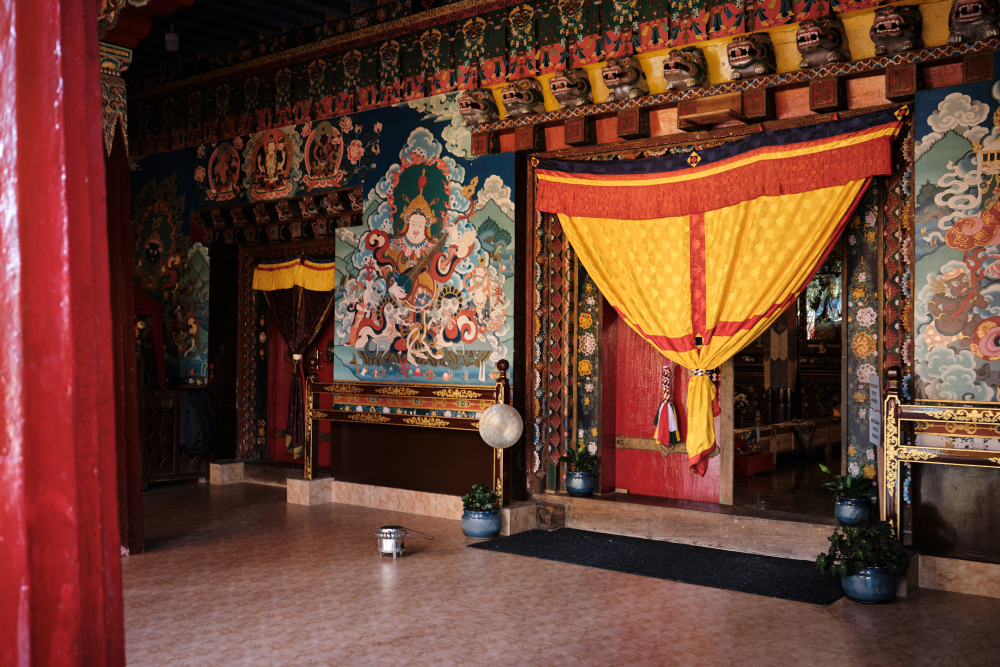
The exterior wall of the Tusklakhang altar. (Picture Credits: Abhishek Anil)
Murals
Large life-size murals (wall paintings), especially those seen in monasteries, often have a narrative flow. The interiors of monasteries are covered with beautiful murals, frescoes, painted and carved woodwork, and paintings that have endured, unless damaged. The dharmapalas (protector deities) are an essential depiction, depicted in fearsome poses symbolizing the fight against ignorance. Some wall paintings in old monasteries have had to be repainted, as in the Dubdi monastery. The natural pigments used in the paintings on interior walls were previously made from precious stones; these have now been replaced with ready-made, artificially colored pigments available in the market.
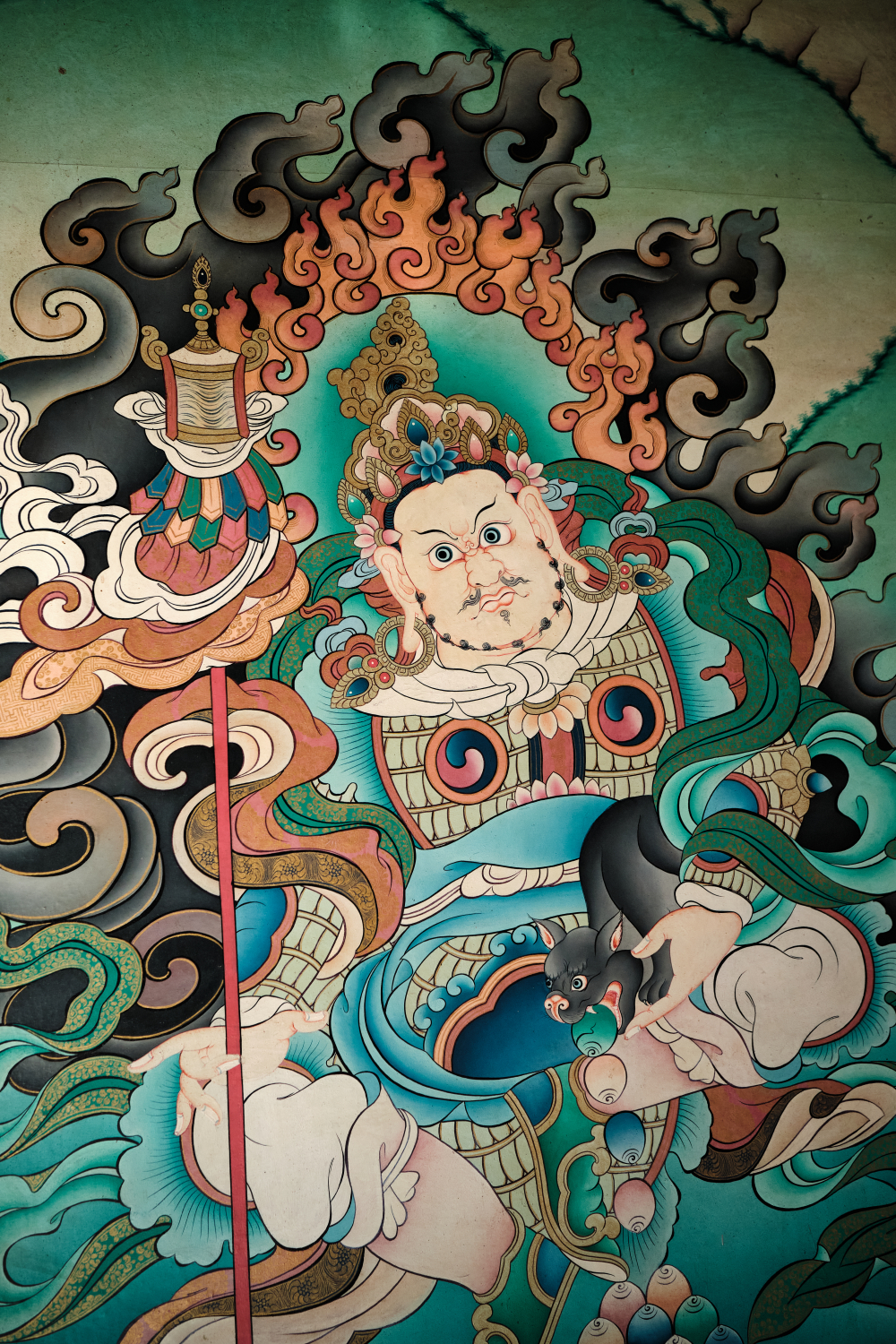
Mural of Jhambala, a deity of wealth and fortune, at the Enchey gompa. (Picture Credits: Abhishek Anil)
The Wheel of Life
The Wheel of Life is a concise symbol of monastic art that effectively explains the most complex aspects of Buddhist philosophy. In its circular form, it depicts the endless cycle of life. It is held firmly by the Great Time, kalpas, which are incredibly long, cyclical periods related to the existence and dissolution of universes, symbolized by a terrific deity. The circle's rim represents how one event or factor leads to another. The center of the chakra contains a cock, a snake, and a pig, each attempting to devour the other, symbolizing raga (attachment/craving), dvesha (aversion/hatred), and moha (delusion/greed), respectively. Each of these figures is colored red, green, and black. The main field of the chakra is filled with symbols of different spheres of life. The upper hemisphere describes, from left to right, the sphere of mankind, the realm of the gods, and the abode of the titans. The lower hemisphere contains, from left to right, the sphere of beasts, the sphere of hell, and the sphere of tantalized ghosts.
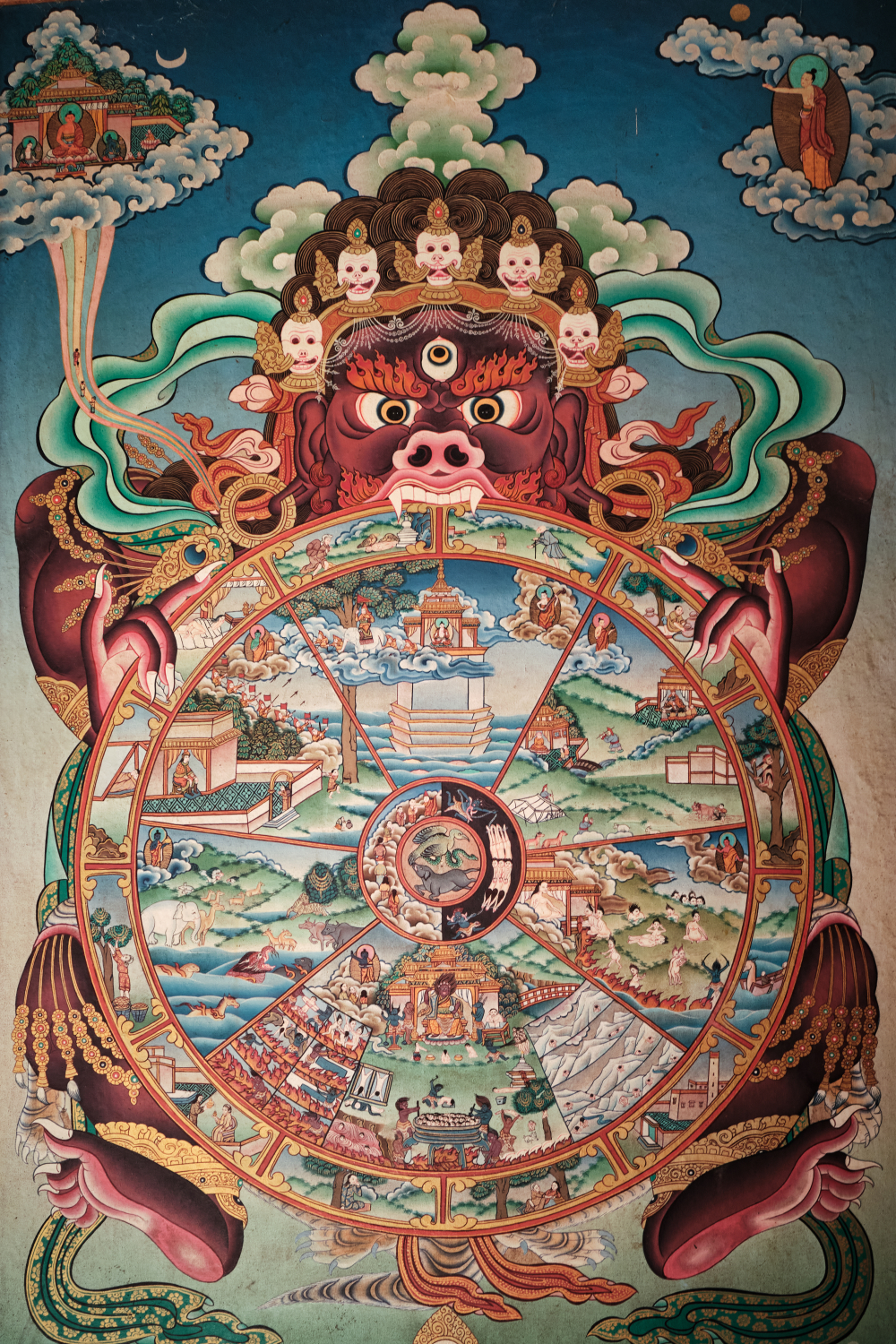
A mural at Enchey Gompa depicting the Wheel of Life. (Picture Credits: Abhishek Anil)
Paintings
Sikkim did not possess any particular style of painting, but adopted the Tibetan style of art. The early monastic paintings were mostly imported from neighbouring countries such as Tibet, Bhutan, and Nepal. Influences of both Chinese and Nepali traditions are seen in the paintings. The locals who painted were few and untrained. The painting training system in Sikkim was introduced when the Palden Thondup Cottage Industry opened in 1957, where painting was formally taught. This institute was instrumental in introducing Tibetan monastic arts in Sikkim and training a large number of local artists. One of the foremost modern Tibetan painters who contributed immensely to Tibetan art in Sikkim was Rinzing Lharipa, commonly known as Bermoik Lharipa, who learnt this art under Kesang Wangdi, an artist from Tibet. Under his guidance, many local artists learnt this style and were later appointed as art teachers in Palden Thondup Cottage Industry, now known as the Directorate of Handlooms and Handicrafts, which is located at Zero Point, Gangtok, Sikkim. It is today a centre for preserving and promoting the traditional art and craft of Sikkim by training local people and providing employment.
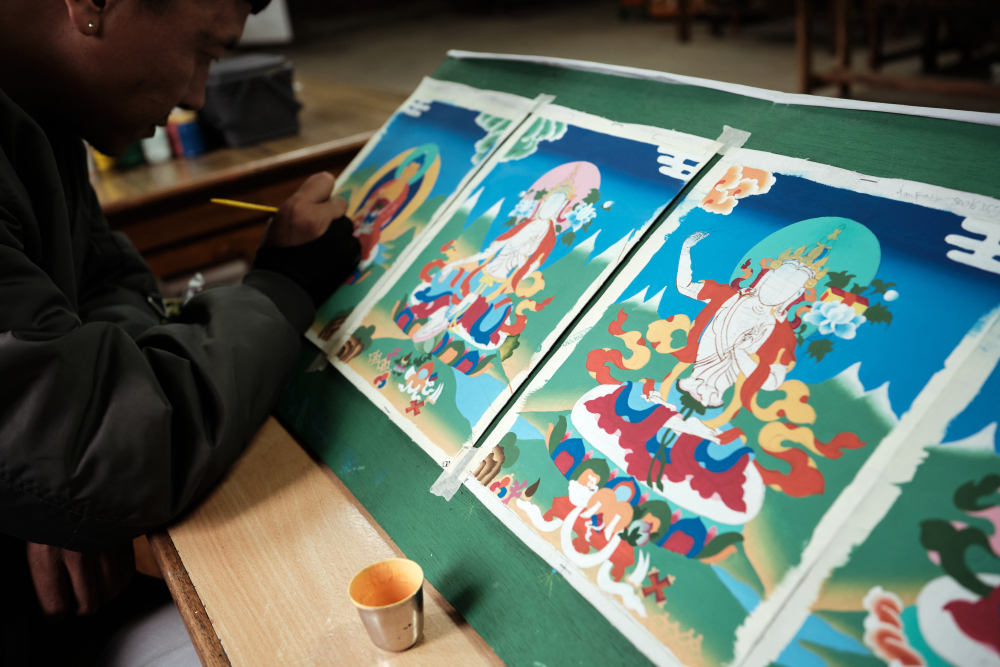
Practicing buddhist painting at DHH. (Picture Credits: Abhishek Anil)
Thangka
A thangka is a Tibetan Buddhist scroll painting on cotton or silk, usually depicting a Buddhist deity or scene. They are mostly hand-painted, with some being embroidered or appliqued. One of the main reasons for painting thangkas was the need for an image in religious practice. It served as a focal point and support for the Buddhist’s faith during meditation and, more importantly, for worship and offerings. Equally, commissioning religious art was believed to provide benefits and happiness, as well as prevent suffering.
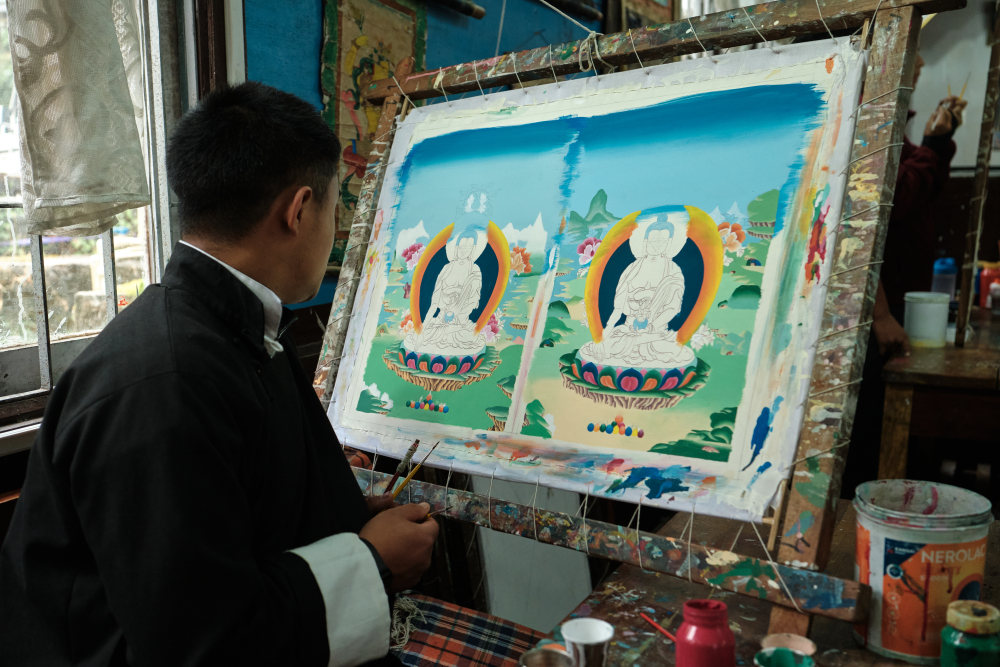
Thangka Painting at DHH, Gangtok. (Picture Credits: Abhishek Anil)
In the Directorate of Handlooms and Handicrafts, training in thangka painting takes four years. The trainees progress from chart paper and poster colors to cotton canvas and acrylic paints using fine brushes. The precise placement and proportions of Buddhist deities are determined by specific iconographic rules and grids that artists learn over the years. It is a long and painstaking process, with a detailed thangka taking months to complete. The artist must have an understanding of Buddhist scriptures and iconography. They draw the outline on the canvas with a pencil, as per the iconographic grids, and then paint it with a fine brush. The background colors are filled first and then the main deity is painted. The color is considered important because it helps identify the deities. There are certain guidelines to be followed while making these paintings, as changing or modifying them would weaken their essential quality. These guidelines have helped artisans maintain and preserve the religious identity of these thangkas; hence, the characterization of the murals, which form an essential part of the monastery interiors, remains the same.
Paintings serve both religious and commercial purposes, with newer themes — like Hindu deities, such as Ganesh — being incorporated. Some commissioned religious thangkas are guided by practicing lamas [x]. They are mounted in brocades of red (the colour of lamas), yellow (or Buddha), and blue (symbolizing eternity).
As with the wall paintings, the natural pigments used before, which were procured from Bhutan and Tibet, are now rare and expensive and have been replaced by modern plastic paints. There are cases where natural pigments from precious stones and gold dust were used in some paintings. Historical canvases made from yak skin, known for durability, have been replaced by cotton canvases.
Today, one of the most distinguished thangka painters from Sikkim is Khandu Wangchuk Bhutia, who has significantly contributed to the preservation and promotion of traditional Buddhist art. His dedication and expertise in thangka painting has earned him the Padma Shri Award in 2022.
Wood Carving in Sikkim
Wood carving is an old traditional craft of Sikkim, traditionally patronized by Buddhist monasteries and households. Monasteries are adorned with chesum, chokse (traditional tables), eight lucky signs of Buddhism, offering bowls and manuscript cases. They are made from locally sourced wood such as raani chaap (macalia exelsa), okner (walnut), and tooni (toona celiata). The design process starts with sketching on paper, the design being transferred by stencil onto the smoothened wood. Different tools are used to carve the wood, the craftsmen using free hand to shape them. Then the piece is completed by smoothing, layered with primer, painted and coated with a protected varnish.
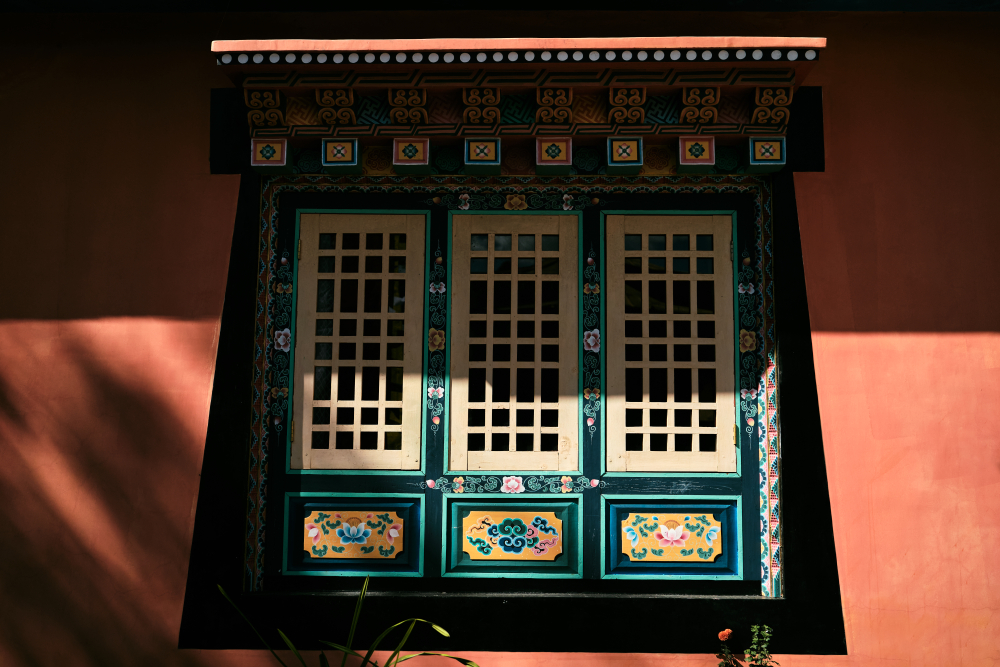
Carved and painted wooden windows at Enchey gompa, Gangtok. (Picture Credits: Abhishek Anil)
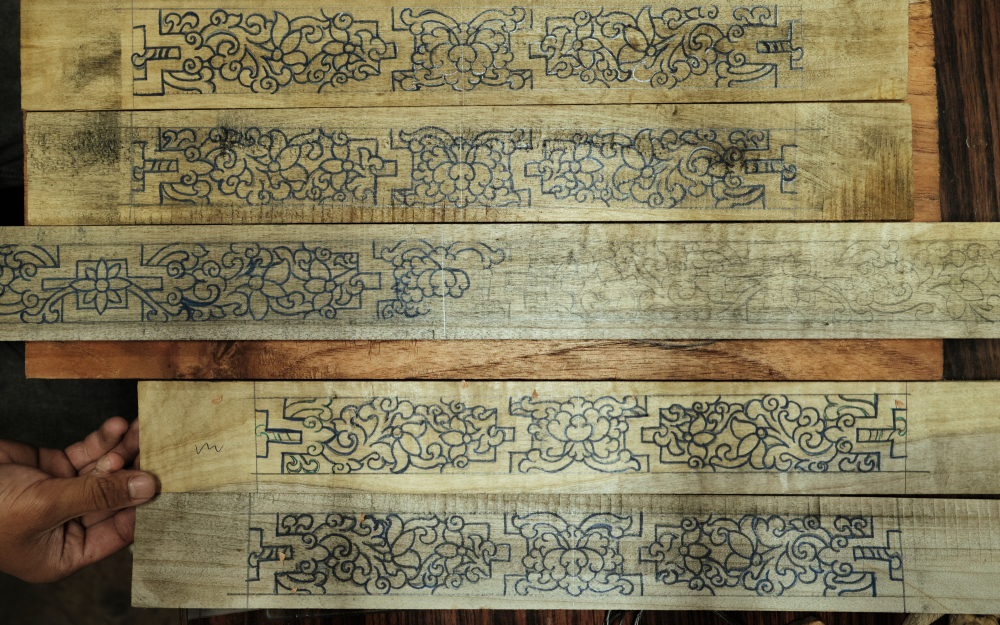
Hand drawings over wooden panels for Choktse table, ready to be carved at DHH, Gangtok. (Picture Credits: Abhishek Anil)
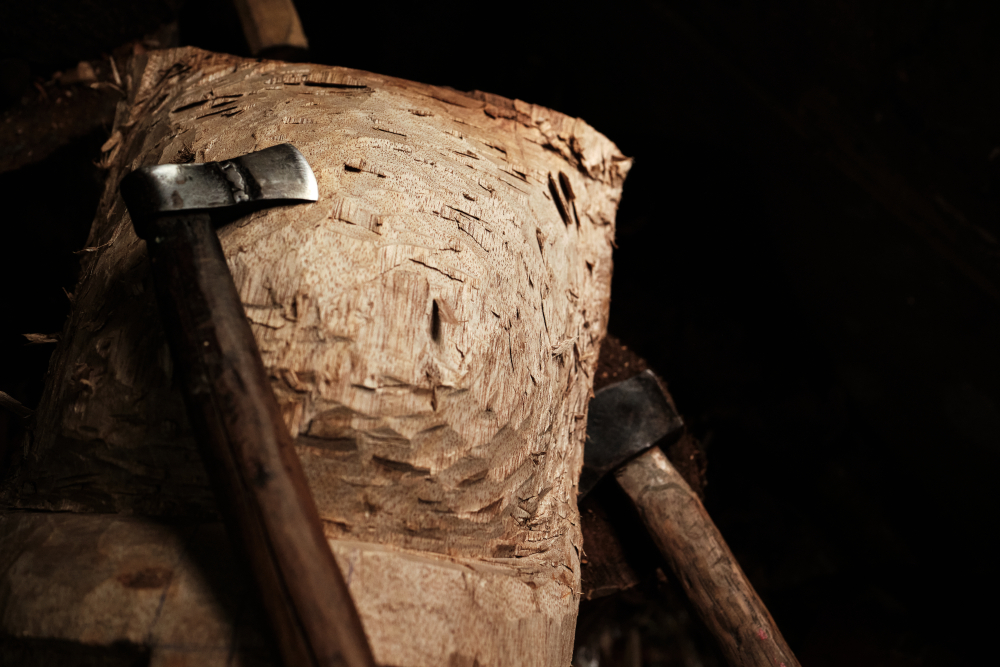
Cutting out wood to make traditional masks at DHH.(Picture Credits: Abhishek Anil)
The windows and doors of the monastery are wooden and are ornately carved and hand-painted and decorated. The chesum in the dukhang of the monastery has motifs of flowers and dragons. There has been use of bright colours, floral motifs, and curvilinear patterns in the wooden pillars, windows, doors, and beams of the monasteries. The Directorate of the Handicraft and Handloom Institute also provides a training course for traditional wood carving.
Conclusion
The traditional methods of building monasteries in Sikkim have undergone significant transformations. Historically, sustainable materials such as wood, stone, and traditional plaster were used to construct monasteries, following age-old methods passed down through generations. They defined the architecture of these monasteries being small and isolated. However, with the rise of contemporary technologies and new materials, these traditional methods have been replaced by concrete, steel, and other materials. The historical and artistic artworks which were painted by artists from Tibet within these monasteries have also been affected. Some of the old paintings, which were once central to the spiritual and cultural experience of these religious sites, have been repainted. The act of repainting leads to the erasure of original artistic details. The artists who painted the murals of the monasteries were initially brought from Tibet. The murals are now painted by local artists who have been trained here. An example is Dubdi monastery, the oldest monastery of Sikkim, where new wall paintings have been repainted on the old ones.
Restoration and conservation efforts are crucial to retain remnants of the old traditional style of art and architecture. Some of the challenges in Sikkim are prolonged monsoons, landslides and earthquakes which cause damage to the art and architectural heritage. Institutional efforts to combat these damages have been slowly and significantly taking place. In 2011 and 2012, the Tibet Heritage Fund (THF) restored the wall paintings of Tsuklakhang Royal Palace monastery in Gangtok. The archive section of the Culture Department, Government of Sikkim safeguards historically important institutions and monuments and works in conservation collaborating with the Archaeological Survey of India (ASI) Delhi, Indian National Trust for Art and Cultural Heritage (INTACH) Delhi, and the National Research Laboratory for Conservation (NRLC) Lucknow. The Architectural Heritage Division of INTACH has surveyed about 160 heritage sites in Sikkim including built heritage, natural landscapes, settlements and villages. Training courses on the conservation of cultural heritage have been conducted in collaboration with organizations like the Himalayan Society for Heritage and Art Conservation (HIMSHACO), Nainital and Anamika Kala Sangam Trust (AKST), Kolkata supported by the Tata Trusts Art Conservation Initiative.
The continued documentation and restoration of the art and architecture of monasteries of Sikkim is essential for safeguarding the rich and unique cultural heritage of Sikkim.
Bibliography
Chopel, Gary. ‘Historic Evolution of the Sikkimese Monastery.’ Bulletin of Tibetology 47, nos. 1–2 (2011): 59.
Dastkari Haat Samiti. ‘The Process of Thangka Painting.’ Google Arts & Culture. Accessed n.d. https://artsandculture.google.com/story/the-process-of-thangka-painting-dastkari-haat-samiti/-QWh8YagYf4tIQ?hl=en.
Directorate of Economics, Statistics, Monitoring & Evaluation. In the Footsteps of the Lotus Born. Gangtok: Government of Sikkim, 2014.
Handa, O. C. Buddhist Monasteries of Himachal. Delhi: Indus Publishing Company, 2004.
Information and Public Relations Department and Ecclesiastical Affairs Department, Government of Sikkim. Temples and Monasteries of Sikkim. Gurgaon: Trysts & Traces, 2016.
InCH Asia. ‘Wood Carving of Sikkim.’ Accessed n.d. https://www.globalinch.org/craft/wood-carving-of-sikkim/.
Jackson, David, and Janice Jackson. Tibetan Thangka Paintings: Methods and Materials. London: Shambhala Publications, 1988.
Kharel, Sunita. ‘History of the Beginning of Buddhism in Sikkim.’ International Journal for Multidisciplinary Research 4, no. 5 (2022): 1.
Risley, H. H. The Gazetteer of Sikkim. Gangtok: Sikkim Natural Conservation Foundation, 1989.
This essay has been created as part of Sahapedia's My City My Heritage project, supported by the InterGlobe Foundation (IGF).