
The natural history of Sikkim is shaped by myth-making and religious ideas. According to various Buddhist beliefs and stories, Guru Rinpoche was believed to have consecrated the land of Sikkim by hiding sacred objects in the caves, rocks, and sacred lakes. Subduing all the evil spirits of the land, he made them the guardians of the hidden treasures. This reinforced an idea of Sikkim as the spiritually protected and holy land, where nature and culture are deeply connected.
Sikkim is blessed with a wide variety of flora, fauna and geographical features. Prominent among these are its water bodies: lakes, rivers, and springs play an important role not only in defining the region’s ecology and environment, but also in the spiritual beliefs, cultural practices, and identity of the various communities of the region. These water bodies are considered to hold cultural, mythological, and religious significance: they are understood to be sacred and pure.
Rivers such as Teesta, Rangit, Lachen, and Lachung and the sacred lakes such as the Tsomgo (sacred lake believed to change colours over the seasons), Khecheopalri, and Gurudongmar are important water bodies of note in Sikkim. These rivers and lakes have shaped the identity and socio-religious ideas, practices, and rituals of a large number of people; several folktales, myths, and local tales abound around these waterbodies, linking nature and culture together.
River Teesta
River Teesta, one of the largest rivers in Sikkim, aids the people of the region with their subsistence by providing water for irrigation, agriculture, hydroelectricity and fishing.
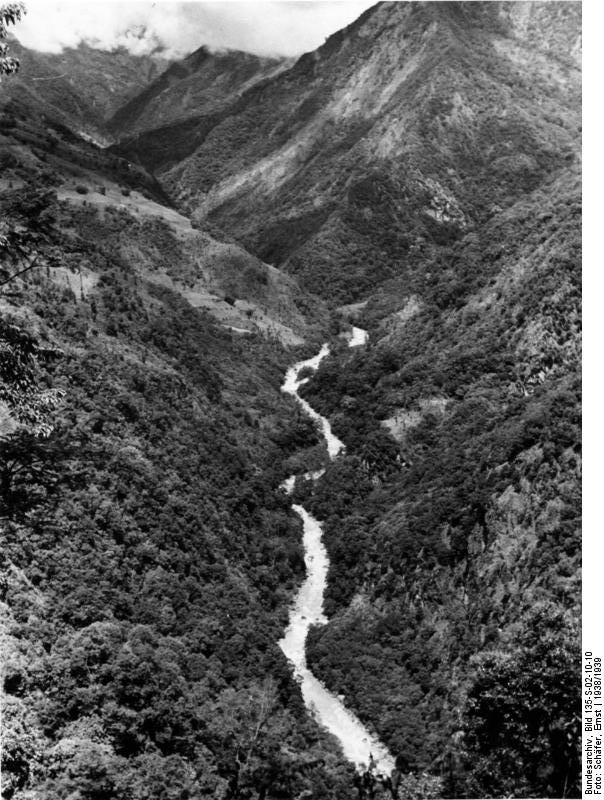
Mangan, the wild Teesta valley. (Picture Courtesy: Ernst Schäfer/Wikimedia Commons)
A popular Lepcha story tells the tale of Rongnyu (Teesta’s original name) and Rungyuit (popularly spelt Rangeet). As per the Lepchas, these two river spirits were created by Itbu-moo, the mother goddess of the Lepchas. These rivers were considered living beings with sacred ancestors and also lovers.
One day, the two rivers decided to race down the hills, promising to wait for the other by the midlands of Punzok (present-day Peshok). Each of them chose a guide. Rongnyu asked Parilbu, a serpent, who guided her with care. But Rangeet asked Tutfo, a bird who was distracted by the nectar of the flowers — as a result of which Rongnyu reached Peshok early. Upon seeing Rongnyu already there, Rangeet exclaimed with great surprise, “Ha Thee Sa-Tha” (When did you arrive?), giving Rungnyu the name Teesta. Rangeet’s pride, crushed that he lost the race, led him to winded backwards in great anger and caused floods. People prayed and fled in terror to the highest hill of Mount Tendong, where the creator descended in the form of kohomfo (patridge), accepted the people’s offerings of chi lok faat (fermented millet), and sent an earthquake to drown the flood waters. Teesta consoles and wooes Rangeet till he softens and they promise to flow together as one: Rangeet on top of Teesta, giving the confluence of the rivers a blue-green colour at the top and a greyish-white below.
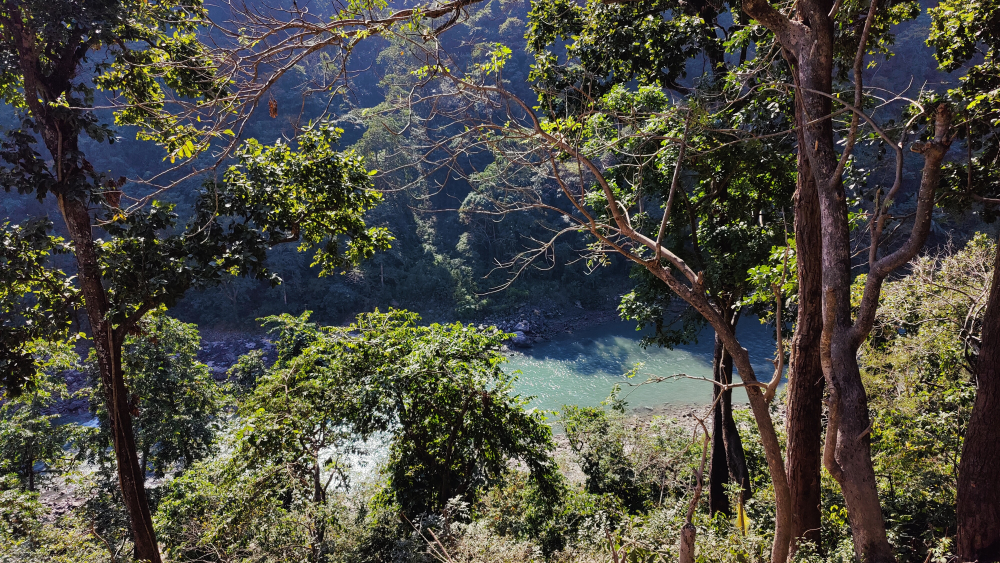
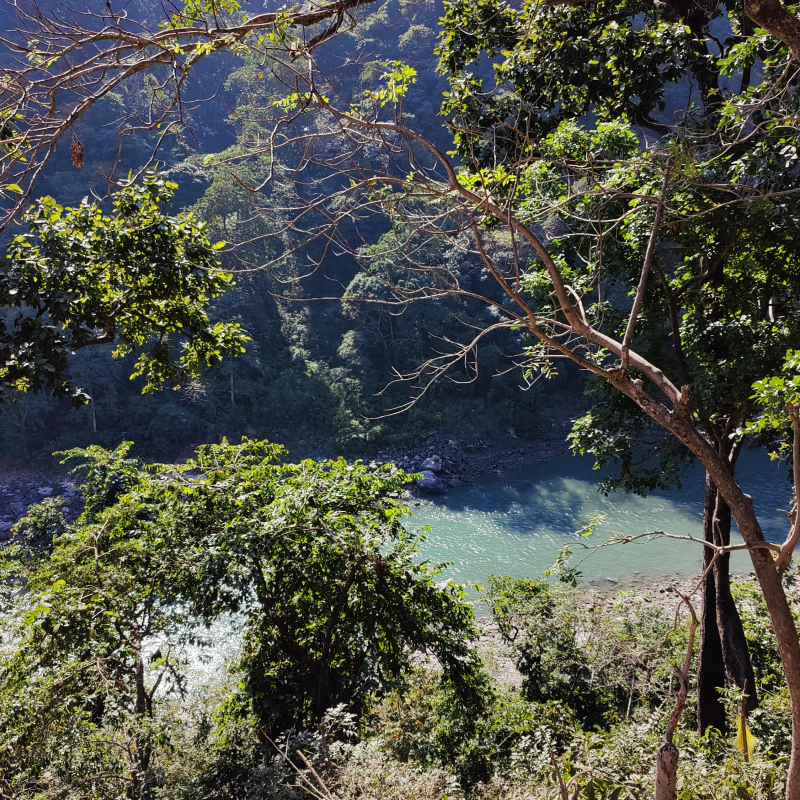
View of Rangeet as seen from Jorethang-Melli road, Sikkim. (Picture Credits: Abhibyanjana R Thatal)
Thus it is that stories like this portray a broader idea of how natural forces are seen as living elements. They are personified and depicted as possessing their own emotions and relationships of love, conflict, and harmony. Tales such as these, which establish that rivers are not just mere resources but sacred living forces, lead to the birth of many rituals that honor the rivers as the ancestors of the community. Such myths and rituals also become part of the different tribes’ identities, as well as teaching environmental ethics rooted in the need to protect and save the river ecosystem.
Through the oral retelling of such stories, myths, and tales, for instance, the Lepchas were able to forge an identity for themselves as the Muntachi Rongkup (Children of the snowy peaks and rivers). Even today, many festivals and ceremonies of the Lepchas — marriages in particular — focus on remembering the love story of Teesta and Rangeet, as the family and friends of the newlyweds remind them that the union of marriage may also face challenges and to inspire them to overcome these obstacles and flow as one. Further, the water of the Teesta is considered sacred by the Lepchas and it is sprinkled on the couple during their marriage ceremony. The myths related to these rivers and their love stories have also been developed into dance traditions, which are performed particularly during Tendong Lho Rum Faat, a festival to celebrate the Tendong Mountains.
Lakes of Sikkim
Equally, Sikkim’s landscape has a large number of lakes which are considered holy and are revered by many tribes and communities. These are depicted as living-conscious beings, sacred spaces, and protectors or guardian deities.
Gurudongmar Lake
The Gurudongmar Lake, one of the highest sacred lakes in the world, is situated at an elevation of 17800 feet in the Mangan District of North Sikkim. The lake was named after Guru Padmasambhava, who was believed to have visited it in the eighth-century CE. It is considered holy and venerated by the Buddhists, Hindus, and Sikhs. According to a popular belief, Guru Padmasambhava, on his journey back to Tibet, witnessed that the locals were not able to use the frozen water of the lake. Upon this sight, he touched a particular portion of the lake — which would stay forever unfrozen, even in extreme winter. This story signifies the idea of the blessing of fertility by Guru Padmasambhava and iterates the crucial role of the lake as the divine-protector of traders and herders. Per another tale from Sikhism, even Guru Nanak is said to have visited the lake in the fifteenth-century CE. Since the lake is considered sacred for several communities, it is part of many rituals, customs, and practices even today. The locals believe that the water of the lake has healing properties and it is also seen as a wish-fulfilling lake.
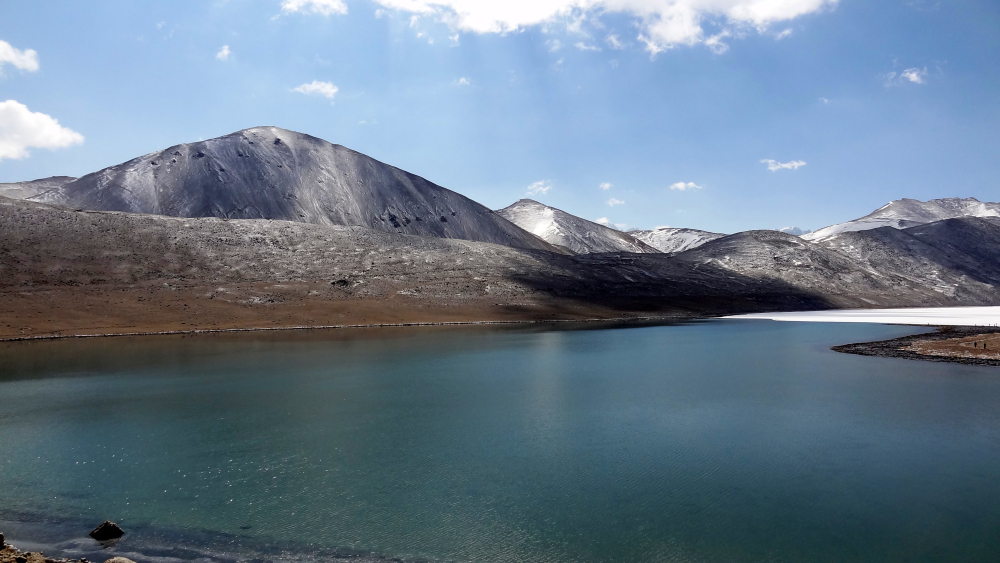
View of Gurudongmar in April. (Picture Courtesy: Veil Flanker/Wikimedia Commons)
Khecheopalri Lake
Originally named the Kha-Chot-Palri, or the heaven of Padmasambhava, another lake of significance is the Khecheopalri, located in the village of Khecheopalri, Geyzing district, West Sikkim. It is one of the holiest lakes in Sikkim out of the state’s 150 lakes, revered by Hindus, Buddhists, and Lepchas alike. The lake is a part of the sacred landscape of the Demazong. Khecheopalri is also a part of the Buddhist pilgrimage circuit. According to Buddhists, the lake is a dwelling place for the Goddess Tara Jestum Dolma, the mother of Lord Buddha. Lake Khecheopalri is considered a trace of her footprint, as the shape of lake indicates.
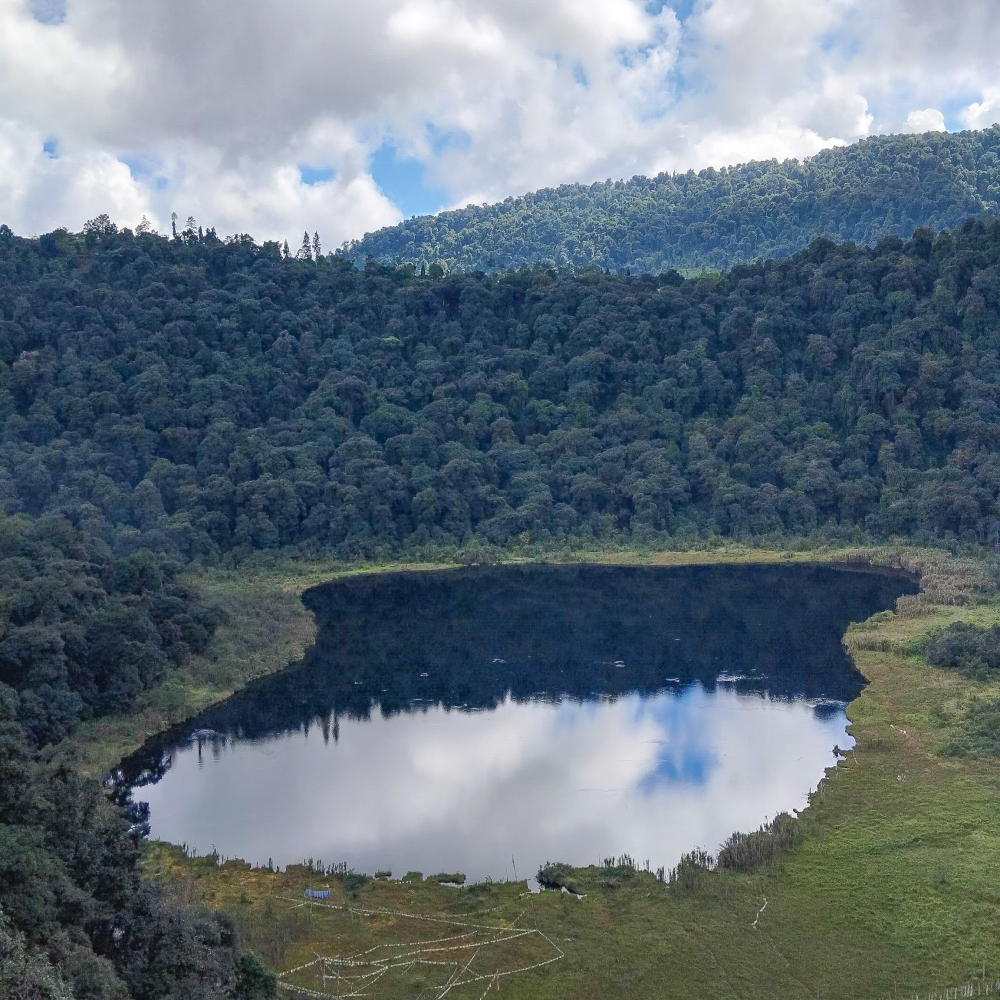
Khecheopalri Lake from the top of the hillock. (Picture Credits: Dibyendu Ash/Wikimedia Commons)
The surroundings of Khecheopalri lake are marked by a number of religious structures, such as the holy caves of Dupukney and Chubukney, which are also worshipped as holy sites where Guru Padmasambhava and lamas (monks) meditated and incarnated themselves.
The lake is also revered by the Hindus, as cave Dupukney is equally believed to be the place where Lord Shiva meditated. The locals offer their prayers here during Hindu festivals such as Shiv Ratri (an annual festival celebrating Shiva) and Nag Panchami (a day for the worship of the nagas or snakes).
Lake Khecheopalri also has another famous origin story. According to this, there were two lakes located in the north-western Himalayas. The older lake is still found in the area, but the younger lake, known as Labding Pokhari, moved to Yuksam. As the people of Yuksam did not respect the Labding Pokhari and started polluting the water, the goddesses were infuriated with the people and decided to shift the younger lake, first to a place called Chhojo, and when the lake did not fit there, to yet another place — Khecheopalri.
In another story associated with this holy lake, most celebrated among the Lepcha community, a Lepcha girl named Nenjo Asha Lham was given a precious gem after being blessed by the river goddesses. This gem, lost by her mother, is believed by locals to be inside the lake till today. Since that gem was blessed, the water of the lake is still considered pure and holy, possessing healing properties which could cure many diseases. It is due to this faith in the sacredness of the water that the locals residing around the lake do not allow the water to be used for any other purposes other than rituals, rites, and ceremonies. The lake is also quite popular all over Sikkim as the wish-fulfilling lake.
Besides stories and myths, there are also numerous religious ceremonies and festivals linked with the lake. Other than frequent community rituals centred around the lake, which are performed mainly during full moon and new moon days, there are two main festivals that are associated with the Khecheopalri lake. One is Chho Tsho, a festival performed mainly to offer thanks to god for providing food. During this festival, which brings the community together, the local people of the village collect money from each household to celebrate and perform rituals at the lake, after which they all enjoy a feast together. The other main festival celebrated is Bhumchu, where the lake goddess is worshipped by the locals to maintain peace and harmony. Organised mainly around February or March, this festival features the lamas and the locals worshipping the goddesses for three days with offerings of colourful idols of god and lamps made of butter. Festivals like these, celebrated since long past, are very popular among the local communities of the place as well as the devotees coming to seek blessings and wish-fulfilment.
Conclusion
These myths and folktales of rivers and lakes in Sikkim are deeply rooted within a community and their collective identity, containing immense socio-religious cultural significance. These stories often share traditional conservational knowledge and emphasize environmental ethics, seeking to establish and prioritize the interconnected bond between the people, the landscape, and their history. Rivers and lakes in Sikkim are not just water bodies providing lifelines to various people of different communities — their stories and myths are mediums through which the gap between divergent groups are slowly overlapping each other, creating a solid foundation on which to further harmony among the people of Sikkim.
Bibliography
Mullard, Saul. Opening the Hidden Land: State Formation and the Construction of Sikkimese History. Leiden: Brill, 2011.
Negi, Sharad Singh. Himalayan Rivers, Lakes, and Glaciers. Delhi: Indus Publishing, 1991.
Shor, T. K. A Step Away from Paradise: A Tibetan Lama's extraordinary Journey to the Land of Immortility. Delhi: Penguin Books, 2011.
Subba, Jash Raj. History, Culture and Custom of Sikkim. Delhi: Gyan Publishing House, 2008.
Dolma, Yishey. ‘Rivers in Love’. Times of India, March 12, 2012. Accessed January 26, 2026. https://timesofindia.indiatimes.com/rivers-in-love/articleshow/10125831.cms?from=mdr.
Chattopadhyay, Tapan. Lepchas and Their Heritage. Delhi: B.R Publishing Corporation, 2000.
Siiger, Halfdan. The Lepchas: Culture and Religion of a Himalayan People. Copenhagen: The National Museum of Denmark, 1967.
Jain, Alka, H. Birkumar Singh, S. C. Rai, E. Sharma. Folklores of Sacred Khecheopalri Lake in the Sikkim Himalaya of India: A Plea for Conservation. Sikkim: G.B. Pant Institute of Himalayan Environment and Development, 2004.
Singh, H. B., P. Prasad, and L. K. Rai. Folk Medicinal Plants in the Sikkim Himalayas of India. Japan: Asian Folklore Studies, 2002.
This essay has been created as part of Sahapedia's My City My Heritage project, supported by the InterGlobe Foundation (IGF).