
Sikkim today juts out like a small Himalayan knuckle from the Indian landmass, wedged between Tibet to its north and northeast, West Bengal to its south, and flanked by Nepal and Bhutan on its west and east. Though diminutive, its geopolitical weight has always far exceeded its geography, for Sikkim possesses the Nathu La and Jelep La mountain passes, dubbed by observers as “the single most geo-strategically important piece of real estate in the entire Himalayan range” (Garver, 2001). These mountain passes form the most accessible route to the Tibetan plateau and lie less than 170 kilometres from the narrow Siliguri Corridor, which connects India’s northeast region to the rest of the country.
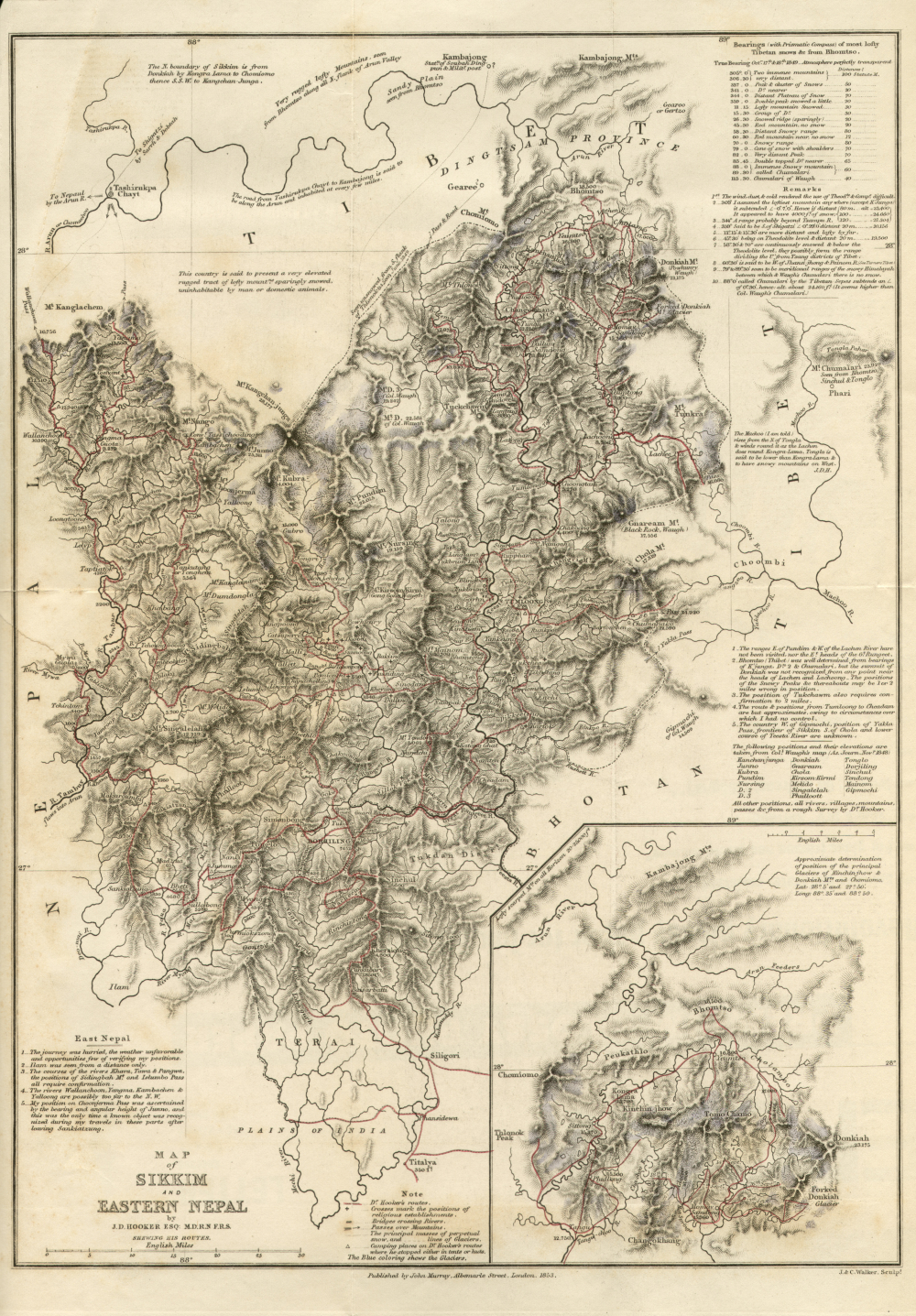
Map of Sikkim and Eastern Nepal from J.D. Hooker’s Himalayan Journals. (Picture Courtesy: John Murray/Wikimedia Commons)
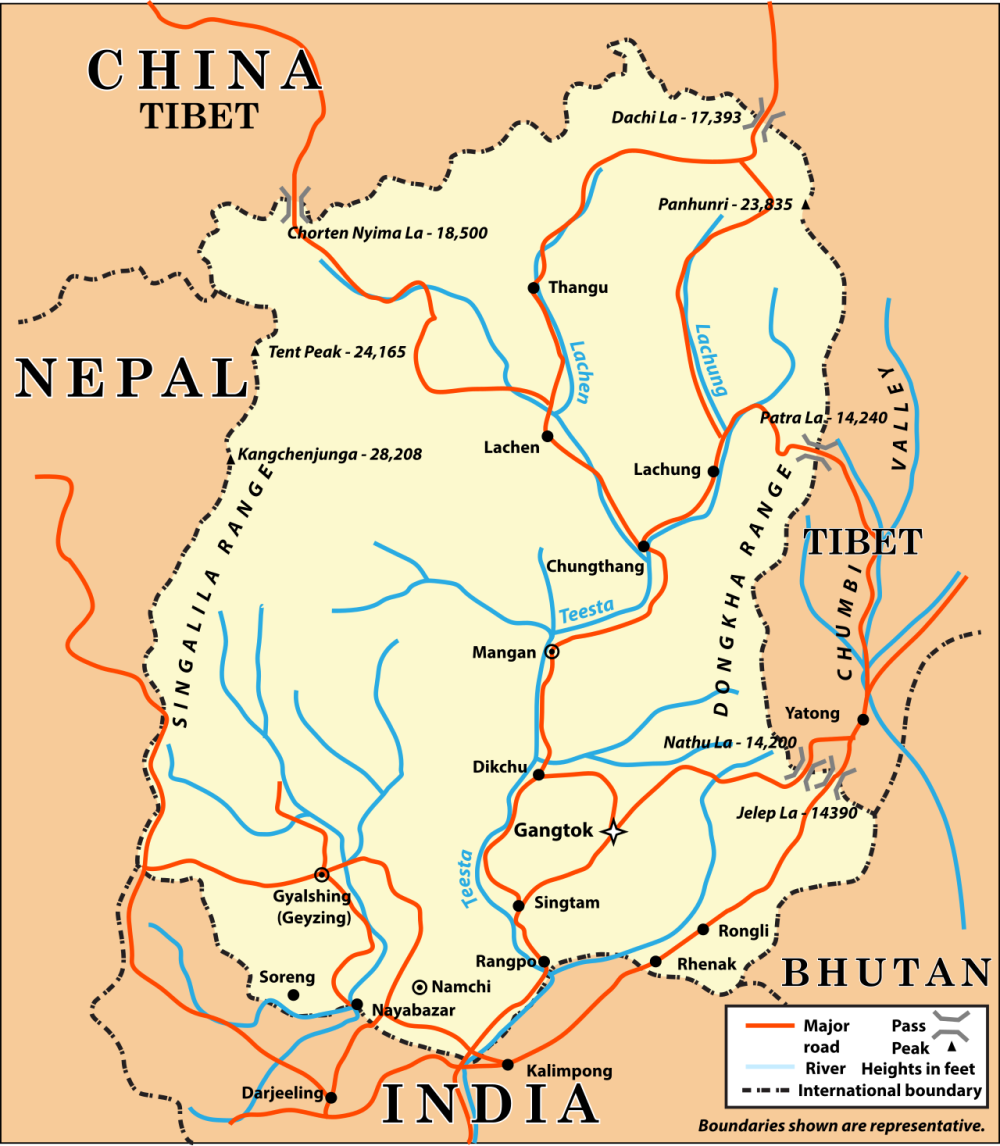
Map of the Indian state of Sikkim and environs. (Picture Courtesy: Philg88/Wikkimedia Commons)
This location has also shaped Sikkim’s social landscape. Today, the state is home to a diverse social mosaic of around twenty-two ethnic groups, broadly categorised today as Bhutia, Lepcha, and Nepali, who collectively embody long histories of interaction, adaptation, and cultural exchange in the region.
This essay offers a broad, and by no means exhaustive, overview of Sikkim’s historical past, moving from its prehistory and pre-colonial foundations to its colonial entanglements, post-colonial developments, and concluding with Sikkim becoming the 22nd state in the Indian republic in 1975.
Early Settlements and Sacred Landscapes
Human presence in Sikkim reaches deep into prehistory. Archaeological finds ranging from chipped stone tools to polished Neolithic axes in Odhare and Sajyong indicate early human movement and technological developments in the region. Linguistic analysis combined with archaeological evidence suggests that the Lepchas were the earliest known inhabitants of Sikkim’s landscape.
Reconstructing Sikkim’s pre-Buddhist past is difficult as written records from the period are sparse. Historians must rely on oral traditions or draw inferences from histories of the neighbouring regions with which Sikkim’s own past has long been intertwined. Before the rise of the Namgyal dynasty, Sikkim appears to have consisted of small, scattered village clusters and petty principalities, separated by its challenging terrain. Demographic estimates by Mullard suggest that perhaps 8000–10000 people inhabited the region in the seventeenth-century, comprising Lepchas, Bhutias, Limbus, and smaller groups.
Much of what exists as early historical records begins with the spread of the Tibetan Buddhist influence. The writings of the Buddhist educated elite framed Sikkim’s past within a sacred Buddhist cosmology. In their telling, Sikkim was sanctified in primordial time by Avalokitesvara (the Buddha of compassion), and later, in the eighth-century, by the tantric Buddhist master, Guru Padmasambhava, who subdued and tamed the region’s indigenous deities and prepared the land for Buddhist cultivation. Thus Sikkim was designated as Beyul Demojong or ‘hidden land of bounty,’ whose ‘hidden’ nature was revealed by the fourteenth-century master Rigdzin Ngödem, affirming its role as a sanctuary for dharma in times of crisis.
The Rise of the Namgyals
This idea of Sikkim as a sacred geographical space provided the intellectual foundation for state formation. According to orthodox accounts, the “opening” of the hidden land took place in the mid-seventeenth-century, when three eminent Buddhist monks — Lhatsun Chenpo, Ngadag Sempa, and Kathog Kuntu Zangpo — selected and enthroned Phuntsog Namgyal as the first Chogyal (king) in the 1640s at Yuksom. The Namgyal dynasty would go on to rule Sikkim for over three centuries until 1975.
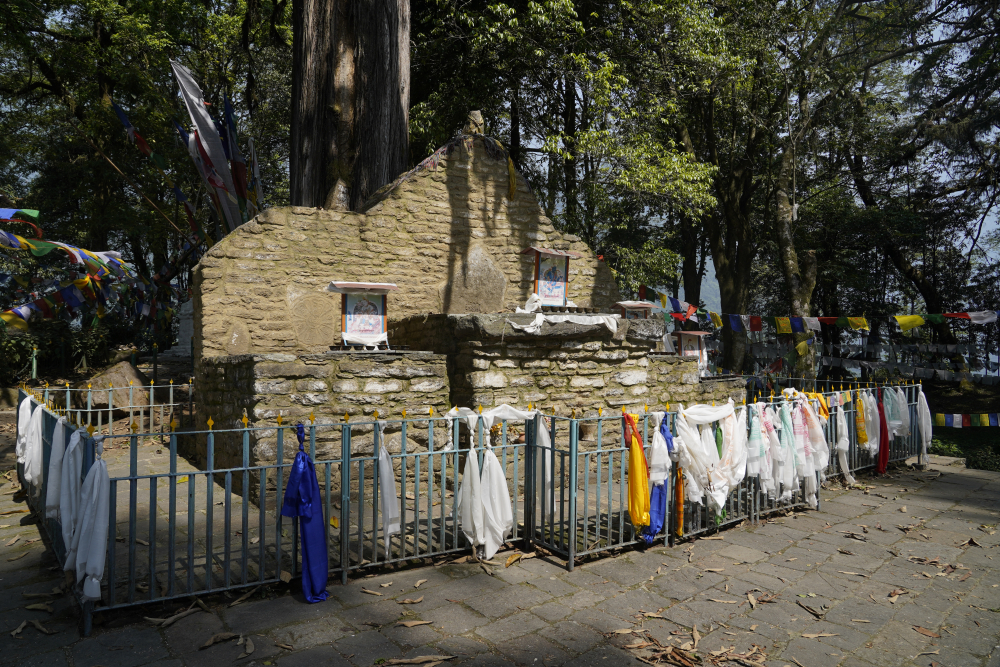
Narbugong Coronation Throne near Yuksom (Gyalshing), West Sikkim. (Picture Courtesy: Anjan Kumar Kundu/Wikimedia Commons)
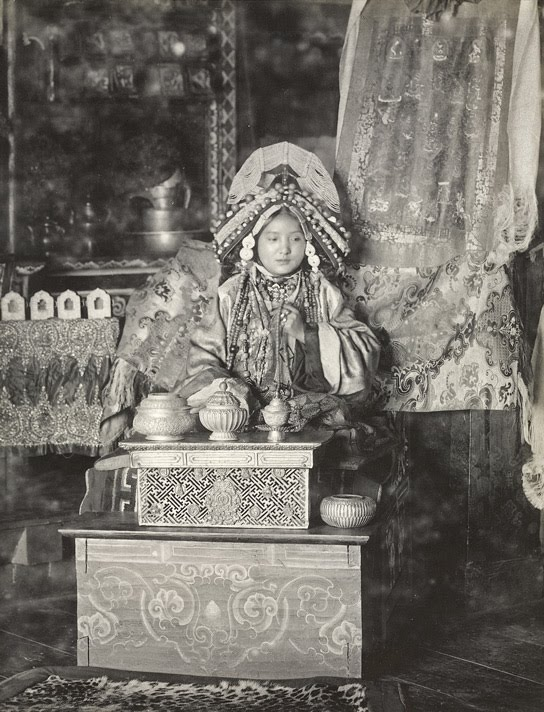
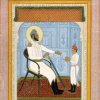
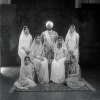
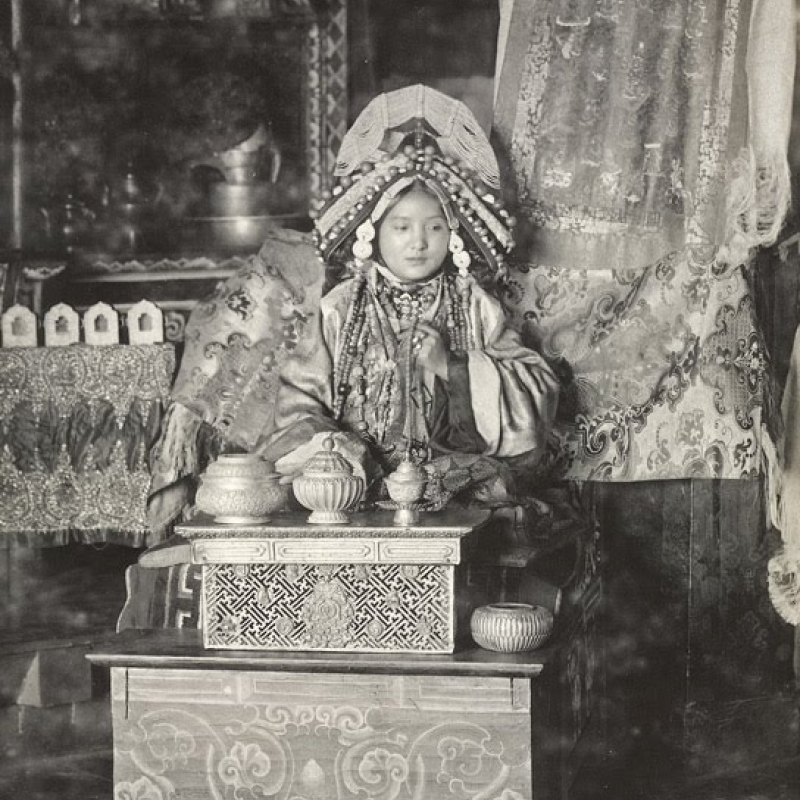
Queen Yeshay Dolma, wife of Thutob Namgyal, the 9th Chogyal of Sikkim. (Picture Courtesy: Johnston & Hoffmann/Wikimedia Commons)
Behind this grand cosmological narrative, though, lay a more fragmented early history, which involved the consolidation of diverse communities into a coherent polity, often requiring sustained negotiation. For instance, the Lho-Mon-Tsong treaty of 1663 was an attempt to forge political unity among the ethnically diverse Bhutias (Lho), Lepchas (Mon), and Limbus (Tsong) communities. Over time, this unifying project drew upon Buddhism and gave rise to a distinctly Sikkimese Buddhist world. Festivals such as Pang Lhabsol, which venerates Mount Khangchendzonga, wove Lepcha cosmology into a shared Bhutia-Lepcha Buddhist framework, fostering a shared sense of Sikkimese nationhood. For instance, the festival was rooted in the commemoration of the ‘blood oath ceremony’ between the Lepcha and Bhutia ancestors wherein, according to tradition, these figures invoked the local deities of Sikkim to bear witness to their eternal friendship. This religious and political culture was Tibetan in inspiration, yet unmistakably local, uniting the people and the sacred landscape under the umbrella of Buddhism with the Namgyal monarch at the helm.
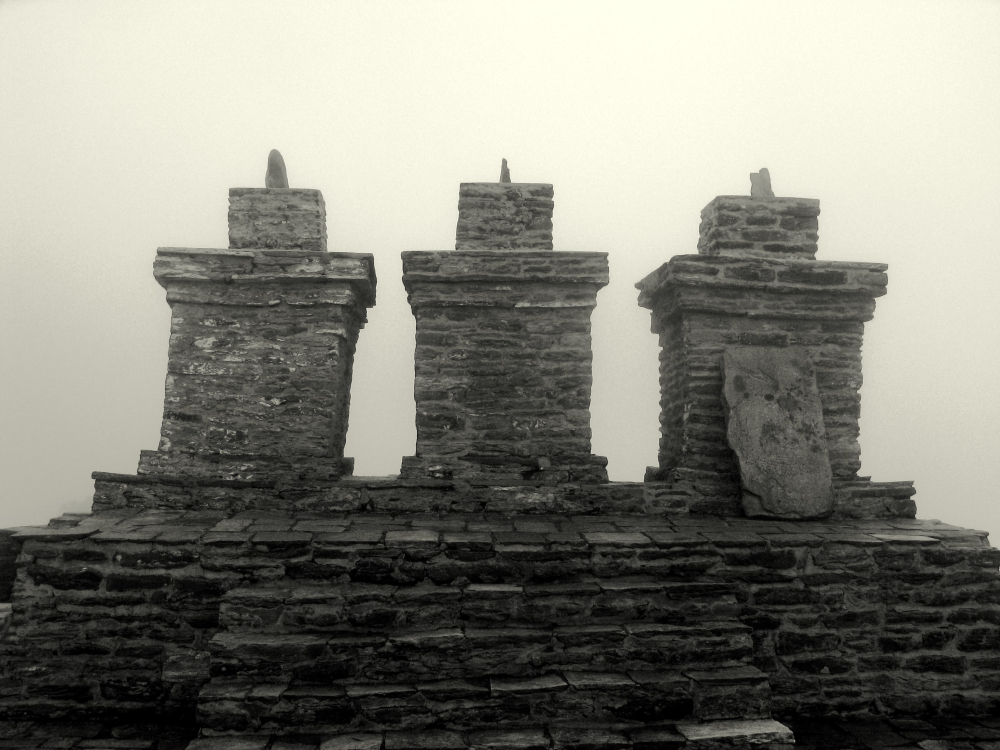
Three chorten remnants at Rabdentse Ruins. (Picture Courtesy: Dhillan Chandramowli/Wikimedia Commons)
However, the nascent Sikkimese polity existed in a volatile Himalayan frontier. By the eighteenth-century, it found itself threatened on both sides by expansionist neighbours. The Gorkha kingdom under Prithvi Narayan Shah pushed eastward into Limbuwan and towards Sikkim’s western frontiers, while Bhutan exerted pressure from the east. These periodic incursions, which also included the ransacking of Sikkim’s then capital, Rabdentse, exposed its geopolitical vulnerabilities. It was within this context of competing regional powers that Sikkim’s entanglements with the English East India Company would take shape.
Under the British Shadow
Sikkim’s first encounter with the English East India Company (EIC) came during the Anglo-Gorkha War of 1815-1816. The EIC were seeking allies against Nepal and found in Sikkim, wearied after years of Gorkha raids, a willing partner. After Nepal’s defeat, the Treaty of Sugauli (1816), and Treaty of Titalia (1817), the EIC restored some of Sikkim’s lost territories and guaranteed its protection against external aggression. Sikkim, in return, agreed to surrender fugitives from British India and prohibit foreign settlement within its borders without British consent. Through this treaty, the EIC formally recognised Sikkim as a foreign state, identifying it as a useful buffer between Bengal and Tibet.
However, this relationship of convenience began to fray over a dispute surrounding the status of Darjeeling. Darjeeling had been granted to the EIC by the Sikkimese ruler as ‘leased land’ for the development of a sanitarium, but the EIC treated it as a possession and transformed it into an administrative centre. The rapid development of Darjeeling under British rule, with laws and wage systems, created a demand for labour, which drew many from Sikkim in search of employment. Thus, the Sikkim tax base was weakened by the loss of manpower and revenue. In response, the British officials, with some Bhutia-Lepcha landlords and the first Pradhan Thekedars, encouraged Nepali settlement in Southern and Western Sikkim. By the 1890s, census records show a demographic transformation in Sikkim, with the Nepali population outnumbering Lepchas and Bhutias; this change would also fundamentally alter Sikkim’s social and political landscape.
This deterioration in the Anglo-Sikkimese relationship was followed by the detention of two British subjects, Dr Archibald Campbell and Sir Joseph Dalton Hooker, in Sikkim. This provided ground for the seizure of Sikkimese territory and later the ‘Sikkim Expedition’ to Tumlong, the then Sikkimese capital. Eventually, this led to the signing of the Treaty of Tumlong (1861), which transformed Sikkim into a British Protectorate. The Anglo-Chinese convention of 1890 would cement that status, with the British retaining control of the administration and foreign relations of the kingdom.
Within this new imperial framework came Gangtok’s rise from a forested ridge into a settled capital. This was less the outcome of local political will than the deliberate project of the Empire. Prior to colonial intervention, the idea of a ‘fixed’ capital seemed foreign, as authority moved with the Chogyal between his palaces and a network of monasteries which housed the spiritual and temporal power.
A decisive change came in 1889 when the British Political Agency for Sikkim, Tibet, and Bhutan affairs was established at Gangtok and John Claude White arrived as its political officer. Gangtok was chosen for reasons of strategic convenience: the ridge offered clearer lines of surveillance and command and its location made it a central node for managing frontier affairs near the mountain passes that linked British India to Tibet. J. C. White was a Public Works Department engineer by training and made Gangtok a laboratory of colonial modernity, albeit with a heavyhandedness that alienated the Sikkimese monarch and drew criticism even from the British establishment. He introduced colonial institutions of governance: land reforms, forestry regulations, regular police force, law courts, and a rudimentary public health system. The Public Works department carved roads into hillsides and dotted Gangtok’s landscape with bungalows, a civil dispensary, boarding schools and sanitation projects. Gangtok was urbanised.
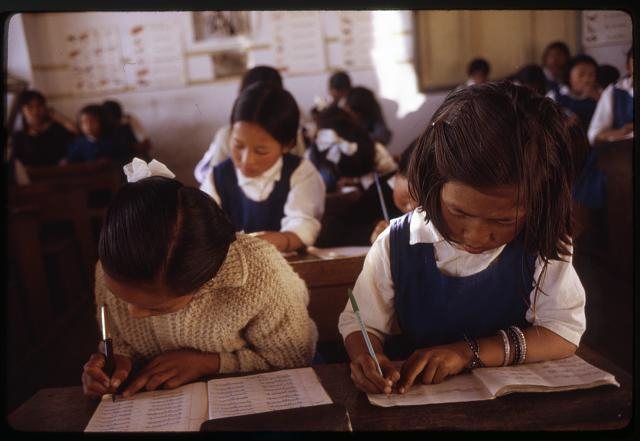
School children at Paljor Namgyal Girls School. (Picture Courtesy: Alice Kandell/Library of Congress)
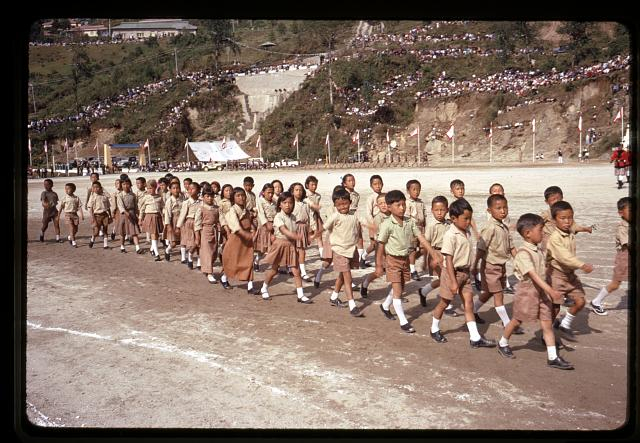
School children line up for Birthday parade for Chogyal of Sikkim. (Picture Courtesy: Alice Kandell/Library of Congress)
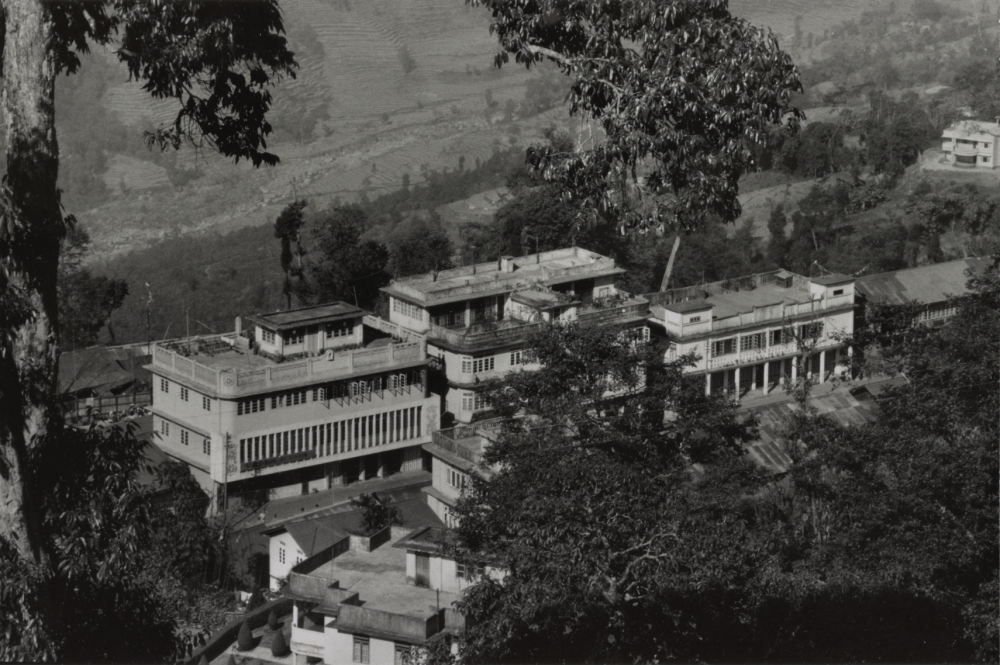
Urban Gangtok between 1965-70. (Picture Courtesy: Alice Kandell/Library of Congress)
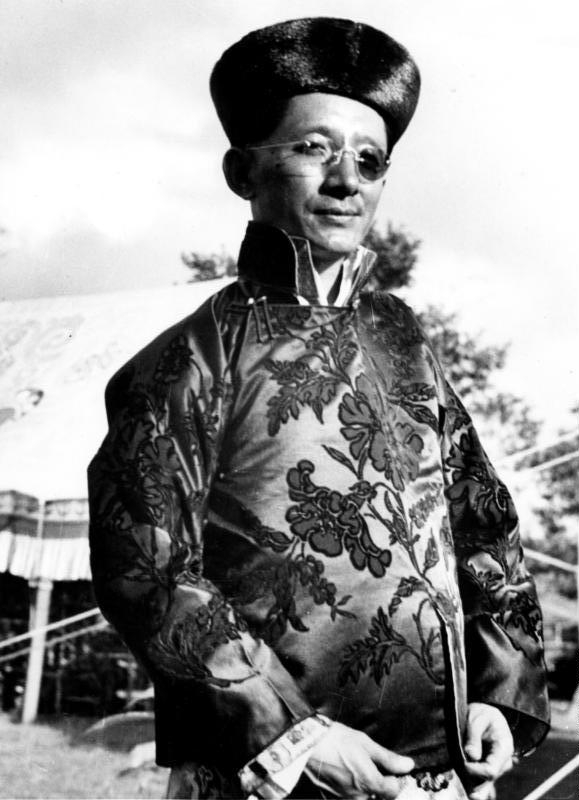
Tashi Namgyal, the 11th Chogyal of Sikkim. (Picture Courtesy: Ernst Schäfer/Wikimedia Commons)
The skyline of the new capital made visible the asymmetry of power that governed it. The Chogyal’s palace stood on one ridge; on the opposite ridge, looming above on higher ground, stood the British Residency, a handsome two storey-Victorian cottage. The local aristocracy soon began to imitate British architectural features from bay windows to verandahs, inspired by the Residency. Gangtok was thus transformed into a capital that reflected imperial order.
The British attempts to enter Tibet culminated in the expedition of British army officer Francis Younghusband (1904-05), where the British successfully but violently reached Lhasa through Sikkim and further underscored its strategic importance. Later, when the 13th Dalai Lama, fleeing unrest in Tibet, sought refuge in Sikkim in 1911, his protection was guaranteed by the British. Sikkim continued to function as a British controlled corridor that enabled his movement, firmly embedding it within the British frontier system. After the British secured paramountcy in the region, limited internal authority was restored to the Chogyal in 1918.
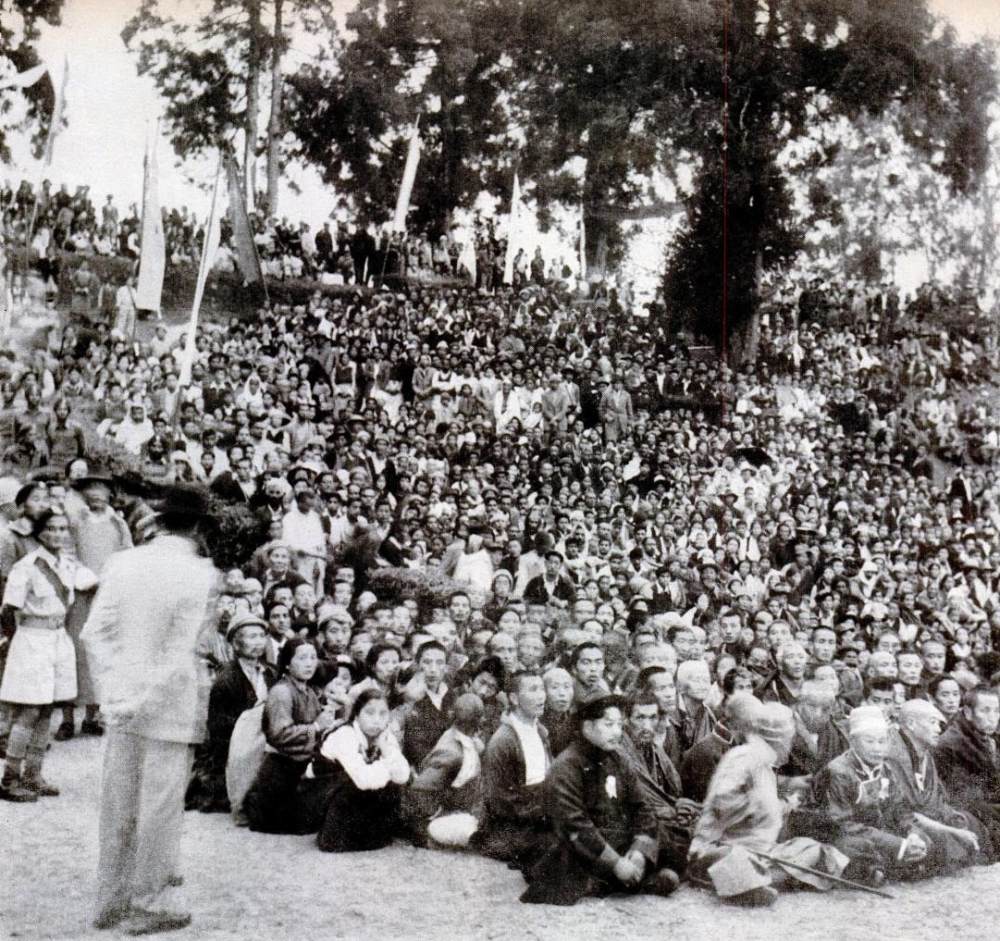
Gathering at Tashiding monastery in Sikkim during the 14th Dalai Lama’s visit. (Picture Courtesy: Homai Vyarawalla/Wikimedia Commons)
Until 1947, Sikkim enjoyed a rule of cautious stability. The British had found an accommodating ally in Sikkim while it benefited in turn from the security of British protection (Duff, 2015). During this time, the last of Sikkim’s kings, Crown Prince Palden Thondup Namgyal emerged as a key political figure, serving as an advisor to his father. By the end of his father’s reign, the younger Namgyal had already begun representing Sikkim in negotiations with the newly independent Indian government.
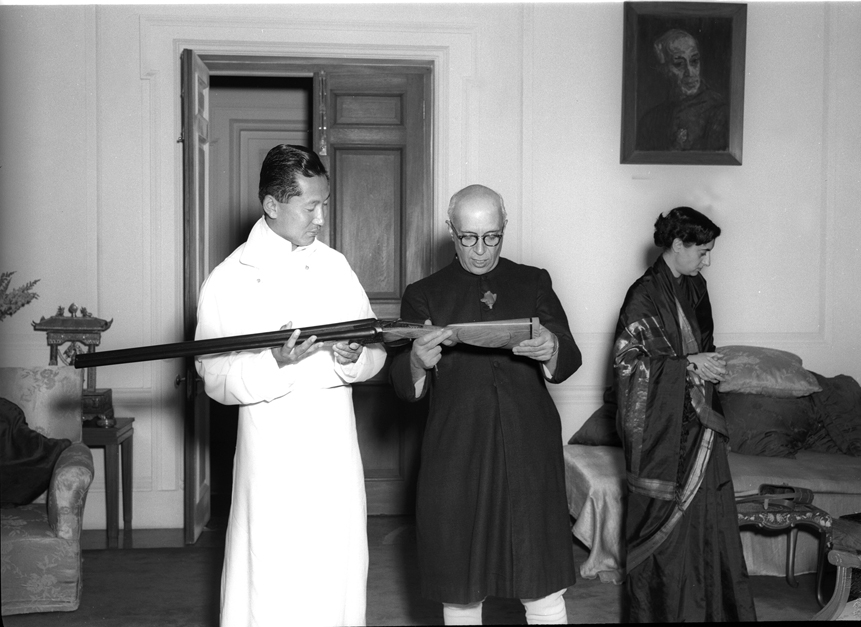
12th Chogyal Palden Thondup Namgyal meeting Jawaharlal Nehru at the Prime Minister’s house, New Delhi. (Picture Courtesy: Internet Archive)
Between Autonomy and Integration
Following India’s independence in 1947, Sikkim found itself in an ambiguous position. Although it had been a member of the Chamber of Princes since 1935, its cultural and religious affinities lay more with Tibet than with India. The Indian cabinet itself was divided on how to handle Sikkim’s status. Sardar Patel favoured a firm assertion of Indian influence to pre-empt Chinese advances, whereas Nehru, inspired by his idea of a “Himalayan federation” and pan-Asian solidarity, preferred to let the Himalayan kingdoms retain autonomy.
Within Sikkim, political change was the order of the day and as early as December 1947, three local organisations came together to form the Sikkim State Congress (SSC), which demanded the abolition of landlordism, the introduction of representative government, and accession to India. The party drew much of its support from the Nepali population, which by then constituted a clear demographic majority. In response, palace loyalists and sections of the Bhutia-Lepcha elite formed the Sikkim National Party (SNP) in 1948. The lines of political conflict, between monarchy and popular representation, minority protection and majoritarian democracy, were thus drawn early.
The following year, the Indo-Sikkim Treaty of 1950, decisively tilted the balance of Sikkim’s autonomy in India’s favour. Of the three treaties India signed with the Himalayan monarchies — Nepal, Bhutan, and Sikkim — it was the most restrictive. It placed Sikkim under India’s protection, granting Delhi control over its defence, foreign affairs, and communications, and the right to intervene in internal matters if law and order were threatened. The treaty was signed at a time of political unrest in Sikkim, stemming from opposition to feudal landlordism and demands for a representative government. The ruler sought Indian protection to preserve the institution of the monarchy, and India, then concerned with instability and strategic vulnerability in a geostrategic region, happily agreed. Sikkim thus moved from British to Indian protection without an intervening period of full sovereignty.
Within this constrained framework, the Namgyal monarchy sought to manage Sikkim’s complex social composition. The palace introduced the “politics of parity” in the State Council which granted equal legislative representation to the Bhutia-Lepcha minority and the Nepali majority in a move aimed at preventing the political marginalisation of the minority. However, the parity system was criticised as a denial of the democratic principle and calls for “One Man, One Vote” would later appear alongside calls demanding land reforms and the end to feudal exploitative systems by the landed aristocracy.
Indian attitudes toward the Sikkimese monarchy evolved alongside regional geopolitics. After the Chinese takeover of Tibet (1959), the Sino-Indian war (1962), and clashes at Cho La and Nathu La (1967), India had become wary of Sikkim’s geostrategic location and importance. By the 1960s, however, Indo-Sikkimese relations began to grow strained also because Chogyal Palden Thondup Namgyal, who ascended the throne in 1965 attempted to articulate a distinctive Sikkimese identity through national symbols, educational reform, and calls for a renegotiation of the 1950 Indo-Sikkim treaty. He even made calls for Sikkim’s membership in the United Nations — moves which deeply unsettled Indira Gandhi’s government.
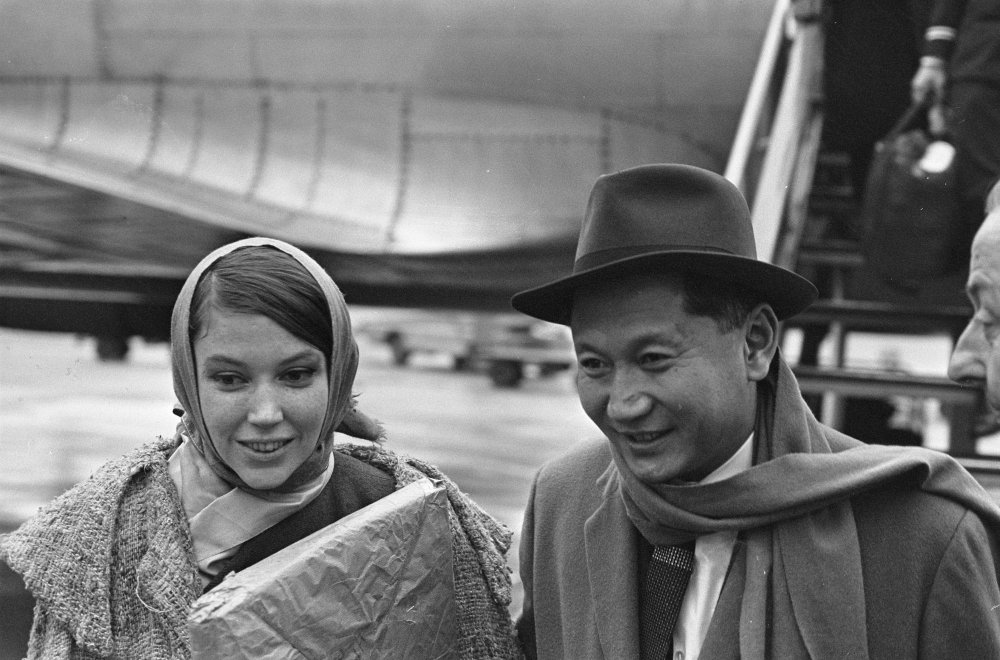
12th Chogyal Palden Thondup Namgyal and Hope Cooke at Schiphol Airport, North Holland, 1966. (Picture Courtesy: Ron Kroon/Wikimedia Commons)
Simultaneously, Sikkim’s international visibility increased dramatically in 1963, when the Crown Prince married Hope Cooke, an American socialite. Western Media outlets such as Time and Vogue celebrated the arrival of an “American Queen in the Himalayas” and Sikkim was briefly transformed into a global curiosity. The palace hoped that this internationalisation might strengthen efforts at increasing Sikkim’s autonomy but it only made India more suspicious, because in the context of the Cold War politics in Asia, Sikkim’s geostrategic location and the Chinese aggression at its frontiers, Sikkim’s Western connections appeared less romantic and more risky.
Beneath the glamour of royal modernity though, political and social tensions were growing. Among other factors, the Chogyal’s vision of a “Tibeto-Burman” national identity, intended to unify the kingdom, instead alienated many among the majority Nepali population, who felt excluded from the state’s political imagination. By the early 1970s, popular discontent had taken shape in the form of political movements demanding greater democracy and equality.
In the 1973 general elections, the Sikkim National Congress (SNC), led by Kazi Lhendup Dorji, alleged large-scale rigging within an already unequal electoral system. Mass demonstrations followed, asking for electoral reforms under the ‘One Man, One Vote’ principle, paralysing Gangtok and leading to a breakdown of law and order. At the Chogyal's request, Indian troops intervened to restore stability in an intervention that decisively altered the balance of power within Sikkim. This led to the signing of the Tripartite Agreement of May 1973, signed by the Chogyal, the Sikkimese parties, and the Government of India. This agreement reduced the monarch to a constitutional figurehead and established a “responsible government” supervised by a Chief Executive who was appointed by the Indian government. A delimitation exercise followed and 31 new constituencies were drawn up. In the elections that followed in 1974, the pro-India Sikkim National Congress won 31 of 32 seats, and the assembly soon passed a resolution calling for an integration with India.
The new state council passed the Government of Sikkim Act in 1974, furthering relations with India, later including a demand to participate in the political institutions of India. To this effect, the Indian parliament amended its constitution, making Sikkim its first and only ‘Associate State’, providing its representation in the Indian parliament. The Chogyal objected to Sikkim’s ambiguous status and appealed to India for a “free and fair” referendum. He was accused of “internationalising” the issue and accused of mobilising external and internal forces to support his cause for freedom. Violence soon spread and seemed uncontrollable to the point of seeking Indian intervention.
On 9th April 1974, Indian troops surrounded the palace and disarmed the Sikkim Guards, leaving one Sikkimese dead, and placed the monarch under house arrest. The very next day, the state council voted to abolish the monarchy and seek full Indian statehood. A referendum on the two issues was scheduled four days later. Thus, in a referendum held on the 14th of April, under Indian supervision, the results reportedly returned a 97 per cent vote in favour of joining the Indian Union. The Indian Parliament swiftly passed the Thirty-Eighth Constitutional Amendment Act, and on 16th May 1975, Sikkim became India’s twenty-second state, bringing an end to three centuries of Namgyal rule.
Postscript
Sikkim’s postcolonial transition, from a monarchy to an Indian state, remains a field of contested narratives shaped by divergent perspectives and much of the literature surrounding this period survives through memoirs and accounts by the political actors and officials. These sources, while invaluable, are also replete with biases and retrospective justification. While some accounts criticise the last Chogyal’s attempts at seeking autonomy as “the over-ambitious, ill-advised, ill-timed venture of a less-astute statesman,” others view it as “the legitimate counterhegemonic nationalistic ambitions of a cultural minority.” Similarly, Sikkim’s merger has also been variously interpreted as “culmination of a legitimate struggle for democratic rights in Sikkim” versus “a cynical process of Indian Imperialism.” Taken together, these interpretations reflect the complexity of historical change that resists a singular linear explanation and instead reveals the complex convergence of competing forces, intentions and unintended consequences.
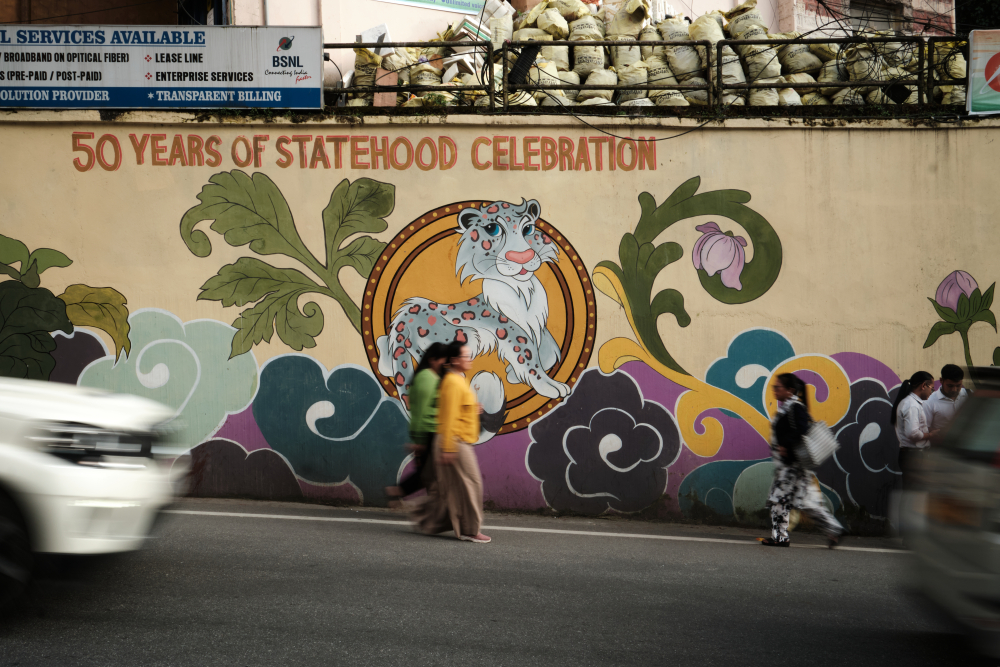
50 years of Statehood street graffiti art. (Picture Credits: Abhishek Anil)
These interpretations need not be mutually exclusive. Attending to them only reveals a complex interplay of class, ethnicity and geopolitics that shaped Sikkim’s transformation. The transition, therefore, needs to be seen as the culmination of longer and larger historical processes — sustained demographic transformation, pressures of Cold War politics, the rise of Indira Gandhi and the gradual erosion of Sikkim’s autonomy under protectorate rule. Sikkim’s journey between ‘Empire’ and ‘Nation’ was thus neither wholly coerced nor entirely free. It was, rather, a distinctly post-colonial outcome which was shaped by local struggles for equality as well as by the strategic imperatives of the larger and newer nation-states.
Bibliography
Ardussi, John A., Denjongpa A. Balikci, and Per K. Sørensen. The Royal History of Sikkim: A Chronicle of the House of Namgyal. Chicago: Serindia Publications, 2008.
Coelho, V. H. Sikkim and Bhutan. New Delhi: Indian Council for Cultural Relations, 1978.
Das, B. S. The Sikkim Saga. New Delhi: Vikas Publishing, 1983.
Das, S. ‘Sikkim the Place and Sikkim the Documentary: Reading Political History through the Life and After-life of a Visual Representation.’ Himalaya: The Journal of the Association for Nepal and Himalayan Studies 33 (2014): 42–56.
Datta-Ray, Sunanda K. Smash & Grab: Annexation of Sikkim. Rev. ed. Chennai: Tranquebar Press, 2013.
Duff, Andrew. Sikkim: Requiem for a Himalayan Kingdom. Gurgaon: Random House India, 2015.
Garver, John W. Protracted Contest: Sino-Indian Rivalry in the Twentieth Century. Seattle: University of Washington Press, 2001.
Gupta, Ranjan. ‘Sikkim: The Merger with India.’ Asian Survey 15, no. 9 (1975): 786–798.
Hiltz, Jackie. ‘Constructing Sikkimese National Identity in the 1960s and 1970s.’ Bulletin of Tibetology (2003): 67–83.
Kharel, Sunita. ‘Gangtok: Metamorphosis of Stereotype–Sikkim Urban Conglomerate into a Colonial Hill Station (1889–1950): A Historical Construct.’ PhD thesis, University of North Bengal, 2005.
McKay, Alex. ‘Indian Structures, Sikkimese Processes: On Being Unprepared for the (Indian) Nation.’ Asian Ethnicity (2021): 272-289.
———. The Mandala Kingdom: A Political History of Sikkim. Gangtok: Rachna Books & Publications, 2021.
———. Their Footprints Remain: Biomedical Beginnings across the Indo-Tibetan Frontier. Amsterdam: Amsterdam University Press, 2007.
McKay, Alex, and Anna Balikci-Denjongpa. Buddhist Himalaya: Studies in Religion, History and Culture. Vol. 2. Gangtok: Namgyal Institute of Tibetology.
Mullard, Saul. Opening the Hidden Land: State Formation and the Construction of Sikkimese History. Leiden: Brill, 2011.
Namgyal, G., and H. Cooke. ‘The Sikkimese Theory of Landholding and the Darjeeling Grant.’ Bulletin of Tibetology 3, no. 2 (1966): 46–58.
Ram, Narasimhan. ‘Sikkim Story: Protection to Absorption.’ Social Scientist 3, no. 2 (1974): 57-71.
Risley, Herbert, ed. The Gazetteer of Sikkim. Calcutta: Bengal Secretariat Press, 1894.
Singh, A. K. J. Himalayan Triangle: A Historical Survey of British India’s Relations with Tibet, Sikkim and Bhutan, 1765–1950. London: British Library, 1988.
Upadhyay, R. Peasants, Resentments and Resistance: A Glimpse on Rural Past of Sikkim, 1914–1950. Delhi: Kalpaz Publications, 2017.
Supplemented by an interview with Pema Wangchuk.
This essay has been created as part of Sahapedia's My City My Heritage project, supported by the InterGlobe Foundation (IGF).